Red, Itchy Face with Pustules: Is It Adult Acne or a Rosacea Flare-Up?
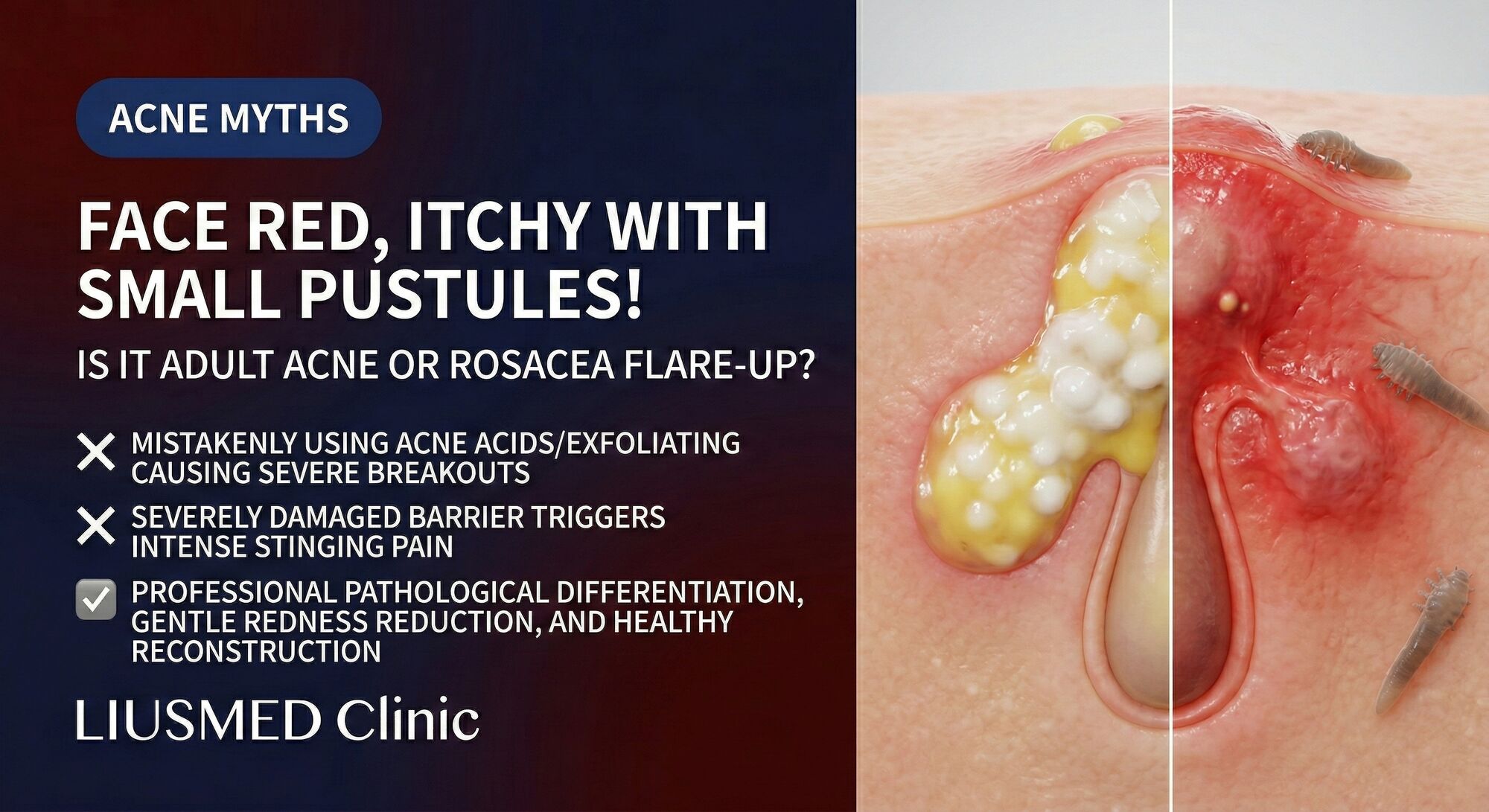
You wake up to another morning of red, inflamed bumps and pustules on your cheeks and chin. You assume it is acne, reach for a benzoyl peroxide wash, and within days your skin is angrier than ever. This scenario plays out for thousands of adults who unknowingly have papulopustular rosacea rather than acne vulgaris. The two conditions look superficially similar but arise from entirely different mechanisms, respond to different treatments, and are worsened by different factors. Misidentification is not merely inconvenient; it often leads to months or years of inappropriate treatment that damages the skin barrier, escalates inflammation, and allows the underlying rosacea to progress unchecked. This article provides a detailed comparison to help you tell them apart.
Table of Contents
- The Core Difference: Pathophysiology of Acne vs. Rosacea
- Clinical Features That Distinguish the Two Conditions
- Why Standard Acne Treatments Can Worsen Rosacea
- The Demodex and Microbiome Connection
- Proper Diagnostic Approach and When to Seek Help
- Targeted Treatment Strategies for Papulopustular Rosacea
- Frequently Asked Questions
- About the Author
- Disclaimer
The Core Difference: Pathophysiology of Acne vs. Rosacea
Acne vulgaris and papulopustular rosacea may both produce red bumps and pustules on the face, but the underlying disease mechanisms have almost nothing in common.
Acne vulgaris is a disease of the pilosebaceous unit (hair follicle plus sebaceous gland). The pathogenesis follows a well-established sequence: androgen-driven sebum overproduction, abnormal follicular keratinization (hyperkeratosis of the infundibulum), proliferation of Cutibacterium acnes within the blocked follicle, and secondary inflammation. The fundamental lesion is the comedone, a plugged follicle. All other acne lesions (papules, pustules, nodules, cysts) arise from comedones.
Papulopustular rosacea does not involve follicular plugging or sebum overproduction. Instead, it arises from dysregulation of the innate immune system in the dermis. Elevated levels of cathelicidin antimicrobial peptides (particularly LL-37), overactive kallikrein-5 (KLK5) serine protease, amplified Toll-like receptor 2 (TLR2) signaling, and neurovascular dysfunction create an inflammatory environment in the dermal tissue. The papules and pustules of rosacea form in the dermis through neutrophilic infiltration driven by these innate immune pathways, not through follicular blockage. Demodex mites, whose density is typically elevated in papulopustular rosacea, contribute by triggering TLR2 activation and carrying Bacillus oleronius bacteria that further stimulate the immune response.
This fundamental difference explains why comedone-targeting treatments (like salicylic acid or retinoids at acne-strength concentrations) do not help rosacea and why anti-inflammatory and anti-parasitic approaches are more effective.
Clinical Features That Distinguish the Two Conditions
Several clinical features, when assessed together, can reliably distinguish papulopustular rosacea from adult acne.
Comedones (blackheads and whiteheads): This is the single most important differentiating feature. Acne produces comedones; rosacea does not. If you see blackheads (open comedones) or small skin-colored bumps with a white center (closed comedones) alongside your inflammatory lesions, acne is the more likely diagnosis. If your bumps are exclusively red papules and dome-shaped pustules on a background of diffuse redness, with no comedones visible, rosacea is far more probable.
Background erythema: Rosacea papules and pustules sit on a canvas of persistent, diffuse redness, often with visible telangiectasia (spider veins). This background erythema is present even between flare-ups. Acne can cause post-inflammatory erythema (red marks left after a pimple heals), but it does not produce the diffuse, symmetrical mid-face redness characteristic of rosacea.
Distribution pattern: Acne in adults commonly affects the jawline, perioral area, and sometimes extends to the neck and chest, particularly in women with hormonal acne. Rosacea strongly favors the central face: cheeks, nose, central forehead, and chin. The periorbital area is typically spared in rosacea.
Age of onset and course: Acne most commonly begins in adolescence (though adult-onset acne does occur, especially in women). Rosacea typically presents after age 30. Acne has a relapsing course often tied to hormonal cycles. Rosacea has a chronic, progressive course with exacerbations triggered by environmental factors (heat, sun, stress, alcohol).
Symptom quality: Acne lesions may be tender to touch but are not typically associated with burning, stinging, or heat-sensitivity between breakouts. Rosacea skin frequently burns, stings, and reacts to products and environmental stimuli even when no active papules are present. This inter-flare sensitivity is a hallmark of the underlying neurovascular and barrier dysfunction.
Sebum production: Patients with acne typically report oily skin, particularly in the T-zone. Rosacea patients frequently describe their skin as dry, dehydrated, and easily irritated, reflecting the impaired barrier function characteristic of the condition.
Why Standard Acne Treatments Can Worsen Rosacea
When papulopustular rosacea is misdiagnosed as acne, patients are often prescribed or self-treat with standard acne therapies that can be profoundly counterproductive.
Benzoyl peroxide: A cornerstone of acne treatment that works by generating free radicals to kill C. acnes bacteria. In rosacea skin, which already has elevated reactive oxygen species (ROS) and impaired antioxidant defenses, benzoyl peroxide adds oxidative stress that amplifies inflammation, damages the already compromised barrier, and worsens burning and erythema. High-concentration formulations (5-10%) are particularly destructive.
Strong retinoids: Tretinoin and adapalene at standard acne concentrations normalize follicular keratinization in acne but cause significant irritation, peeling, and barrier disruption in rosacea skin. The resulting inflammation triggers flushing and can convert a localized papulopustular flare into widespread erythema and sensitivity.
Salicylic acid and glycolic acid peels: Chemical exfoliants that unclog pores in acne are unnecessary in rosacea (which does not involve follicular plugging) and frequently cause stinging, burning, and reactive flushing by disrupting the barrier and activating sensory nerve fibers.
Oral isotretinoin at standard acne doses: While low-dose isotretinoin has shown some benefit in select rosacea cases, standard acne-dose isotretinoin (0.5-1 mg/kg/day) causes dramatic drying of skin and mucous membranes that exacerbates rosacea symptoms and barrier dysfunction.
Astringents and alcohol-based toners: Designed to reduce oiliness in acne-prone skin, these strip lipids from the already lipid-deficient rosacea barrier, worsening transepidermal water loss (TEWL) and triggering inflammation.
The pattern is consistent: treatments designed for the oily, comedone-driven pathophysiology of acne are harmful when applied to the dry, barrier-compromised, neurogenically inflamed skin of rosacea.
The Demodex and Microbiome Connection
One area where the pathophysiology of acne and rosacea intersects, but diverges in detail, is the role of the skin microbiome.
In acne, the key microorganism is Cutibacterium acnes (formerly Propionibacterium acnes), an anaerobic bacterium that thrives in sebum-filled, oxygen-poor follicles. C. acnes activates innate immunity through TLR2 and TLR4, producing the inflammatory component of acne.
In rosacea, the key organisms are Demodex mites (D. folliculorum and D. brevis) and their associated bacteria, particularly Bacillus oleronius. Demodex mites are normal inhabitants of human facial skin, but their density is significantly elevated in papulopustular rosacea (often 5 to 10 times the density found on healthy skin). At these elevated densities, the mites and their bacterial cargo overwhelm the local immune tolerance:
- Chitin from mite exoskeletons activates the NLRP3 inflammasome
- Bacillus oleronius proteins stimulate TLR2, driving neutrophilic inflammation
- Mite death releases internal contents that trigger both innate and adaptive immune responses
- Physical disruption of follicular architecture by high mite loads contributes to perifollicular inflammation
This is why ivermectin (an anti-parasitic that reduces Demodex density) is effective in papulopustular rosacea but has no role in acne treatment, while antibiotics targeting C. acnes help acne but do not address the Demodex-driven component of rosacea.
Proper Diagnostic Approach and When to Seek Help
If you have been treating what you believe is adult acne for more than two to three months without improvement, or if acne treatments seem to make your skin worse, a reassessment is warranted. Consider these steps:
Step 1: Look for comedones. Examine your skin carefully in good lighting, perhaps with magnification. If you cannot find any blackheads or closed comedones among your bumps, the diagnosis of acne should be questioned.
Step 2: Assess the background. Is there persistent redness between breakouts? Are spider veins visible? Does your skin burn or sting with products that should be gentle? These features point to rosacea.
Step 3: Review your triggers. Are flare-ups tied to heat, sun, stress, alcohol, or spicy food rather than to hormonal cycles, product changes, or dietary factors associated with acne? Non-specific environmental triggers are characteristic of rosacea.
Step 4: Seek specialist evaluation. A dermatologist or physician experienced in rosacea can usually distinguish the two conditions clinically. Dermoscopy can reveal vascular patterns specific to rosacea. In difficult cases, a skin biopsy shows distinct histological patterns: perifollicular lymphocytic infiltrate in rosacea versus intrafollicular neutrophils with comedone formation in acne.
Early and accurate diagnosis is important because papulopustular rosacea responds well to targeted treatment, and delayed diagnosis allows progression of the underlying neurovascular and immune dysfunction.
Targeted Treatment Strategies for Papulopustular Rosacea
Once papulopustular rosacea is correctly identified, treatment shifts to approaches that address its specific pathophysiology.
Topical ivermectin (1%): Reduces Demodex density and has anti-inflammatory properties independent of its antiparasitic action. It inhibits NF-kB signaling and reduces cathelicidin pathway activation. Clinical trials show significant reduction in inflammatory lesion counts with good tolerability.
Topical azelaic acid (15%): Has anti-inflammatory, anti-keratinizing, and mild antibacterial properties. It reduces KLK5 activity and LL-37 production and is well-tolerated by sensitive rosacea skin. It also helps with post-inflammatory erythema.
Low-dose oral doxycycline (40 mg modified-release): At sub-antimicrobial doses, doxycycline inhibits matrix metalloproteinases (MMPs) and neutrophilic inflammation without affecting the gut microbiome significantly. This anti-inflammatory (not antibiotic) dose is specifically designed for rosacea.
Topical metronidazole (0.75-1%): A longstanding first-line therapy with anti-inflammatory and antioxidant properties. Reduces ROS and inhibits neutrophil-generated inflammation.
Targeted injection approaches: For moderate to severe papulopustular rosacea or cases resistant to topical therapy, Rosacea Injection Treatment protocols deliver anti-inflammatory and immunomodulating agents directly into the affected dermis, addressing the inflammatory cascade at its tissue-level source.
Barrier repair: Regardless of the active treatment chosen, repairing the compromised skin barrier with ceramide-rich, fragrance-free moisturizers is essential. A functional barrier reduces trigger sensitivity, supports medication tolerability, and prevents secondary irritant reactions.
| Feature | Adult Acne | Papulopustular Rosacea |
|---|---|---|
| Comedones present | Yes (hallmark feature) | No |
| Background erythema | Absent or mild | Persistent, diffuse |
| Telangiectasia | Absent | Often present |
| Distribution | Jawline, perioral, T-zone | Central face, periorbital sparing |
| Predominant sensation | Tenderness at lesion site | Burning, stinging, widespread sensitivity |
| Skin type | Oily | Dry, barrier-compromised |
| Key pathogen | Cutibacterium acnes | Demodex mites, Bacillus oleronius |
| Key treatment | Retinoids, benzoyl peroxide | Ivermectin, azelaic acid, low-dose doxycycline |
| Worsened by | Hormonal fluctuations, occlusive products | Heat, sun, alcohol, stress, harsh skincare |
Frequently Asked Questions
Q1: Can I have both acne and rosacea at the same time?
Yes. Some patients have a combination of acne vulgaris and rosacea, sometimes termed "acne rosacea" in older terminology. In these cases, comedones coexist with the diffuse erythema and telangiectasia of rosacea. Treatment must address both conditions, often with gentler versions of acne therapies (low-concentration retinoids, gentle cleansers) combined with rosacea-specific treatments. A physician can help design a regimen that addresses both without exacerbating either.
Q2: I am a woman in my 30s with breakouts along my jawline. Is that more likely acne or rosacea?
Jawline-predominant breakouts in women in their 30s and 40s are most commonly hormonal acne, often linked to fluctuations in androgens around the menstrual cycle. Rosacea more typically affects the central face (cheeks, nose). However, the two can coexist, so examine for the other distinguishing features: comedones, background erythema, sensitivity, and trigger patterns.
Q3: My doctor prescribed a topical antibiotic for my rosacea. Is that the same as treating it like acne?
Topical antibiotics like metronidazole are used in rosacea for their anti-inflammatory properties, not for antibacterial action against acne-causing bacteria. The mechanism is different from using topical clindamycin or erythromycin for acne. Metronidazole reduces reactive oxygen species and modulates the innate immune response. Its use in rosacea is evidence-based and distinct from acne antibiotic therapy.
Q4: Will changing my diet help with papulopustular rosacea the way it might help acne?
Dietary triggers play different roles in the two conditions. In acne, high-glycemic diets and dairy have been associated with increased lesion counts through insulin/IGF-1 (Insulin-like Growth Factor 1 — growth/repair signal molecule) pathways and hormonal modulation. In rosacea, dietary triggers act primarily through vasodilatory and neurogenic mechanisms: alcohol dilates vessels, spicy food activates TRPV1 (Transient Receptor Potential channels) channels, and hot beverages cause thermal flushing. Identifying and moderating your specific dietary triggers can reduce flare frequency, but the mechanism is vascular and neurogenic rather than hormonal.
Q5: Are the acne scars from rosacea the same as regular acne scars?
Papulopustular rosacea generally causes less scarring than severe acne because it does not produce the deep nodular and cystic lesions that destroy dermal architecture. Rosacea can leave post-inflammatory erythema (persistent red marks) that can take months to fade. True atrophic scarring (ice pick, boxcar, rolling scars) is uncommon in rosacea unless there has been extensive or chronic inflammation.
Q6: I used a strong retinol product and my skin exploded with bumps and redness. Did the retinol cause rosacea?
Retinol does not cause rosacea, which is a genetically and immunologically predisposed condition. However, retinol can unmask or exacerbate latent rosacea by disrupting the skin barrier, increasing transepidermal water loss, and triggering inflammatory cascades in susceptible skin. If a retinol product triggered a dramatic flare of diffuse redness, burning, and papulopustules, the underlying rosacea was likely already present and the retinol served as the triggering insult.
About the Author
Dr. Ta-Ju Liu is the founder of Liusmed Clinic, where he practices regenerative medicine and minimal incision surgery. With deep expertise in inflammatory skin conditions, Dr. Liu focuses on accurate differential diagnosis and mechanism-targeted treatment strategies for rosacea and related conditions. His clinical philosophy centers on understanding and addressing the root pathophysiology rather than pursuing surface-level symptom management.
Disclaimer
This article is provided for educational and informational purposes only and does not constitute medical advice, diagnosis, or treatment. The clinical distinctions described are general guidelines and individual presentations may vary. Self-diagnosis is not a substitute for professional evaluation. Consult a qualified healthcare provider for personalized diagnosis and treatment recommendations. Do not discontinue or modify any prescribed treatment without consulting your physician.

Specialties
Credentials
- Kaohsiung Medical University, School of Medicine
- Attending Physician, Dermatology, Kaohsiung Chang Gung Memorial Hospital
- Attending Physician, Aesthetic Center, Kaohsiung Chang Gung Memorial Hospital
- Visiting Physician, Dermatology, Xiamen Chang Gung Hospital
- Visiting Physician, Aesthetic Center, Xiamen Chang Gung Hospital
"For every surgery, I strive to achieve a good outcome through a small incision and refined technique. Minimally invasive surgery is not just a technique — it's a commitment of respect to every patient."
Recovery after any procedure needs peer support too


Want to learn more?
Schedule a consultation for professional evaluation and advice