
Thread-Lift Revision and Thread Removal
Bumps, Exposed Ends, Dents, AsymmetryThe First Step Is Assessment, Not More Threads
A thread going in does not mean that waiting is all you can do when something goes wrong. Bumps, palpable threads, dents and asymmetry after a thread lift can usually be classified before anything is decided: some are best observed until the material absorbs, others can be localized and removed focally. Liusmed takes on thread problems from other clinics — we work out which layer the thread sits in and what state it is in, then decide whether it should come out and how.
Why Choose Liusmed for Thread-Lift Revision

Assess First
The first step in thread revision is assessment, not adding more threads.
Removal & Release
When needed, problematic threads are removed and adhesions released.

Take Over & Follow-Up
We take over thread-lift problems from elsewhere and value repair and follow-up.
On This Page
Our Approach: Assess First, Not More Threads First
When a thread lift goes wrong, the most common response is to place a few more threads over the problem. But without first establishing which layer the original threads sit in and how the tension is distributed, adding threads usually just layers the problem further. Revision starts by seeing the situation clearly.
Classify First, Then Decide Whether to Intervene
Not every complaint after a thread lift needs intervention. Early bruising, swelling-related asymmetry and transient tightness usually belong to a phase where tissue is still inflamed and remodeling, and rushing in can interfere with recovery. What genuinely warrants active assessment is a bump still stable at three months, a palpable thread, repeated local inflammation, or a clear dent or crease.
Localization Comes Before Removal
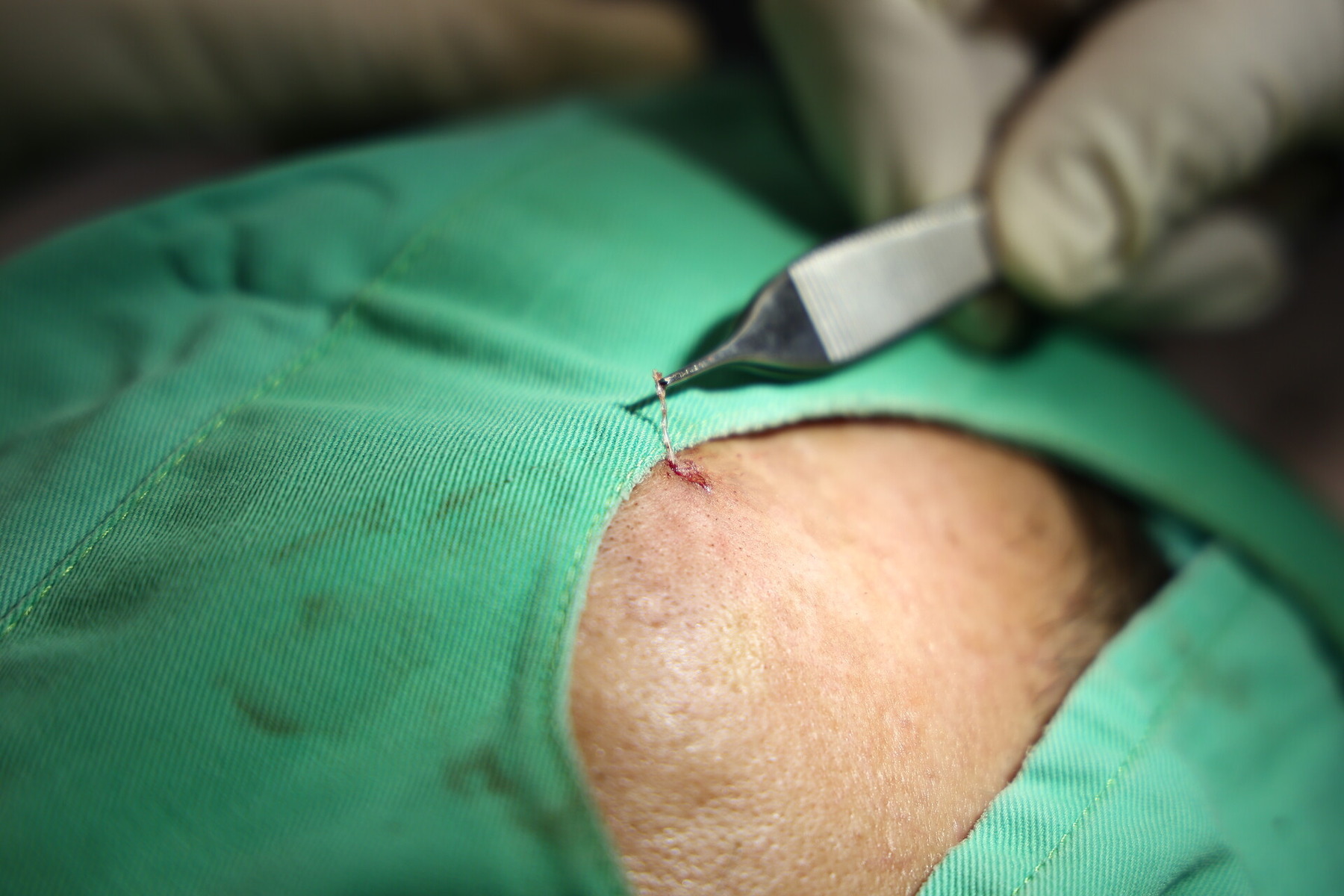
What decides a removal is not force but whether the position, depth and relationship to surrounding tissue can be established. Ultrasound helps determine which layer a thread sits in, whether adhesion or inflammatory reaction lies nearby, and where it sits relative to vessels and nerves. Once that is clear, the thread can be taken out precisely through a very small puncture rather than searched for through an incision.
Cases From Other Clinics, With the Original Records
Thread problems from another clinic can be assessed and treated here, but we do not operate immediately when information is thin. Thread type, quantity, timing, and what has already been attempted all shape the revision path. Please bring the original treatment records where possible — clear information matters more than acting fast.
Removal Is Not the Goal for Every Thread
Some threads metabolize on their own along the absorption timeline of the material, and forcing them out only adds another wound. Some situations call for a rest period after removal so tissue can settle before anything is re-planned. The aim of revision is to resolve the problem, not to take out every thread. What is appropriate, and what results follow, vary from person to person.
Localization and Removal Technique
Built on years of minimally invasive filler and thread extraction work

Ultrasound Localization and Classification
See it before touching it
High-frequency ultrasound establishes which layer the thread sits in, whether adhesion or inflammatory reaction surrounds it, and its relationship to vessels and nerves. Classification is what tells us whether a thread should be observed or removed.

Pinhole Micro-Extraction
Out through a very small opening
Once localization is confirmed, the thread is reached through a tiny puncture and taken out along its course, keeping disruption of healthy surrounding tissue to a minimum. Actual incision size depends on the position and depth of the thread.

Adhesion Release and Tissue Handling
More than pulling a thread out
Threads are often surrounded by fibrosis and adhesion, and removal alone does not always improve the surface. Where needed, the adhesed tissue is addressed at the same time so surface dents and tethering ease together with it.

Rest, Then Re-Plan
No rush to fill it back
Cases needing comprehensive treatment are generally advised to rest after removal so tissue can settle before the next step is discussed. Adding new threads or filler in the same session tends to blur the assessment.
Four Common Thread-Lift Problem Patterns
Each pattern is handled differently — find yours first

A Bump That Will Not Settle
Often mistaken for a pimple
A thread bunching or folding at one point creates a localized raised area under the skin. Because the position is fixed and it looks like a small lump, it is often treated as acne — topicals and squeezing change nothing, and months later it is still there.
Ultrasound first confirms whether a thread lies under the bump and which layer it sits in. If a thread is the cause and it can be localized, the responsible segment can be taken out through a very small puncture.

Palpable Threads, Exposed Ends or Repeated Inflammation
The same spot keeps flaring
When a thread end sits close to the surface, a cord-like firmness can be felt, and in more marked cases the end protrudes through the skin. Where an anchor point was not handled well or a thread has migrated, the same spot becomes red and inflamed repeatedly.
A repeatedly inflamed site is first assessed for infection or foreign-body reaction. After that, the exposed or poorly positioned segment is removed and the surrounding tissue addressed, so the same point is not continually irritated.

Dents, Creases and Surface Irregularity
Marks that follow the thread path
Where thread tension is too high or the plane too superficial, the surface skin is drawn into a groove or crease along the insertion path, often most visible in certain expressions or at certain angles.
The assessment separates a tension problem from a plane problem. Some cases improve once adhesion is released; others need the tethering segment removed before anything further is discussed.

Asymmetry and Expression Tethering
Swelling and structure are not the same thing
Asymmetry in the early period usually comes from swelling and settles with time. If it is still obvious at three months, it generally reflects a difference in thread count, tension or plane between the two sides, sometimes with a pulling sensation on smiling.
We first confirm the swelling phase has passed. Where the difference is structural, thread distribution on both sides is assessed before deciding between removing and redistributing, or resting and re-planning as a whole.
Observe, Remove Focally, or Re-Plan
Mapped against the three-stage strategy in the Yu 2022 case series
| Comparison | Conservative Observation | Focal Removal | Full Re-Planning |
|---|---|---|---|
| Typical timing | Within 2 weeks post-op | 2 weeks - 3 months | Persisting after shape has settled |
| Common presentation | Bruising, swelling-related asymmetry, transient tightness | Fixed bump, palpable thread, repeated local inflammation | Widespread irregularity, marked asymmetry, expression affected |
| Approach | Follow-up and post-op care guidance | Ultrasound localization, then removal of the responsible segment | Full removal, then redesign after some weeks of rest |
| Assessment needed | Comparison at follow-up visits | Ultrasound classification + original records | Bilateral thread distribution + original records |
| Proportion in the literature | About 70% | About 25% | About 5% |
| Worth noting | Do not rush to cover it with more threads | Not every thread needs removing | New threads are not advised immediately after removal |
What the Studies Say — What It Means for You
We surface 4 pivotal studies on "PDO thread efficacy and thread revision," each with a "what it means for you" — translating academic numbers into the questions you actually bring to clinic.
Thread Lifting Problems from Elsewhere? We Will Not Just "Add More Threads"
Yu 2022 case series (DOI:10.1007/s00266-021-02644-2): 47 thread complications managed — 70% resolved conservatively, 25% needed focal removal, 5% required major revision. "Revision success correlates positively with patient willingness to wait" — rushing "add more threads to cover" often compounds problems.
Observation (<2 weeks)
Early problems are mostly bruising, swelling-related asymmetry, transient tightness. Do not rush revision — body is in inflammation and remodeling phase.
- Cold compress, light massage
- Antibiotics/anti-inflammatory if needed
- 70% of cases resolve here
Focal Removal (2 wk-3 mo)
If bumps, palpable threads, or asymmetry persist, assess "tension distribution" and "individual thread migration" — may require 2-3 mm micro-incision to remove problem threads.
- Micro-incision along thread path
- Visual evaluation at 4-8 weeks
- 25% of cases resolve here
Full Replanning (>3 mo)
Persistent issues after shape stabilization reflect "fundamentally wrong thread placement or plane." Resolution requires "full removal + 4-6 weeks rest + replanning" — not "add more threads to cover."
- 4-6 weeks rest after removal, then redesign
- Redesign per structural principles
- 5% of cases need this stage
Honest reminder: We will not act with "insufficient information" — please provide your original thread records (type, count, date, prior treatments). Clear information enables a correct pathway design, which matters more than "act immediately."
The Revision Process
From assessment through follow-up
History and Records
We establish the original thread type, quantity and timing, and what has already been attempted. Where information is thin we ask you to fill the gaps first rather than operating immediately
Ultrasound Localization and Classification
Confirming which layer the thread sits in, the state of surrounding adhesion or inflammation, and its relationship to vessels and nerves, which determines whether the case is observation, focal removal or comprehensive treatment
Removal and Tissue Handling
Once localization is confirmed, the responsible segment is taken out through a very small puncture, with adhesion released at the same time where needed
Rest and Onward Planning
Recovery is followed at review visits. Cases needing re-planning are advised to rest for some weeks until tissue settles before the next step is discussed, rather than placing new threads in the same session
Frequently Asked Questions
Yes, though it depends on the situation. A thread is solid and runs along a defined path, so once its position and depth can be established there is usually a chance of taking it out through a very small puncture. Localization is what decides it — searching without clear localization risks damaging healthy surrounding tissue. Whether removal is appropriate still needs individual assessment.
"It did not come out that time" and "this thread cannot come out" are two different statements. Difficulty depends on the thread type, the plane it was placed in, how much fibrosis surrounds it, and whether imaging localization was available. Where an earlier attempt did not succeed, it is worth re-assessing position and state with ultrasound before concluding there is no other route.
Early swelling settles with time. But a bump in a fixed position whose appearance and feel have not changed, still present beyond three months, should raise the question of a thread rather than something to wait out. These bumps are frequently mistaken for acne, and topical treatment does not help.
No. Absorbable threads are metabolized along the timeline of the material, and for segments that do not affect appearance or function, observation is often more sensible than forced removal, because removal means another opening. The decision rests on whether symptoms persist, whether the position is clear, and whether the benefit of removal outweighs the cost of another wound.
Adding threads is not advisable as a first step. Without first establishing the original tension distribution and planes, new threads make later interpretation harder and the actual problem point harder to localize. Clinically we assess the current state, establish what needs addressing, and only then discuss whether re-planning is needed.
It depends on the extent of removal and the state of the tissue. After a full removal, some weeks of rest are generally advised so tissue can settle before a new design, rather than placing threads in the same session. The actual interval is discussed individually at review based on how recovery is going.

About Dr. Ta-Ju Liu
Minimally invasive filler and thread extraction
"When a patient arrives with a problem, what they need first is not another procedure. It is someone who will look carefully at what is actually there. Once that is clear, you know whether to take it out or wait."
Dr. Liu works extensively on filler nodules, pillow face and thread-related revision. Clinically the logic is shared: establish what the material is, which layer it sits in and what state it is in, then decide the route and the timing for removal, rather than adding another layer of treatment on top of the existing problem.
Other Services
And After the Revision? How a Thread Lift Is Planned in the First Place
After removal and a rest period, many people want to know how a next attempt should be planned so the same thing does not recur. Plane, tension distribution and thread selection are what decide whether a lift holds or leaves a bump — the structural full-face thread lifting page covers all of it. Whether a repeat is appropriate still depends on how your tissue looks after removal.
See Structural Full-Face Thread LiftingThread Lift Revision · 70% Conservative · Yu 2022 3-Stage Strategy
Thread issues from another clinic? The first step is evaluation — not adding more threads
70% conservative observation + 25% local extraction + 5% full re-planning · original thread records required
Your Thread Lift Revision Treatment Includes
3-stage revision strategy · evaluate before acting
70% conservative + 25% local extraction + 5% full re-planning
No criticism of original thread surgeon · cooperation, not competition
Original thread material and records required
Material type determines extraction strategy; no records → ultrasound localization first
Structural skeletal filling as follow-up · thread lift is essentially skeletal remodeling
Included and aftercare
- Suture Removal Included
- Photo Upload + Online Wound Care Advice
- 14-Day / 1-Mo / 3-Mo Follow-Up
- Post-Op Light Therapy Included
Select any item to see its full scope and exclusions
Not sure which approach fits you?
Send a few photos first, or book a consultation directly. How booking works
You're not alone in this
Recovering after a procedure takes more than treatment — it helps to have reliable information and people who have been through the same thing. Whether it is filler, fat grafting, scars, energy devices, thread lifts, surgery, or a problem that came back after treatment, you can start in two places: Dr. Ta-Ju Liu’s health-education posts, and the patient Q&A forum where you can ask anonymously.

Dr. Liu’s health-education posts
fillerrevision.com
Articles and real case notes written up by Dr. Ta-Ju Liu: how common post-procedure problems are told apart, what repair usually involves, and what to watch for while you recover.

Patient Q&A Forum
Write it down — Dr. Liu replies in the thread
Describe your situation anonymously. Dr. Liu replies as health education — what it might be, what needs to be told apart, and which signs mean you should be seen soon — and you can read how other patients’ recoveries went.
Start by Seeing What Is Actually There
Bumps, palpable threads, dents and asymmetry after a thread lift differ in what is appropriate and when. Book an assessment and Dr. Liu will review your situation together with your original treatment records to determine whether it should be observed or addressed.
Book Thread Lift Revision Consultation