
Scar Repair Authority Guide
Combined Treatment for Keloids,Surgical Scars & Trauma Contracture
A clinic with sustained focus on scar and keloid treatment. Dr. Liu, with over 15 years of experience as a dermatology specialist, provides "intralesional injection," "minimal incision scar revision," and "combined anti-recurrence therapy" for different scar types, combining science and art to solve your hypertrophic scars and appearance concerns.
Why Choose Liusmed for Scar Repair

Scar-Type Triage
Atrophic, hypertrophic, and keloid scars each need their own plan — we classify first.

Minimal, Scar-Aware
We improve scars through minimal approaches, aiming not to leave noticeable new ones.

Honest Expectations
Scars rarely vanish completely; we explain honestly how much can improve.
Table of Contents

The Truth: Why Scars Can't "Completely Disappear"
Medically, scars rarely "completely disappear." Every journey leaves traces - any wound reaching the dermis will leave a scar. This is the body's natural healing result, not a limitation of medical technology.
"Our treatment goal is not to make scars 'disappear,' but to make them 'inconspicuous'—color close to skin tone, surface flat, lines extremely fine, so you barely notice them in daily life."
— Dr. Ta-Ju Liu
Three Treatment Goals
Symptom Relief
Eliminate itching, pain, tightness and other discomfort
Appearance Improvement
Make scar color, texture, thickness approach normal skin
Function Restoration
Address contracture scars affecting joint movement
Scar Types: Hypertrophic Scar vs Keloid
Correct diagnosis is the first step to effective treatment

Hypertrophic Scar
Hypertrophic Scar
- Scar becomes red, thick, and raised
- Growth limited to original wound area
- May be itchy or painful
- Usually fades naturally over time (months to years)
Treatment: Most can be effectively controlled with intralesional injection; severe cases may consider surgical revision.

Keloid
Keloid
- Grows beyond original wound boundary
- Continues to grow without regression
- Noticeable itching and pain
- Visibly red, swollen, and hard texture
- Common in certain body types and areas (chest, shoulders, ears)
Treatment: Requires long-term battle with combined therapy (injection + surgery + compression) for effective control.

Atrophic Scar
Atrophic Scar
- Sunken surface with disrupted skin texture
- Common after acne, chickenpox, or surgery
- Subtypes: icepick, boxcar, rolling
- Subcutaneous fibrosis pulls skin downward
Treatment: Requires subcision + fat/PRP grafting for volume restoration, combined with laser resurfacing for surface texture.
Key Difference: Hypertrophic scars are "self-limiting," keloids "grow beyond the original wound edge."
Three Treatment Approaches
Choose the most suitable treatment based on scar type

Intralesional Injection
Direct injection of steroids or anti-metabolic drugs into the scar core to inhibit fibroblast activity, softening and flattening the scar.
- For: Hypertrophic scars, early keloids
- Frequency: Monthly, about 3-6 sessions
- Advantage: Non-invasive, outpatient procedure

Minimal Incision Scar Revision
For old scars or lesions not responding to injection, surgical excision and re-suturing with fine technique to minimize new scarring.
- For: Mature depressed scars, wide scars, contracture scars
- Techniques: W-plasty, Z-plasty, flap transfer
- Advantage: One-time improvement, long-lasting results

Combined Anti-recurrence Therapy
Combining "core debulking surgery," "post-operative radiation therapy (SRT)" or "long-term local injection," with silicone patch compression—a three-pronged approach to reduce recurrence.
- For: Stubborn keloids, recurrent lesions
- Strategy: Multi-directional combined attack
- Key: Long-term follow-up and compression therapy
The Long-term Battle with Keloids
Not a one-time treatment, but a persistent battle requiring patience
Keloid recurrence rates are indeed higher, depending on body type and wound location (chest and shoulders with high tension are most prone to recurrence). But don't lose hope—
"At Liusmed Clinic, we use 'combined therapy' and emphasize 'long-term post-operative follow-up,' which can significantly reduce recurrence rates. This is a long-term battle, but with persistence, you can see hope."
— Dr. Ta-Ju Liu
Liusmed Keloid Control Strategy
Detailed evaluation of keloid type, tension location, recurrence risk
Surgical removal of keloid core, preserving edge skin to reduce tension
Radiation therapy (SRT) or long-term injection to suppress recurrence
Silicone patches or pressure garments for 6-12 months
Regular visits, early detection of recurrence signs for immediate intervention
Liusmed Scar Repair Process
Professional Assessment × Personalized Plan × Long-term Care

Scar Evaluation
Detailed assessment of scar type (hypertrophic vs keloid), severity, and tension location

Treatment Goal Setting
Set goals based on three levels: symptom relief, appearance improvement, function restoration

Combined Treatment
Choose based on scar type: intralesional injection, minimal incision revision, laser/light therapy, or combination

Post-op Protection & Follow-up
Keloids require compression therapy and long-term follow-up to minimize recurrence

Golden Treatment Period
The 3-6 months after wound healing is the scar remodeling phase. We recommend using silicone patches or scar gel as soon as sutures are removed. If you notice the scar becoming red or raised, seek immediate injection treatment for better results.
About the Author
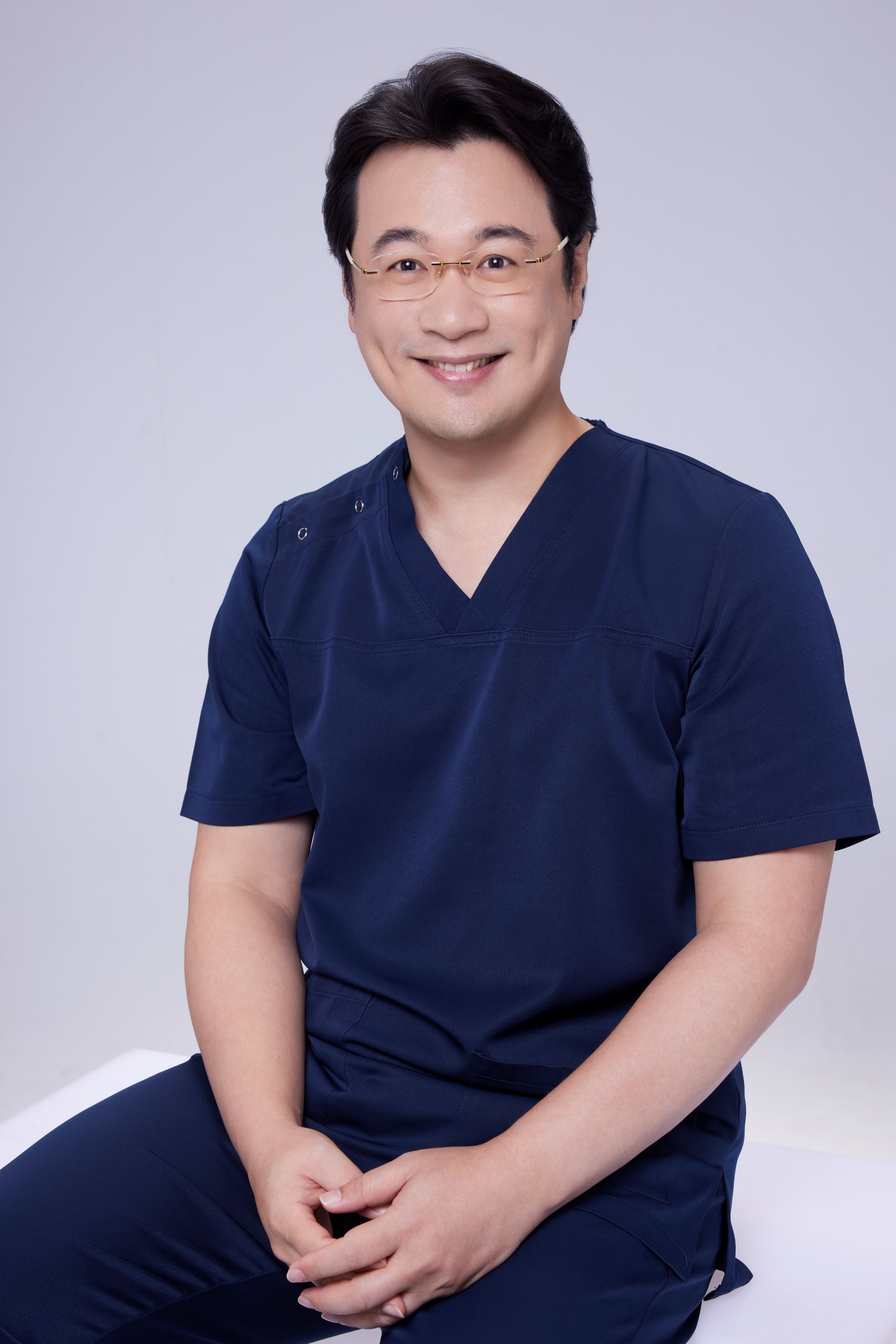
Dr. Ta-Ju Liu
Director, Liusmed Clinic
- Over 15 years of experience as a dermatology specialist
- Expert in scar and keloid combined treatment
- Board-certified Dermatologist
- Handled numerous difficult scar cases
- Committed to honest expectation setting
"Scar treatment requires the combination of science and art. Science tells us the principles, art shows us how to make results natural and beautiful."
Frequently Asked Questions (FAQ)
Q1: Can scars completely disappear after treatment?
Medically, it's difficult to "completely disappear." Any injury to the dermis layer will leave a scar. Our treatment goal is to make scars "inconspicuous"—color close to skin tone, surface flat, lines extremely fine—so they're barely noticeable in daily life unless examined closely.
Q2: I have severe keloids—will they recur after treatment?
This is a long-term battle. Keloid recurrence rates are indeed higher, depending on body type and wound location (chest and shoulders with high tension are most prone to recurrence). At Liusmed Clinic, we use "combined therapy" and emphasize "long-term post-operative follow-up" to significantly reduce recurrence rates.
Q3: When is the ideal time to treat C-section scars?
The golden period is 3-6 months after wound healing. This is the scar remodeling phase. We recommend using silicone patches or scar gel as soon as sutures are removed. If you notice the scar becoming red or raised, seek immediate injection treatment for better results.
Q4: Is scar treatment painful?
It depends on the treatment method. Surgery is done under local anesthesia, with substantially less pain. For intralesional injection (scar injections), because scar tissue is hard, you may feel pressure pain when medication is administered. Using our long-developed gentle relief workflow, ultra-fine needles mixed with anesthetic, and no general anesthesia, you can communicate with the physician in real time without general-anesthesia risk; we minimize discomfort, and comfort varies by individual.
Q5: Can old scars (over 10 years) still be treated?
Yes. Although new scars have the highest plasticity, old scars can still be improved through surgical revision (excision and re-suturing) or laser resurfacing. For old white depressed scars, minimal incision scar revision surgery can also be considered.
Q6: How many treatments are needed? What about costs?
It varies by individual. Keloids typically require multiple injections (monthly, about 3-6+ times) to flatten. Scar revision surgery is usually one-time but requires months of post-operative care. Costs depend on scar size, length, and difficulty; actual fees are explained on an individual basis by the doctor during a LINE consultation or in-person visit.
Large-Area Hypertrophic Scars: Why "Completing the Protocol" Decides Flatness
Scars from burns, long surgical wounds, or C-sections are often not a single spot but a long band or an entire sheet. A hypertrophic scar thickens but stays within the original wound boundary — unlike a keloid, which extends beyond the edge and tends to recur. It usually responds better to intralesional injection, and some flatten over time on their own. But to flatten the whole sheet evenly, the entire scar must be injected at many points with even dosing.
The larger the area and the more injection points, the more pain becomes the main reason a protocol is left incomplete — the treated parts flatten while the missed parts stay raised, leaving an uneven result. Letting the whole scar be injected evenly and the full protocol be completed properly is exactly what decides whether it ends up flat.

Gentle Relief, Substantially Less Pain
Our long-developed gentle relief workflow substantially reduces discomfort, with no general anesthesia — so you can communicate with the physician in real time, without general-anesthesia risk, and need not give up over fear of pain, letting the full set of evenly dosed injection points be completed. The method is decided by physician evaluation.
Map the Whole Scar
Plan multi-point injections by length and thickness, avoiding missed or over-dosed spots
Gentle Relief Plan
Substantially less pain, no general anesthesia
Staged Course, Tracked Adjustment
Monthly staged injections, dose adjusted to response; results vary by individual
Honest Disclosure: Effect & Risk
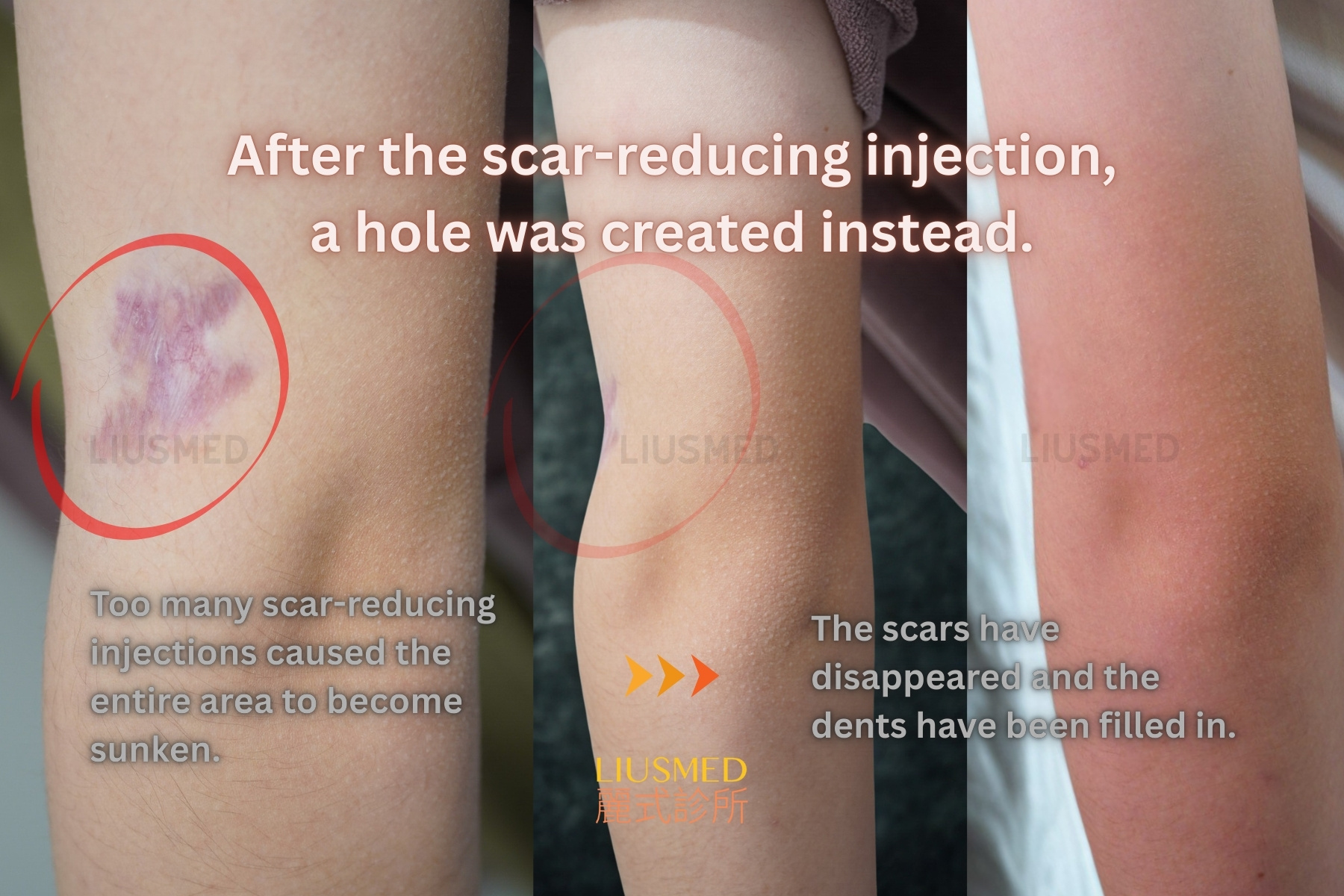
Intralesional corticosteroid (triamcinolone) injection is the main first-line option for hypertrophic scars; it can improve height, redness, firmness and discomfort, but requires a planned course and results vary by individual. Possible risks include skin atrophy/depression, telangiectasia, pigment change, or scar widening; dose and concentration must be judged by the physician, as over-injection may instead cause the original scar to atrophy and sink. Mature, already-flattened old scars usually respond to a limited degree. Suitability and method are determined by the physician in person.
Hypertrophic Scar vs Keloid: Don't Confuse Them
The hypertrophic scar discussed here stays within the original wound, is self-limiting, and usually responds better to injection; a keloid extends beyond the original wound edge, keeps expanding, has a higher recurrence rate, and needs a combined anti-recurrence strategy. The treatment logic differs — if your scar clearly extends beyond the original wound and keeps enlarging, please see the keloid page.
Go to the Keloid PageOther Repair Services
Keloid + Hypertrophic Scar + Atrophic Scar · Combined Treatment Strategy
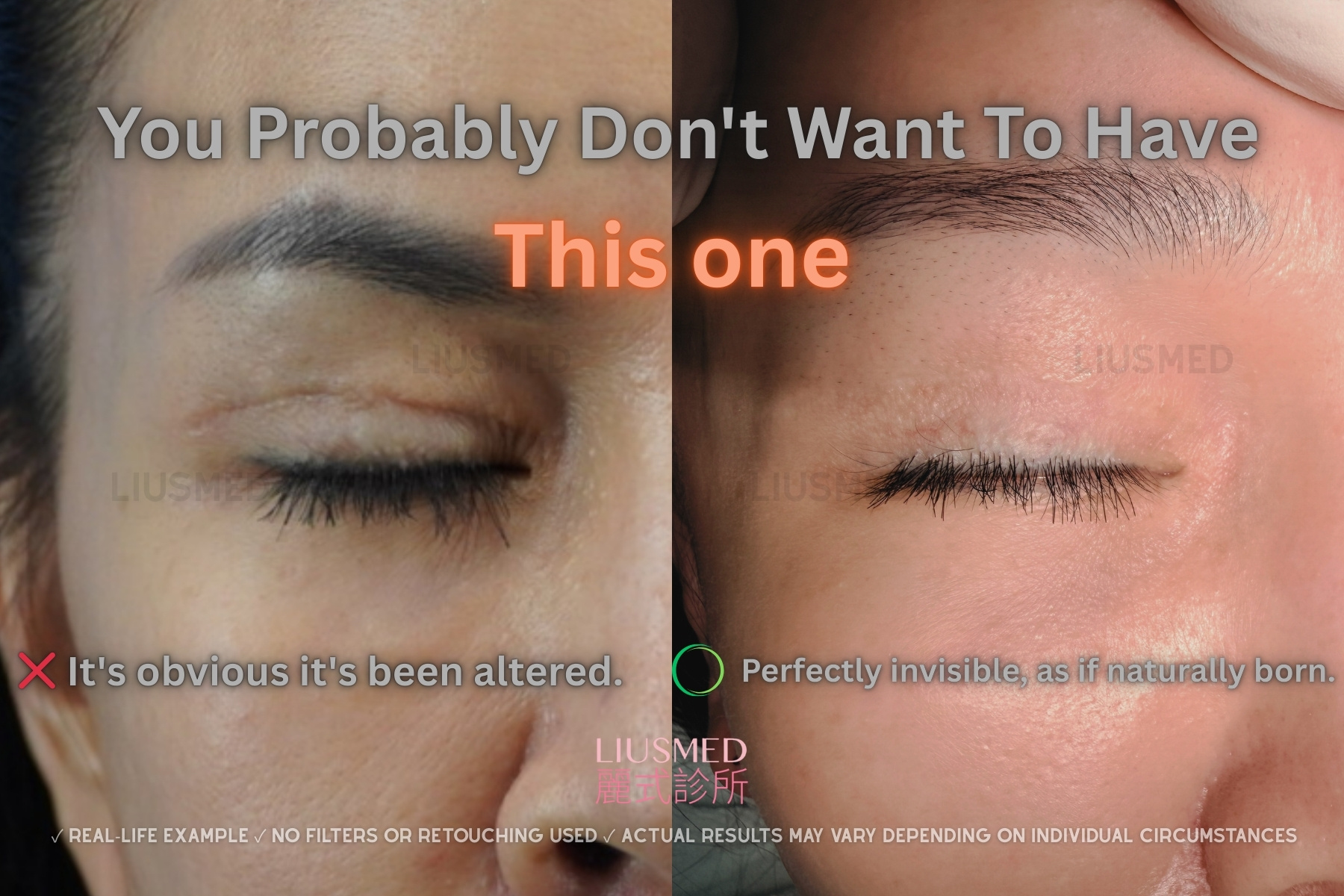
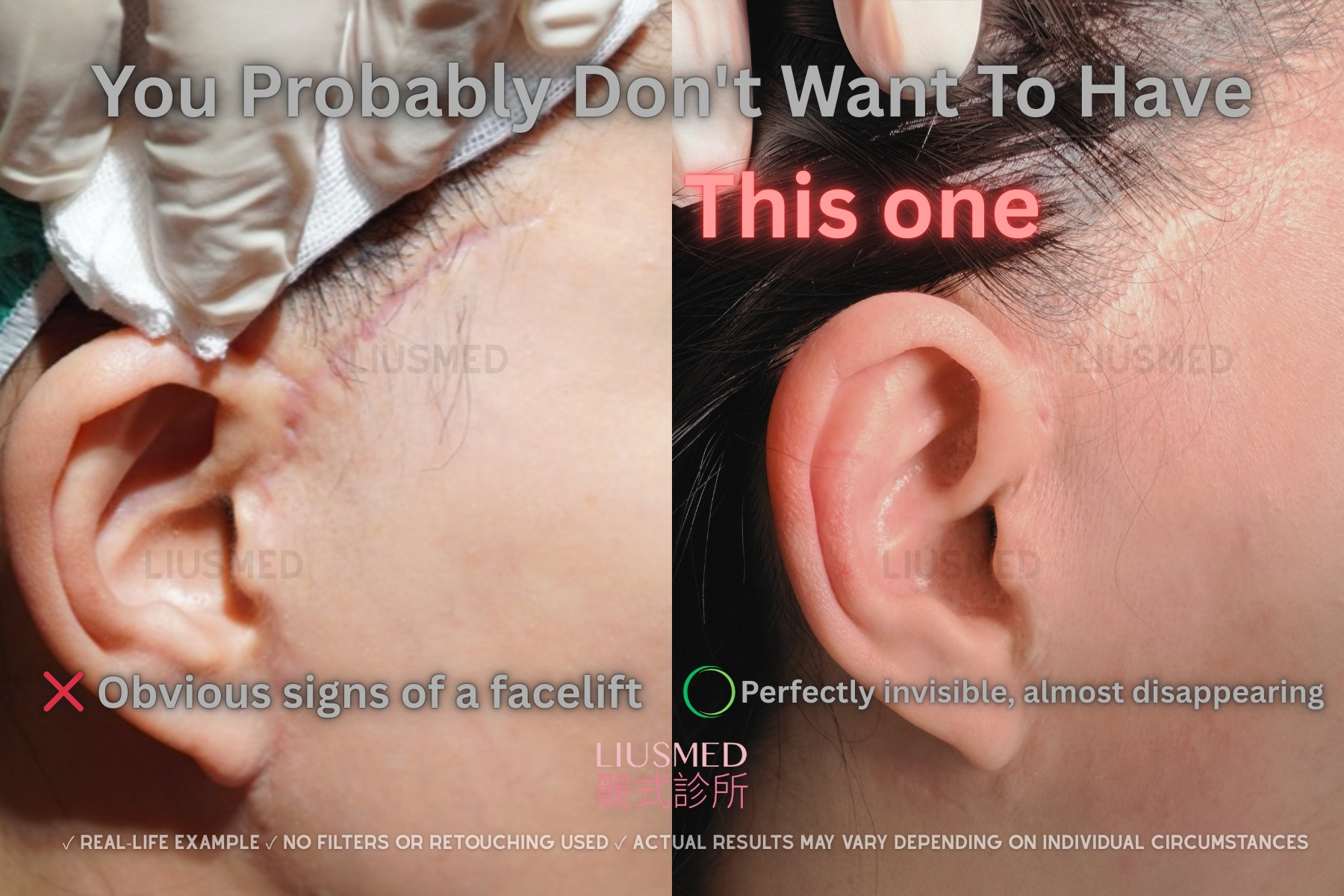
Our goal is not erasure — but imperceptibility
Intralesional corticosteroid injection as the main first-line option · W-plasty / subcision surgical excision · type-specific combination therapy
Your Scar Repair Treatment Includes
Hypertrophic vs. keloid precise classification
Hypertrophic self-limits · keloid expands indefinitely · diagnosis drives strategy
Intralesional corticosteroid injection as the main first-line option
First-line for hypertrophic scars · >90% control rate
Fractional laser + PRP for atrophic scars
Cumulative RCTs show ECCA improvement superior to laser alone
Surgery + injection + pressure + adjuvant RT for keloid
Included and aftercare
Select any item to see its full scope and exclusions
Not sure which approach fits you?
Send a few photos first, or book a consultation directly. How booking works
You're not alone in this
Recovering after a procedure takes more than treatment — it helps to have reliable information and people who have been through the same thing. Whether it is filler, fat grafting, scars, energy devices, thread lifts, surgery, or a problem that came back after treatment, you can start in two places: Dr. Ta-Ju Liu’s health-education posts, and the patient Q&A forum where you can ask anonymously.

Dr. Liu’s health-education posts
fillerrevision.com
Articles and real case notes written up by Dr. Ta-Ju Liu: how common post-procedure problems are told apart, what repair usually involves, and what to watch for while you recover.

Patient Q&A Forum
Write it down — Dr. Liu replies in the thread
Describe your situation anonymously. Dr. Liu replies as health education — what it might be, what needs to be told apart, and which signs mean you should be seen soon — and you can read how other patients’ recoveries went.

Let Scars No Longer Be a Burden
Book a consultation and let us evaluate your scar condition to create the best treatment plan.
Book Scar Revision Consultation