
Full-Face Autologous Fat Micro-Grafting
Structural · Multi-Layer · PRP-Boosted SurvivalMidface / malar / temples / tear-trough / nasolabial folds | Coleman 2006 structural + Strong 2015 three-step precision + Gentile 2019 PRP boost
Structure · Precision · Boost
Structural Multi-Layer Injection
We never inject "a blob in one location." Coleman 2006 structural technique (PMID:16936550) clearly defines: multi-layer micro-droplet injection at supraperiosteal, deep fat, superficial fat, and subdermal levels — small volumes (≤0.1 mL per point) at each layer. This principle determines survival more than the fat itself — the 50-70% vs 20-40% gap lives here.
Harvest · Process · Inject — Three-Step Precision
Strong 2015 SR (Systematic Review) (PMID:26397260) lays out three "best-practice" pillars: harvest at ≤−400 mmHg (manual syringe), low-speed centrifugation 1200 g × 3 min, multi-layer micro-droplet injection. All three must be done correctly to reach the 60-70% retention zone; cutting any one corner drops retention to 30-40%. We do not take shortcuts — all three by the textbook.

PRP Boost: +20-30% Retention
Gentile 2019 SR (DOI:10.3390/biomedicines7040084) shows PRP (Platelet-Rich Plasma) augmented groups achieved ~20-30% higher facial fat retention at 6-12 months — most pronounced in tear-trough, temporal, and malar zones with relatively lower vascularity. PRP's growth factors also directly improve skin texture — two outcomes in one session. For a significant full-face fat grafting investment, this 20-30% boost is the watershed between "needing a 6-month top-up" and "stable for years."
Liusmed Clinic — Cross-Specialty Core Principles
From skin tumors to facial volumetric reconstruction, we hold to "you can only treat what you can see, and only honesty earns long-term trust." 3D mapping + structural technique + PRP boost + 6-month quantitative evaluation — we take "how much survives?" all the way using the strongest-evidence approach.


You Might Be Experiencing
Two extremes are common in the facial-volume journey: "I'll just keep doing HA filler" (5-year cost ends up above fat grafting, plus pillow-face risk) and "more is better, fill it up in one go" (recipient compression and paradoxically lower retention). Autologous fat offers a third path: strongest-evidence structural technique + literature-backed PRP boost — a middle path between "permanent integration" and "repeated injection."
- Midface depression, prominent cheekbones, malar atrophy (age-related fat pad loss)
- Temporal hollows, sunken orbits (periorbital aging signature)
- Prominent tear troughs, deep infraorbital hollows (still look tired even after rest)
- Deep nasolabial folds, jowl ptosis (synergizes with thread lifting)
- Want to switch from repeated HA (Hyaluronic Acid) filler to permanent tissue volumization (long-term HA cost has exceeded fat grafting)
- Facial hollowing after pregnancy or weight loss (fat pad volume loss)
Bone-Frame × Stem Cells × PRP: Three Layers Working Together
Facial fat grafting success requires three things at once: "skeletal support," "tissue regeneration," and "accelerated perfusion." No single layer alone is sufficient; only the combination produces stable yet natural change at 6-12 months.

Structural Bone-Frame Reconstruction
Young faces look dimensional because cheekbones, maxilla, and mandible provide strong skeletal support. With age, bone resorbs and soft tissue sags, causing contours to collapse. Coleman 2006 (PMID:16936550) structural technique's core: small micro-droplet injections above periosteum to build "synthetic bone support," then layer-by-layer volumetric completion at deep/superficial/subdermal levels — treating fat as a "3D skeleton" rather than a "filling material."

Adipose Stem Cell Regeneration
Autologous fat is more than "volume" — adipose tissue contains adipose-derived stem cells (ADSCs) that release growth factors (VEGF (Vascular Endothelial Growth Factor), PDGF (Platelet-Derived Growth Factor), bFGF, IGF-1 (Insulin-like Growth Factor 1)) stimulating recipient-zone neovascularization and fibroblast activity. This is also the source of post-op skin texture improvement (firmness, pore size, glow). Low-speed centrifugation at 1200 g × 3 min is specifically chosen to preserve ADSC viability — over-centrifugation (>1500 g) kills most stem cells.

PRP Signaling Synergy
High-concentration platelets centrifuged from your own blood release PDGF, TGF-β (Transforming Growth Factor Beta), VEGF, EGF upon activation. Adding these to fat grafting accelerates recipient-zone neovascularization (the critical "blood supply within 48 hours" for grafted fat) and simultaneously stimulates skin collagen and elastic fiber remodeling. Gentile 2019 SR shows +20-30% retention improvement — most pronounced in low-vascularity zones like tear-trough and temples.
What the Studies Say — What It Means for You
We surface 4 pivotal studies on "structural fat grafting × PRP boost," each with a "what it means for you" — translating academic numbers into the questions you actually bring to clinic.
Autologous Fat vs HA Filler vs Sculptra vs Silicone Implant
Each volumization treatment has its place. This table consolidates Coleman 2006, Strong 2015, Gentile 2019 so you and your physician share a common vocabulary.
| Item | Autologous Fat | HA Filler | Sculptra | Silicone/Medpor Implant |
|---|---|---|---|---|
| Mechanism | Long-term autologous integration + ADSC regeneration | Absorbable gel volume | PLLA (Poly-L-Lactic Acid) stimulates collagen | Permanent foreign-body implant |
| Duration | Permanent (surviving fraction) | 6-18 months (varies) | ~2 years | Permanent (unless removed) |
| Retention Rate | Structural ~50-70%; +PRP boost 20-30% | N/A(fully absorbed) | Varies by volume/metabolism | 100%(physical material unchanged) |
| 5-Year Total Cost | Relatively lower (incl. top-up; ~0.4-0.6× the repeated-HA path) | Relatively higher (cumulative re-injection every 1-2 yrs) | Moderate (~every 2 yrs) | Moderate (single implant, few follow-ups) |
| Main Risks | Survival uncertainty, 1-2 wk bruising, very rare vascular occlusion | Pillow face, vascular occlusion (rare but serious) | Nodules, granuloma (improper massage) | Infection, displacement, surgical removal needed |
| Recommended Strategy | Whole-face structural reconstruction + permanent tissue → autologous fat (+PRP); single-zone touch-up → HA; concurrent skin tightening → Sculptra; severe bone deficit → implant | |||
Key Insight: "5 years of HA costs more than fat grafting" is the commonly-overlooked long-term cost — but this does not mean HA is wrong, just that each has its place. **Autologous fat suits "whole-face structural reconstruction"; HA suits "single-zone touch-ups."** We do not push fat grafting at first consultation — if you only want to address one tear-trough zone, HA may be more precise and reversible. **Right tool beats expensive tool.**
Why Liusmed Clinic Chose "Structural × PRP-Boosted" as Our Strategy
We do not pitch "newest, flashiest therapy" — the strongest literature evidence clearly points to the integrated "Coleman structural + Strong three-step precision + Gentile PRP boost" combination. The two axes behind our choice: literature support and clinical observation.
Literature Support
- ·Coleman 2006 (PMID:16936550): structural technique yields 50-70% facial fat retention (vs 20-40% bolus single-layer); multi-layer micro-droplet injection is core.
- ·Strong 2015 SR (PMID:26397260): harvest pressure, processing, injection layering — three "best-practice" pillars explain the 30% vs 70% inter-clinic gap.
- ·Khouri 2014 (PMID:24572853): "recipient site capacity" is the rate-limiting factor for survival; overfilling paradoxically reduces retention.
- ·Gentile 2019 SR (DOI:10.3390/biomedicines7040084): adding PRP improves 6-12 month facial retention by ~20-30%; greatest benefit in low-vascularity zones.
Dr. Liu — Clinical Observations
- ·Clinically, "too much at once" patients often have the worst retention — recipient compression starves the back rows. We honestly counsel at first visit: better to do 1-2 staged sessions 3-6 months apart than chase "fill everything at once."
- ·For patients switching from prior HA to fat grafting, we first assess residual HA and fibrosis — sometimes dissolving with hyaluronidase and waiting 2-3 months for tissue recovery before grafting, to avoid operating on an uneven recipient.
- ·For BMI < 18 lean patients, donor fat may be insufficient — we honestly discuss: forcing extraction from a small donor zone risks local depression; better to recommend weight adjustment for 3-6 months before re-evaluating, or consider HA/Sculptra alternatives.
- ·For severely asymmetric or single-side collapse cases, we do not jump in immediately — we first evaluate for structural causes (post-traumatic tissue loss, nerve injury, congenital deformity). Coordinating with plastic/craniofacial surgery if needed; we avoid surface filling before diagnosing the root cause.
- ·We use 3D volume comparison, global photos, and 6-month formal quantitative evaluation — not subjective "does it look different?" Updated each follow-up — patients themselves end up valuing this most.
We did not pick the "newest, flashiest therapy" — we picked the combination with the strongest current evidence, alignment with our cross-specialty philosophy, and the ability to maximize your fat's survival in the recipient. This treatment investment is not for "getting it injected" — it is for "how much survives and how long it lasts."
Treatment Process
From evaluation to follow-up, five stages ensuring structural technique and long-term survival

Clinic Evaluation
3D facial mapping + body fat distribution

Low-Pressure Harvest
≤−400 mmHg manual syringe

Dual-Stage Processing
Sedimentation + 1200 g × 3 min

Multi-Layer Injection
Supraperiosteal/deep/superficial/subdermal

6-Month Formal Eval
3D volume comparison + global photos
Clinical Evidence & References
Autologous fat grafting is performed under Taiwan's Special Medical Technology Regulations, limited to qualified institutions and personnel; our clinic complies. PRP is an out-of-pocket adjunct regenerative item. High-quality evidence (Coleman 2006, Strong 2015, Khouri 2014, Gentile 2019) continues to strengthen the clinical basis for structural fat grafting. We track each patient objectively via 3D volume comparison, global photos, and 6-month formal quantitative evaluation.
- [1]OCEBM 52006
Coleman SR. Structural Fat Grafting: More Than a Permanent Filler. Plast Reconstr Surg 118(3 Suppl):108S-120S.
Foundational structural FG paper: three core principles (manual low-pressure harvest, light centrifugation, multi-layer/multi-tunnel/micro-droplet injection); long-term retention ~50-70% (vs 20-40% for bolus single-layer).
PMID: 16936550 - [2]OCEBM 1a2015
Strong AL, et al.. The Current State of Fat Grafting: A Review of Harvesting, Processing, and Injection Techniques. Plast Reconstr Surg 136(4):897-912.
Systematic review: harvest pressure ≤−400 mmHg, low-speed centrifugation 1200 g × 3 min, multi-layer micro-droplet injection are the three "best-practice" pillars; over-pressure or over-centrifugation severely damages adipocyte viability — main driver of clinic-to-clinic retention variance (30% vs 70%).
PMID: 26397260 - [3]OCEBM 2b2014
Khouri RK, et al.. Megavolume Autologous Fat Transfer. Plast Reconstr Surg 133(3):550-557.
Emphasizes "recipient site capacity" as rate-limiting factor for survival — when the recipient cannot accommodate, overfilling compresses blood supply and reduces retention. Pre-expansion of recipient achieved retention in the 80% range.
PMID: 24572853 - [4]OCEBM 1a2019
Gentile P, et al.. A Comparative Translational Study: The Combined Use of PRP and AFG for Facial Volumization. Biomedicines 7(4):84.
Systematic review: PRP-augmented groups achieved ~20-30% higher facial retention at 6-12 months; greatest benefit in tear-trough, malar, temporal zones with relatively lower vascularity; concurrent skin texture improvement (firmness, pore size).
DOI: 10.3390/biomedicines7040084 - [5]OCEBM 52004
Mojallal A, Foyatier JL. Historical Review of the Use of Adipose Tissue Transfer in Plastic and Reconstructive Surgery. Ann Chir Plast Esthet 49(5):419-425.
AFG historical review: since Neuber's first description in 1893, the technique has evolved across three eras; modern structural technique (since Coleman 2000) has raised retention from ~30% to the 50-70% range, repositioning fat as "autologous regenerative material" rather than mere filler.
Our Commitment to Honest Disclosure
Every procedure deserves your full understanding before deciding. The following summarizes common considerations and current research context; individual applicability is evaluated by the physician so you can proceed with confidence.
Contraindications
- •Extremely lean body habitus (insufficient donor fat; BMI < 18 generally needs evaluation)
- •Severe coagulopathy, uncontrolled anticoagulant therapy
- •Active facial infection (cellulitis, severe acute acne)
- •Active malignancy, acute autoimmune disease
- •History of severe local-anesthetic reactions
- •Unrealistic expectations (e.g., "look like a different person") — counseling required first
Common Side Effects
- •Bruising/swelling at donor and injection sites (10-20%, resolves 1-2 weeks)
- •Transient firmness at injection sites (typically softens within 4-8 weeks)
- •Infection (< 1%, mitigated by sterile technique + prophylactic antibiotics)
- •Oil cysts / fat nodules (0.5-2%, usually from single-point over-injection; mostly self-resolve, few require aspiration)
- •Lower-than-expected retention (30-50% of cases may need a 6-12 month top-up)
- •Very rare: vascular occlusion (< 0.1%, mainly associated with sharp needle + shallow rapid injection — we use blunt cannula + slow layered injection to mitigate)
Research Status & Clinical Observations
- •Retention has both "individual variation" and "technique dependence": the same fat in different hands ranges from 30% to 70% retention. Strong 2015 SR clearly identified three key variables (harvest pressure, processing, injection layering), but this also means "we cannot guarantee 70% retention for any individual" — only commit to operating with the strongest-evidence technique.
- •PRP boost has a "preparation-quality prerequisite": concentration, leukocyte ratio, and activation differ widely across clinics — a key driver of inconsistent literature effect sizes. We prepare both leukocyte-rich and leukocyte-poor PRP (LR-PRP / LP-PRP), choosing by site and case and recording each preparation; the concentration multiple is not fixed at a single value.
- •Severe structural asymmetry requires evaluating other causes first: for congenital deformity, post-traumatic tissue loss, or unilateral collapse from nerve injury, fat grafting can be adjunctive but cannot address the root cause — coordination with plastic/craniofacial surgery is recommended first.
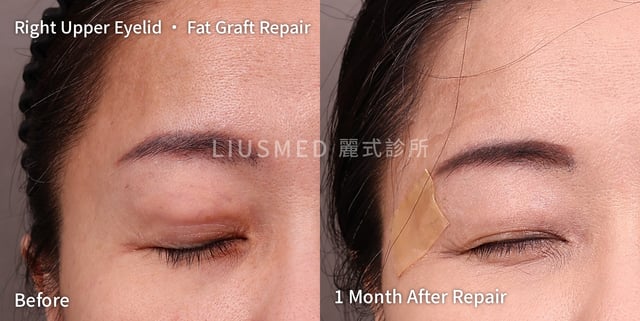
In the eye hollows, the layer matters more than the volume
Upper-eyelid skin is very thin, so fat placed too superficially shows its outline even at rest. In this patient, the upper eyelid hollows had been grafted with fat; about three months later they began to bulge, more so after weight gain, and ultrasound confirmed the fat sat superficially. It was later removed with a staged pinhole extraction. This is worth knowing before a graft, which is why we show it here.
What Your Plan Is Made Of
| Item | How Cost Is Explained | Notes |
|---|---|---|
| Initial evaluation (3D facial mapping + body fat distribution) | Discussed case-by-case after in-person evaluation | — |
| Full-face autologous fat grafting (single session: harvest + process + injection) | Discussed case-by-case after in-person evaluation | Varies by volume, zones, and thread-lifting combination |
| PRP boost (recommended for +20-30% retention) | Discussed case-by-case after in-person evaluation | LP or LR chosen by site |
| 6-month formal quantitative evaluation (3D volume comparison, global photos) | Included in protocol | — |
| 6-12 month top-up (if under-survival) | Discussed case-by-case after in-person evaluation | Most patients are fine with one session; top-up is the exception and costs less than the initial procedure — discussed case-by-case at the in-person visit |
Actual pricing depends on individual symptoms, treatment count, and custom formulation — explained on a case-by-case basis via LINE consultation or in-person visit. The physician walks you through the treatment and the reasoning behind it for your individual situation.
FAQ
How long does fat grafting last? Will it all be reabsorbed?
Why is clinic-to-clinic survival rate so different (30% vs 70%)?
Does adding PRP actually make a difference?
What are the pros and cons vs. HA filler?
Where is fat harvested from? Will it leave scars?
Can I have a lot done in one session?
Can it be combined with facial thread lifting?
Who should not have this treatment?

Dr. Ta-Ju Liu
Director, Liusmed Clinic · Over 15 years in minimally-invasive treatment
- Former attending dermatologist, Chang Gung Medical Center & Cosmetic Center
- Board-certified dermatologist · minimally-invasive surgery focus
- Advanced ultrasound-guided procedures · filler complication repair · complete apocrine gland clearance
"You can only treat what you can see" is the core belief running through every procedure I do. The subcutaneous world is intricate; what used to depend on experience and palpation now has a more reliable lens — advanced ultrasound. Seeing vessels, nerves, capsules, and glands first, then deciding where and how deep to cut — that is the standard every patient deserves.
One Face, One Case — Let Us First Map It in 3D, Then Decide Volume and Zones
We do not push "fixed packages." Every zone's volume, every layer's allocation, every PRP-boost decision is designed for your facial architecture. Start with LINE consultation or book a face-to-face visit.
Structural Facial Fat Grafting · Harvest + Process + Inject 3-Step
Fat grafting is not magic — it's a 50-70% retention engineering process
Coleman 2006 structural 50-70% retention range · low-pressure harvest ≤−400 mmHg + dual-layer purification + 4-layer injection + 6-month 3D comparison
Your Facial Fat Grafting Treatment Includes
Low-pressure harvest · preserves viable fat cells
Suction ≤−400 mmHg avoids mechanical disruption of cell membranes
Dual-layer purification · remove excess oil and blood
4-layer injection · maximizes recipient-bed surface area
Khouri 2014 supports small parcels + multi-layer + non-overlap
6-month 3D volume comparison · quantifies retention
Included and aftercare
- Suture Removal Included
- Photo Upload + Online Wound Care Advice
- 14-Day / 1-Mo / 3-Mo Follow-Up
- Post-Op Light Therapy Included
Select any item to see its full scope and exclusions
Not sure which approach fits you?
Send a few photos first, or book a consultation directly. How booking works