Fat Graft Survival: Harvest, Purify, Inject Key Factors
One-Minute Summary
Key Conclusions:
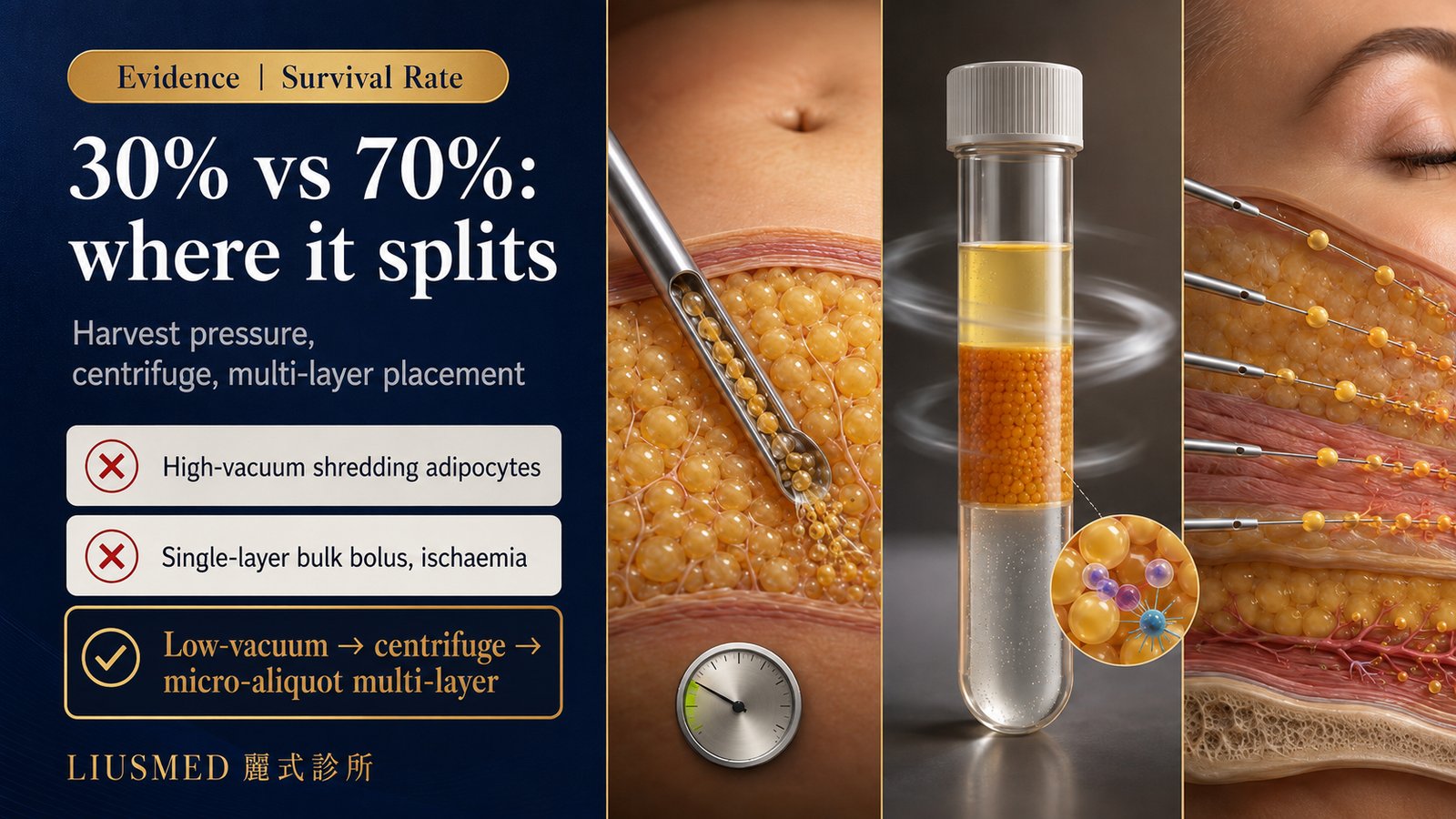
- Full-face fat graft (Fat Grafting / Lipofilling — autologous fat transfer) survival ranges from 30% to 70% depending on technique. A 2024 systematic review on low-volume facial fat grafting reported a pooled retention rate of 47% at 3–12 months.
- The 12 critical factors fall into three phases: 4 in harvesting, 3 in purification, 5 in injection.
- Harvest negative pressure is the most overlooked damage point: high-vacuum aspiration disrupts 30–60% of adipocyte membranes.
- Centrifugation parameters determine ADSC (Adipose-Derived Stem Cells — stem cells harvested from fat tissue) survival: 1200g × 3 minutes is the Coleman standard, while 600g preserves more SVF (Stromal Vascular Fraction — mixed cell fraction from digested fat tissue) cell activity (2024 evidence).
- On the injection side, the "small volume, multiple passes" principle is paramount — ≤0.2ml per pass, layered placement, and avoiding vascular zones can double survival rates.
Why Such a Wide Survival Gap?
If you compare post-op photos across clinics, results vary dramatically — some patients achieve full results in one session that last 5+ years; others see complete absorption at 3 months and need repeat sessions.
This is not luck. It is the cumulative outcome of 12 technical variables.
Key insight: Fat grafting is not "injecting fat." It is fundamentally a cell-engineering challenge: establishing new vascular supply within 3 months. Mishandling at any step degrades survival.
Phase 1: Four Harvest-Side Variables
1. Donor Site Selection
ADSC density varies by anatomical region:
| Site | ADSC Density | Clinical Note |
|---|---|---|
| Lower abdomen | High | First choice — abundant and accessible |
| Medial thigh | Medium-high | Suits slim patients, dual contouring benefit |
| Lateral thigh | Medium | High volume but slightly lower ADSC |
| Flanks | Medium | Common for male patients |
| Back | Low | Not preferred |
Lower abdomen and medial thigh are the two highest-ADSC zones — historically why Coleman Technique (standardized fat-grafting method: low-vacuum harvest + centrifugation + multi-layer micro-injection) favored lower abdomen harvest.
2. Harvest Pressure — The Most Overlooked Damage Point
This is the fastest test of how seriously a surgeon takes the procedure.
- Machine-vacuum liposuction: vacuum may reach −600 mmHg, disrupts 30–60% of adipocyte membranes
- Manual syringe aspiration (Coleman core): vacuum −30 to −60 mmHg, cell integrity >95%
Studies show 10ml-syringe manually aspirated fat yields 4.11 × 10⁸ viable adipocytes/ml vs 2.57 × 10⁸/ml for conventional liposuction.
Key insight: Asking your surgeon "do you use machine or manual syringe aspiration?" is the single most direct way to gauge technique tier. Surgeons who invest the time in 10ml-syringe manual harvest typically also invest in purification and injection precision.
3. Cannula Diameter and Tip Geometry
- Diameter: 3–4mm is the optimal balance (too thin: cell deformation; too thick: larger incision, more bruising)
- Tip: Blunt tips outperform sharp tips — lower adipocyte tearing rate
4. Tumescent Solution Concentration
Tumescent solution contains epinephrine for vasoconstriction, but excessive concentration impairs subsequent adipocyte metabolism:
- Recommended: 0.05% Lidocaine + 1:500,000 Epinephrine
- Wait time: Allow 15–20 minutes after injection before harvesting — many clinics skip this step to save time
Phase 2: Three Purification Variables
5. Processing Method: Sedimentation vs Centrifugation vs Filtration
A 2024 systematic review confirmed centrifugation outperforms sedimentation clinically:
| Method | Purification Efficiency | ADSC Retention | Indication |
|---|---|---|---|
| Sedimentation only | Low | High | Large volumes, less precise |
| Gauze filtration | Medium | Medium | Speed-prioritized |
| Centrifugation (Coleman) | High | Medium-high | First choice for facial precision |
| Dual-stage (sediment + centrifuge) | Highest | High | Premium facial grafting |
6. Centrifuge Parameters: 1200g × 3 min vs 600g
Coleman's standard is 1200g × 3 minutes (~3000 rpm). However, 2024 research shows:
- 600g lower-speed centrifugation: highest stromal vascular fraction (SVF) cell count and viability
- No centrifugation: lowest SVF (not recommended)
- Excessive g-force: damages adipocytes, reducing survival
Key insight: "Centrifugation vs no centrifugation" was historically debated. The 2024 verdict is clear: centrifugation is better, but lower g-force is preferable. In clinical practice, the Coleman classic remains a stable, reliable choice.
7. Wash Solution Selection
The fluid used to wash fat before injection also affects survival:
- Saline: baseline, removes free oil
- Lactated Ringer's: closer to physiological pH, slightly better in some studies
- PRP (Platelet-Rich Plasma — concentrate of your own blood platelets rich in growth factors) supplementation: rich in platelet-derived growth factors, enhances angiogenesis (new blood vessel formation; used in ADSC augmentation strategies)
Phase 3: Five Injection Variables
The injection phase carries the largest technical variance and deserves the most patient attention.
8. The "Small-Volume, Multiple-Pass" Principle
This is the soul of Coleman technique:
- Volume per pass: ≤0.2ml
- Per anatomical zone: at least 2 crossing directions
- Avoid single-bolus overfill: >0.3ml creates a "central necrosis zone" where inner cells die from hypoxia before vascularization
9. Multi-Layer Zone Injection
Each layer survives by different mechanisms:
| Layer | Purpose | Survival Mechanism |
|---|---|---|
| Supraperiosteal | Structural support (zygoma, temple) | Periosteal vascular supply |
| Deep fat compartment | Volume (mid-face, tear trough) | Surrounding adipose vasculature |
| Superficial fat | Contour fine-tuning | Subdermal vascular network |
| Sub-dermal | Texture refinement | Dermal microvasculature |
Each layer needs even, thin distribution. "Spread thinly" beats "stack densely."
10. Injection Pressure and Speed
- Slow injection: 0.1–0.2 ml/sec, avoiding high-pressure cell damage
- Retrograde release: deposit fat during cannula withdrawal, not stationary push
- 3ml syringe over 10ml: smaller syringes give finer pressure control
11. Vascular Danger Zones
Vascular occlusion (filler-induced vascular blockage) is the most catastrophic complication. High-risk zones:
- Glabella (supratrochlear, supraorbital arteries)
- Temple (superficial temporal artery)
- Nasal bridge (dorsal nasal artery)
- Nasolabial fold (angular and facial artery branches)
Key insight: In these zones, blunt cannula > sharp needle — blunt tips are less likely to puncture vessel walls. Combined with ultrasound guidance or strict retrograde technique, risk drops further.
12. Overfill Strategy
Since 30–50% of fat is reabsorbed within 3 months, surgeons typically overfill by 20–30% to compensate. But this requires nuance — overfill that is too dense causes fat necrosis and oil cysts; overfill that is too superficial causes unnatural post-op puffiness.
ADSC Enhancement: 2024 Survival Breakthrough
The 2024 Aesthetic Plastic Surgery Network Meta-Analysis (NMA — indirect multi-treatment comparison; 31 RCTs, 1,656 patients) ranked techniques:
| Technique | Survival Rank (SUCRA %) |
|---|---|
| ADSC-enriched fat grafting (CAL) | 82.17% |
| Salvia miltiorrhiza adjuvant | 69.76% |
| PRP-assisted | Moderate (55–65%) |
| Standard Coleman | Baseline (40–60%) |
| Raw lipoaspirate, untreated | Lowest (<40%) |
Cell-Assisted Lipotransfer (CAL) Principle: A portion of harvested fat is centrifuged to extract stromal vascular fraction (SVF, containing ADSCs), then mixed back into the remaining fat for injection. The resulting fat has 2× ADSC density, with superior survival and regenerative effects. SUCRA (Surface Under the Cumulative Ranking — NMA ranking metric 0–100%) higher means better.
Five Patient-Side Factors
Technique matters most, but patient physiology contributes too. Factors documented to reduce survival:
- Smoking — nicotine constricts vessels and impairs neovascularization. Recommended: stop smoking 4 weeks pre-op through 8 weeks post-op
- Poorly-controlled diabetes — HbA1c >7.5% significantly reduces survival
- Long-term steroid use — suppresses angiogenesis
- Aggressive dieting / rapid weight loss — destabilizes fat
- Premature return to vigorous exercise — avoid first 4 weeks; mechanical compression destabilizes cells
The Critical 3-Month Window: What You Can Do
The first 3 months decide 80% of the outcome. During this period:
- Cold compress for 48 hours: reduces edema and inflammation, avoid direct pressure
- Anti-inflammatory diet: omega-3, vitamin C, zinc
- No smoking, no alcohol: minimum 8 weeks
- Avoid sauna and hot baths: high temperature accelerates metabolism
- No prone sleeping: do not pressurize recipient sites
- No massage: counterintuitively, massage destabilizes settling cells, not promote absorption
- 3, 6, 12-month follow-ups: evaluate touch-up needs (~30% of patients undergo small touch-up at 3–6 months)
Key insight: Post-op management aims to "let cells stably wait for vascular supply to establish." This is not passive recovery; it is an active cellular engineering process.
Common questions
How high is the fat survival rate, really?
It depends heavily on technique. Post-op photos vary a lot between clinics — some patients get it right in one session and still hold the contour five years later, others reabsorb most of it within three months. A recent systematic review of low-volume facial fat grafting put the average retention at roughly 47% over 3–12 months, with the overall range running from 30% to 70%. So "what's the survival rate" is almost the same question as "how carefully was it done."
Why does one person's graft settle while another needs repeated touch-ups?
Because fat grafting isn't just "put the fat in." It's essentially a three-month process of getting the fat cells to re-establish a blood supply. Between harvesting, purification, and injection there are a dozen technical steps, and cutting a corner at any of them costs you. Add physiology on top — smoking, poorly controlled blood sugar, and long-term steroids all lower survival. So the result is technique, physiology, and aftercare multiplied together.
Does machine versus manual-syringe harvesting actually matter?
Yes, and it's the fastest way to gauge how careful a surgeon is. Traditional high-vacuum machine liposuction can reach −600 mmHg and damages 30–60% of the fat cell membranes; low-pressure manual harvesting with a syringe stays at −30 to −60 mmHg, keeps cell integrity above 95%, and yields a noticeably higher count of viable fat cells. A surgeon willing to spend the time hand-harvesting with a syringe usually puts the same care into purification and injection.
Can I massage the area afterward to help absorption?
Please don't. People assume massage improves circulation, but during that window the fat cells are waiting for blood vessels to grow in and are very fragile — pressing on them just destabilizes them and lowers survival. Whether the fat lives is 80% decided in the first three months, and what helps then is cold compress, an anti-inflammatory approach, and no pressure — not actively kneading it.
Why does the surgeon deliberately overfill?
Because roughly 30–50% of the fat is reabsorbed within three months, so surgeons often overfill by about 20–30% to offset the expected loss. But it takes judgment — too much, packed too densely, causes fat necrosis and oil cysts, and too superficial leaves unnatural swelling. Overfilling is a balancing act, not a "more is better" move.
Conclusion: Survival Rate = Technique × Physiology × Management
Next time you compare fat grafting quotes across clinics, evaluate these as core questions:
- Machine vacuum or manual syringe harvest?
- Purification method? Centrifugation parameters?
- Is ADSC augmentation (CAL) offered?
- What multi-layer protocol is used?
- What is the touch-up policy?
Low-priced clinics that cannot answer these in detail typically have several-fold higher survival risk. For patients seeking single-session, long-term stable results, choosing a surgeon who invests time in every step is the most effective form of cost control.
If you have questions about fat survival optimization or want to learn about our full-face fat grafting protocol, please book a consultation.
Medical References
- Coleman SR (Systematic Review). Structural Fat Grafting: Beyond the Lipocyte. Plast Reconstr Surg. 2006.
- The Current State of Fat Grafting: A Review of Harvesting, Processing, and Injection Techniques. Plast Reconstr Surg. 2015. PMID (PubMed Identifier): 26086386.
- The Effect of Centrifuge Duration on Fat Graft Survival. Aesthet Surg J. 2023. PMID: 36998923.
- Effectiveness and Safety of Different Methods of Assisted Fat Grafting: A Network Meta-Analysis. Aesthet Plast Surg. 2024.
- Revisiting Fat Graft Harvesting and Processing Technique to Optimize Its Regenerative Potential. PMC11723667. 2024.
- Improving the Retention of Low-Volume Autologous Fat Grafting. PMC11249923. 2024.
- Survival Mechanisms and Retention Strategies in Large-Volume Fat Grafting. Aesthet Plast Surg. 2024.
- A Systemic Review of Autologous Fat Grafting Survival Rate and Related Severe Complications. PMC4831554.
Editorial review: Reviewed by Dr. Ta-Ju Liu. Last reviewed 2026-04-27. Educational content; does not constitute individualized medical advice.
Related Services

Specialties
Credentials
- Kaohsiung Medical University, School of Medicine
- Attending Physician, Dermatology, Kaohsiung Chang Gung Memorial Hospital
- Attending Physician, Aesthetic Center, Kaohsiung Chang Gung Memorial Hospital
- Visiting Physician, Dermatology, Xiamen Chang Gung Hospital
- Visiting Physician, Aesthetic Center, Xiamen Chang Gung Hospital
"For every surgery, I strive to achieve a good outcome through a small incision and refined technique. Minimally invasive surgery is not just a technique — it's a commitment of respect to every patient."
Recovery after any procedure needs peer support too


Want to learn more?
Schedule a consultation for professional evaluation and advice