Autologous Fat vs Hyaluronic Acid Filler for Full-Face Volumization: 2026 Evidence-Based Comparison
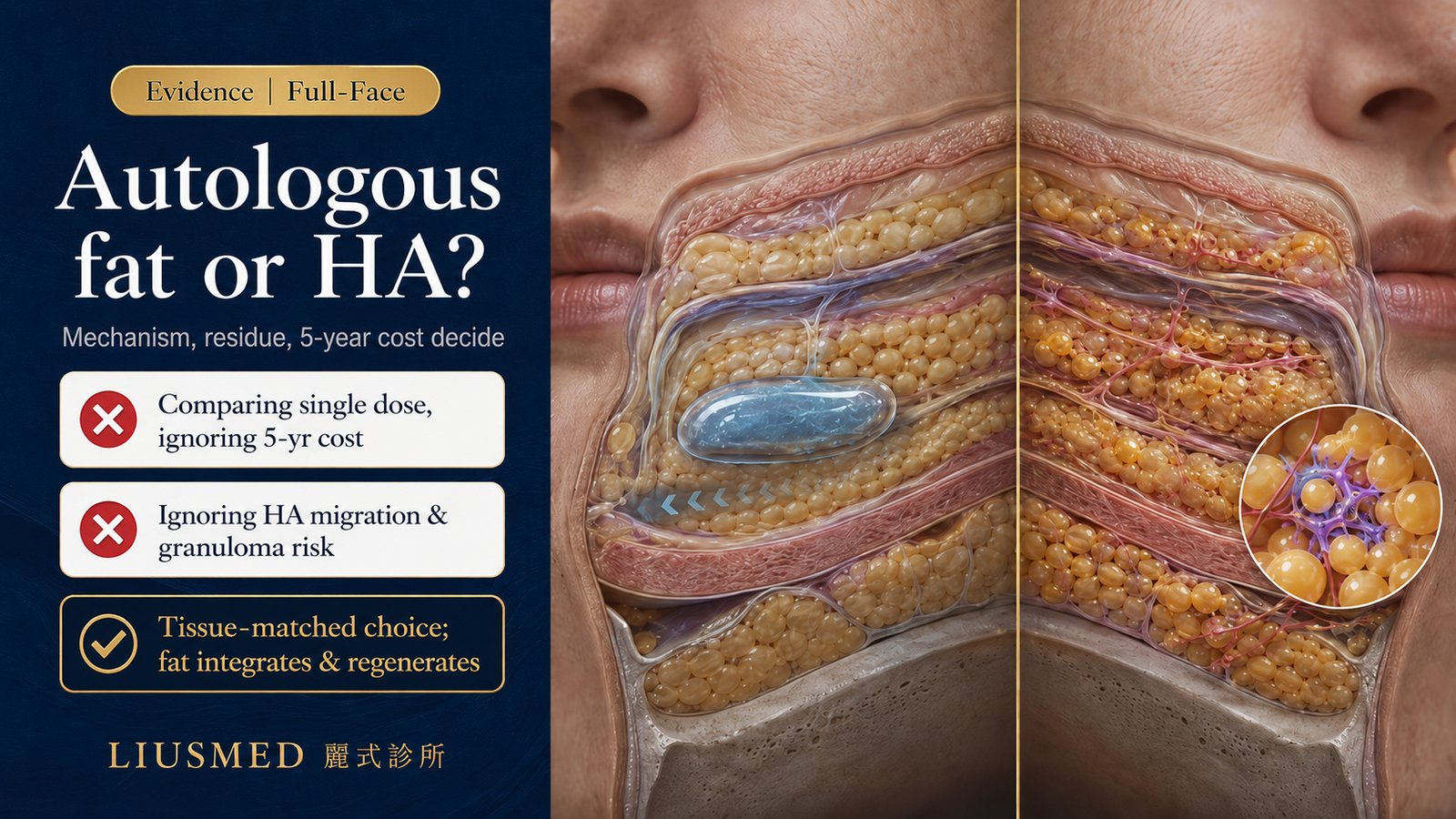
One-Minute Summary
Key Conclusions:
- Short-term efficacy (within 9 months): A 2017 single-blind RCT (Randomized Controlled Trial — gold-standard treatment comparison study) by Hu et al. (J Cosmet Dermatol, n=57) found no significant difference in Wrinkle Severity Rating Scale (WSRS — 0–5 wrinkle depth rating) between Coleman (standardized fat-grafting method) fat grafting and hyaluronic acid (HA — sugar molecule naturally in skin, holds water) for nasolabial folds.
- Long-term efficacy (2+ years): Surviving fat integrates permanently as autologous tissue. A 2024 review of 33 MRI (Magnetic Resonance Imaging) cases shows HA can persist in mid-face for 2 to 15 years, far longer than the manufacturer-claimed 6–18 months.
- Survival rate: Traditional Coleman technique yields 40–70%. A 2024 Network Meta-Analysis (NMA — indirect multi-treatment comparison) identified ADSC (Adipose-Derived Stem Cells — stem cells harvested from fat tissue)-assisted grafting as the highest-survival modality (SUCRA — Surface Under the Cumulative Ranking, NMA ranking metric 0–100% — 82.17%).
- Serious complication rate: A retrospective study of 290,307 HA injection sites reported 0.0041% serious complications including vascular occlusion (filler-induced vascular blockage), blindness, and skin necrosis. Fat grafting carries no foreign-body reaction but does carry harvest-related risks.
- 5-year total cost: HA cumulative spend is typically USD $5,000–$20,000+ depending on frequency. Fat grafting requires higher upfront investment but is generally more economical at 5+ years.
Why the Filler Decision Logic Has Changed in 2026
For the past decade, patients framed the "fat vs HA" choice as a binary: "permanent vs temporary." But 2024–2025 publications on long-term MRI follow-up, network meta-analyses, and ADSC mechanism research have fundamentally changed how we should evaluate this decision:
- HA is not a "fully metabolized temporary filler" — MRI evidence shows residue lasting up to 15 years.
- Autologous fat is not an "unpredictable survival gamble" — ADSC-assisted protocols and Coleman standardization have made survival predictable.
- Filling is no longer just "adding volume" — fat carries adipose-derived stem cells (ADSCs) with documented effects on basement membrane repair, collagen synthesis, and angiogenesis (new blood vessel formation).
Key insight: In 2026, the decision logic should pivot from "which lasts longer" to a four-dimensional framework: tissue response, regenerative benefit, reversibility, and long-term cumulative risk.
1. Mechanism: Foreign Material vs Autologous Tissue
What HA Filler Actually Is
HA fillers are cross-linked polysaccharide gels. To extend metabolic half-life, manufacturers add the cross-linker BDDE (1,4-butanediol diglycidyl ether — HA cross-linker for elasticity). Mainstream products including Restylane, Juvederm, and Belotero all rely on this technology.
- Mechanism: Pure volumetric occupation, no biological activity
- Metabolism: Slowly broken down by endogenous hyaluronidase (enzyme that dissolves HA filler), but residual free BDDE has potential immunogenic concerns
- Placement: Multi-layer (supraperiosteal, deep fat, superficial fat, dermal)
What Autologous Fat Actually Is
Autologous fat grafting is more than volumetric replacement. Each milliliter of adipose tissue contains approximately 1×10⁵ to 1×10⁶ adipose-derived stem cells (ADSCs), which once survived will:
- Secrete growth factors (VEGF — Vascular Endothelial Growth Factor, new blood vessel signal; HGF; IGF-1 — Insulin-like Growth Factor 1, growth/repair signal molecule) that drive angiogenesis (new blood vessel formation)
- Upregulate type I and III collagen, elastin, and TIMP-1
- Improve skin density, hydration, and capillary density via paracrine signaling
- Provide antioxidant and anti-inflammatory effects
Key insight: HA fills. Autologous fat fills and feeds. The former adds volume only; the latter simultaneously volumizes and triggers a regenerative cascade. This is the most fundamental divergence and the root cause of long-term outcome differences.
2. Efficacy: What Does the Evidence Say?
Short-Term (Within 9 Months): No Significant Difference
The Hu et al. 2017 single-blind RCT (J Cosmet Dermatol) enrolled 62 nasolabial fold patients, randomly allocating Coleman fat to one side and HA to the other. Outcomes were assessed by blinded evaluators using WSRS and the Global Aesthetic Improvement Scale (GAIS — 5-grade subjective aesthetic outcome) at 1, 3, 6, 9, and 12 months.
Result: No significant WSRS difference between the two arms within 9 months.
Long-Term: Divergence Begins
| Time Point | Autologous Fat | HA Filler |
|---|---|---|
| 3 months | 30–50% absorbed; survivors stabilize | Original volume retained |
| 12 months | Survivors integrated as permanent tissue | Manufacturer claims metabolism complete; MRI shows otherwise |
| 2 years | Persistent autologous tissue | 33-case MRI series: 100% still detectable |
| 5–15 years | Behaves as native tissue, ages proportionally | MRI shows partial residue up to 15 years, with site-dependent metabolism |
The 2024 Casabona et al. 33-patient MRI longitudinal study (Plast Reconstr Surg Glob Open) is one of the most consequential publications in filler science: HA was detectable in 100% of patients at 2 years; lateral temporal-cheek HA persisted at 27 months; chin HA was nearly fully metabolized by 19 months.
Key insight: "HA disappears within a year" is an outdated marketing claim. MRI evidence reveals that patients receiving repeated injections may accumulate years (or even a decade) of residue — the anatomic substrate of Facial Overfilled Syndrome (FOS — overfilled-face syndrome from excess filler, "pillow face").
Survival Rate: Technique Determines Outcome
A 2024 Aesthetic Plastic Surgery Network Meta-Analysis (31 RCTs, 1,656 patients) compared assisted fat grafting modalities:
| Technique | Relative Survival Ranking (SUCRA %) |
|---|---|
| ADSC-assisted fat grafting | 82.17% (highest) |
| Salvia miltiorrhiza-assisted | 69.76% |
| PRP-assisted | Moderate |
| Standard Coleman technique | Baseline (~40–60%) |
| Raw lipoaspirate without processing | Lowest |
Coleman Technique Three Pillars:
- Harvest with 10ml syringe under low-pressure manual aspiration — protects adipocyte integrity
- Centrifugation purification (1200g × 3 minutes) — removes fluid and damaged cells
- Multi-layer micro-aliquot injection with 3ml syringe — ~0.2 ml per cannula pass, minimum two directions
3. Safety: Two Fundamentally Different Risk Profiles
HA Complication Spectrum
A 2025 retrospective study of 290,307 HA injection sites (Wang et al.) reported a 0.0041% serious complication rate. Low absolute incidence, but irreversible consequences:
- Vascular occlusion: Filler enters a vessel, causing tissue ischemia
- Blindness: Retrograde flow into the ophthalmic artery, especially when injecting forehead, glabella, or nasal bridge
- Skin necrosis: Tissue death from sustained ischemia
- Delayed nodules (biofilm): Recurrent swelling months to years post-injection (see biofilm article)
- Facial Overfilled Syndrome (FOS): Cumulative residue producing unnatural facial bulge
- Migration: Filler tracks along fascial planes away from the injection site
High-risk zones: Forehead, glabella, mid-nasal bridge — densely vascular regions where blindness cases have been reported worldwide.
Autologous Fat Complication Spectrum
A fundamentally different risk profile, divided into two domains:
Donor-site risks:
- Local bruising, swelling, transient sensory changes
- Skin contour irregularity (rare)
- Harvest incision scar (2–3mm, nearly invisible by 2–4 weeks)
Recipient-site risks:
- Vascular occlusion: Similar mechanism to HA but lower incidence due to larger particle size; harder to manage when it occurs as no enzymatic dissolution is available
- Oil cyst: Overinjection or excessive single-bolus dose causing damaged adipocyte cyst formation
- Calcification: Necrotic fat may calcify (more common in breast grafting; rare in face)
- Insufficient survival: May require touch-up at 3–6 months
Key insight: Autologous fat carries no foreign-body complications (no rejection, no biofilm, no FOS, no BDDE residue) but does carry surgical risks. HA carries no surgical risk but has cumulative foreign-body risks. The two risk profiles are not directly comparable by incidence rate alone.
4. Long-Term Cost: The 5-Year Math
HA's Cumulative Cost Trap
For a moderate full-face protocol (5–8 syringes per year):
| Item | Per-syringe (USD) | Annual | 5-Year Total |
|---|---|---|---|
| Mid-tier HA, 5–8 syringes | $300–500 | $1,500–4,000 | $7,500–20,000 |
| Premium HA, 5–8 syringes | $500–800 | $3,000–6,400 | $15,000–32,000 |
Autologous Fat: Single Procedure + Optional Touch-Up
| Item | USD | Maintenance |
|---|---|---|
| Full-face autologous fat (harvest + processing + injection) | $3,000–7,000 | Most patients single session |
| 3–6 month touch-up (~30% of patients) | $1,000–2,000 | — |
5-Year Total: USD $4,000–9,000
Key insight: Even with higher upfront investment, autologous fat is typically 30–60% of HA's 5-year total cost. For patients planning long-term volume maintenance, fat grafting is the more economical option. But cost is not the sole criterion — recovery time, reversibility, and personal physiology must also be weighed.
5. Clinical Decision Framework: Who Fits Which?
Better Candidates for Autologous Fat
- Need multi-zone full-face volumization (mid-face, temples, tear troughs, nasolabial folds)
- Plan for long-term retention, want to avoid repeat injections
- Have a history of repeated HA accumulation and want to transition to permanent tissue
- Seek regenerative benefits (skin texture improvement, pore refinement)
- Have adequate donor sites (abdomen, thighs, flanks)
- Can accommodate 1–2 weeks of bruising recovery
Better Candidates for HA Filler
- First-time filler patient wanting to trial small areas
- Need immediate effect (event 1–2 weeks away)
- Extremely lean, insufficient donor fat
- Cannot accommodate 2-week recovery (occupational constraints)
- Want reversibility (hyaluronidase — enzyme that dissolves HA filler — available for emergency dissolution)
- Localized small-volume needs (single tear trough, lips)
Combined Approaches
Many clinicians now use a "fat as foundation + HA for fine-tuning" strategy: fat establishes long-term structure, HA performs precise touches or future micro-corrections. We also offer combined protocols of thread lifting + autologous fat, since their mechanisms (lift vs volume) are complementary.
6. What If You Already Have HA Accumulation or Complications?
If any of the following describe you, your filler strategy must address accumulation before adding more material:
- Pillow face after years of repeated HA injections
- Recurrent swelling at injection sites (biofilm-suspicious)
- HA migration to unintended areas
- Facial stiffness or unnatural expression
We specialize in ultrasound-guided minimally invasive HA extraction combined with autologous fat reconstruction. Resources:
7. Five Self-Assessment Questions Before Booking a Consult
- Time horizon: How long do I want results to last? Less than a year? Or a 10+ year volume plan?
- Physiology: Is my body fat percentage adequate for harvest? Any coagulation issues?
- History: Have I had any prior fillers? Where, when, which brand?
- Lifestyle: Can I commit to 1–2 weeks of bruising recovery? Or only weekend availability?
- Values: Do I prefer "permanent autologous tissue" or "reversible temporary fill"?
Key insight: There is no universally "better" choice — only what fits your current life stage, budget, and risk tolerance. A professional clinician's role is to provide customized guidance based on your anatomy and long-term plan, not to push a single modality.
Frequently Asked Questions
Autologous fat or HA filler — which is actually better?
There's no universally better one, only the one that fits you. In the short term, the literature actually shows the two perform similarly for nasolabial folds; the difference only opens up over the long term. HA's strengths are that it's immediate, reversible, and good for small, precise touch-ups; the fat that survives integrates into your own tissue and carries a regenerative benefit, which suits full-face, multi-zone cases and people planning to maintain volume long term. So I start by looking at your time horizon, your physiology, what you've had done before, and whether you can take one to two weeks of bruising recovery, and we decide together — rather than defaulting to one modality and pushing it.
Doesn't HA just fully metabolize within a year?
That's actually an outdated idea. Recent MRI follow-up studies have found HA can persist in the mid-face for several years, and in some sites for over a decade — far longer than the manufacturer-stated 6 to 18 months. It also explains why people who inject repeatedly can accumulate years of residue in the tissue, which is the anatomic basis of "pillow face." So if you've had many rounds, working out how much of the old material is still there often matters more than rushing to add more.
Fat survival sounds like a gamble — can it really be predicted?
It genuinely used to be hard to predict, but that's changed. Survival is largely determined by technique: standardized harvesting, centrifugation purification, and multi-layer micro-aliquot injection, plus the stem cells the fat itself carries, have made survival far more predictable than before. It isn't 100% survival, though — a portion is typically absorbed early and what remains then stabilizes, so some people have a single touch-up at three to six months. That's exactly why I'll tell you honestly at the consultation that it isn't a guaranteed one-and-done.
How do the two risk profiles differ?
They're two entirely different kinds of risk, and you can't compare them by incidence alone. HA carries "foreign-material" risks — vascular occlusion, biofilm-driven recurrent swelling, accumulation-driven pillow face, migration — low in frequency but some consequences are irreversible. Autologous fat has none of those foreign-material problems (no rejection, no pillow face, no cross-linker residue), but it adds "surgical" risks instead, like bruising at the harvest site, an oil cyst at the injection site, or under-survival needing a touch-up. Which one suits you depends on which category of risk concerns you more and whether your body is a good fit for harvesting.
I've had a lot of repeat HA and my face feels a bit stiff — can I just add fat on top?
In that situation I usually suggest dealing with the accumulation first rather than layering more on top. If there's pillow face after years of repeat injection, recurrent swelling, migration, or a stiff expression, the order is to first assess whether the old filler is still there and where it is, remove it minimally-invasively under ultrasound guidance if needed, and then talk about whether to reconstruct with autologous fat. Clean up the foundation first, and what you build on top afterward looks far more natural — that's our consistent approach with these cases.
Conclusion: From Volumization to Tissue Ecosystem Restoration
For the past decade, the technical question in aesthetic filler was "how to add volume more safely." The next decade is shifting to "how can filling itself trigger tissue regeneration?" Autologous fat — naturally carrying adipose stem cells — sits at the leading edge of that transition.
This does not mean HA will be obsolete. For "immediate, reversible, precise" applications, HA remains irreplaceable. But for patients pursuing long-term volume, tissue health, and regenerative benefit, autologous fat grafting has become the preferred 2026 option aligned with the regenerative-medicine trend.
If you are considering full-face volumization, or seeking to transition strategy after years of HA injections, book a consultation and let Dr. Ta-Ju Liu evaluate the most appropriate plan for your case.
Medical References
- Hu Y, Xue C, He Y, et al. Comparative study of autologous fat vs hyaluronic acid in correction of the nasolabial folds. J Cosmet Dermatol. 2017. PMID (PubMed Identifier): 28294535.
- Casabona G, et al. Long-term MRI Follow-up of Hyaluronic Acid Dermal Filler. Plast Reconstr Surg Glob Open. 2022;10(4).
- Hyaluronic Acid Filler Longevity in the Mid-face: A Review of 33 Magnetic Resonance Imaging Studies. Aesthet Surg J. 2024. PMID: 39015357.
- Wang Y, et al. Serious Complications of Hyaluronic Acid Fillers: A Retrospective Study of 290,307 Cases. PMID: 40358958.
- Effectiveness and Safety of Different Methods of Assisted Fat Grafting: A Network Meta-Analysis. Aesthet Plast Surg. 2024.
- Coleman SR (Systematic Review). Structural Fat Grafting: Beyond the Lipocyte. Plast Reconstr Surg. 2006.
- Survival Mechanisms and Retention Strategies in Large-Volume Fat Grafting: A Comprehensive Review. Aesthet Plast Surg. 2024.
- Adipose-Derived Stem Cells for Facial Rejuvenation. PMID: 35055432.
Editorial review: Reviewed by Dr. Ta-Ju Liu. Last reviewed 2026-04-27. This article is for educational purposes only and does not constitute personalized medical advice; treatment decisions require an in-person professional evaluation.
Related Services

Specialties
Credentials
- Kaohsiung Medical University, School of Medicine
- Attending Physician, Dermatology, Kaohsiung Chang Gung Memorial Hospital
- Attending Physician, Aesthetic Center, Kaohsiung Chang Gung Memorial Hospital
- Visiting Physician, Dermatology, Xiamen Chang Gung Hospital
- Visiting Physician, Aesthetic Center, Xiamen Chang Gung Hospital
"For every surgery, I strive to achieve a good outcome through a small incision and refined technique. Minimally invasive surgery is not just a technique — it's a commitment of respect to every patient."
Recovery after any procedure needs peer support too


Want to learn more?
Schedule a consultation for professional evaluation and advice