Rejecting Assembly-Line Aesthetics: Dr. Liu's Customized Refractory Pigment Repair Philosophy
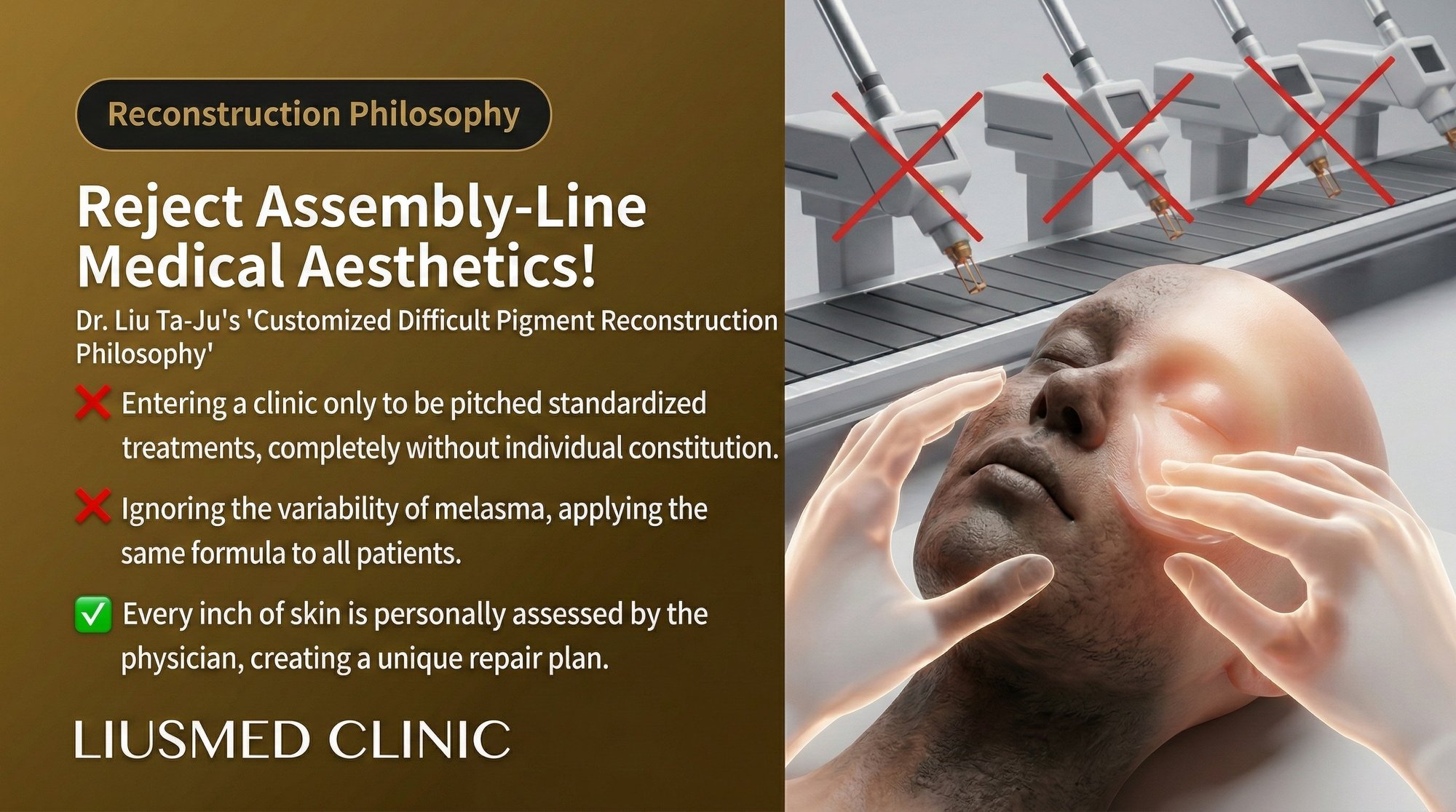
The aesthetic medicine industry has an efficiency problem masquerading as a quality problem. Clinics optimize for throughput: standardized protocols, fixed treatment packages, predictable session counts. For straightforward cosmetic concerns, this model works well enough. But for refractory melasma — the kind that has been treated and retreated, that has rebounded after lasers, darkened after peels, and stubbornly persisted through every topical regimen — the assembly-line model is not just inadequate. It is part of the reason the condition became refractory in the first place.
Dr. Ta-Ju Liu founded Liusmed Clinic on a fundamentally different premise: that complex pigmentary disorders require treatment plans built from first principles, not selected from a menu. This article explores the philosophy behind that approach and why it matters for patients whose melasma has resisted everything they have tried.
Table of Contents
- The Assembly-Line Problem in Aesthetic Medicine
- What Makes Melasma Refractory
- First-Principles Thinking in Pigment Repair
- The Liusmed Customization Framework
- Case Pattern Analysis: Why Standardized Protocols Fail
- What Patients Should Expect From Individualized Care
- Frequently Asked Questions
- About the Author
- Disclaimer
The Assembly-Line Problem in Aesthetic Medicine {#assembly-line-problem}
Walk into most aesthetic clinics and the experience follows a familiar pattern. A brief consultation leads to a recommended treatment package — often determined as much by the devices the clinic owns as by the patient's specific condition. Melasma patients might receive a series of low-fluence Q-switched (Q-switched laser) Nd:YAG (Erbium-doped Yttrium-Aluminum-Garnet laser) laser sessions, a course of chemical peels, or a combination protocol that the clinic applies to all pigmentation patients with minor variations.
This approach has its logic. Standardization reduces training requirements, simplifies scheduling, and creates predictable revenue. For many aesthetic concerns — mild sun spots, superficial pigmentation, skin tone evening — it delivers acceptable results.
But melasma is not a simple cosmetic concern. It is a complex, multifactorial condition with distinct subtypes, variable depth, hormonal dependencies, vascular components, and a tendency to worsen with inappropriate treatment. Applying a standardized protocol to melasma is like prescribing the same physical therapy routine to every patient with back pain — it might help some, but it will fail many and actively harm a few.
The patients who arrive at Liusmed Clinic have typically experienced this firsthand. They have completed full courses of laser treatment only to see their melasma return darker than before. They have used prescription topicals for months with marginal improvement. They have spent considerable money and time, and their condition is often worse than when they started — not because their previous doctors were incompetent, but because the treatment model itself was not designed for the complexity of their condition.
What Makes Melasma Refractory {#refractory-melasma}
Understanding why melasma becomes refractory is essential to understanding why customization matters. Melasma does not become treatment-resistant randomly. Specific pathological and iatrogenic factors drive refractoriness:
Accumulated thermal damage. Repeated laser treatments, even at low fluence, deposit thermal energy into the dermis over time. This chronic thermal insult can upregulate inflammatory pathways, stimulate VEGF (Vascular Endothelial Growth Factor)-mediated angiogenesis, and paradoxically increase melanocyte activity in susceptible individuals.
Basement membrane degradation. The basement membrane zone — the structural barrier between the epidermis and dermis — is frequently compromised in melasma. Aggressive treatments that cause even mild epidermal injury can further degrade this barrier, allowing melanin to drop into the dermis where it becomes far more difficult to treat.
Vascular entrenchment. Over time, the increased vascularity associated with melasma becomes structurally established. New blood vessels form, inflammatory mediator delivery increases, and the melanogenic stimulus from below becomes self-reinforcing. This vascular component is rarely addressed by conventional pigment-targeting treatments.
Skin barrier compromise. Long-term use of potent topicals — particularly high-concentration hydroquinone and aggressive retinoids — can compromise the skin barrier, increasing transepidermal water loss and sensitizing the skin to inflammatory triggers. The compromised barrier then makes the skin more reactive to subsequent treatments.
Hormonal persistence. In patients with hormonally driven melasma (pregnancy, oral contraceptives, hormone replacement therapy), the hormonal stimulus may persist even as surface treatments are applied. Without addressing or accounting for the hormonal component, treatment results remain temporary.
Each of these factors requires a different therapeutic response. A patient with primarily vascular-driven refractory melasma needs a fundamentally different approach than one with basement membrane degradation from excessive laser treatment. No standardized protocol can account for these distinctions.
First-Principles Thinking in Pigment Repair {#first-principles}
Dr. Liu's approach begins not with treatment selection but with pathological analysis. Before any intervention is planned, three questions must be answered:
What is the current state of the tissue? This goes beyond visual assessment. What is the depth of pigmentation? What is the status of the basement membrane? Is there significant dermal vascularity? Has previous treatment caused measurable tissue damage? What is the skin barrier integrity?
What are the active drivers of pigmentation? Is melanocyte hyperactivity being driven primarily by UV exposure, hormonal factors, chronic inflammation, vascular stimulation, or a combination? Each driver requires a targeted intervention, and addressing the wrong driver wastes time while the condition progresses.
What is the treatment history, and what has it done to the skin? This is perhaps the most critical question for refractory cases. Previous treatments are not neutral — they leave biological footprints. Laser treatments may have induced subclinical fibrosis. Chemical peels may have thinned the epidermis. Hydroquinone may have caused exogenous ochronosis in rare cases. The treatment plan must account for what has been done, not just what exists.
Only after these questions are thoroughly answered does treatment planning begin. And the plan is constructed specifically for that patient — not adapted from a template, but built from first principles based on their unique pathological profile.
The Liusmed Customization Framework {#customization-framework}
At Liusmed Clinic, the Melasma Injection Treatment protocol is structured around a customization framework with four dimensions:
Dimension 1: Tissue State Assessment
Every refractory melasma patient undergoes comprehensive evaluation of their skin's current condition. This includes assessment of pigment depth and distribution, vascular patterns, skin barrier function, and evidence of prior treatment damage. This assessment informs whether the skin needs a period of stabilization before active treatment can begin — a step that many clinics skip entirely.
Dimension 2: Driver Identification
Through clinical evaluation, history taking, and sometimes targeted investigation, the primary and secondary drivers of each patient's melasma are identified. This is not a checkbox exercise — it requires clinical experience and dermatopathological reasoning to weigh the relative contribution of each factor.
Dimension 3: Sequenced Intervention Design
Treatment modalities are selected and sequenced based on the first two dimensions. The order of interventions matters enormously. For example, attempting pigment reduction before addressing vascular drivers often leads to rapid rebound. Similarly, applying regenerative treatments before stabilizing active inflammation can amplify the inflammatory response.
A typical sequencing might involve:
| Phase | Focus | Duration | Example Interventions |
|---|---|---|---|
| Stabilization | Barrier repair, inflammation reduction | 4-8 weeks | Barrier-restoring topicals, anti-inflammatory agents |
| Vascular modulation | Reduce dermal vascularity | 4-6 weeks | Tranexamic acid (oral/injectable), targeted vascular protocols |
| Tissue repair | Basement membrane and dermal restoration | 6-12 weeks | PRP therapy, growth factor delivery, collagen remodeling |
| Pigment reduction | Controlled melanin clearance | 8-16 weeks | Low-energy devices (if appropriate), depigmenting agents |
| Maintenance | Long-term stability | Ongoing | Topical regimen, periodic in-clinic maintenance, UV protection |
Dimension 4: Adaptive Monitoring
The treatment plan is not fixed. At regular intervals, the patient's response is assessed, and the plan is adjusted accordingly. Some patients respond faster than expected and can advance to the next phase. Others reveal complexities that require extending a phase or revising the approach. This adaptive capacity is impossible within a rigid standardized protocol.
Case Pattern Analysis: Why Standardized Protocols Fail {#case-patterns}
Without disclosing individual patient details, certain recurring patterns illustrate the necessity of customization:
The laser-damaged pattern. Patients who have received 10, 20, or even 30+ laser sessions for melasma frequently present with thinned epidermis, compromised basement membrane, and paradoxically worsened pigmentation. For these patients, any further energy-based treatment is contraindicated until the skin has been rehabilitated. The standard protocol of adding more laser sessions is precisely the wrong approach.
The topical plateau pattern. Patients who have used triple combination creams (hydroquinone, tretinoin, corticosteroid) for extended periods often hit a plateau beyond which no further improvement occurs. The skin has adapted, the barrier is compromised from long-term corticosteroid use, and continuing the same regimen yields diminishing returns. These patients need a fundamentally different approach that addresses the tissue changes caused by prolonged topical therapy.
The hormonal persistence pattern. Patients with hormonally driven melasma who undergo standard pigment-reducing treatments without hormonal assessment or accommodation often experience excellent initial results followed by complete relapse. The treatment addressed the symptom but not the driver.
The mixed-depth pattern. Patients with both epidermal and dermal melasma require different interventions for each component. A treatment that effectively addresses epidermal melanin may be entirely ineffective against dermal melanophages. Without distinguishing the depth profile, treatment remains incomplete.
Each of these patterns requires a different therapeutic strategy. The assembly-line model, by design, cannot distinguish between them.
What Patients Should Expect From Individualized Care {#patient-expectations}
Patients seeking customized melasma treatment should understand several realities that distinguish this approach from conventional care:
The initial consultation is extensive. A thorough evaluation of tissue state, treatment history, and driving factors cannot be completed in a 15-minute appointment. Patients should expect a comprehensive initial assessment and should come prepared with detailed treatment history.
Treatment begins with assessment, not intervention. There is often a gap between the first consultation and the first active treatment. This gap is not wasted time — it is used for stabilization, diagnostic refinement, and careful treatment design.
The timeline is longer but the results are more durable. Refractory melasma did not become refractory overnight, and it will not be resolved quickly. A 6-to-12-month treatment arc is typical, but the results achieved through tissue-level repair tend to be significantly more stable than those achieved through aggressive short-term pigment destruction.
Communication is continuous. Because the treatment plan adapts based on response, ongoing dialogue between patient and physician is essential. Patients are active participants in their care, not passive recipients of a predetermined protocol.
Frequently Asked Questions
Q1: What does "assembly-line aesthetics" mean, and is it always bad?
Assembly-line aesthetics refers to the practice of applying standardized treatment protocols to all patients with a given concern, with minimal customization. For straightforward cosmetic treatments — such as mild sunspot removal or routine skin rejuvenation — this approach can be efficient and effective. The problem arises when it is applied to complex, multifactorial conditions like refractory melasma, where individual variation in pathology and treatment history demands a personalized approach.
Q2: How do I know if my melasma is refractory?
Melasma is generally considered refractory when it has failed to respond adequately to first-line treatments (topical depigmenting agents and sun protection) and second-line treatments (chemical peels, laser therapy) over a reasonable treatment period. If you have completed multiple courses of treatment without sustained improvement, or if your melasma has worsened after treatment, your condition may be classified as refractory.
Q3: Can I continue my current topical regimen while pursuing customized treatment?
This depends entirely on what you are currently using and the state of your skin. Some topicals are complementary to the repair process and can be continued or modified. Others — particularly high-concentration hydroquinone or potent corticosteroids used long-term — may need to be tapered or discontinued to allow tissue recovery. This is assessed individually during the initial evaluation.
Q4: Why does Dr. Liu prioritize tissue repair before pigment reduction?
Because refractory melasma is fundamentally a tissue-level disorder. The visible pigmentation is a symptom of underlying pathological processes — basement membrane disruption, vascular proliferation, chronic inflammation. Attempting to reduce pigment without first addressing these root causes typically leads to temporary improvement followed by rebound. Repairing the tissue environment creates the conditions for sustainable pigment reduction.
Q5: Is this approach more expensive than standard melasma treatment?
The per-session cost may be comparable to or moderately higher than conventional treatments. However, when considering the total cost of care — including the money already spent on failed standardized treatments that need to be repeated — individualized care often represents better long-term value. We discuss treatment investment transparently during consultation. Learn more about our Melasma Injection Treatment program.
Q6: Do you reject laser treatment entirely for melasma?
No. Laser treatment has a legitimate role in melasma management when used appropriately — with correct parameters, at the right point in the treatment sequence, and in patients whose tissue can tolerate it. What we reject is the reflexive application of laser treatment as a default first-line intervention for all melasma patients, particularly those whose skin has already been damaged by previous laser sessions.
About the Author
Dr. Ta-Ju Liu is the founder of Liusmed Clinic, where he has developed a practice centered on regenerative medicine and minimal incision surgery. His approach to refractory pigment disorders draws on dual expertise in dermatological science and tissue repair, emphasizing individualized treatment design over standardized protocols. Dr. Liu is committed to advancing the understanding and treatment of complex conditions that resist conventional aesthetic approaches.
Disclaimer
This article is provided for educational and informational purposes only and does not constitute medical advice, diagnosis, or treatment. Individual conditions vary significantly, and the treatment approaches described here may not be appropriate for all patients. Always consult a qualified healthcare professional for personalized medical guidance. Treatment outcomes cannot be guaranteed and depend on numerous individual factors.

Specialties
Credentials
- Kaohsiung Medical University, School of Medicine
- Attending Physician, Dermatology, Kaohsiung Chang Gung Memorial Hospital
- Attending Physician, Aesthetic Center, Kaohsiung Chang Gung Memorial Hospital
- Visiting Physician, Dermatology, Xiamen Chang Gung Hospital
- Visiting Physician, Aesthetic Center, Xiamen Chang Gung Hospital
"For every surgery, I strive to achieve a good outcome through a small incision and refined technique. Minimally invasive surgery is not just a technique — it's a commitment of respect to every patient."
Recovery after any procedure needs peer support too


Want to learn more?
Schedule a consultation for professional evaluation and advice