Given Up on Lasers? Dr. Liu's "Repair Over Destruction" Rosacea Rebuilding Philosophy
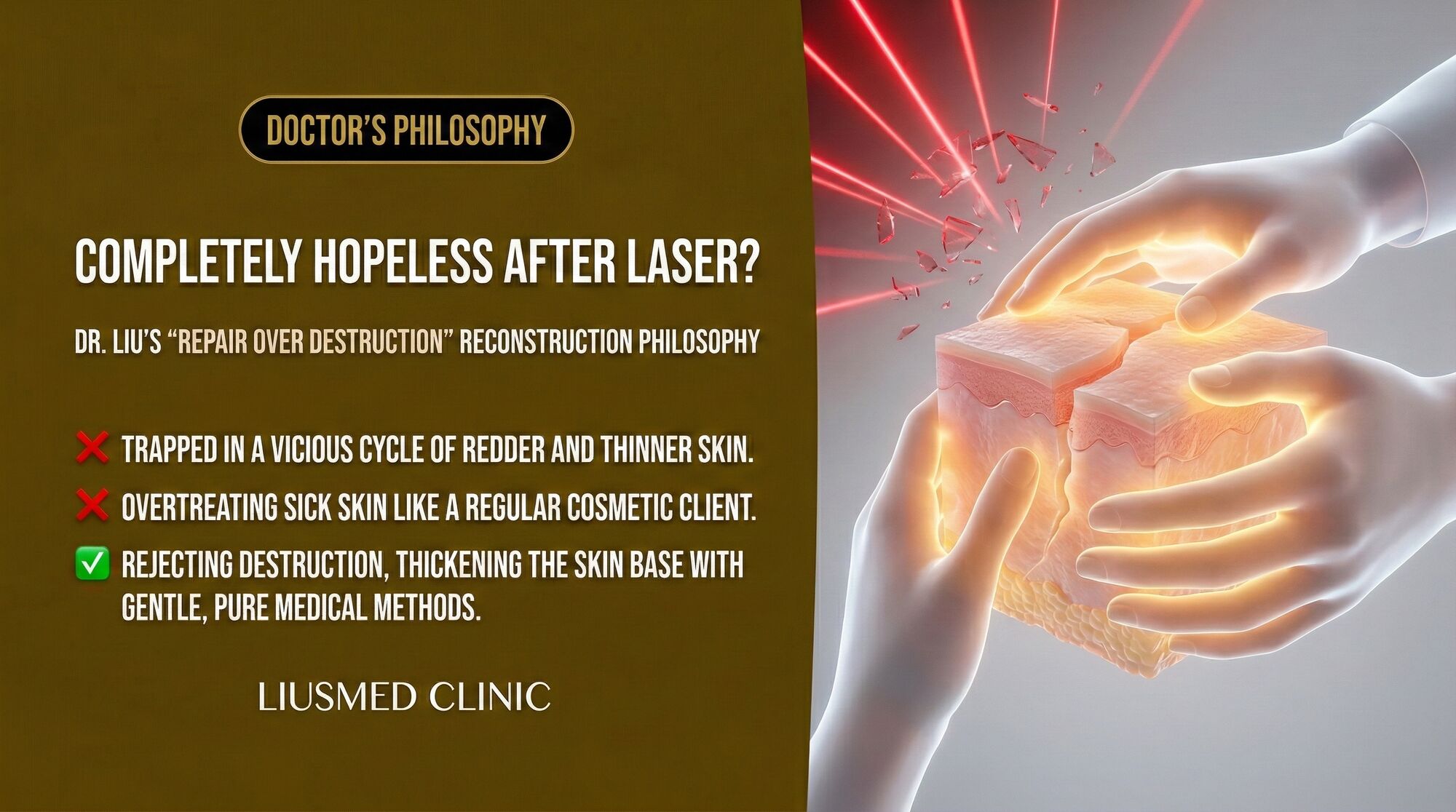
You have done everything by the book. Pulsed dye laser for the redness. IPL (Intense Pulsed Light) for the diffuse flush. Topical brimonidine for the flares. Maybe even oral isotretinoin for the papules. Each time, a few weeks of improvement, followed by the slow, demoralizing return of heat, redness, and visible vessels. If this cycle sounds familiar, it is not because you chose the wrong laser or the wrong doctor. It is because the treatment paradigm itself has a blind spot, and that blind spot is what Dr. Ta-Ju Liu has spent years addressing through a fundamentally different approach: repair over destruction.
Table of Contents
- The Destruction Paradigm and Its Limits
- Why Destroyed Vessels Come Back
- The Repair Over Destruction Philosophy
- How Rebuilding Works in Practice
- Laser vs. Repair: A Side-by-Side Framework
- Who Benefits Most from This Approach
The Destruction Paradigm and Its Limits
Modern rosacea treatment is dominated by a destruction paradigm. Visible telangiectasia? Destroy the vessels with targeted light energy. Inflammatory papules? Destroy the bacteria with antibiotics. Demodex overpopulation? Destroy the mites with ivermectin. Flushing? Constrict the vessels with alpha-agonists.
Each of these interventions works. The vessels do collapse. The papules do resolve. The mites do die. The flushing does temporarily subside. But the question that the destruction paradigm fails to ask is: what happens to the tissue left behind?
When a pulsed dye laser fires at 595 nanometers, it delivers energy that is selectively absorbed by oxyhemoglobin within the target vessel. The vessel wall is thermally damaged, collapses, and is gradually reabsorbed by the body. This is elegant physics and effective medicine for isolated telangiectasia in otherwise healthy skin.
But rosacea skin is not otherwise healthy. The dermal matrix surrounding those vessels is chronically inflamed, structurally weakened, and immunologically dysregulated. Destroying a vessel in this environment is like pulling a weed from soil that is perfectly optimized for growing weeds. The soil has not changed. New vessels grow because the conditions that created them remain intact.
Why Destroyed Vessels Come Back
Understanding vessel recurrence requires looking beneath the surface. In rosacea-affected skin, several factors conspire to regenerate abnormal vasculature:
Chronic VEGF (Vascular Endothelial Growth Factor — new blood vessel signal) overexpression. Vascular endothelial growth factor (VEGF) is elevated in rosacea skin. This signaling molecule actively promotes the growth of new blood vessels. Laser treatment destroys existing vessels but does not address the VEGF signal, so the body simply builds replacements.
Perivascular inflammation. The tissue surrounding blood vessels in rosacea skin contains elevated levels of inflammatory mediators including interleukin-1, tumor necrosis factor-alpha, and matrix metalloproteinases. This inflammatory soup weakens vessel walls and promotes the formation of the dilated, tortuous vessels characteristic of rosacea.
Degraded extracellular matrix. The collagen and elastin framework that normally provides structural support to blood vessels is compromised in rosacea. Without adequate scaffolding, newly forming vessels lack the structural constraint that keeps healthy vessels at normal caliber. They dilate because nothing holds them in shape.
Neurogenic inflammation. Sensory nerve fibers in rosacea skin release substance P and calcitonin gene-related peptide (CGRP), which promote vasodilation and vascular permeability. Laser treatment of vessels does not address the neurogenic input that drives vascular dysfunction.
This is why the recurrence rate after vascular laser treatment for rosacea is so much higher than for simple telangiectasia in non-rosacea patients. The problem is not the laser. The problem is that rosacea is a tissue disease being treated as a vascular disease.
The Repair Over Destruction Philosophy
Dr. Liu's approach begins with a simple reframing: rosacea is not a collection of abnormal vessels to be destroyed. It is a damaged tissue environment that produces abnormal vessels as a symptom. The treatment priority, therefore, should be repairing the environment rather than repeatedly eliminating its products.
This philosophy rests on three principles:
Principle 1: Repair the soil before pulling the weeds. Before any consideration of vascular intervention, the tissue environment must be stabilized. This means restoring skin barrier function, reducing chronic dermal inflammation, and beginning the process of extracellular matrix reconstruction. Only when the tissue environment has shifted from a pro-angiogenic state toward a state that supports normal vascular architecture does targeted intervention become strategically valuable.
Principle 2: Build structural support, not just symptom control. Conventional rosacea management focuses on what the patient sees and feels: redness, papules, flushing. The repair philosophy focuses on what the tissue needs: ceramide-rich barrier integrity, organized collagen architecture, balanced immune surveillance, and stable neurovascular regulation. These structural improvements are not immediately visible but they determine whether surface improvements will last.
Principle 3: Measure tissue health, not just symptom reduction. Success in the repair model is measured not only by visual improvement but by objective indicators of tissue health: transepidermal water loss measurements, dermoscopic vascular architecture assessment, and inflammatory marker trends. A treatment that improves appearance without improving tissue health is incomplete.
At Liusmed Clinic, these principles inform every stage of the Rosacea Injection Treatment protocol.
How Rebuilding Works in Practice
The repair-first approach unfolds in distinct but overlapping phases.
Phase 1: Barrier stabilization (weeks 1-4). The skin barrier is the first line of defense and the most immediately addressable deficit. Through targeted delivery of barrier-building components, including physiological lipid mixtures matched to the skin's natural ceramide-cholesterol-fatty acid ratio, the barrier begins to regain its ability to retain moisture and exclude irritants. Patients typically notice reduced sensitivity and burning within the first two weeks.
Phase 2: Inflammation reduction and immune rebalancing (weeks 2-8). With a more functional barrier reducing external irritant load, attention turns to the chronic inflammatory state within the dermis. Regenerative protocols deliver anti-inflammatory biologics and immune-modulatory signals directly to the affected tissue, shifting the local immune environment away from the Th1/Th17 dominance that perpetuates rosacea inflammation.
Phase 3: Matrix reconstruction (weeks 4-16). This is the phase that has no equivalent in conventional rosacea treatment. Through stimulation of fibroblast activity and guided collagen deposition, the dermal extracellular matrix is gradually rebuilt. As structural support around blood vessels improves, existing dilated vessels begin to normalize in caliber. New vessel formation shifts from pathological (dilated, tortuous) toward physiological (organized, appropriately calibrated).
Phase 4: Vascular stabilization (weeks 8-24). With a repaired matrix providing structural support and reduced VEGF signaling from the now-balanced immune environment, the vascular architecture stabilizes. Many patients find that vessels that would previously have required laser treatment have normalized on their own. For those with persistent large-caliber vessels, targeted laser can now be used strategically with significantly reduced recurrence rates because the tissue environment no longer promotes regrowth.
Laser vs. Repair: A Side-by-Side Framework
| Dimension | Laser-First Approach | Repair-First Approach |
|---|---|---|
| Starting point | Visible vascular targets | Tissue environment assessment |
| Primary mechanism | Thermal destruction of abnormal vessels | Biological restoration of tissue homeostasis |
| Barrier function | Often further impaired by procedures | Actively rebuilt as first priority |
| Vessel recurrence | Common; underlying drivers persist | Reduced; tissue environment no longer promotes abnormal angiogenesis |
| Treatment frequency | Repeated sessions every 6-12 months | Phased rebuilding with decreasing intervention intensity |
| Downtime | Post-laser purpura, swelling, sensitivity | Minimal; biological processes occur without tissue disruption |
| Long-term trajectory | Maintenance dependency | Progressive self-sustaining improvement |
| Skin quality | May decline with repeated thermal exposure | Improves as barrier, matrix, and immune function are restored |
| Role of laser | Primary therapeutic tool | Optional strategic adjunct after tissue stabilization |
This framework does not argue that lasers are harmful or ineffective. It argues that their effectiveness is maximized and their necessity often reduced when the tissue environment is addressed first.
Who Benefits Most from This Approach
The repair-over-destruction philosophy is particularly relevant for:
Laser refugees. Patients who have undergone multiple laser sessions with diminishing returns or worsening sensitivity. Their skin may have accumulated thermal damage that, combined with rosacea-related barrier dysfunction, creates a cycle of increasing fragility.
Steroid-damaged skin. Patients with a history of topical corticosteroid use whose skin barrier has been severely compromised. These patients often cannot tolerate laser treatment and require barrier restoration before any energy-based intervention.
Neurovascular-dominant rosacea. Patients whose primary symptoms are burning, stinging, and flushing rather than visible telangiectasia. Laser targets vessels but does not address the neurovascular dysregulation driving these symptoms.
Young patients with early rosacea. Catching rosacea early and repairing the tissue environment before significant vascular damage accumulates can potentially prevent the progression that leads to laser dependency.
Patients seeking long-term resolution. Those who are unwilling to accept indefinite maintenance treatments and want a strategy aimed at achieving self-sustaining skin health.
Frequently Asked Questions
Q1: Does "repair over destruction" mean Dr. Liu never uses lasers?
No. Lasers remain a valuable tool for specific situations, particularly large-caliber vessels that are unlikely to normalize through tissue repair alone. The difference is that in Dr. Liu's practice, laser is positioned as a strategic adjunct used after tissue stabilization, not as the default first-line intervention.
Q2: How is this different from just using gentle skincare?
Gentle skincare is a necessary but insufficient component of tissue repair. The repair approach involves active delivery of regenerative biologics to the dermis, not merely reducing surface irritation. Over-the-counter barrier creams support the surface; regenerative protocols rebuild the dermal architecture that determines long-term skin behavior.
Q3: If this approach is evidence-based, why don't more dermatologists use it?
Medical specialties tend to operate within their established toolsets. Dermatology training emphasizes pharmacology and procedural interventions. Regenerative medicine training emphasizes tissue biology and repair mechanisms. Few physicians hold deep expertise in both fields. As cross-disciplinary training becomes more common, this integrated approach is gaining broader recognition.
Q4: Will my rosacea be completely cured?
Rosacea involves genetic predispositions that cannot be eliminated. The goal of the repair approach is to restore tissue health to a point where the skin can maintain itself with minimal intervention, a state of stable remission rather than a definitive cure. Many patients achieve extended periods of clear, comfortable skin.
Q5: How do I know the tissue is actually being repaired and not just the symptoms improving temporarily?
Objective measurements including transepidermal water loss, dermoscopic vascular architecture assessment, and skin barrier function tests provide quantitative evidence of tissue improvement independent of visual appearance. These measurements are tracked throughout treatment.
Q6: Can I pursue this approach if I am currently using prescription rosacea medications?
Yes. The repair approach is designed to integrate with existing treatments. Medications are typically continued during the initial stabilization phase and gradually tapered as tissue health improves and the need for pharmacological symptom management decreases.
About the Author
Dr. Ta-Ju Liu is the founder and lead physician at Liusmed Clinic in Taiwan. His clinical philosophy centers on regenerative medicine and tissue repair, applying these principles to rosacea treatment, skin barrier restoration, and minimal incision surgery. Dr. Liu developed the "Repair Over Destruction" framework after observing that conventional rosacea treatments, while effective at symptom management, consistently failed to produce lasting improvement in patients with refractory disease. His work focuses on rebuilding the biological conditions that allow skin to heal and maintain itself.
Disclaimer
This article is provided for educational and informational purposes only and does not constitute medical advice, diagnosis, or treatment. The "repair over destruction" philosophy described here reflects one clinical approach among several valid treatment strategies for rosacea. Individual results vary based on rosacea subtype, severity, duration, and patient-specific factors. All treatment decisions should be made in consultation with a qualified physician. Do not discontinue any prescribed medication without consulting your treating doctor.
Specialties
Credentials
- Kaohsiung Medical University, School of Medicine
- Attending Physician, Dermatology, Kaohsiung Chang Gung Memorial Hospital
- Attending Physician, Aesthetic Center, Kaohsiung Chang Gung Memorial Hospital
- Visiting Physician, Dermatology, Xiamen Chang Gung Hospital
- Visiting Physician, Aesthetic Center, Xiamen Chang Gung Hospital
"For every surgery, I strive to achieve a good outcome through a small incision and refined technique. Minimally invasive surgery is not just a technique — it's a commitment of respect to every patient."
Recovery after any procedure needs peer support too


Want to learn more?
Schedule a consultation for professional evaluation and advice