HA Filler Brand Comparison: Complication Risk Profiles of Juvéderm, Restylane, and Others
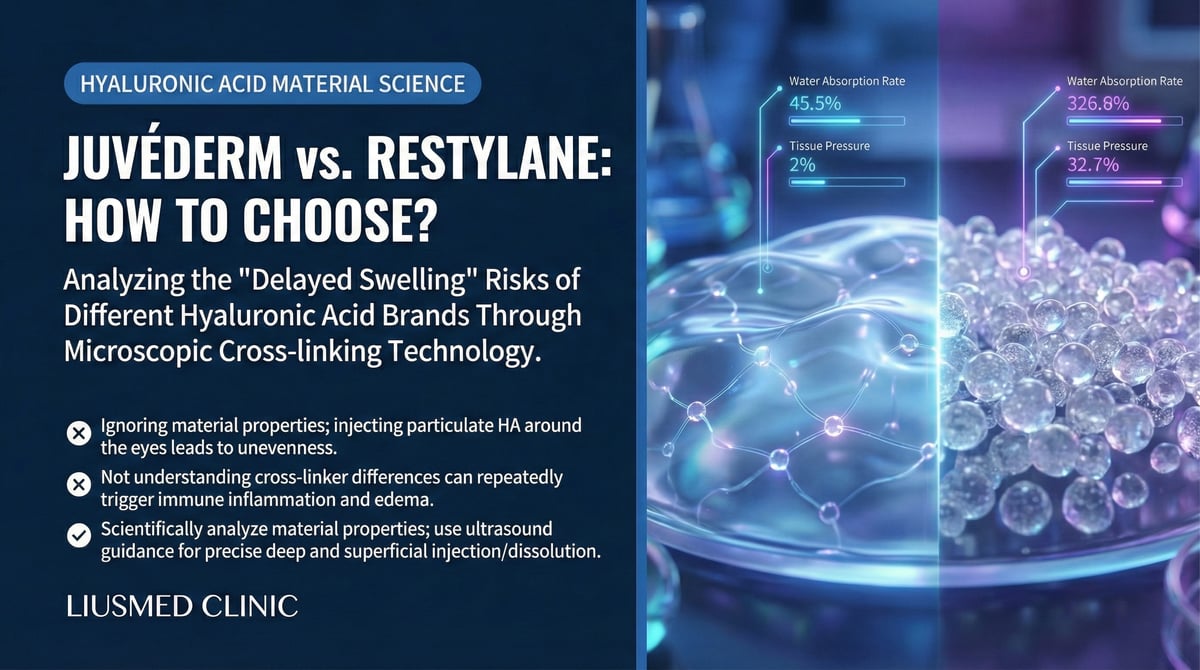
Are All HA (Hyaluronic Acid — sugar molecule naturally in skin, holds water) Fillers the Same? Brand Differences Matter More Than You Think
"Hyaluronic acid is hyaluronic acid — they should all be basically the same, right?" This is a common misconception. In reality, different HA filler brands differ significantly in cross-linking technology, particle structure, cohesivity, and rheological properties. These seemingly technical differences directly influence how the filler behaves in tissue — including how it distributes, how it degrades, and what types of complications it may trigger.
As a physician who has spent years managing filler complications, I have observed that different HA brands do exhibit distinct "complication tendencies." Understanding these differences helps patients make more informed choices before injection and guides correct management strategies when complications arise.
Key Insight: "All HA fillers can be dissolved with hyaluronidase" is theoretically correct, but the response speed and dose requirements can vary dramatically between brands — a critical consideration in complication management.
Technical Differences Among Major HA Brands
Cross-Linking Technology Comparison
| Brand | Cross-Linking Technology | Characteristics | Key Product Lines |
|---|---|---|---|
| Juvéderm | VYCROSS | High/low MW HA blend cross-linking | Voluma, Volift, Volbella |
| Restylane | NASHA / OBT | Minimal modification / optimal balance | Lyft, Defyne, Refyne |
| Haiwei | Cross-linked HA | Common in Asian markets | Multiple formulations |
| Princess | S.M.A.R.T. | High-purity HA | Volume, Filler, Rich |
| Megafill | Cross-linked HA | Regional Asian brand | Multiple formulations |
Rheological Properties and Clinical Behavior
| Property | High Cohesivity Products | Low Cohesivity Products |
|---|---|---|
| Representative brand | Juvéderm Voluma | Restylane |
| Tissue behavior | Tends to maintain bolus shape | Disperses more readily into tissue |
| Sculpting ability | Stronger | Softer |
| Migration tendency | Low (but displaces as a unit if it occurs) | Moderate (gradual diffusion) |
| Hyaluronidase response | May require higher dose/more time | Generally responds faster |
Complication Risk Profiles by Brand
Juvéderm Series
VYCROSS technology characteristics: High cohesivity maintains better shape stability in tissue, but this also means:
| Complication Type | Risk Level | Notes |
|---|---|---|
| Tyndall effect | Moderate | Blue discoloration possible with superficial injection |
| Delayed swelling | Moderate to high | VYCROSS products have higher hydrophilicity |
| Hyaluronidase resistance | Moderate to high | Higher cross-linking may require more enzyme |
| Vascular occlusion | Low to moderate | Comparable to all HA fillers |
| Lump formation | Low to moderate | High cohesivity sometimes creates palpable masses |
Clinical observation: Juvéderm Voluma, due to its high cohesivity, may require higher hyaluronidase doses and longer reaction times when dissolution is needed compared to other brands.
Restylane Series
NASHA/OBT technology characteristics: More traditional cross-linking approach with a broader texture range:
| Complication Type | Risk Level | Notes |
|---|---|---|
| Tyndall effect | Moderate to high | More noticeable with some products at superficial depth |
| Delayed swelling | Low to moderate | Relatively lower hydrophilicity |
| Hyaluronidase response | Good | Generally responds faster to enzyme dissolution |
| Nodule formation | Low to moderate | Particulate products occasionally produce palpable nodules |
| Migration | Moderate | Lower cohesivity products may diffuse over time |
Asian Market Brands
The Asian market features numerous HA brands with variable quality:
| Risk Factor | Details |
|---|---|
| Quality control variability | Batch-to-batch consistency may be insufficient |
| Unstable cross-linking | May lead to unpredictable degradation rates |
| Impurity residue | Lower-purity products may trigger more inflammatory reactions |
| Hyaluronidase response | Some brands respond less predictably to enzyme |
Key Insight: Brand selection is not only about results — it is fundamentally about safety. Choosing brands with extensive clinical data ensures more predictable management options if complications arise.
The Myth That "All HA Can Be Dissolved"
Theory Versus Reality
All HA fillers can theoretically be degraded by hyaluronidase. However, clinical reality introduces several variables:
| Factor | Impact on Dissolution |
|---|---|
| Cross-linking degree | Higher cross-linking requires more enzyme and more time |
| Time since injection | Long-standing HA may be partially encapsulated |
| Volume injected | Large volumes require staged dissolution |
| Injection site | Areas with fewer vessels see slower enzyme diffusion |
| Brand differences | Different cross-linking technologies respond differently to enzyme |
Common Reasons for Dissolution Failure
- Insufficient dosing: Underestimating filler volume or cross-linking density
- Imprecise injection: Enzyme not making direct contact with the filler
- Capsule barrier: Long-standing filler encased in fibrous capsule blocks enzyme penetration
- Non-HA components: Some products may contain additives not degraded by hyaluronidase
- Misidentification: The injected material is not actually HA (told it was HA but was not)
For more on how encapsulation affects dissolution, see Why Dissolving Enzymes Fail When Capsules Form.
The Role of Ultrasound in Brand Identification and Management
Ultrasound Appearance of Different Brands
While ultrasound cannot definitively identify specific brands, it provides important clues:
| Ultrasound Feature | Possible Interpretation |
|---|---|
| Homogeneous hypoechoic mass | High-cohesivity product (e.g., Voluma) |
| Scattered hypoechoic dots | Particulate product (e.g., classic Restylane) |
| Hypoechoic area with capsule | Long-standing filler |
| Hypoechoic area without clear borders | Low-cohesivity or partially degraded product |
Ultrasound-Guided Management Strategies
| Scenario | Management Approach |
|---|---|
| HA amenable to dissolution | Ultrasound-guided precise hyaluronidase injection |
| Partially encapsulated HA | Attempt dissolution first; extraction if insufficient |
| Fully encapsulated HA | Ultrasound-guided minimally invasive extraction |
| Uncertain if HA | Ultrasound assessment before deciding strategy |
Recommendations for Filler Selection
Principles for Reducing Complication Risk
| Principle | Explanation |
|---|---|
| Choose brands with clinical data | Prioritize global brands with robust safety evidence |
| Understand filler properties | Different sites require different rheological characteristics |
| Inject conservatively | Less is more; additional volume can be added later |
| Document injection details | Brand, lot number, volume, site — critical for future management |
| Choose a practitioner who manages complications | Can prevent, recognize, and treat |
Already Experiencing Problems? Let Us Help
If you have developed lumps, swelling, Tyndall effect, or any unexpected changes after HA injection, the first step is a professional ultrasound evaluation to confirm filler location, condition, and the most appropriate management plan.
Further reading:
- Is HA Really Completely Absorbed?
- Why Dissolving Enzymes Fail When Capsules Form
- Why Fillers Migrate
About the Author
Dr. Ta-Ju Liu
- Current Position: Director, Liusmed Clinic
- Specialties: Minimally invasive surgery, filler complication repair, ultrasound-guided extraction
- Experience: 15+ years of clinical minimally invasive surgery; over 10,000 successful cases
- Philosophy: "Brand selection is the first line of defense in filler safety. Understanding different brands' characteristics and risks ensures more effective management when it is needed."

Specialties
Credentials
- Kaohsiung Medical University, School of Medicine
- Attending Physician, Dermatology, Kaohsiung Chang Gung Memorial Hospital
- Attending Physician, Aesthetic Center, Kaohsiung Chang Gung Memorial Hospital
- Visiting Physician, Dermatology, Xiamen Chang Gung Hospital
- Visiting Physician, Aesthetic Center, Xiamen Chang Gung Hospital
"For every surgery, I strive to achieve a good outcome through a small incision and refined technique. Minimally invasive surgery is not just a technique — it's a commitment of respect to every patient."
Recovery after any procedure needs peer support too


Want to learn more?
Schedule a consultation for professional evaluation and advice