Inflamed Epidermoid Cyst: What To Do and Why You Should Never Squeeze It
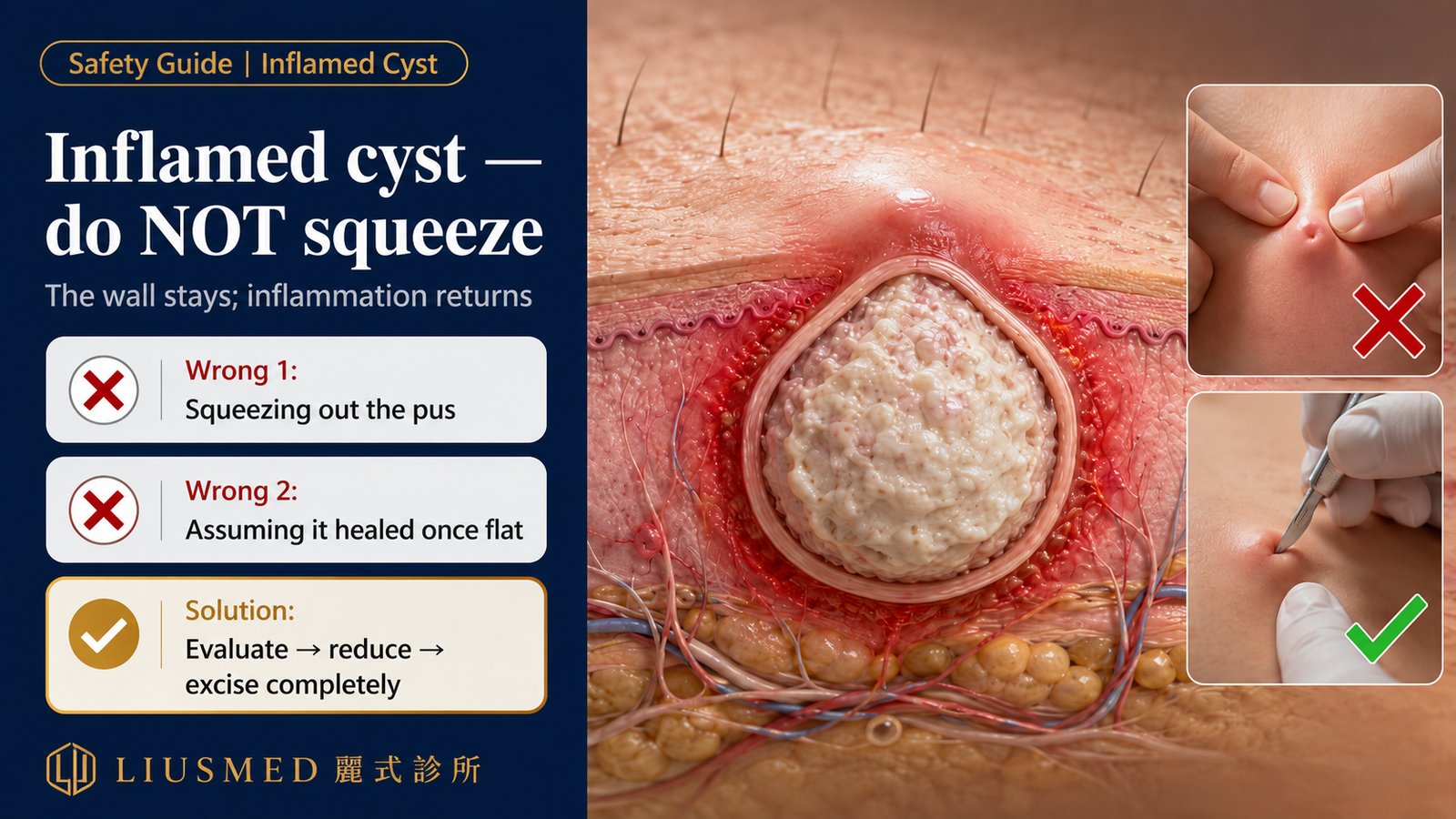
That lump on the back of your neck has been there for months. Then, overnight, it turns red, swells up, and starts to throb — and the first instinct many people have is to squeeze it.
This is understandable. It is also one of the most reliable ways to make things considerably worse.
An epidermoid cyst (often called a sebaceous cyst) that becomes inflamed is not just "a pimple that got big." The pus you see is a symptom; the cyst wall — the closed sac that has been producing keratin and sebum all along — is the underlying cause. Squeeze the pus out and the wall remains, ready to refill and re-inflame within weeks, with more scarring and internal adhesions than before.
This article explains why cysts inflame, what happens when you squeeze, and what to actually do instead.
Why an Epidermoid Cyst Suddenly Gets Inflamed
An epidermoid cyst is a closed sac embedded in the skin, lined with epithelial cells, and filled with keratin debris and sebum. Under normal conditions it sits quietly, sometimes for years. But if the cyst wall ruptures — even partially — the contents spill into surrounding tissue, triggering an intense foreign-body inflammatory response.
Common triggers
- Friction or repeated pressure: clothing collars, bra straps, seat belts, pillowcases
- Bacterial entry: the tiny skin pore (the "punctum") that marks the cyst's surface connection can allow bacteria in
- Wall rupture from internal pressure: as the cyst enlarges, pressure can reach a tipping point and the wall breaks spontaneously
- External squeezing: directly accelerates wall rupture — which is exactly why squeezing worsens the situation
Once the wall ruptures, the immune system treats the leaked keratin as a foreign body. White blood cells flood in, and the resulting collection of dead cells and fluid is what we recognize as pus. Externally, the cyst becomes red, swollen, warm, and tender; it may spontaneously drain a white or yellowish discharge.
Key insight: The pus is a symptom of the inflammation; the cyst wall is the root cause. Draining the pus without removing the wall leaves the problem intact.
Squeezing: From Momentary Relief to a Cycle of Worsening
Squeezing an infected cyst may expel some pus and briefly reduce the bulge. The costs, however, are predictably high.
Why you should not squeeze
1. The wall remains → recurrence
Squeezing expels contents, not the wall. Any portion of wall that stays behind will continue producing keratin, and the cyst will re-accumulate within weeks to months. Each inflammatory episode creates more adhesions between the wall and the surrounding tissue, making future surgical removal progressively more technically challenging.
2. Infection spreads → cellulitis
Forceful pressure can rupture the wall at a deeper level, driving infected material into a wider area of subcutaneous tissue. If bacteria spread into the surrounding fat and connective tissue, cellulitis — a diffuse, painful skin and soft-tissue infection — can develop. Severe cellulitis may require intravenous antibiotics or hospitalization.
3. Additional scarring
The skin around an inflamed cyst is already under mechanical stress. Adding the trauma of squeezing increases the likelihood of hypertrophic scarring or keloid formation, particularly on the neck, chest, and shoulders — all areas with elevated scar risk.
| Consequence of squeezing | Specific risk |
|---|---|
| Wall remains intact | Re-inflation within weeks; increased surgical difficulty |
| Infection spreads | Cellulitis, abscess, rarely necrotizing fasciitis |
| Additional trauma | Hypertrophic scar or keloid |
| Increased adhesions | More complex future excision |
Key insight: When a cyst is inflamed, the right first step is professional evaluation, not self-treatment. Short-term relief from squeezing trades for longer-term, harder-to-resolve consequences.
The Right Strategy: Treat the Inflammation First, Remove the Cyst Later
The most common question patients ask when a cyst flares up is: "Can I just have it removed right now?"
The short answer: usually not immediately, and for good reasons.
Why surgeons typically wait out the acute phase
- Inflamed tissue is congested, swollen, and fragile — the surgical planes that allow clean removal of the cyst wall are obscured
- Operating in an infected field risks spreading infection and impairs wound healing
- Local anesthetic diffuses poorly through inflamed, acidic tissue, making adequate anesthesia more difficult
Standard management during the inflammatory phase
- Physician assessment — rule out spreading cellulitis or other urgent complications
- Oral antibiotics — to control the bacterial component and reduce erythema, swelling, and pain
- Incision and drainage (I&D) if needed — when a fluctuant abscess is present, a small incision to drain the collection can quickly reduce pressure and pain (note: I&D is not the same as complete excision — the wall remains)
- Surgical excision after inflammation resolves — typically 4–8 weeks after the acute episode, once tissue planes have normalized
Treatment timeline
| Phase | Approach | Rationale |
|---|---|---|
| Acute inflammation | Antibiotics ± incision and drainage | Reduce infection; avoid definitive excision |
| Resolution (2–4 wks post-antibiotic) | Observation, plan excision timing | Assess tissue recovery |
| Stable phase | Complete cyst wall excision | Clear planes allow thorough removal |
Exceptions exist: in some cases of large abscess formation or when the clinical picture permits, partial or complete excision can be considered at the time of drainage. This is a clinical judgment call for your physician — not a decision to make at home.
When to Seek Immediate Medical Attention
The following signs mean the infection may be spreading or has already done so. Do not delay seeing a physician:
- Redness that expands rapidly beyond the cyst itself
- Red streaking radiating from the cyst (a sign of lymphangitis)
- Fever (body temperature above 38°C / 100.4°F)
- Severe tenderness even with light touch
- A wound that has been draining for more than 3 days with no improvement
- Any symptom that causes significant concern
Frequently Asked Questions
Q1: Can I apply iodine or topical antibiotics to help?
A1: Topical antiseptics can reduce surface bacteria at the punctum, but they do not penetrate into the subcutaneous cyst sac where the real inflammation is occurring. They are not a substitute for medical evaluation. If redness or swelling increases, seek care promptly.
Q2: The cyst burst on its own and drained. Is that a good sign?
A2: Spontaneous drainage can relieve pressure and temporarily reduce pain, but the cyst wall is still present. The opening will need appropriate wound care, and complete surgical excision should be planned once the inflammation fully resolves to prevent recurrence.
Q3: Can medication make the cyst disappear entirely?
A3: Antibiotics and corticosteroids can control the inflammatory episode, but they cannot dissolve or eliminate the cyst wall, which is a physical structure. As long as the wall remains, the cyst will continue to exist and can re-inflame. Complete excision of the cyst wall is the only method that removes the source.
Q4: How long after the inflammation settles should I wait before surgery?
A4: A waiting period of 4–8 weeks after completing the antibiotic course is generally recommended to allow full tissue recovery. Your physician will assess the specific timing based on how the area looks and feels.
What to Do When a Cyst Gets Inflamed
When a cyst flares up, the impulse to squeeze it is almost universal — and almost always the wrong move. The pus can come out; the wall stays behind. The next round of inflammation will be harder to treat.
The correct approach: see a physician, manage the acute episode appropriately, and plan definitive excision once the tissue is calm.
- For a complete overview of epidermoid cysts and their treatment, see Epidermoid Cyst Complete Guide
- Learn about Cyst Excision and CO₂ Laser (Carbon Dioxide Laser — deep-ablative CO₂ skin laser) Cyst Surgery at our clinic
- More cyst questions answered in Cyst FAQ
- Ready to discuss your situation? Book a consultation
Dr. Ta-Ju Liu specializes in minimally invasive removal of subcutaneous tumors, with a clinical approach built on precise timing: treating the inflammation first, then excising the cyst wall completely when the tissue is ready. If your cyst is recurrently inflamed or has recently flared, we would be glad to evaluate it and map out the right next step.

Specialties
Credentials
- Kaohsiung Medical University, School of Medicine
- Attending Physician, Dermatology, Kaohsiung Chang Gung Memorial Hospital
- Attending Physician, Aesthetic Center, Kaohsiung Chang Gung Memorial Hospital
- Visiting Physician, Dermatology, Xiamen Chang Gung Hospital
- Visiting Physician, Aesthetic Center, Xiamen Chang Gung Hospital
"For every surgery, I strive to achieve a good outcome through a small incision and refined technique. Minimally invasive surgery is not just a technique — it's a commitment of respect to every patient."
Want to learn more?
Schedule a consultation for professional evaluation and advice