Bought Dozens of Laser Sessions with No End in Sight? The Truth Behind Aesthetic Marketing
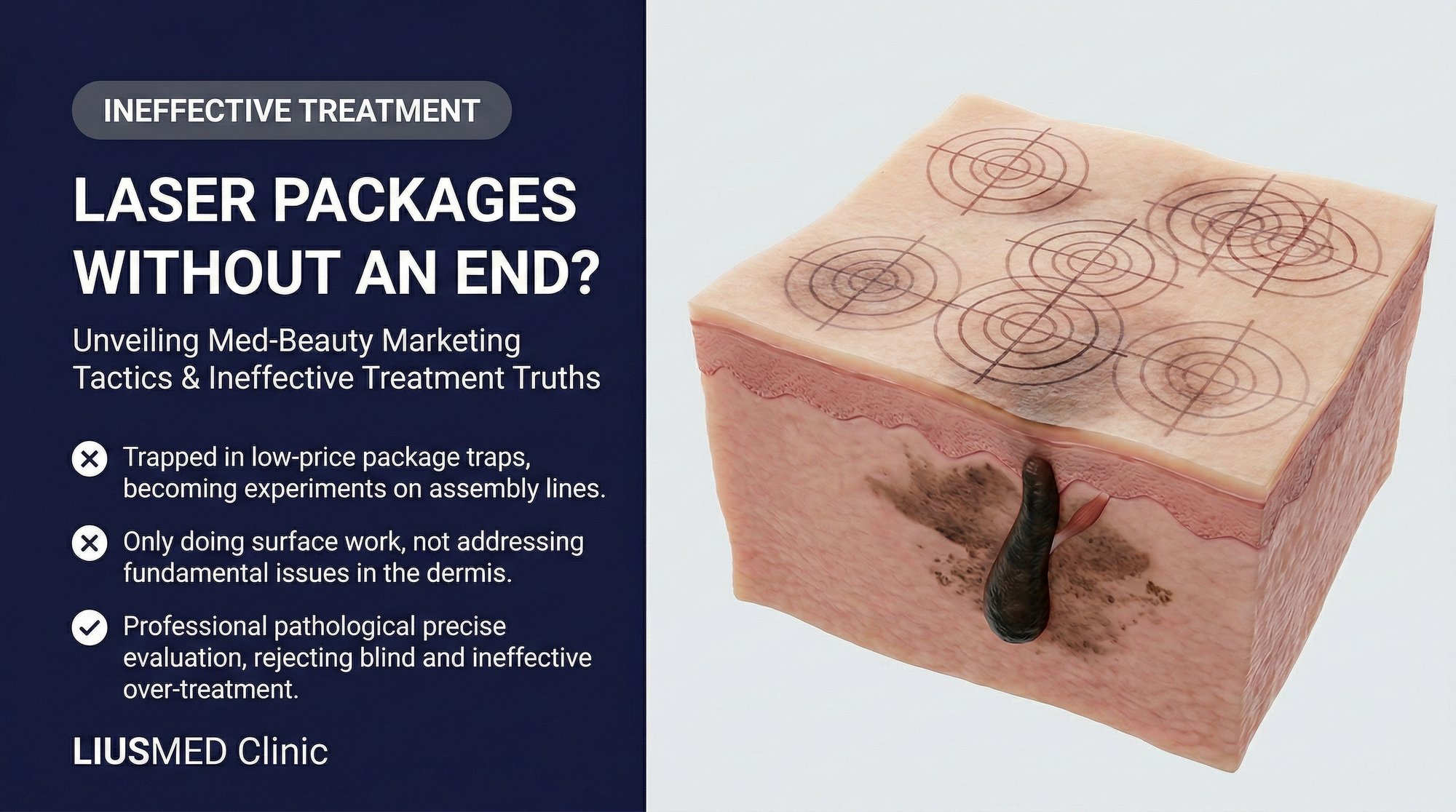
The consultation goes something like this. You walk into a sleek aesthetic clinic concerned about the brown patches on your cheeks. The consultant examines your skin, perhaps with a Wood's lamp, and delivers the verdict: melasma. The recommended treatment: laser toning. The recommended course: a package of ten sessions, prepaid at a discounted rate. If you commit to twenty sessions upfront, the per-session price drops even further.
It sounds reasonable. Bulk buying is how most things work. And the clinic seems confident: most patients see significant results, they assure you.
Fast forward six months. You have completed your ten sessions. The melasma is slightly lighter, maybe, or perhaps it is the same. Perhaps it is darker in some areas. The clinic suggests purchasing another package to continue treatment. You have already invested significant money, and stopping now feels like abandoning the investment. So you buy another ten.
This cycle can repeat for years. It is not accidental. It is the predictable outcome of a business model that is fundamentally misaligned with the biology of melasma.
Table of Contents
- The Economics of Laser Packaging for Melasma
- Why the Subscription Model Works for Business but Not for Patients
- The Sunk Cost Trap: Why Patients Keep Buying
- Red Flags in Aesthetic Marketing for Melasma Treatments
- Package-Based Laser Model vs. Outcome-Based Treatment: A Comparison
- How to Evaluate Melasma Treatment Proposals Critically
The Economics of Laser Packaging for Melasma
To understand why laser packages dominate the melasma treatment landscape, you need to understand the economics from the clinic's perspective.
A laser device represents a significant capital investment, typically ranging from fifty thousand to several hundred thousand dollars depending on the technology. This is a fixed cost that must be recouped through treatment revenue. The marginal cost of each additional laser session is relatively low: consumables (laser tips, cooling gel), electricity, and technician time. This cost structure, high fixed costs and low marginal costs, creates a powerful incentive to maximize the number of sessions delivered.
Melasma is the ideal condition for this business model for several reasons. First, it is common, affecting an estimated fifteen to fifty percent of women in certain populations. Second, it is chronic, meaning patients will need ongoing treatment. Third, the partial and temporary improvements that laser can achieve create a compelling "it's working, just slowly" narrative that justifies continued sessions. Fourth, the condition's natural fluctuations with seasons, hormones, and sun exposure can be attributed to treatment effects or treatment interruption, making it difficult for patients to objectively assess efficacy.
From a purely business perspective, a melasma patient who purchases recurring ten-session packages year after year is far more valuable than a patient who achieves resolution in three to five sessions and never returns. The package model creates recurring revenue from a chronic condition, which is the foundation of a profitable aesthetic practice.
This is not to suggest that all clinics are deliberately keeping patients on ineffective treatments. Many genuinely believe in their protocols and are following established treatment paradigms. But the economic structure creates incentives that align poorly with patient outcomes, and patients deserve to understand this misalignment.
Why the Subscription Model Works for Business but Not for Patients
The subscription model for laser melasma treatment depends on several assumptions that do not hold up under scrutiny.
Assumption one: More sessions equal better results. This is true for some conditions (laser hair removal, for instance, requires multiple sessions to catch hair follicles in different growth phases). For melasma, the relationship between session count and improvement is not linear. Initial sessions may produce visible improvement as superficial pigment is cleared. Beyond a certain point, additional sessions produce diminishing returns because the laser cannot address the underlying inflammatory and vascular microenvironment driving the condition. Worse, excessive sessions can cause cumulative damage (barrier compromise, PIH rebound, vascular changes) that actually worsens the melasma.
Assumption two: Maintenance sessions are necessary to prevent relapse. This assumption contains a kernel of truth wrapped in a significant distortion. Melasma does tend to recur, which does necessitate some form of ongoing management. However, if the only maintenance strategy available is the same laser treatment that could not produce lasting clearance, the patient is locked into an indefinite treatment cycle by design rather than by medical necessity. Effective melasma management should aim to reduce the need for frequent interventions, not create dependency on them.
Assumption three: The package represents good value. A ten-session package at a discounted per-session rate appears to offer value compared to individual session pricing. However, value must be measured by outcomes, not by per-unit pricing. Paying a lower price per session for sessions that do not produce lasting improvement is not a good value; it is a lower-cost version of a poor investment. The total cost of years of laser packages typically far exceeds the cost of a treatment approach that addresses the condition more fundamentally, even if the per-session price of the alternative is higher.
The Sunk Cost Trap: Why Patients Keep Buying
Behavioral economics explains why patients continue purchasing laser packages even when results are disappointing. The sunk cost fallacy, the tendency to continue investing in something because of the investment already made rather than because of future expected returns, is one of the most powerful cognitive biases affecting consumer decision-making.
After completing a ten-session package with partial results, the patient faces a choice: stop treatment and accept that the money spent did not produce the desired outcome, or purchase another package in the hope that continued treatment will eventually justify the total investment. Psychologically, stopping feels like admitting defeat and writing off the previous expenditure as a loss. Continuing feels like maintaining hope and protecting the value of the previous investment.
Clinics, whether intentionally or not, reinforce this dynamic. Common narratives include statements suggesting that skin is responding well and just needs more time, that stopping now would mean losing the progress already made, that the next course of treatment will be the one that produces the breakthrough, or that switching to a different treatment means starting over from zero.
These narratives are not necessarily dishonest, but they are structured in a way that consistently points toward one conclusion: buy more sessions. The patient never hears a framework for when to stop and try something different, because that framework would undermine the business model.
Additionally, the social dynamics of the clinic environment reinforce continued purchasing. Consultants are trained in sales, and the relationship between patient and consultant often involves trust, rapport, and a desire to please. Saying "no" to a recommended package can feel like rejecting the consultant's professional judgment, creating social pressure that compounds the financial and psychological pressures already in play.
Red Flags in Aesthetic Marketing for Melasma Treatments
Learning to identify problematic marketing practices can protect you from investing in ineffective treatment cycles. Watch for these patterns:
Emphasis on session count rather than outcomes. When the treatment plan is defined by the number of sessions rather than by measurable clinical endpoints, the plan is structured around billing rather than biology. A sound treatment plan defines what success looks like and how it will be measured, with the number of sessions as a variable rather than a fixed commitment.
Discounting tied to bulk purchasing. The deeper the discount for larger packages, the stronger the financial pressure to over-commit before knowing whether the treatment will work for you. Ethical treatment models typically offer the option to pay per session or commit to small trial courses before escalating investment.
Vague or shifting goalposts. If the definition of "improvement" keeps changing, or if initial promises of clearance evolve into promises of "control" or "management" as treatment progresses, the goalposts are shifting to justify continued treatment in the absence of the originally promised results.
Reluctance to discuss alternatives. A provider genuinely focused on your outcomes should be willing to discuss when their treatment might not be the best option and what alternatives exist. Resistance to this conversation suggests that maintaining your business as a patient takes priority over optimizing your outcome.
Before-and-after photos taken under different lighting or conditions. Melasma appearance varies dramatically with lighting, angle, and skin preparation. Legitimate before-and-after documentation uses standardized photography with consistent lighting, positioning, and skin conditions. Photos taken with different lighting or after skin preparation (moisturizer, primer) can make modest changes appear dramatic.
Pressure to decide immediately. Offers that expire if you do not commit during the consultation create artificial urgency that prevents thoughtful decision-making. Any legitimate medical treatment will still be available next week.
Package-Based Laser Model vs. Outcome-Based Treatment: A Comparison
| Factor | Package-Based Laser Model | Outcome-Based Treatment Model |
|---|---|---|
| Success Metric | Sessions delivered | Clinical improvement measured objectively |
| Treatment Plan Structure | Fixed number of sessions determined at first visit | Adaptive plan adjusted based on response at each visit |
| Financial Model | Prepaid bulk purchase; incentivizes high session count | Pay-as-you-go or milestone-based; incentivizes efficiency |
| When Treatment Stops | When package is exhausted (then another is recommended) | When clinical goals are met or when plateau indicates need to change approach |
| Alternative Discussion | Rare; alternatives threaten the package sale | Built into the process; provider adjusts approach based on response |
| Provider Accountability | Accountability is to deliver sessions | Accountability is to deliver results |
| Typical Total Cost (Melasma) | Ongoing; often cumulates to thousands over years | Defined; typically reaches endpoint within months |
| Patient Autonomy | Reduced by financial commitment and sunk cost pressure | Preserved; patient can reassess after each session |
The Melasma Injection Treatment approach aligns with the outcome-based model. Treatment is structured around clinical response, with each session building on the previous one's results. The goal is to address the underlying condition efficiently rather than to deliver a predetermined number of sessions regardless of response.
How to Evaluate Melasma Treatment Proposals Critically
Armed with an understanding of the marketing dynamics, here is how to evaluate any melasma treatment proposal you receive, whether for laser, peels, injectables, or any other modality.
Ask for a defined clinical endpoint. What does success look like, specifically? A fifty percent reduction in MASI (Melasma Area and Severity Index) score? Clearance of visible pigment? The answer should be concrete and measurable, not vague promises of improvement.
Ask for a timeline with decision points. At what point will the provider reassess whether the treatment is working? What criteria will trigger a change in approach? If the only decision point is the end of the purchased package (with a recommendation to buy another), the plan lacks genuine clinical checkpoints.
Ask what happens if the treatment does not work. A provider confident in their approach should be willing to discuss this scenario and have a plan for it. If the response is simply "that does not happen" or "you just need more sessions," that is a red flag.
Calculate the total projected cost. Not just the current package, but the realistic total cost if the condition behaves as melasma typically does (chronic, relapsing, requiring ongoing management). Compare this to alternative treatment approaches on a total-cost basis, not per-session basis.
Request standardized photography. Ask for your baseline photos to be taken under consistent conditions (same room, same lighting, same camera settings, clean skin). This allows objective comparison at each reassessment point rather than relying on subjective impression.
Take time to decide. If a clinic pressures you to commit to a package during your first visit, that is a marketing strategy, not a medical recommendation. Take the information home, research the proposed treatment, seek a second opinion, and make your decision without time pressure.
Consider the provider's track record with melasma specifically. Melasma is notoriously difficult to treat, and a provider's success with other pigmentation conditions does not automatically transfer. Ask specifically about their melasma outcomes, including recurrence rates, not just initial improvement rates.
The best treatment decisions are made by informed patients who understand both the clinical and economic dimensions of their options. Your melasma is a medical condition, not a marketing opportunity, and the approach you choose should reflect that.
Frequently Asked Questions
Q1: I have already purchased a large laser package for melasma. Should I complete it or stop?
This depends on your results so far. If you are seeing progressive improvement with no signs of skin damage (sensitivity, redness, visible vessels), completing a reasonable number of sessions may be worthwhile. If you have noticed any worsening, plateau after initial improvement, or signs of cumulative damage, stopping is advisable regardless of remaining paid sessions. The money already spent should not influence your decision about future treatment; focus only on whether additional sessions are likely to benefit or harm your skin going forward.
Q2: Are all aesthetic clinics that sell laser packages being deceptive?
No. Package pricing is a common and legitimate business practice across many industries, including healthcare. Many clinics genuinely believe in the efficacy of their laser protocols and offer packages as a convenience and cost reduction for patients. The issue is not deception but rather a structural misalignment between the business model and the biology of melasma. Even well-intentioned clinics may inadvertently keep patients on suboptimal treatment paths because the economic incentives do not encourage pivoting to alternative approaches.
Q3: How much should I expect to spend on effective melasma treatment in total?
Total cost varies significantly based on the severity and type of melasma, the treatment approach, and geographic location. However, a reasonable benchmark is that an effective treatment plan should show clear progress within three to six months. If you are spending continuously without a foreseeable endpoint, the approach may not be addressing the underlying condition. A comprehensive evaluation at a specialized clinic can provide a more realistic cost projection based on your specific situation.
Q4: My clinic switched me from toning laser to picosecond and says this will be more effective. Is that likely?
Upgrading the laser technology does not address the fundamental limitation of energy-based treatments for melasma: they clear pigment without addressing the microenvironment that drives pigment production. While picosecond may offer some advantages in terms of reduced thermal damage, the recurrence patterns for melasma remain similar across laser platforms. If the toning laser did not produce lasting results, picosecond is unlikely to produce a fundamentally different outcome.
Q5: Is the injection approach also sold in packages?
Treatment models vary by clinic. The Melasma Injection Treatment approach at specialized centers is typically structured around clinical milestones rather than fixed package sizes. The treatment plan is based on the individual patient's melasma characteristics, with reassessment built into the process. This allows the treatment to adapt based on response rather than following a predetermined session count.
Q6: How do I find a provider who prioritizes outcomes over session sales?
Look for providers who perform thorough diagnostic evaluation before recommending treatment, who discuss realistic expectations including the possibility of incomplete improvement, who define measurable clinical endpoints and reassessment timelines, who are willing to discuss alternative approaches if their primary recommendation does not produce adequate results, and who do not pressure you to commit to large prepaid packages at the first visit. A provider who takes time to understand your melasma history, explains the biological rationale for their recommended approach, and gives you space to make an informed decision is far more likely to deliver genuine value than one who leads with a package promotion.
About the Author
Dr. Ta-Ju Liu is the founder of Liusmed Clinic, a specialized center for regenerative medicine and minimal incision surgery in Taiwan. Dr. Liu is committed to an outcome-driven treatment philosophy where clinical response guides treatment decisions rather than predetermined session counts. His approach to melasma emphasizes thorough diagnostic evaluation, evidence-based treatment selection, and transparent communication about expected outcomes and limitations.
Disclaimer
This article is provided for educational and informational purposes only and does not constitute medical advice or financial advice. Individual treatment experiences and costs vary significantly based on numerous factors. Always consult qualified medical professionals before making decisions about melasma treatment. The opinions expressed reflect the author's clinical experience and interpretation of available evidence as of the publication date.

Specialties
Credentials
- Kaohsiung Medical University, School of Medicine
- Attending Physician, Dermatology, Kaohsiung Chang Gung Memorial Hospital
- Attending Physician, Aesthetic Center, Kaohsiung Chang Gung Memorial Hospital
- Visiting Physician, Dermatology, Xiamen Chang Gung Hospital
- Visiting Physician, Aesthetic Center, Xiamen Chang Gung Hospital
"For every surgery, I strive to achieve a good outcome through a small incision and refined technique. Minimally invasive surgery is not just a technique — it's a commitment of respect to every patient."
Recovery after any procedure needs peer support too


Want to learn more?
Schedule a consultation for professional evaluation and advice