Post-Laser Hyperpigmentation: Can PRP Therapy Rescue It?
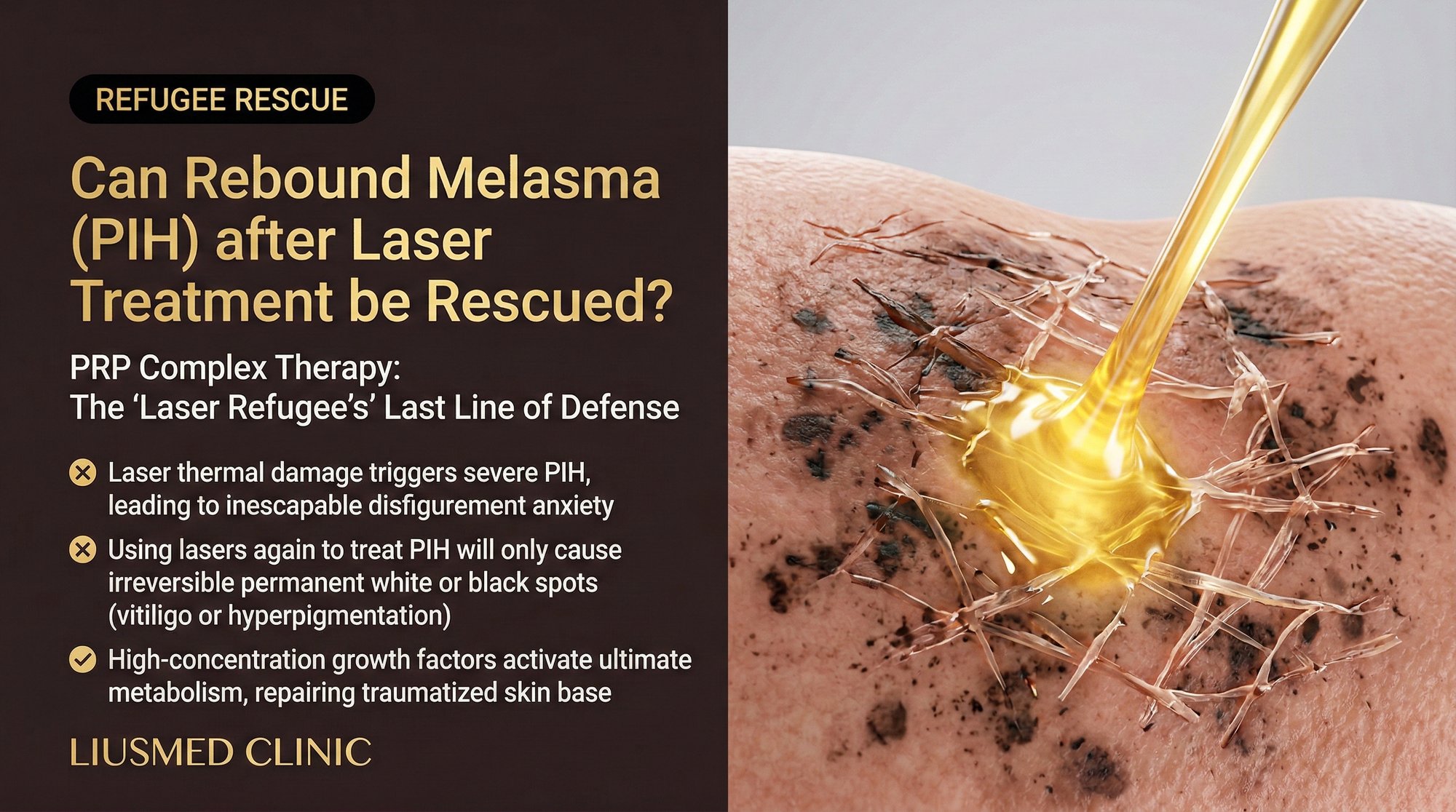
They came in with melasma. They were told the laser would fix it. And they left with something worse: deeper pigmentation, damaged tissue, and the devastating realization that the treatment designed to help them made their condition harder to treat. These patients — laser refugees — are not rare exceptions. They represent a significant and growing population seeking rescue from iatrogenic harm.
Table of Contents
- The Laser Refugee Phenomenon: How Good Intentions Create Worse Outcomes
- Understanding Post-Laser Hyperpigmentation: PIH (Post-Inflammatory Hyperpigmentation) vs. Rebound Melasma
- Why Conventional Rescue Approaches Fall Short
- The PRP (Platelet-Rich Plasma — concentrate of your own blood platelets rich in growth factors) Rescue Mechanism: Repair Instead of Destroy
- The Liusmed Rescue Protocol: A Phased Approach for Laser-Damaged Skin
- Prevention and the Case for First-Line Non-Laser Treatment
The Laser Refugee Phenomenon: How Good Intentions Create Worse Outcomes
The scenario plays out in clinics worldwide with disturbing regularity. A patient presents with melasma — those distinctive brown or gray-brown patches, usually on the cheeks, forehead, or upper lip. The treating clinician, following established protocols, recommends laser treatment. The specific laser may vary — Q-switched (Q-switched laser) Nd:YAG (Erbium-doped Yttrium-Aluminum-Garnet laser), fractional CO2, picosecond alexandrite — but the fundamental approach is the same: use light energy to fragment melanin.
The first session may even show improvement. The surface melanin absorbs the laser energy, fragments, and is cleared by the body's immune cells. The patient is encouraged. A second session follows. Perhaps a third. And then, somewhere between sessions 3 and 6, the pigmentation begins to return. Not at its original level — darker. More diffuse. More resistant to further treatment.
This is not a rare complication. Published meta-analyses of laser treatment for melasma report rebound hyperpigmentation rates ranging from 20% to over 50% depending on the laser type, treatment parameters, and patient population. For patients with Fitzpatrick (Fitzpatrick Skin Type) skin types III-V (which includes the majority of melasma patients worldwide), the risk is even higher.
The mechanism is well-understood but insufficiently communicated to patients before treatment. Laser energy generates thermal injury in the dermis. This injury triggers an inflammatory response. In melasma-prone skin, inflammation is the primary driver of melanocyte activation. The laser, intended to reduce pigmentation, instead amplifies the very signal that produces it.
What makes this particularly devastating for patients is the compound nature of the damage. They now have their original melasma pathology plus laser-induced tissue injury. The dermis may show thermal scarring. The basement membrane, already compromised by melasma, sustains further damage from the laser. The inflammatory environment is intensified. The blood vessels, already abnormal in melasma, may proliferate further in response to thermal injury.
These patients — who entered treatment trusting that a well-established medical technology would help them — find themselves in a worse position than when they started. Many cycle through multiple clinics seeking help, earning the clinical designation "laser refugees."
Understanding Post-Laser Hyperpigmentation: PIH vs. Rebound Melasma
Accurate diagnosis of the post-laser condition is essential for appropriate rescue treatment. Two distinct but frequently co-existing conditions can produce darkening after laser treatment:
Post-inflammatory hyperpigmentation (PIH) is a reactive process in which melanocytes overproduce melanin in response to tissue injury and inflammation. PIH can occur after any inflammatory insult — not only laser treatment but also burns, chemical peels, and even acne. In PIH, the melanocytes are responding normally to an abnormal inflammatory stimulus. Once the inflammation resolves, PIH gradually fades — though this can take months to years without intervention.
Rebound melasma is the reactivation and intensification of the underlying melasma disease process. The laser-induced inflammation does not merely trigger a temporary reactive pigmentation; it reignites the chronic inflammatory and vascular cascade that drives melasma. Rebound melasma is the more serious condition because it represents disease progression rather than a simple reactive response.
In practice, laser refugees often present with both conditions simultaneously. The superficial component (PIH) overlays the deeper, reactivated melasma, creating a complex pigmentary picture that is substantially worse than the original presentation.
| Feature | Post-Inflammatory Hyperpigmentation (PIH) | Rebound Melasma |
|---|---|---|
| Mechanism | Reactive melanin production from inflammation | Reactivation of chronic disease process |
| Pattern | Corresponds to areas of laser treatment | Extends to original and new melasma-prone areas |
| Depth | Often superficial (epidermal) | Mixed epidermal and dermal |
| Natural course | Gradually fades over months | Persists or worsens without treatment |
| Vascular component | Minimal | Significant (reactivated angiogenesis) |
| Basement membrane | Additional damage from laser | Pre-existing + laser damage compounded |
| Inflammatory mediators | Acutely elevated, gradually declining | Chronically elevated, self-sustaining |
| Treatment difficulty | Moderate (time + protection may suffice) | High (requires active intervention) |
Why Conventional Rescue Approaches Fall Short
When patients present with post-laser worsening, the conventional treatment toolkit offers limited options:
Topical depigmenting agents (hydroquinone, arbutin, azelaic acid, kojic acid) can be helpful for the superficial PIH component but cannot address the deep dermal pigment or the reactivated vascular and inflammatory processes. Their penetration is limited to the epidermis, and they have no effect on the structural damage to the basement membrane or the dermis.
Waiting it out is sometimes recommended on the theory that PIH will eventually self-resolve. While partially true for the PIH component, this approach does nothing for rebound melasma and subjects the patient to months or years of visible worsening that carries significant psychological burden. Furthermore, during the waiting period, the ongoing inflammatory process continues to cause structural damage.
More laser treatment is occasionally recommended to address the worsened pigmentation. In the vast majority of cases, this is counterproductive. The skin that has already demonstrated its tendency to hyperpigment in response to laser energy will likely do so again, creating a deepening cycle of treatment and rebound. There are specific situations where very low-fluence laser treatment can be appropriate, but these require extremely careful case selection.
Oral tranexamic acid can help suppress the inflammatory component but addresses only part of the problem. It does nothing to repair the structural damage — the broken basement membrane, the dermal fibrosis, the disrupted tissue architecture — that makes the condition self-perpetuating.
None of these approaches address the central challenge of the laser refugee: damaged tissue that needs to be repaired, not further treated with destructive modalities.
The PRP Rescue Mechanism: Repair Instead of Destroy
The fundamental paradigm shift in treating laser refugees is the transition from destruction to repair. Every conventional approach attempts to destroy something — melanin, melanocytes, blood vessels. PRP-based therapy instead provides the biological raw materials for the tissue to heal itself.
When high-concentration PRP is delivered to laser-damaged melasma skin through the Melasma Injection Treatment protocol, it initiates several rescue mechanisms simultaneously:
Inflammation resolution. The growth factors and anti-inflammatory cytokines in PRP actively drive the resolution of chronic inflammation. Unlike anti-inflammatory drugs that simply suppress inflammation, PRP-derived mediators guide the immune response from a chronic, tissue-damaging pattern to a constructive, healing pattern. This is particularly critical in laser-damaged skin where the inflammatory response has been amplified by thermal injury.
Thermal scar remodeling. Laser-induced thermal damage creates areas of denatured collagen and fibrotic scarring in the dermis. PRP growth factors, particularly PDGF (Platelet-Derived Growth Factor — platelet-released cell growth signal) and TGF-beta, stimulate fibroblasts to gradually replace this damaged collagen with new, properly organized tissue. This remodeling process reduces the fibrotic trapping of melanophages and improves tissue compliance and drug diffusion.
Basement membrane reconstruction. The BMZ, already compromised by melasma and further damaged by laser treatment, is a priority repair target. PRP-stimulated type IV collagen synthesis at the dermo-epidermal junction progressively rebuilds the barrier that prevents melanin from continuing to fall into the dermis.
Melanocyte environment normalization. Laser treatment can damage melanocytes directly, leading to uneven melanocyte distribution — some areas depleted, others hyperactive. The growth factor environment created by PRP supports normalization of melanocyte function without stimulating overproduction, helping to restore even pigmentation across the treated zone.
Vascular normalization. Combined with TXA (Tranexamic Acid) in the Liusmed protocol, PRP helps normalize the pathological vasculature. The anti-angiogenic effect of TXA reduces abnormal new vessel formation, while PRP supports the maturation and stabilization of remaining vessels, reducing leakiness and inflammatory mediator release.
The Liusmed Rescue Protocol: A Phased Approach for Laser-Damaged Skin
Treating laser refugees requires modifications to the standard melasma injection protocol. The Liusmed rescue protocol adds a preparatory phase that addresses the unique pathology of laser-damaged tissue.
Phase 0: Cooling period (2-8 weeks before starting). If the patient has recently undergone laser treatment, a cooling period allows the acute inflammatory response to subside. During this time, the patient is placed on strict sun protection, a gentle barrier-repair skincare regimen, and potentially oral TXA to begin suppressing the inflammatory cascade. No invasive treatments are performed during this phase.
Phase 1: Rescue induction (Sessions 1-3). The initial sessions focus heavily on inflammation resolution and vascular suppression. The TXA component of the protocol may be emphasized, and PRP concentration is maximized. The hydro-dissection technique is applied gently, as laser-damaged tissue may be more fragile and reactive than untreated melasma skin. Session spacing may be extended to 4 to 5 weeks to allow more recovery time.
Phase 2: Structural repair (Sessions 4-6). As the inflammatory environment stabilizes, the focus shifts to tissue repair. PRP-driven collagen remodeling addresses the thermal scarring. Basement membrane repair accelerates. The hydro-dissection component can be intensified as tissue health improves.
Phase 3: Pigment resolution (Sessions 7-10). With the structural and inflammatory foundations addressed, the remaining pigmentary component begins to clear through natural turnover and melanophage drainage. Sessions may become less intensive as the tissue approaches a normalized state.
Phase 4: Maintenance. Laser refugees may require slightly more frequent maintenance sessions than non-laser-treated patients, reflecting the deeper structural damage that was repaired and the skin's demonstrated susceptibility to inflammatory pigment triggers.
| Protocol Phase | Sessions | Primary Focus | Key Differences from Standard Protocol |
|---|---|---|---|
| Phase 0 (Cooling) | Pre-treatment period | Calm acute inflammation | Extended rest period, barrier care |
| Phase 1 (Rescue) | 1-3 | Inflammation suppression | Gentler technique, wider spacing |
| Phase 2 (Repair) | 4-6 | Structural remodeling | Higher PRP concentration, thermal scar targeting |
| Phase 3 (Resolution) | 7-10 | Pigment clearance | Progressive technique intensification |
| Phase 4 (Maintenance) | Ongoing | Sustained results | Potentially more frequent than standard |
Prevention and the Case for First-Line Non-Laser Treatment
The best treatment for post-laser hyperpigmentation is prevention. This means honestly evaluating whether laser treatment is appropriate for a given melasma patient before the first pulse is fired.
The evidence increasingly supports non-laser approaches as first-line treatment for melasma, particularly for patients with moderate to severe disease, Fitzpatrick skin types III-VI, or a history of post-inflammatory hyperpigmentation from any cause. These patients have the highest risk of laser-induced worsening and the most to gain from approaches that avoid thermal injury entirely.
The Melasma Injection Treatment protocol was developed specifically as an alternative to laser treatment — not as a rescue therapy, although it has proven effective in that role. Its anti-inflammatory, anti-vascular, and regenerative mechanisms address the same pathology that lasers fail to treat, without generating the thermal injury that triggers rebound.
For patients considering melasma treatment for the first time, the decision framework should weigh not only the potential benefits of each approach but also the consequences of treatment failure. A failed course of mesotherapy leaves the patient no worse than when they started. A failed course of laser treatment can leave them substantially worse, with additional tissue damage that complicates all future treatment efforts.
This asymmetry of risk — where the downside of the gentler approach is negligible and the downside of the aggressive approach is significant — makes a compelling case for trying the non-destructive approach first.
Frequently Asked Questions
Q1: My melasma got worse after laser treatment. Is there any hope?
Yes. Post-laser worsening is a recognized complication with well-understood mechanisms, and it is treatable. The key is to shift from destructive approaches (more laser, aggressive peels) to regenerative approaches that repair the tissue damage and resolve the inflammation driving the worsened pigmentation. PRP-based mesotherapy specifically addresses the structural and inflammatory damage that lasers leave behind.
Q2: How long should I wait after my last laser session before starting PRP rescue treatment?
A minimum cooling period of 4 to 8 weeks after the last laser session is recommended. This allows the acute inflammatory response to subside and gives the tissue time to stabilize. Patients with severe post-laser inflammation may need a longer cooling period, which will be determined during the initial consultation.
Q3: Will the rescue treatment take longer than treating someone who never had laser treatment?
Typically yes. Laser refugees generally require 2 to 4 additional sessions compared to patients with untreated melasma of similar severity. This additional time is needed to address the layer of laser-induced tissue damage (thermal scarring, amplified inflammation, additional basement membrane disruption) before the underlying melasma pathology can be effectively treated.
Q4: Can I ever have laser treatment again after PRP rescue therapy?
This decision should be made cautiously and on a case-by-case basis. For most laser refugees, the demonstrated susceptibility to laser-induced hyperpigmentation makes future laser treatment for melasma inadvisable. However, once the skin has been fully restored through the rescue protocol, certain very low-energy laser applications for other indications may be safe under careful monitoring.
Q5: Is post-laser darkening the same as my original melasma getting worse?
It is usually both. The laser triggers post-inflammatory hyperpigmentation (a reactive response to thermal injury) and simultaneously reactivates the underlying melasma disease process (rebound). The surface darkening is often PIH, while the deeper, more persistent worsening reflects genuine melasma progression. Effective rescue treatment must address both components.
Q6: Can post-laser hyperpigmentation resolve on its own without any treatment?
The PIH component may gradually fade over 6 to 18 months with strict sun protection alone. However, the rebound melasma component will not resolve spontaneously — it requires active treatment to suppress the reactivated inflammatory and vascular processes. Waiting without treatment also allows continued structural damage (basement membrane degradation, fibrosis progression) that makes future treatment more difficult.
About the Author
Dr. Ta-Ju Liu is the founder of Liusmed Clinic and a specialist in regenerative medicine and minimal incision surgery. Recognizing the growing population of patients harmed by inappropriate laser treatment of melasma, Dr. Liu developed the rescue protocol as an extension of the Liusmed Melasma Injection approach, specifically addressing the compound pathology of laser-damaged melasma skin. Liusmed Clinic advocates for evidence-based, non-destructive first-line treatment of melasma to prevent iatrogenic harm.
Disclaimer
This article is provided for educational and informational purposes only. It does not constitute medical advice, diagnosis, or treatment. The term "laser refugee" is used colloquially to describe patients who have experienced worsening of melasma after laser treatment and is not a formal medical diagnosis. Individual responses to any treatment vary, and all medical procedures carry inherent risks. Consult a qualified healthcare professional before making any decisions regarding medical treatment.
Specialties
Credentials
- Kaohsiung Medical University, School of Medicine
- Attending Physician, Dermatology, Kaohsiung Chang Gung Memorial Hospital
- Attending Physician, Aesthetic Center, Kaohsiung Chang Gung Memorial Hospital
- Visiting Physician, Dermatology, Xiamen Chang Gung Hospital
- Visiting Physician, Aesthetic Center, Xiamen Chang Gung Hospital
"For every surgery, I strive to achieve a good outcome through a small incision and refined technique. Minimally invasive surgery is not just a technique — it's a commitment of respect to every patient."
Recovery after any procedure needs peer support too


Want to learn more?
Schedule a consultation for professional evaluation and advice