Seeing Beyond the Spots to the Sick Skin Beneath: A Letter to Those Struggling with Pigmentation Treatment
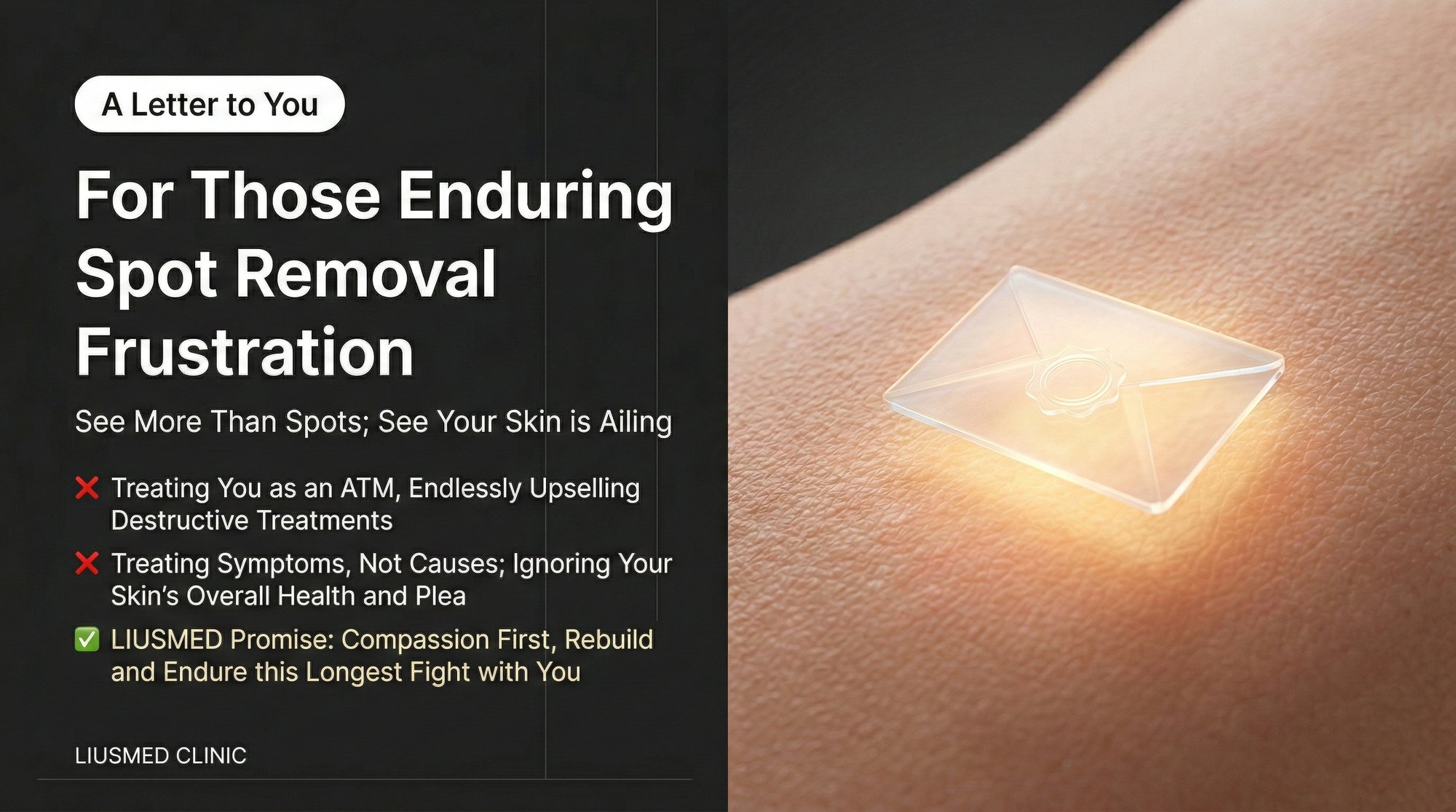
If you are reading this, you have probably been on a long journey. Maybe it started with a single brown patch that appeared during pregnancy or after starting a new medication. Maybe it crept in gradually, so slowly that you did not notice until one day you looked in the mirror and the face looking back at you did not feel like your own. However it began, the journey since then has likely been exhausting — a succession of treatments that promised improvement, delivered temporarily, and then left you back where you started, or worse.
This letter is written to you — not as a sales pitch for a specific treatment, but as an attempt to reframe how you think about what is happening to your skin. Because the single most important shift in melasma treatment is not a new laser, a new injectable, or a new topical cream. It is a shift in understanding: from chasing spots to healing skin.
Table of Contents
- The Spot-Chasing Trap
- What Your Skin Is Actually Telling You
- The Difference Between Removing Melanin and Healing Skin
- Why Previous Treatments May Have Made Things Worse
- What Healing-First Treatment Looks Like
- A Realistic Picture of What Is Possible
- Frequently Asked Questions
- About the Author
- Disclaimer
The Spot-Chasing Trap {#spot-chasing-trap}
From the moment melasma is noticed, the instinct is to eliminate it. This is natural — the spots are the visible problem, the source of distress, and the thing you want gone. The entire aesthetic medicine industry is structured around this instinct. Clinics advertise before-and-after photos showing dramatic pigment clearance. Product marketing promises to brighten, lighten, and even out skin tone. The implicit message is clear: the melanin is the enemy, and success means destroying it.
So you begin treating the spots. Topical lightening creams. Chemical peels. Laser sessions. Maybe injectable treatments. And often, these treatments do reduce the visible pigmentation — sometimes dramatically. For a few weeks, perhaps even a few months, you see improvement. You feel hopeful. Maybe this time it will last.
But it does not last. The spots return. Sometimes they return in the same pattern. Sometimes they come back darker, or in areas that were not affected before. And each time, the emotional toll compounds. You start to wonder if there is something uniquely wrong with your skin, something that makes it resistant to every treatment.
Here is what nobody told you during this cycle: you were never treating the disease. You were treating the symptom. The brown patches are not the disease — they are a signal from skin that is inflamed, structurally compromised, and vascularly dysregulated. Every time a treatment cleared the pigment without addressing these underlying conditions, it was like painting over water damage on a wall without fixing the leaking pipe. The paint looks great for a while. The stain always comes back.
This is the spot-chasing trap, and escaping it requires a fundamental change in how you and your treatment provider think about melasma.
What Your Skin Is Actually Telling You {#what-skin-tells-you}
Melasma-affected skin is sick skin. That is not a metaphor — it is a pathological reality. When researchers examine melasma tissue under a microscope, they find a constellation of abnormalities that extend far beyond excess melanin:
The protective barrier is broken. The basement membrane — the thin, critical structure that separates the outer skin (epidermis) from the deeper skin (dermis) — is frequently disrupted in melasma. This disruption allows melanin to fall into the dermis, where it is engulfed by immune cells and becomes extremely resistant to treatment. Every aggressive treatment that damages the skin surface can worsen this disruption.
There is chronic, silent inflammation. Melasma skin contains elevated levels of inflammatory mediators — substances that promote swelling, redness, and tissue damage at a microscopic level. This inflammation is not visible to the naked eye, but it continuously stimulates melanocytes (the pigment-producing cells) to produce more melanin. It is like having a furnace running in the background that you cannot see or feel, but that keeps the room too hot no matter how much you open the windows.
There are too many blood vessels. Melasma-affected skin has increased vascularity — more blood vessels, and blood vessels that are more dilated, than normal skin. These vessels deliver inflammatory signals, hormonal triggers, and nutrients that sustain melanocyte overactivity. This vascular component is one of the most underappreciated factors in melasma and one of the least addressed by conventional treatments.
The structural scaffolding is damaged. Chronic UV exposure — the same UV exposure that triggers and maintains melasma — degrades the collagen and elastic fiber network in the dermis. This degraded scaffold provides a permissive environment for ongoing pigmentary dysfunction and reduces the skin's capacity to self-repair.
When you understand these changes, the pattern of treatment failure starts to make sense. Clearing the melanin without repairing the basement membrane means new melanin will fall into the dermis just as fast as the old melanin is removed. Reducing pigment without addressing vascularity means the blood vessels will continue delivering the signals that stimulate pigment production. Treating the spots without calming the inflammation means the inflammatory fire keeps burning under the surface, reigniting the pigmentation process.
Your skin is not failing to respond to treatment. It is responding exactly as sick tissue responds when only the symptoms are addressed while the disease continues.
The Difference Between Removing Melanin and Healing Skin {#removing-vs-healing}
This distinction is the single most important concept in modern melasma management. The following comparison illustrates how these two approaches differ across every dimension of care:
| Dimension | Removing Melanin | Healing Skin |
|---|---|---|
| Target | The brown patches (melanin deposits) | The tissue environment producing the patches |
| Methods | Lasers, peels, lightening agents | Anti-inflammatory, regenerative, vascular-modulating therapies |
| Basement membrane | Ignored or further damaged | Actively repaired |
| Inflammation | Often worsened by treatment | Primary treatment target |
| Vascularity | Not addressed | Directly modulated |
| Timeline to visible change | Fast (weeks) | Slower (months) |
| Durability of results | Low (frequent recurrence) | Higher (sustained improvement) |
| Cumulative effect of repeated treatment | Skin becomes more fragile and reactive | Skin becomes healthier and more resilient |
| Emotional experience | Hope-disappointment cycles | Gradual, sustained confidence building |
The melanin-removal approach is seductive because it produces visible results quickly. But speed and visibility are not the same as effectiveness and durability. The healing approach requires more patience, but it addresses the actual disease process rather than its most visible manifestation.
This does not mean that melanin reduction has no role — it does, but it should come after the tissue environment has been stabilized and repaired, not before. The sequence matters enormously.
Why Previous Treatments May Have Made Things Worse {#previous-treatments}
This is a difficult truth, but an important one: some of the treatments you have received for melasma may have inadvertently contributed to making your condition more resistant to future treatment.
Repeated laser treatments deposit thermal energy into tissue that is already inflamed. While a single, appropriately calibrated laser session may not cause harm, repeated sessions — particularly at settings that are not specifically optimized for melasma — can upregulate inflammatory pathways, stimulate the formation of new blood vessels (angiogenesis), and further compromise the basement membrane. The net result can be a temporary reduction in visible pigment followed by a rebound that is worse than the original condition.
Aggressive chemical peels can thin the epidermis and damage the basement membrane zone. Deep peels, in particular, create controlled wounds that heal through inflammatory processes — the same inflammatory processes that drive melanocyte activity in melasma. For some patients, especially those with darker skin types, the post-inflammatory hyperpigmentation from the peel itself can be worse than the melasma.
Long-term high-concentration hydroquinone is effective as a short-term depigmenting agent, but prolonged use (beyond 3-4 months without breaks) can paradoxically cause a condition called exogenous ochronosis — a blue-grey discoloration that is even more difficult to treat than the original melasma. Even without ochronosis, long-term hydroquinone can sensitize the skin and compromise the melanocyte microenvironment.
Over-exfoliation and aggressive retinoid use can strip the skin barrier, increase transepidermal water loss, and make the skin more reactive to UV exposure and other triggers. When the barrier is compromised, every subsequent treatment carries higher risk and lower efficacy.
If you recognize your own treatment history in these descriptions, please understand: this is not your fault. You trusted your treatment providers, and they likely followed protocols that are widely practiced in the field. The problem is not with individual practitioners but with a treatment paradigm that has prioritized pigment clearance over tissue health.
The good news is that treatment-induced damage is often reversible. Skin is a regenerative organ, and with the right approach, the tissue environment can be rehabilitated — even in patients who have undergone extensive prior treatment.
What Healing-First Treatment Looks Like {#healing-first}
At Liusmed Clinic, our Melasma Injection Treatment protocol begins from the premise that the skin must be healed before the pigment can be sustainably cleared. In practice, this means:
Step 1: Stop the damage. Before adding any new treatment, we assess what your current regimen and recent treatments have done to your skin. In some cases, the most therapeutic first step is to stop — to discontinue treatments that are causing ongoing tissue damage and to allow the skin to begin recovering. This may include tapering aggressive topicals, pausing energy-based treatments, and implementing a simplified, barrier-supportive skincare routine.
Step 2: Calm the inflammation. Using targeted anti-inflammatory interventions — which may include injectable treatments, carefully selected topicals, and systemic approaches where appropriate — the chronic inflammatory milieu in the skin is gradually quieted. As inflammation decreases, the stimulus driving melanocyte overactivity begins to diminish.
Step 3: Repair the tissue infrastructure. With inflammation controlled, regenerative therapies — including PRP (platelet-rich plasma) and growth-factor-based protocols — are introduced to repair the basement membrane, modulate vascularity, and restore dermal collagen architecture. This phase rebuilds the structural foundations that prevent melanin from falling into the dermis and that reduce the vascular stimulus to melanocytes.
Step 4: Gradual, controlled pigment management. Only after the tissue environment has been stabilized and repaired are pigment-targeting interventions introduced — and even then, with conservative parameters and careful monitoring. The goal is to reduce pigment at a pace that the now-healthier skin can sustain without inflammatory rebound.
Step 5: Sustainable maintenance. The transition from active treatment to maintenance is planned from the beginning. Maintenance includes daily topical care, consistent photoprotection, periodic in-clinic assessment, and maintenance treatments at individually determined intervals.
This sequence may seem slower than a direct laser-and-lightening approach. It is. But the results it produces are qualitatively different — they are built on a foundation of healthy, resilient tissue rather than temporarily cleared pigment sitting on top of still-sick skin.
A Realistic Picture of What Is Possible {#realistic-picture}
Honesty is a form of respect, and you deserve honesty about what melasma treatment can and cannot achieve.
What is achievable: Significant, sustained improvement in pigmentation. Greater skin health, resilience, and tolerance. Reduced frequency and severity of recurrence. A relationship with your skin that is based on understanding and management rather than fear and frustration. For many patients, a level of improvement that allows them to feel comfortable and confident without heavy concealing makeup.
What is not currently achievable: A permanent, one-time cure. Complete elimination of all pigmentation in every patient. Immunity from all future recurrence. These claims, when made by any clinic or product, are not supported by the current state of medical knowledge.
What varies between patients: The degree of improvement, the timeline, and the maintenance requirements. These depend on factors including the depth and chronicity of the melasma, the extent of prior treatment damage, hormonal factors, skin type, UV exposure history, and adherence to the maintenance regimen.
This honest framing is not meant to discourage but to liberate. When you stop chasing a cure and start pursuing sustainable management, the pressure lifts. Every measurable improvement becomes a genuine victory rather than a prelude to anticipated failure. The emotional relationship with your skin shifts from adversarial to collaborative.
Your melasma does not define you, and it does not have to control your experience of your own face. But getting there requires looking beyond the spots to the skin beneath — and finding care that does the same.
Frequently Asked Questions
Q1: If melasma is a chronic condition, is treatment even worth pursuing?
Yes. Managing a chronic condition is not the same as living with an untreatable one. Diabetes is chronic, but well-managed diabetes allows a full, healthy life. Similarly, well-managed melasma can achieve a level of stability and cosmetic improvement that significantly enhances quality of life. The key is a treatment approach that aims for sustainable control rather than a one-time fix.
Q2: How do I know if my skin has been damaged by previous treatments?
Signs of treatment-induced skin damage include increased sensitivity, persistent redness, a feeling of thinness or fragility, worsened pigmentation after treatment, and a pattern of diminishing returns from treatments that initially worked. A comprehensive assessment at a repair-focused clinic can evaluate the current state of your skin and identify any treatment-related damage that needs to be addressed.
Q3: Is it too late to switch to a healing-first approach after years of aggressive treatment?
It is rarely too late. Skin has remarkable regenerative capacity, and even tissue that has been compromised by years of aggressive treatment can often be rehabilitated with the right approach. The recovery timeline may be longer for patients with extensive treatment histories, but the trajectory toward healthier, more resilient skin remains achievable. Visit our Melasma Injection Treatment page to learn about consultation options.
Q4: Why do some doctors still recommend aggressive laser treatment for melasma?
Laser treatment for melasma is not universally inappropriate — it has a role when used carefully, at appropriate parameters, in correctly selected patients, and at the right point in a treatment sequence. However, the reflexive use of aggressive laser protocols for all melasma patients persists partly due to institutional inertia, device availability driving treatment selection, and the seductive appeal of rapid visible results. The shift toward tissue-level, healing-first approaches is occurring in the field but has not yet become the dominant paradigm.
Q5: What is the single most important thing I can do for my melasma right now?
Protect your skin from ultraviolet radiation consistently and thoroughly. UV exposure is the single most powerful trigger for melasma activation and recurrence. Broad-spectrum sunscreen (SPF 50+, reapplied every 2 hours during sun exposure), physical sun protection (wide-brimmed hats, seeking shade), and visible light protection (tinted sunscreens containing iron oxide) form the foundation upon which every other treatment builds. No treatment can succeed if UV protection is insufficient.
Q6: How is Liusmed Clinic's approach different for international patients?
Liusmed Clinic welcomes international patients and can accommodate consultations that account for travel logistics and follow-up considerations. The initial assessment and treatment planning can include telemedicine components, and treatment schedules can be designed to accommodate patients who cannot attend frequent local appointments. The core philosophy — healing the skin first, then managing pigment — remains the same regardless of the patient's location.
About the Author
Dr. Ta-Ju Liu is the founder of Liusmed Clinic, a specialized practice integrating regenerative medicine with minimal incision surgical techniques. His approach to melasma reflects a deep conviction that effective treatment must look beyond surface symptoms to address the tissue-level pathology that drives chronic pigmentary disorders. Dr. Liu's clinical philosophy prioritizes tissue health, honest patient communication, and sustainable treatment frameworks over quick-fix solutions.
Disclaimer
This article is written as an educational resource and does not constitute medical advice, diagnosis, or treatment. It is intended to provide a conceptual framework for understanding melasma and is not a substitute for individual clinical evaluation. Every patient's condition is unique, and treatment recommendations must be based on comprehensive, personalized assessment by a qualified healthcare professional. Outcomes described are general possibilities, not guaranteed results.

Specialties
Credentials
- Kaohsiung Medical University, School of Medicine
- Attending Physician, Dermatology, Kaohsiung Chang Gung Memorial Hospital
- Attending Physician, Aesthetic Center, Kaohsiung Chang Gung Memorial Hospital
- Visiting Physician, Dermatology, Xiamen Chang Gung Hospital
- Visiting Physician, Aesthetic Center, Xiamen Chang Gung Hospital
"For every surgery, I strive to achieve a good outcome through a small incision and refined technique. Minimally invasive surgery is not just a technique — it's a commitment of respect to every patient."
Recovery after any procedure needs peer support too


Want to learn more?
Schedule a consultation for professional evaluation and advice