Why Do Lipomas Develop? Causes, Risk Factors, and Who Is Most Likely to Get One
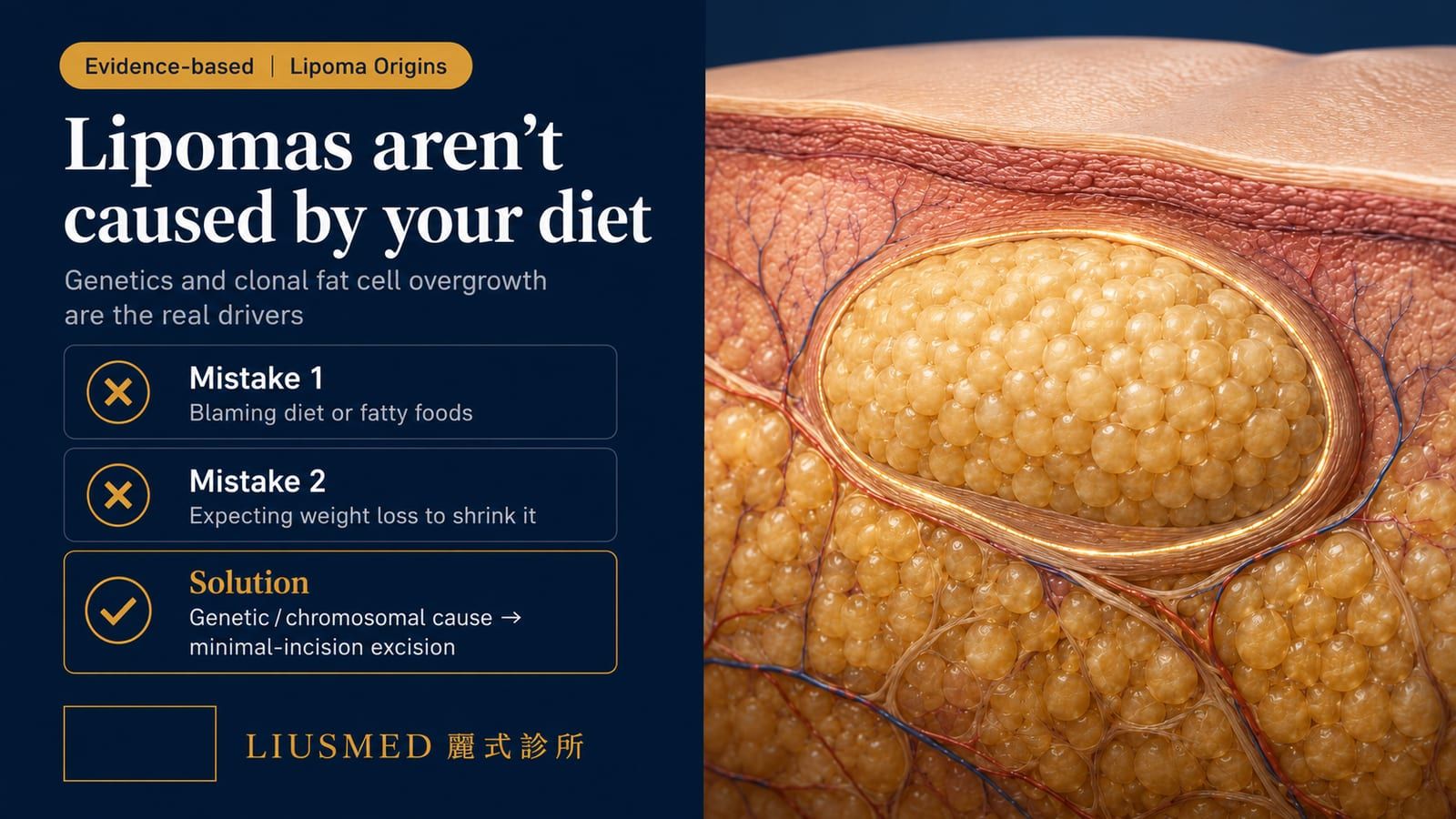
One of the most common questions patients ask after a lipoma is diagnosed is some version of: "Did I cause this — through my diet, or because I gained weight?"
In the vast majority of cases, the answer is no. Lipomas are not the result of eating too much fat or being sedentary. Understanding why they actually form matters — not just for peace of mind, but because the real drivers (genetics, chromosomal changes, and occasionally prior trauma) shape how you should think about monitoring and managing them.
How a Lipoma Forms: Localized Clonal Fat Cell Overgrowth
A lipoma is a benign soft-tissue tumor composed of mature adipocytes (fat cells) enclosed in a thin fibrous capsule. Histologically, the cells look entirely normal — they are simply present in an abnormal, self-contained aggregate.
Current evidence points to clonal proliferation as the underlying mechanism: a cluster of fat cells in a specific location begins to replicate outside normal physiological controls, forming a well-circumscribed mass. This is a local process; it does not reflect anything about the body's overall fat metabolism.
At the molecular level, a subset of lipomas carry identifiable chromosomal rearrangements, most notably:
- Rearrangements of the HMGA2 gene on chromosome 12q
- Abnormalities of chromosomes 6 and 13
These chromosomal findings confirm that lipomas are a form of genetically regulated proliferation, distinct from simple fat accumulation.
Key insight: A lipoma results from focal clonal overgrowth of fat cells with underlying chromosomal abnormalities — not from excess body fat redistributing itself into a lump. Losing weight will not make an existing lipoma shrink, because a lipoma does not participate in the body's normal fat metabolism.
Who Gets Lipomas? Age Groups and At-Risk Populations
Lipomas can appear at virtually any age, but certain patterns emerge consistently:
| Characteristic | Detail |
|---|---|
| Peak age of detection | 40–60 years; rare in children, though not impossible |
| Sex | Slightly more common in men (roughly 2:1 male-to-female ratio) |
| Family history | First-degree relatives with lipomas significantly increases risk |
| Multiple lipomas | Those who develop one often have others at other sites |
A note on younger patients (under 30): a lipoma appearing at a younger age warrants careful clinical evaluation — both to rule out atypical lipomatous tumors and to provide clear, accurate reassurance.
Three Key Contributing Factors
Genetics: The Strongest Driver
Familial multiple lipomatosis is an autosomal dominant condition in which individuals develop tens to hundreds of lipomas across the body, typically beginning in the third or fourth decade of life. The transmission probability from parent to child is approximately 50%.
Even outside this defined syndrome, having a first-degree relative (parent, sibling) with lipoma history meaningfully increases your own likelihood of developing one. This does not mean a lipoma is inevitable — but it means that if you notice an unexplained soft lump, informing your physician about family history is clinically relevant.
Trauma: A Possible Trigger in Some Cases
A subset of lipomas appear to develop at sites of prior injury or sustained pressure — a phenomenon sometimes called post-traumatic lipoma. Patients occasionally report that a lipoma emerged months or years after a bruise, sprain, or repetitive impact to the same anatomical region.
The proposed mechanism involves disruption of the local fat tissue architecture following injury, which may trigger an abnormal regenerative response. These are typically solitary and unrelated to familial patterns.
Key insight: If your lipoma is located precisely at a site where you experienced significant prior trauma, this is worth mentioning to your physician. It is an informative piece of clinical history.
Lipid Disorders: A Partial Association
Some research has identified an association between hypertriglyceridemia (elevated blood triglycerides) and the development of multiple lipomas. However, the causal relationship remains under investigation, and elevated triglycerides alone do not cause lipomas in the general population.
Obesity: Much Less Related Than You Might Think
This is the misconception most worth addressing directly.
Obesity does not cause lipomas. Overweight individuals carry more body fat overall, but their fat cells are not more prone to forming clonal tumors. In clinical practice, lipomas are equally common in lean and overweight patients. Existing lipomas do not shrink when a patient loses weight — because the lipoma is a discrete tumor that does not participate in the body's normal fat metabolism cycles.
Summary: What the Evidence Shows
| Proposed Factor | Evidence Strength | Notes |
|---|---|---|
| Genetics / chromosomal changes | ★★★★☆ | Primary driver; HMGA2 rearrangements, familial patterns |
| Prior trauma | ★★★☆☆ | Observed clinically; mechanism not fully established |
| Lipid abnormalities (hypertriglyceridemia) | ★★☆☆☆ | Associated with multiple lipomas; causation unclear |
| Obesity | ★☆☆☆☆ | No direct causal relationship |
| Diet | ★☆☆☆☆ | No established evidence |
"I Didn't Do Anything Wrong — So Why Did This Happen?"
This is one of the more emotionally significant questions that comes up in the clinic, and it deserves a direct answer.
You did not do anything wrong. Lipomas reflect a localized, genetically mediated aberration in fat cell behavior — the same kind of constitutional variability that causes some people to develop varicose veins or benign skin tags. It is not a behavioral consequence.
What this means practically:
- Changing your diet or losing weight is unlikely to affect a lipoma — though those goals have independent health value
- The right focus is monitoring and timely treatment: a small, stable lipoma can be observed; one that is growing, causing discomfort, or located in a sensitive area deserves clinical evaluation
At LIUSMED Clinic, lipoma removal uses a <20% extreme minimal-incision technique — the incision length is less than one-fifth of the lipoma's diameter, far smaller than conventional excision. The earlier a lipoma is addressed, the smaller the incision required. Learn more at Lipoma Removal at LIUSMED.
If you have discovered a soft lump and want to understand what it is:
- Lipoma vs. Epidermoid Cyst: How to Tell the Difference — a side-by-side breakdown of the two most common subcutaneous tumors
- Subcutaneous Lump: How Ultrasound Helps Identify It — why imaging is the most reliable first step
- Lipoma Removal: Minimal-Incision Surgery Guide — what the surgical process involves
- Questions about your specific situation? Book a consultation
Dr. Ta-Ju Liu has spent his career focused on minimally invasive removal of subcutaneous tumors. Discovering a lump raises natural questions — the most useful next step is an accurate diagnosis that tells you what you are dealing with and whether anything needs to be done.
Common questions
Is a lipoma caused by a greasy diet or by being overweight?
Not really. A lipoma is a benign local overgrowth of fat cells, and it has almost nothing to do with how much fat you eat or whether you carry extra weight. We see them just as often in lean patients. You don't need to change your diet or lose weight because of one.
If I lose weight, will an existing lipoma get smaller or go away?
No. A lipoma is a self-contained lump that doesn't take part in your body's normal fat metabolism, so it won't shrink when your weight drops. If it bothers you, removal is the way to deal with it.
Do lipomas run in families? If a relative had one, will I get one too?
Genetics has the most direct influence here. Familial multiple lipomatosis is passed down in a dominant pattern, with roughly a 50% chance from parent to child, and even outside that syndrome, having a first-degree relative with a lipoma raises your odds. It's a probability, not a certainty — but if it runs in your family, mention that when you have an unexplained lump checked.
Are areas that were injured more likely to develop a lipoma?
Some lipomas do show up at spots that were previously bruised, sprained, or under long-term pressure — what's sometimes called a post-traumatic lipoma, and it's usually a single one. If your lump happens to sit exactly where you had an old injury, that's worth telling your doctor, because it helps with the assessment.
I already have one lipoma — will more show up later?
It's possible. People who develop one often turn out to have others elsewhere, especially when there's a family tendency. So the practical approach is to keep an eye on any changes and get things looked at if a lump keeps growing or starts to bother you.

Specialties
Credentials
- Kaohsiung Medical University, School of Medicine
- Attending Physician, Dermatology, Kaohsiung Chang Gung Memorial Hospital
- Attending Physician, Aesthetic Center, Kaohsiung Chang Gung Memorial Hospital
- Visiting Physician, Dermatology, Xiamen Chang Gung Hospital
- Visiting Physician, Aesthetic Center, Xiamen Chang Gung Hospital
"For every surgery, I strive to achieve a good outcome through a small incision and refined technique. Minimally invasive surgery is not just a technique — it's a commitment of respect to every patient."
Want to learn more?
Schedule a consultation for professional evaluation and advice