What Is That Lump 2 Years After Filler Injection?
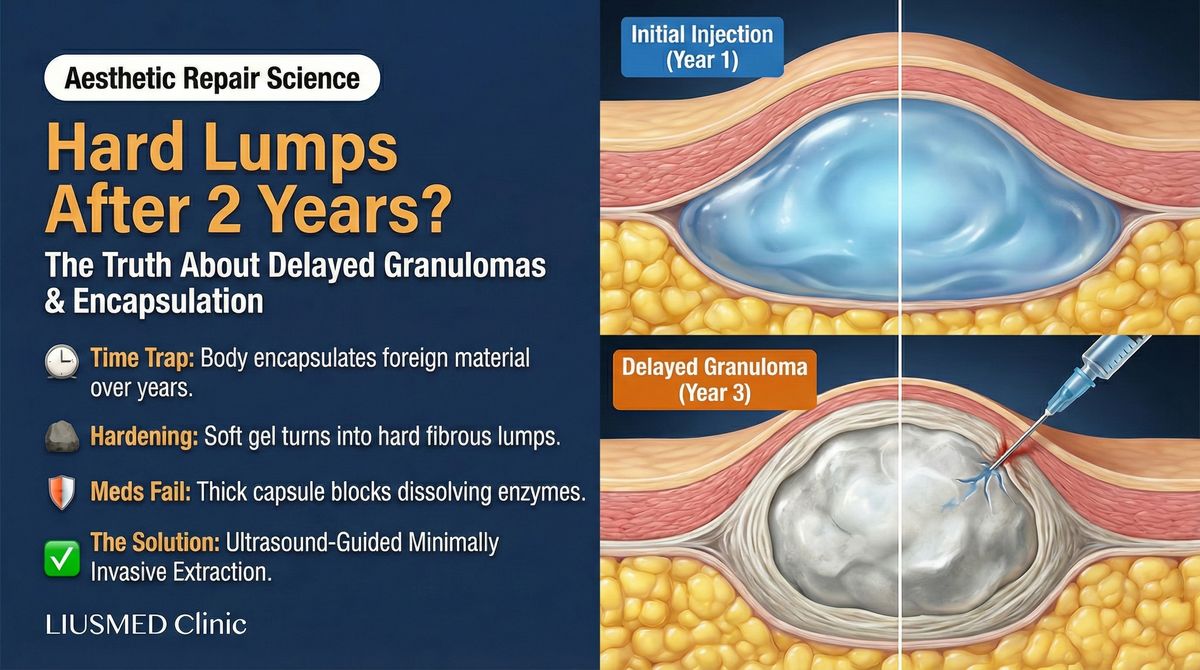
Why Am I Feeling a Lump Years After My Filler Injection?
You had dermal filler injected two or three years ago. Everything seemed fine at first. But now, there is a firm lump beneath your skin that was not there before, and it seems to be getting harder over time. You are not imagining it, and you are not alone. Delayed nodule formation is one of the most under-discussed complications of dermal fillers, and understanding why it happens is the first step toward resolving it.
This article explains the biological mechanisms behind late-onset filler lumps, why conventional dissolvers often fail at this stage, and what evidence-based treatment options are available.
What Causes Lumps to Appear Years After Injection?
The Encapsulation Process
When filler is injected into the soft tissue, the body recognizes it as a foreign substance. In most cases, the immune response is mild and the filler integrates uneventfully. However, over months and years, the body can mount a chronic foreign body reaction that encapsulates the filler material in a fibrous shell.
| Timeline | What Happens |
|---|---|
| 0–6 months | Filler settles, mild inflammation resolves |
| 6–18 months | Slow fibrous tissue formation around filler |
| 1–3 years | Encapsulation completes, lump becomes palpable |
| 3+ years | Possible calcification, progressive hardening |
This capsule is the body's attempt to wall off the foreign material. The result is a firm, often painless nodule that becomes increasingly noticeable.
Foreign Body Granuloma
In some patients, the immune response escalates beyond simple encapsulation. Foreign body granulomas form when immune cells—particularly macrophages and giant cells—cluster around the filler material in an aggressive inflammatory reaction.
Granulomas can:
- Appear suddenly, even years after injection
- Feel firm, tender, or warm to the touch
- Grow slowly over time
- Occur with any filler type, including hyaluronic acid
Key Insight: The timing of lump appearance does not correlate with the original injection quality. Even well-placed filler by an experienced injector can trigger delayed granuloma formation in susceptible individuals.
Why Do Dissolvers Fail on Old Filler Lumps?
The Limitation of Hyaluronidase (enzyme that dissolves HA filler)
Hyaluronidase (the enzyme used to dissolve hyaluronic acid fillers) works by breaking down the HA (Hyaluronic Acid — sugar molecule naturally in skin, holds water) molecules through enzymatic degradation. However, once a fibrous capsule has formed around the filler:
| Factor | Why Dissolution Fails |
|---|---|
| Physical barrier | The capsule prevents hyaluronidase from reaching the filler |
| Altered composition | Encapsulated HA becomes cross-linked with fibrous tissue |
| Reduced penetration | The enzyme cannot diffuse through dense scar tissue |
| Mixed material | Granulomatous tissue does not respond to hyaluronidase |
What About Non-HA Fillers?
For fillers like Sculptra (PLLA), Ellanse (PCL), Radiesse (CaHA), or silicone, there is no dissolver available. These materials can only be removed physically. When they become encapsulated, the treatment approach must shift from pharmacological dissolution to mechanical extraction.
Dr. Liu explains: "Patients often come to me after multiple failed dissolution attempts. By the time a filler lump is two or three years old, the capsule is well established. Injecting more hyaluronidase into the area only causes swelling and tissue damage without addressing the core problem."
How Are Delayed Filler Lumps Diagnosed?
Clinical Examination
A thorough assessment begins with:
- Palpation: Evaluating the lump's firmness, mobility, and boundaries
- History review: Identifying the filler type, injection date, and previous treatments
- Symptom assessment: Noting any pain, tenderness, or progressive changes
High-Frequency Ultrasound
Ultrasound is the gold standard for diagnosing encapsulated filler lumps. It reveals:
| Information | Clinical Value |
|---|---|
| Filler location | Exact depth and tissue plane |
| Capsule thickness | Degree of encapsulation |
| Filler type clues | Different fillers show different echo patterns |
| Surrounding tissue | Inflammation, fibrosis, or vascular proximity |
| Volume estimation | How much material needs to be removed |
Ultrasound can distinguish between simple filler deposits, encapsulated nodules, granulomas, and other soft tissue pathology such as lipomas or cysts that may mimic filler complications.
What Is Ultrasound-Guided Pinhole Extraction?
The Definitive Treatment for Encapsulated Filler
When dissolution fails, ultrasound-guided pinhole extraction is the most reliable method for removing encapsulated filler lumps. This minimally invasive technique involves:
- Pre-operative ultrasound mapping: Identifying the exact location, depth, and extent of the encapsulated filler
- Anesthesia: The procedure is performed in a clinic setting under local anesthesia plus gentle pain-relief anesthesia
- Pinhole incision: A tiny incision (typically less than 1.5mm) is made at a concealed location
- Real-time guided extraction: Using continuous ultrasound guidance, the capsule is accessed and the filler material is carefully removed
- Completeness verification: Post-extraction ultrasound confirms no significant residual material remains
Why Pinhole Extraction Works When Dissolvers Do Not
| Advantage | Explanation |
|---|---|
| Bypasses the capsule | Physical access overcomes the barrier that blocks dissolvers |
| Material-agnostic | Works on HA, PLLA, PCL, CaHA, and other filler types |
| Precision | Ultrasound guidance targets only the foreign material |
| Tissue preservation | Normal tissue is separated and preserved during extraction |
| Verification | Ultrasound confirms complete removal in real time |
What to Expect: Recovery and Results
Post-Procedure Timeline
| Period | What to Expect |
|---|---|
| Day 1–3 | Mild swelling and bruising at the extraction site |
| Week 1 | Swelling subsides, follow-up evaluation |
| Week 2–4 | Tissue remodeling begins |
| Month 1–3 | Gradual tissue recovery, final contour emerges |
| Month 3–6 | Long-term follow-up, assess if secondary treatment needed |
Most patients experience minimal downtime. The pinhole incision heals with virtually no visible scarring.
Will the Area Look Sunken After Removal?
This depends on the volume of filler removed and the tissue condition. In most cases:
- Small to moderate lumps leave no noticeable depression
- Larger volumes may require a 3–6 month recovery period for tissue to rebound
- If needed, a small amount of fresh HA filler can be placed after full recovery
Frequently Asked Questions
Can I just leave the lump alone?
In many cases, encapsulated filler lumps are medically benign. However, they may continue to harden, become more visible, or occasionally cause discomfort. Some patients also experience psychological distress from the visible or palpable abnormality. Treatment is elective but recommended if the lump is progressing.
How do I know if my lump is a granuloma or just encapsulated filler?
Ultrasound can usually differentiate between the two. Granulomas tend to show more irregular borders and mixed echogenicity, while simple encapsulated filler appears as a well-defined hypoechoic mass within a hyperechoic capsule.
Is the procedure painful?
Under local anesthesia plus gentle pain-relief anesthesia, most patients report only mild pressure or discomfort during the extraction. Post-procedure pain is typically manageable with over-the-counter analgesics.
Take the First Step Toward Resolution
If you have a lump that appeared months or years after filler injection, the most important step is obtaining an accurate diagnosis through ultrasound evaluation. Understanding what the lump is made of and how it has changed over time determines the most effective treatment path.
Schedule a consultation to receive a comprehensive ultrasound assessment and personalized treatment plan.
Contact us to book your evaluation
About the Author
Dr. Ta-Ju Liu
- Current Position: Director, Liusmed Clinic
- Specialties: Minimally invasive surgery (lipoma, cyst), hyperhidrosis surgery, thread lifting, filler complication repair
- Experience:
- 15+ years of clinical minimally invasive surgery experience
- Over 10,000 successful minimally invasive cases
- Board-certified dermatologist
- Philosophy: "Late-onset filler lumps are a solvable problem. The key is accurate diagnosis with ultrasound followed by precise, tissue-sparing extraction."
Related Services

Specialties
Credentials
- Kaohsiung Medical University, School of Medicine
- Attending Physician, Dermatology, Kaohsiung Chang Gung Memorial Hospital
- Attending Physician, Aesthetic Center, Kaohsiung Chang Gung Memorial Hospital
- Visiting Physician, Dermatology, Xiamen Chang Gung Hospital
- Visiting Physician, Aesthetic Center, Xiamen Chang Gung Hospital
"For every surgery, I strive to achieve a good outcome through a small incision and refined technique. Minimally invasive surgery is not just a technique — it's a commitment of respect to every patient."
Recovery after any procedure needs peer support too


Want to learn more?
Schedule a consultation for professional evaluation and advice