How Many Melasma Injection Sessions Do You Need?
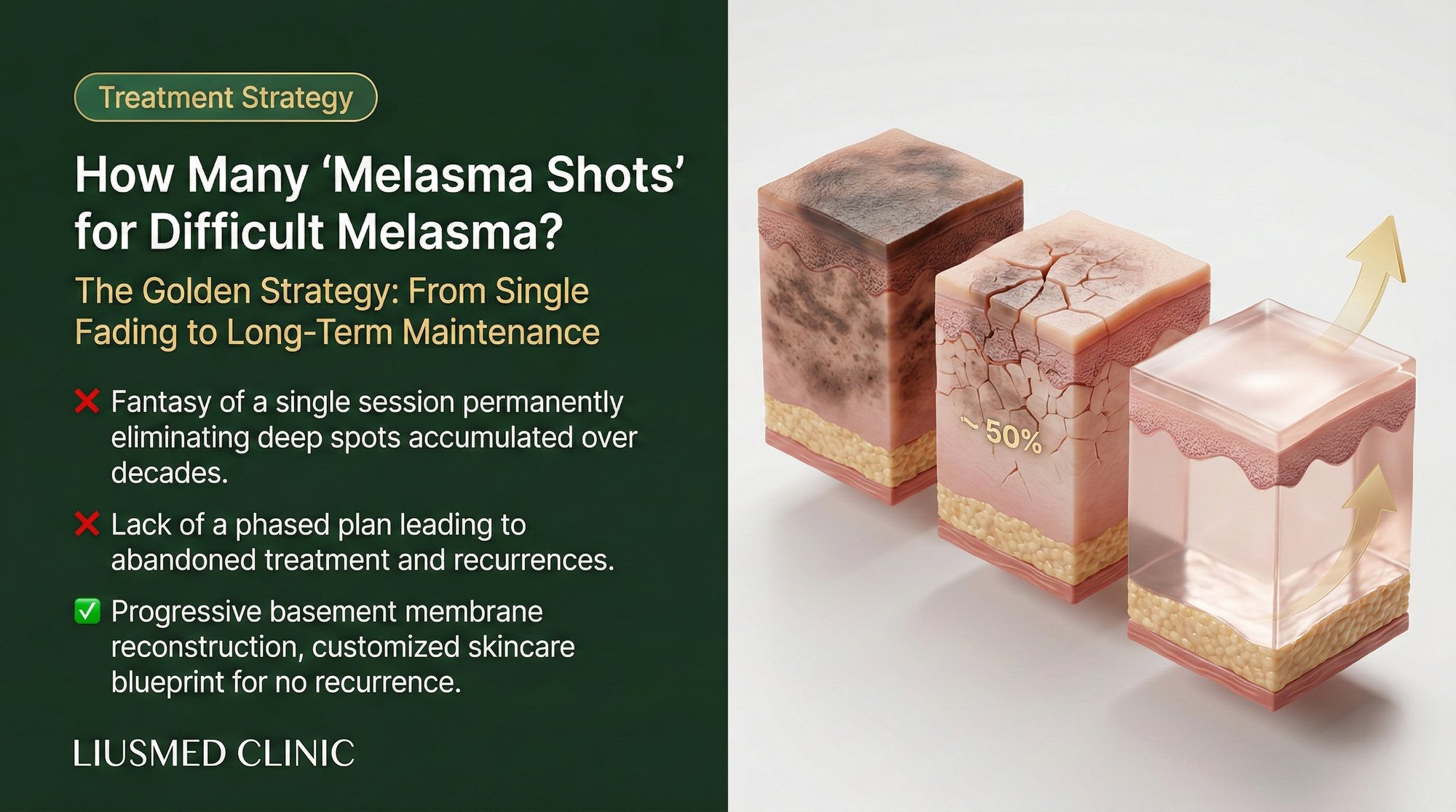
Patients want a number. Three sessions? Six? Ten? The truthful answer is that melasma treatment is not a fixed-length procedure — it is a phased strategy with an induction phase, a consolidation phase, and a maintenance phase. Understanding this arc transforms expectations from "when will I be done" to "how do I stay ahead of this condition."
Table of Contents
- Why There Is No Universal Session Count for Melasma
- Phase 1: Induction — Building Momentum in Sessions 1-3
- Phase 2: Consolidation — Deepening Results in Sessions 4-6
- Phase 3: Maintenance — Sustaining Results Long-Term
- Factors That Influence Your Individual Treatment Timeline
- Building a Realistic Treatment Plan With Your Physician
Why There Is No Universal Session Count for Melasma
Melasma is not a uniform condition. Two patients may both present with brown patches on the cheeks, but the underlying pathology can be vastly different. One may have predominantly epidermal pigmentation driven by recent hormonal changes with an intact basement membrane. The other may have deep dermal pigmentation with years of accumulated fibrosis, vascular dysfunction, and multiple failed laser treatments.
These two patients will respond to the Melasma Injection Treatment at different rates, require different treatment intensities, and need different maintenance strategies. Promising both the same "five-session cure" would be dishonest.
What can be reliably predicted is the treatment arc: the phased progression from initial response through consolidation to maintenance. Every melasma patient follows this arc, even though the pace and duration of each phase varies.
The critical insight that sets the Liusmed approach apart from conventional treatment paradigms is this: melasma is a chronic condition, not an acute disease. It has triggers (UV exposure, hormonal fluctuations, inflammation) that persist throughout life. The goal of treatment is not a one-time cure but rather a strategy that brings the condition under control and keeps it there with minimal ongoing intervention.
This reframing is liberating rather than discouraging. It means patients do not need to achieve "perfection" in a fixed number of sessions. Instead, they build progressive improvement and then maintain it with decreasing effort over time.
Phase 1: Induction — Building Momentum in Sessions 1-3
The induction phase establishes the therapeutic foundation. These initial sessions focus on suppressing the active inflammatory and vascular drivers of melasma and initiating the regenerative repair process.
Session 1: Baseline establishment and initial response. The first session serves dual purposes: it delivers the initial therapeutic payload and it provides diagnostic information. The physician observes how the tissue responds to injection — the degree of fibrosis, the vascular pattern, the depth and distribution of pigment — and uses this information to refine the treatment plan for subsequent sessions.
Most patients notice subtle improvement within 7 to 14 days after the first session. The most common early change is a reduction in the redness or vascular component of melasma, reflecting the anti-angiogenic effect of TXA (Tranexamic Acid). Pigment lightening may be minimal or absent after a single session, as the structural repair process is just beginning.
Session 2 (3-4 weeks after Session 1): Amplification. The second session builds on the foundation laid by the first. The anti-inflammatory environment established by Session 1 means that Session 2's therapeutic agents encounter less pathological resistance and can distribute more effectively through the tissue. Patients typically notice more pronounced improvement after Session 2 than after Session 1 — not because the treatment was different, but because the tissue was better prepared to respond.
Session 3 (3-4 weeks after Session 2): Consolidation of initial gains. By the third session, the inflammatory environment of the melasma lesion has been substantially modified. VEGF (Vascular Endothelial Growth Factor — new blood vessel signal) levels are reduced, mast cell activity is suppressed, and the first evidence of basement membrane repair is emerging. Visible pigment reduction is typically apparent to both the patient and the physician.
At this point, the physician conducts a formal reassessment. The response to the first three sessions provides critical prognostic information about the expected trajectory and the likely total number of sessions needed.
| Session | Primary Objective | Expected Visible Change | Internal Process |
|---|---|---|---|
| Session 1 | Establish anti-inflammatory baseline | Subtle vascular improvement | Inflammation suppression initiated |
| Session 2 | Amplify therapeutic effect | Noticeable lightening begins | Fibroblast activation, early collagen synthesis |
| Session 3 | Consolidate initial gains | Measurable pigment reduction | BMZ repair underway, vascular normalization |
Phase 2: Consolidation — Deepening Results in Sessions 4-6
The consolidation phase takes the improvements achieved during induction and deepens them by continuing the structural repair that prevents recurrence.
Sessions 4-5: Structural remodeling. With the inflammatory environment under control, the regenerative components of the protocol — particularly high-concentration PRP (Platelet-Rich Plasma — concentrate of your own blood platelets rich in growth factors) — can work at maximum efficiency. Type IV collagen synthesis at the basement membrane zone reaches therapeutic levels. The dermal fibrosis characteristic of chronic melasma is progressively broken down and replaced with organized, healthy collagen.
During this phase, patients often report that their melasma improvement accelerates. This non-linear response reflects the cumulative nature of structural repair — early sessions lay the groundwork, and later sessions build upon an increasingly restored tissue architecture.
Session 6: Stabilization assessment. The sixth session typically marks the transition point between active treatment and maintenance. At this visit, the physician evaluates the current status against the baseline, assesses the stability of the improvement, and determines the appropriate maintenance schedule.
For patients with mild to moderate melasma and a good treatment response, six sessions may represent the completion of active treatment, with transition to maintenance. For patients with severe, deep, or heavily pre-treated melasma, additional consolidation sessions (7-8) may be recommended before transitioning.
The consolidation phase is where the fundamental difference between the Liusmed approach and laser-based treatments becomes most apparent. Laser treatments often produce their maximum visible effect early (by destroying surface melanin) and then plateau or worsen. The injection protocol shows progressive improvement that builds through the consolidation phase because it is repairing tissue rather than destroying it.
Phase 3: Maintenance — Sustaining Results Long-Term
The maintenance phase is the most commonly neglected aspect of melasma treatment — and arguably the most important. Without maintenance, even excellent treatment results will gradually fade as the chronic triggers of melasma continue to operate.
Early maintenance (months 1-6 after completing active treatment). Sessions are spaced every 6 to 8 weeks. The objective is to reinforce the structural repairs achieved during consolidation and to suppress any recurrence of the inflammatory and vascular pathology. Each maintenance session is typically less intensive than an active treatment session, focusing on targeted areas that show any early signs of recurrence.
Established maintenance (months 6-12). If the early maintenance phase shows stable results, session intervals are extended to every 8 to 12 weeks. Some patients can extend to quarterly sessions. The physician monitors for any signs of relapse at each visit and adjusts the interval accordingly.
Long-term maintenance (beyond 12 months). Many patients settle into a pattern of quarterly or biannual maintenance sessions that keep their melasma well-controlled with minimal time commitment. Some patients with mild melasma and diligent sun protection can eventually space sessions to biannual visits.
The maintenance philosophy recognizes a clinical reality: melasma triggers (hormones, UV, genetics) do not disappear. Seasonal UV increases, hormonal fluctuations, and life stresses can reactivate the pathological cascade. Regular maintenance prevents small recurrences from becoming full relapses, which would require restarting the induction phase.
| Maintenance Phase | Session Interval | Session Intensity | Monitoring Focus |
|---|---|---|---|
| Early (months 1-6) | Every 6-8 weeks | Moderate | Stability of results, early recurrence signs |
| Established (months 6-12) | Every 8-12 weeks | Light to moderate | Seasonal variation, hormonal influences |
| Long-term (12+ months) | Every 3-6 months | Light | Annual trend, trigger management |
Factors That Influence Your Individual Treatment Timeline
Several variables determine where an individual patient falls within the treatment arc:
Melasma depth and type. Epidermal-predominant melasma (brown under Wood's lamp) typically responds faster, often achieving satisfactory improvement in 3 to 4 sessions. Mixed or dermal-predominant melasma (blue-gray component) requires more sessions — typically 5 to 8 — because the deep pigment trapped in dermal macrophages takes longer to clear through the lymphatic system.
Duration of melasma. Patients with recent-onset melasma (less than 2 years) tend to respond faster because the degree of dermal fibrosis and structural damage is less advanced. Patients with melasma lasting 5, 10, or 20 years have accumulated more fibrosis and adhesions that require more sessions of hydro-dissection and regenerative repair.
Previous treatment history. Patients who have undergone multiple rounds of aggressive laser treatment often present with treatment-induced damage layered on top of the melasma pathology. The dermis may show thermal scarring, disrupted melanocyte distribution, and exaggerated inflammatory responses. These patients may require 2 to 3 additional sessions compared to treatment-naive patients to address the iatrogenic damage before the melasma itself can be effectively treated.
Hormonal status. Active hormonal triggers (pregnancy, oral contraceptive use, perimenopause) create a headwind against treatment. Patients with ongoing hormonal stimulation may require more frequent sessions and a more intensive maintenance schedule. When possible, addressing the hormonal trigger (changing contraceptive method, managing menopausal symptoms) enhances treatment response.
Sun exposure habits. Patients who maintain rigorous daily sun protection respond faster and maintain results longer. Those with significant ongoing UV exposure — due to occupation, location, or lifestyle — may require more intensive treatment and more frequent maintenance.
Skin type. Fitzpatrick (Fitzpatrick Skin Type) skin types IV-VI produce melanin more readily and may require additional sessions to achieve the same degree of lightening compared to lighter skin types. However, the anti-inflammatory mechanism of the Liusmed protocol is equally effective across all skin types, and the absence of PIH (Post-Inflammatory Hyperpigmentation) risk makes it particularly advantageous for darker skin.
Building a Realistic Treatment Plan With Your Physician
The initial consultation for the Melasma Injection Treatment includes a comprehensive assessment that forms the basis for an individualized treatment plan. This plan is not fixed in stone — it evolves based on the patient's response to treatment.
Consultation assessment includes:
- Wood's lamp examination to determine pigment depth
- Dermoscopic evaluation of vascular pattern and pigment distribution
- Assessment of skin thickness and fibrosis by palpation
- Review of previous treatment history and outcomes
- Hormonal history and current status
- Sun exposure patterns and sun protection habits
- Discussion of patient goals and expectations
A typical treatment plan outlines:
- Estimated number of induction sessions (usually 3-6)
- Session interval during induction (usually 3-4 weeks)
- Reassessment points (usually after sessions 3 and 6)
- Estimated maintenance interval (adjusted after completing induction)
- Complementary measures (sunscreen protocol, skincare adjustments)
The plan is presented as a range rather than a fixed number because individual response cannot be predicted with precision until treatment begins. The physician commits to transparent communication at each reassessment point, adjusting the plan based on objective measurements of improvement.
Patients should understand that the goal is not to count sessions to completion but to achieve a sustainable level of improvement that can be maintained with reasonable ongoing effort. For some patients, 80% improvement with quarterly maintenance is a better outcome than chasing 100% clearance with diminishing returns.
Frequently Asked Questions
Q1: Can I see results after just one session?
Yes, most patients notice subtle improvement after the first session, particularly in the redness and vascular component of their melasma. However, the most significant changes become visible after 2 to 3 sessions as the anti-inflammatory and regenerative effects accumulate. Setting expectations for gradual, progressive improvement rather than dramatic single-session transformation leads to greater satisfaction.
Q2: What happens if I stop treatment after the induction phase without maintenance?
Without maintenance, the structural repairs achieved during induction will gradually be undermined by ongoing exposure to melasma triggers (UV, hormones, inflammation). Most patients experience noticeable recurrence within 6 to 12 months of stopping treatment entirely. The recurrence is typically less severe than the original presentation, and retreatment is faster than the initial course.
Q3: Can I combine the injection treatment with other melasma therapies?
Complementary approaches include diligent broad-spectrum sun protection, appropriate topical agents (prescribed by your physician), and lifestyle modifications. Aggressive treatments such as chemical peels or lasers should generally be avoided during the active treatment phase, as they can counteract the anti-inflammatory benefits of the protocol. Your physician will advise on specific combinations.
Q4: Is the treatment plan different for melasma that has been worsened by previous laser treatments?
Yes. Patients with laser-induced damage often require 2 to 3 additional sessions to address thermal scarring and disrupted melanocyte distribution before the melasma-specific treatment can achieve its full effect. The protocol may also be modified with higher PRP concentrations or additional anti-inflammatory components to manage the exaggerated inflammatory response common in laser-damaged skin.
Q5: How do I know when to transition from active treatment to maintenance?
Your physician will recommend the transition based on objective assessment at the Session 6 (or equivalent) reassessment. Key indicators include stable improvement between sessions, normalized dermoscopic vascular pattern, and patient satisfaction with the current level of improvement. If the melasma is still actively improving between sessions, continuing the active treatment phase yields better long-term results.
Q6: Is there a maximum number of sessions beyond which treatment is no longer beneficial?
There is no strict maximum, but diminishing returns become apparent when the treatable pathology has been largely resolved. Most patients achieve their peak improvement within 6 to 10 active sessions. Beyond this point, the focus shifts entirely to maintenance. If a patient has not shown meaningful improvement after 4 to 5 sessions, the physician will reassess the diagnosis and treatment approach rather than continuing the same protocol.
About the Author
Dr. Ta-Ju Liu is the founder of Liusmed Clinic and a specialist in regenerative medicine and minimal incision surgery. His approach to melasma treatment emphasizes realistic treatment planning, transparent communication of expected timelines, and sustainable long-term management strategies. Liusmed Clinic is committed to evidence-based treatment protocols that prioritize durable outcomes over quick fixes.
Disclaimer
This article is provided for educational and informational purposes only. It does not constitute medical advice, diagnosis, or treatment. Treatment timelines and session counts described represent typical ranges based on clinical experience and may vary significantly based on individual patient factors. Consult a qualified healthcare professional for a personalized treatment plan tailored to your specific condition and goals.

Specialties
Credentials
- Kaohsiung Medical University, School of Medicine
- Attending Physician, Dermatology, Kaohsiung Chang Gung Memorial Hospital
- Attending Physician, Aesthetic Center, Kaohsiung Chang Gung Memorial Hospital
- Visiting Physician, Dermatology, Xiamen Chang Gung Hospital
- Visiting Physician, Aesthetic Center, Xiamen Chang Gung Hospital
"For every surgery, I strive to achieve a good outcome through a small incision and refined technique. Minimally invasive surgery is not just a technique — it's a commitment of respect to every patient."
Recovery after any procedure needs peer support too


Want to learn more?
Schedule a consultation for professional evaluation and advice