Melasma Is Actually a Photoaging Disease? How Laser's Photothermal Effect Paradoxically Angers Your Skin
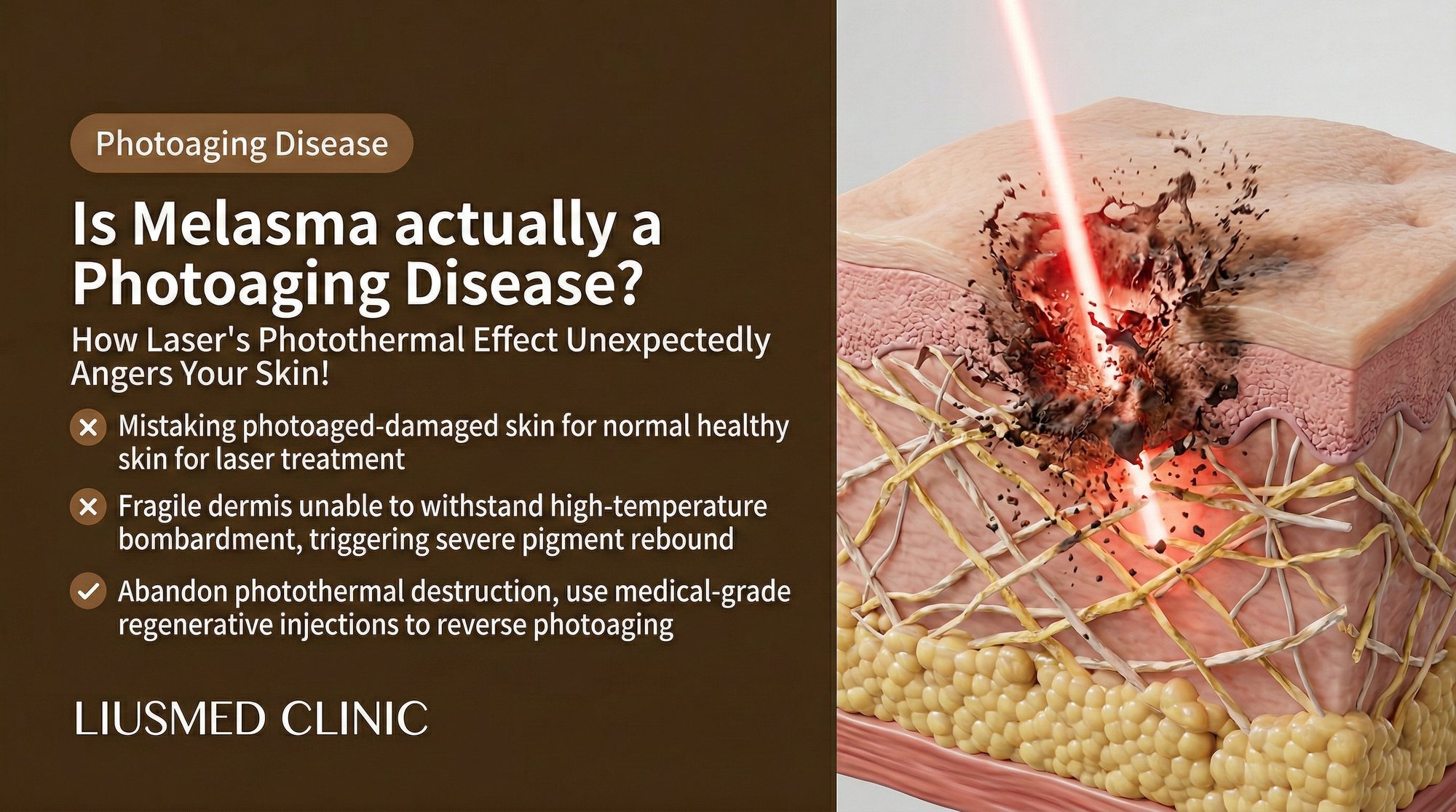
When your dermatologist tells you that the dark patches on your cheeks are melasma, the next sentence is often about laser treatment. It seems logical: lasers target pigment, melasma is pigment, therefore lasers should fix melasma. Yet a growing body of clinical evidence tells a more complicated story—one where the photothermal energy meant to clear pigment can paradoxically inflame the same tissue pathways that caused the pigment to appear in the first place. Understanding why requires a fundamental shift in how we classify melasma: not as a pigmentation disorder, but as a photoaging disease.
Table of Contents
- Reclassifying Melasma: From Pigment Problem to Photoaging Syndrome
- The Photothermal Effect: How Lasers Work on Skin
- The Paradox: When Therapeutic Light Mimics Pathologic Light
- Solar Elastosis, Mast Cells, and Vascular Remodeling
- Clinical Evidence of Laser-Induced Melasma Worsening
- Breaking the Paradox: Non-Photothermal Alternatives
Reclassifying Melasma: From Pigment Problem to Photoaging Syndrome
Traditional dermatology textbooks categorize melasma alongside other pigmentary disorders—freckles, lentigines, post-inflammatory hyperpigmentation. This classification emphasizes the visible symptom (excess melanin) and naturally leads to therapies that target melanin production or destroy existing melanin deposits.
However, histopathological analysis of melasma skin reveals a constellation of changes that extend far beyond melanocyte hyperactivity:
- Solar elastosis: Degenerated elastic fibers in the upper dermis, a hallmark of cumulative UV damage.
- Increased dermal vascularity: Abnormal proliferation of blood vessels in the papillary dermis.
- Basement membrane disruption: Fragmentation of the dermal-epidermal junction (DEJ), allowing melanin to drop into the dermis.
- Elevated mast cell density: Inflammatory cells that release histamine, tryptase, and pro-angiogenic factors.
- Senescent fibroblast accumulation: Dermal cells that have shifted from a regenerative to a pro-inflammatory secretory phenotype.
These features are strikingly similar to what we observe in photoaged skin—skin that has accumulated years of UV-induced structural damage. The melanin excess in melasma is better understood as a downstream consequence of this photoaging process rather than an isolated melanocyte malfunction.
When melasma is reframed as a photoaging disease, the treatment calculus changes dramatically. The question shifts from "how do we destroy the pigment?" to "how do we repair the photodamaged dermal environment that is driving pigment overproduction?"
The Photothermal Effect: How Lasers Work on Skin
All pigment-targeting lasers operate on the principle of selective photothermolysis: a specific wavelength of light is absorbed by a chromophore (in this case, melanin), converting light energy into thermal energy. The rapid heating causes the melanin-containing structure to fragment, and the debris is subsequently cleared by macrophages and lymphatic drainage.
The key variables in this process are:
| Parameter | Role |
|---|---|
| Wavelength | Determines which chromophore absorbs the energy (melanin, hemoglobin, water) |
| Pulse Duration | Shorter pulses confine thermal damage to the target; longer pulses allow heat to spread |
| Fluence | Energy per unit area—higher fluence means more thermal energy delivered |
| Spot Size | Affects depth of penetration and energy distribution |
| Repetition Rate | Multiple passes accumulate thermal load in the tissue |
Q-switched (Q-switched laser) nanosecond lasers and picosecond lasers both target melanin, but with different pulse durations. Picosecond devices generate a greater photomechanical (pressure wave) component relative to photothermal, which proponents argue reduces collateral thermal damage. However, even picosecond lasers still deliver meaningful thermal energy to the dermis, particularly during multi-pass protocols.
The fundamental issue is this: any device that uses light energy to interact with skin tissue generates heat in the dermis. The amount varies, but the thermal load is never zero.
The Paradox: When Therapeutic Light Mimics Pathologic Light
Here is the core paradox of laser treatment for melasma: the disease is driven by chronic light-induced damage to the dermis, and we treat it by delivering more light energy into the same damaged dermis.
UV radiation from sunlight damages dermal tissue through two primary mechanisms:
- Direct DNA damage via UVB absorption.
- Reactive oxygen species (ROS) generation via UVA-mediated photochemical reactions.
Laser treatment, while using different wavelengths, triggers overlapping downstream pathways:
- Thermal stress activates heat-shock proteins (HSPs) in keratinocytes and fibroblasts, triggering cytokine cascades similar to those induced by UV exposure.
- Photothermal energy generates localized ROS in the dermis, contributing to oxidative stress in an already oxidatively compromised tissue.
- Mast cell degranulation occurs in response to both UV exposure and laser-induced thermal perturbation, releasing histamine, tryptase, and VEGF (Vascular Endothelial Growth Factor — new blood vessel signal).
- Melanocyte stimulation can paradoxically increase after sub-lethal thermal exposure, as melanocytes upregulate melanogenesis as a protective response to perceived light-induced threat.
In healthy, non-photoaged skin, these cascades resolve through normal wound-healing pathways. But in melasma skin—where the dermis is already chronically inflamed, the basement membrane is compromised, and senescent fibroblasts are secreting pro-inflammatory factors—the additional thermal insult from laser treatment adds fuel to a fire that never fully extinguished.
The result is the familiar clinical pattern: short-term pigment reduction followed by rebound hyperpigmentation, often darker or more extensive than the original presentation.
Solar Elastosis, Mast Cells, and Vascular Remodeling
Three histological features deserve special attention because they form the structural foundation of the melasma-as-photoaging model, and each is potentially worsened by photothermal treatment.
Solar Elastosis In photoaged skin, normal elastic fibers in the upper dermis are replaced by amorphous, thickened elastotic material. This degraded matrix cannot provide the mechanical signaling that fibroblasts need to maintain a healthy regenerative phenotype. Instead, fibroblasts surrounded by elastotic material are more likely to enter senescence and begin secreting SASP (Senescence-Associated Secretory Phenotype) factors, perpetuating inflammation and melanocyte activation.
Laser-induced thermal injury to the dermis can accelerate elastotic degeneration by denaturing additional collagen and elastic fiber proteins. While some laser advocates argue that controlled thermal injury stimulates "new collagen formation," in melasma-affected dermis, the remodeling response is often disordered—producing more fibrosis than functional repair.
Mast Cell Hyperactivity Mast cells in melasma skin are both more numerous and more easily triggered than in non-lesional skin. Tryptase released by degranulating mast cells activates protease-activated receptor 2 (PAR-2) on keratinocytes, which in turn increases melanosome transfer from melanocytes to keratinocytes—directly darkening the skin. Histamine promotes vascular dilation and permeability, creating the erythematous undertone often visible in melasma patches.
Laser energy is a potent trigger for mast cell degranulation. Even "gentle" low-fluence protocols can activate mast cells in a sensitized dermis.
Vascular Remodeling The increased vascularity in melasma skin is not merely a bystander phenomenon. Vascular endothelial cells secrete endothelin-1 and SCF (Stem Cell Factor), both potent melanocyte activators. VEGF-driven angiogenesis creates a positive feedback loop: more vessels mean more inflammatory cell delivery, more paracrine signaling, and more melanocyte stimulation.
Certain vascular lasers can target aberrant vessels, but the photothermal energy required also affects surrounding dermal tissue. The net effect on the melasma microenvironment depends heavily on the degree of pre-existing dermal damage—a variable that is difficult to assess clinically before treatment.
Clinical Evidence of Laser-Induced Melasma Worsening
Published clinical data supports the paradox described above. Multiple studies and reviews have documented the following patterns:
| Observation | Clinical Significance |
|---|---|
| Post-laser rebound hyperpigmentation in 30-40% of melasma patients | Suggests laser-induced inflammatory cascade re-activates melanocytes |
| Mottled hypopigmentation after repeated low-fluence toning sessions | Indicates cumulative melanocyte damage without addressing root cause |
| Increased MASI scores at 6-month follow-up despite initial improvement | Demonstrates short-term clearance followed by long-term worsening |
| Higher recurrence rates in patients with prominent solar elastosis on biopsy | Confirms photoaging severity as a predictor of laser treatment failure |
| Development of confetti-like depigmentation (guttate hypomelanosis) | Irreversible melanocyte loss from cumulative thermal injury |
These outcomes do not mean lasers are universally harmful for all pigmentary conditions. Discrete solar lentigines, seborrheic keratoses, and some forms of post-inflammatory hyperpigmentation respond well to appropriately calibrated laser therapy. The problem is specific to melasma because melasma involves a fundamentally different tissue pathology—one rooted in chronic photoaging rather than focal melanocyte overactivity.
Breaking the Paradox: Non-Photothermal Alternatives
If the photothermal mechanism is part of the problem, the solution is to treat melasma without adding thermal energy to an already heat-damaged dermis. Several strategies align with this principle:
Intradermal Injection Therapy The Melasma Injection Treatment bypasses the skin surface entirely, delivering anti-inflammatory and tissue-repair agents directly into the affected dermis via precise manual injection. This approach adds zero thermal load while targeting the inflammatory mediators, senescent fibroblasts, and vascular abnormalities that drive melasma. Tranexamic acid, when delivered intradermally, has demonstrated anti-angiogenic and anti-inflammatory effects at the tissue level—not just a surface-level bleaching action.
Oral and Systemic Anti-Inflammatory Support Low-dose oral tranexamic acid has shown efficacy in reducing melasma severity through systemic inhibition of plasminogen activation. When combined with intradermal therapy, the two routes of delivery address both local and systemic contributors to dermal inflammation.
Strict Photoprotection Because melasma is fundamentally a photoaging disease, rigorous broad-spectrum UV and visible light protection is non-negotiable. Tinted sunscreens containing iron oxide block visible light wavelengths (400-700 nm) that conventional UV-only sunscreens miss. Visible light can activate opsin receptors in melanocytes, driving melanogenesis independently of UV exposure.
Topical Barrier Repair While topical agents alone cannot reach deep dermal inflammation, maintaining epidermal barrier integrity reduces transepidermal water loss and limits the penetration of environmental irritants that can trigger inflammatory signaling in the superficial dermis.
The overarching principle is clear: when treating a disease rooted in chronic light-induced tissue damage, adding more light energy is inherently contradictory. A repair-focused strategy that addresses the photoaged dermal environment—without thermal aggravation—offers a more physiologically coherent path to sustained improvement.
Frequently Asked Questions
Q1: Does this mean I should never use any laser on melasma?
Not necessarily. In carefully selected cases with predominantly epidermal pigmentation and minimal dermal photoaging, certain laser protocols may provide benefit. However, for mixed or dermal-dominant melasma—especially when solar elastosis is present—the risk of photothermal aggravation often outweighs the benefit. A thorough evaluation of your skin's dermal health should precede any laser decision.
Q2: What about picosecond lasers? I've been told they are safer for melasma.
Picosecond lasers deliver a higher proportion of photomechanical energy relative to photothermal compared to nanosecond devices. While this may reduce thermal collateral damage, it does not eliminate it. Picosecond treatments still generate heat in the dermis, still trigger mast cell activation, and still carry risk of rebound in photoaged skin. The improvement over nanosecond devices is a matter of degree, not a fundamental change in mechanism.
Q3: How do I know if my melasma is "photoaging-type" versus simple pigmentation?
Clinical clues include: melasma that has been present for many years, a history of significant cumulative sun exposure, visible signs of skin aging (fine lines, textural irregularity, telangiectasia) in the affected area, and a pattern of darkening after heat exposure (not just UV). A dermatologist experienced in melasma can assess dermal involvement through clinical examination and, in some cases, dermoscopy or histological evaluation.
Q4: If melasma is a photoaging disease, will anti-aging treatments help?
Some anti-aging strategies overlap with melasma management—particularly those that reduce oxidative stress, support collagen synthesis, and promote fibroblast health. However, many popular "anti-aging" treatments (fractional lasers, intense pulsed light, radiofrequency) rely on controlled thermal injury to stimulate remodeling, which carries the same paradoxical risk in melasma-prone skin. The key is selecting regenerative approaches that repair without thermal aggravation.
Q5: Can the Melasma Injection Treatment address solar elastosis?
The injection protocol delivers agents that target inflammation, abnormal vascularity, and melanocyte signaling pathways. While it does not reverse established solar elastosis directly, it can modulate the inflammatory consequences of elastotic dermis—reducing SASP signaling, stabilizing mast cells, and promoting healthier fibroblast function. Over time, this shifts the dermal environment from a pro-pigmenting to a more neutral state.
Q6: How important is visible light protection compared to UV protection for melasma?
Extremely important. Research has demonstrated that visible light (particularly blue-violet wavelengths around 400-450 nm) can induce melanogenesis in melanocytes, especially in darker skin types. Standard UV sunscreens do not block visible light. Tinted sunscreens with iron oxide pigments provide this additional protection and are considered essential for melasma management. Combining tinted sunscreen with physical barriers (hats, visors) provides the most comprehensive photoprotection.
About the Author
Dr. Ta-Ju Liu is the founder of Liusmed Clinic in Taipei, Taiwan, where he leads a practice dedicated to regenerative medicine and minimal incision surgery. With dual expertise in dermatology and surgical repair, Dr. Liu developed the clinic's signature repair-over-destruction philosophy after observing that many refractory skin conditions—including melasma, rosacea, and filler complications—share a common root in chronic tissue-level inflammation. His clinical approach prioritizes restoring the skin's native repair mechanisms rather than adding further injury through aggressive interventional techniques.
Disclaimer
This article is provided for educational and informational purposes only and does not constitute medical advice, diagnosis, or treatment. Individual results vary based on skin type, condition severity, and treatment compliance. Always consult a qualified dermatologist or medical professional before beginning any treatment for melasma or other skin conditions. The information presented reflects the clinical perspective of the author and Liusmed Clinic as of the publication date.

Specialties
Credentials
- Kaohsiung Medical University, School of Medicine
- Attending Physician, Dermatology, Kaohsiung Chang Gung Memorial Hospital
- Attending Physician, Aesthetic Center, Kaohsiung Chang Gung Memorial Hospital
- Visiting Physician, Dermatology, Xiamen Chang Gung Hospital
- Visiting Physician, Aesthetic Center, Xiamen Chang Gung Hospital
"For every surgery, I strive to achieve a good outcome through a small incision and refined technique. Minimally invasive surgery is not just a technique — it's a commitment of respect to every patient."
Recovery after any procedure needs peer support too


Want to learn more?
Schedule a consultation for professional evaluation and advice