How Manual Mesotherapy Repairs the Basement Membrane
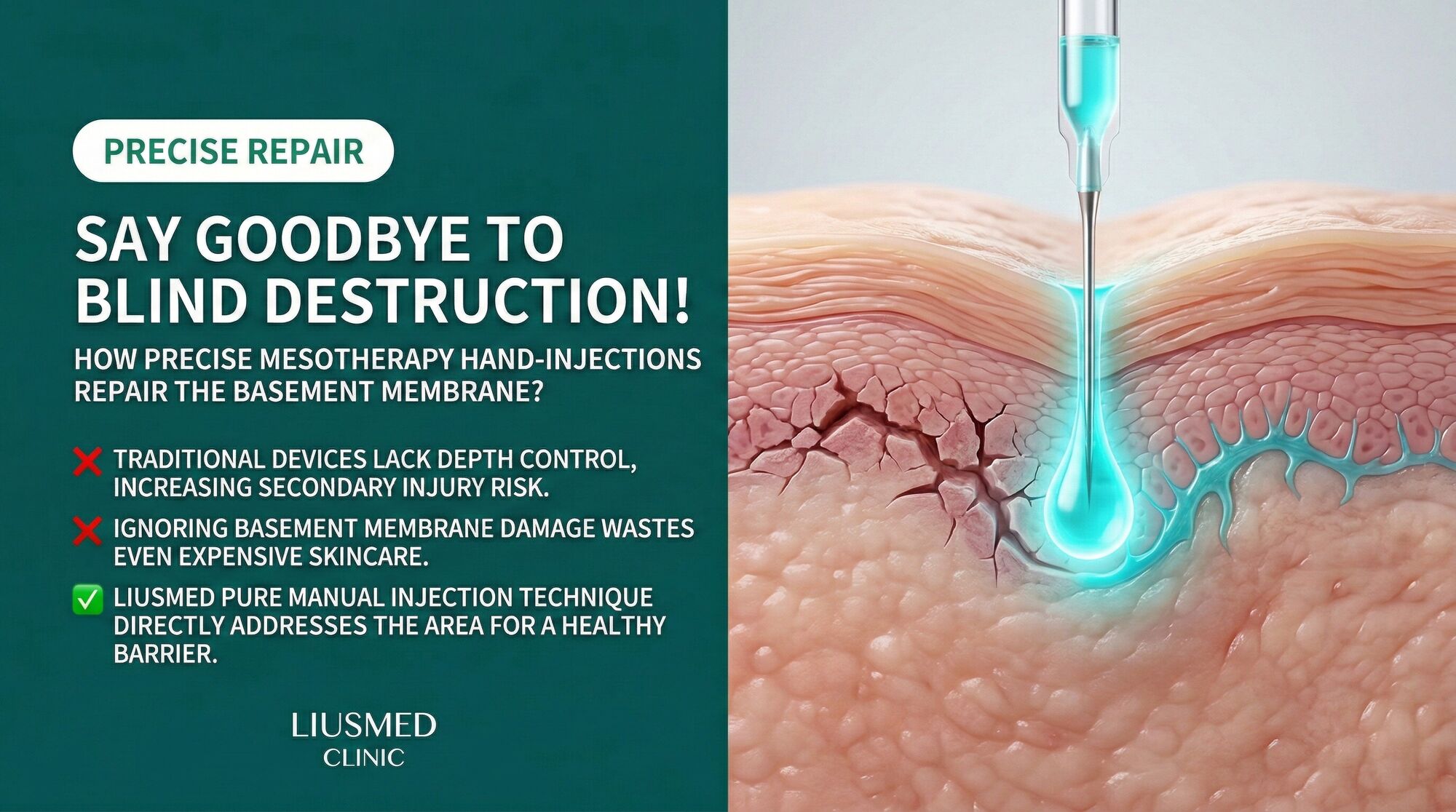
Most rosacea discussions focus on what you can see: the redness, the visible vessels, the papules. But beneath those surface signs lies a structural failure that rarely makes it into the consultation room -- the breakdown of the basement membrane zone. This microscopically thin layer at the boundary between the epidermis and dermis is the gatekeeper of skin architecture. When it fragments, everything above it becomes vulnerable. And no amount of laser energy, topical cream, or oral antibiotic can rebuild it from the outside.
Manual mesotherapy injection offers something fundamentally different: the ability to deliver reparative agents directly into the tissue plane where the damage lives. Not above it. Not below it. Into it.
Table of Contents
- What Is the Basement Membrane and Why Does It Matter in Rosacea
- How Rosacea Degrades the Dermo-Epidermal Junction
- The Logic of Mesotherapy (shallow micro-injection of nutrients/meds): Depth-Specific Delivery
- Key Agents Used for Basement Membrane Restoration
- Manual Technique vs. Automated Delivery: Precision Matters
- Clinical Evidence and Observable Outcomes
What Is the Basement Membrane and Why Does It Matter in Rosacea
The basement membrane zone (BMZ) is a specialized extracellular matrix structure approximately 50 to 100 nanometers thick that sits between the basal keratinocytes of the epidermis and the papillary dermis below. Despite its thinness, it performs several critical functions:
Structural anchorage. The BMZ physically anchors the epidermis to the dermis through a complex system of hemidesmosomes, anchoring filaments (laminin-332 and laminin-511), and anchoring fibrils (collagen VII). When this system is intact, the two tissue layers move as a coordinated unit. When it is disrupted, they begin to separate functionally -- a phenomenon that manifests as skin fragility, increased transepidermal water loss, and impaired barrier function.
Selective permeability. The BMZ acts as a molecular filter, regulating which cells and signaling molecules can pass between the dermis and epidermis. In healthy skin, this prevents inflammatory cells from freely infiltrating the epidermis and keeps dermal growth factors in their appropriate compartment.
Polarity signaling. Basal keratinocytes receive differentiation signals from the BMZ. When the basement membrane is intact, keratinocytes proliferate, differentiate, and migrate in an orderly fashion. When the BMZ is fragmented, epidermal turnover becomes disorganized, contributing to the rough texture and impaired barrier seen in chronic rosacea.
Angiogenesis regulation. The intact BMZ contains anti-angiogenic domains within its collagen IV and collagen XVIII networks. These domains actively suppress blood vessel sprouting into the upper dermis. When the BMZ is degraded, this anti-angiogenic brake is released, contributing to the neovascularization that defines rosacea.
In short, the basement membrane is not a passive boundary. It is an active regulatory structure, and its degradation is a central event in the progression of rosacea from occasional flushing to persistent erythema and structural skin changes.
How Rosacea Degrades the Dermo-Epidermal Junction
The breakdown of the BMZ in rosacea is driven by several converging mechanisms:
Matrix metalloproteinase (MMP) overexpression. Chronic inflammation in rosacea skin upregulates MMP-2 and MMP-9, enzymes that specifically cleave collagen IV, the primary structural component of the basement membrane. UV exposure, which is a common rosacea trigger, further amplifies MMP expression.
Mast cell degranulation. Perivascular mast cells in rosacea release tryptase and chymase, serine proteases that directly degrade BMZ components and activate latent MMPs, creating a cascade of enzymatic destruction.
Cathelicidin-driven inflammation. The overexpression of LL-37 in rosacea skin not only drives inflammation and angiogenesis but also activates fibroblasts and immune cells to release additional proteases that attack the BMZ.
Reduced synthesis. Simultaneously, the fibroblasts responsible for producing new BMZ components (collagen IV, laminin, nidogen, perlecan) become dysfunctional under chronic inflammatory stress. Degradation outpaces production, and the net result is progressive thinning and fragmentation of the BMZ.
Histological studies of rosacea skin consistently show discontinuities in the BMZ when examined with PAS staining or immunofluorescence for collagen IV. These are not subtle findings -- in moderate to severe rosacea, the BMZ can appear segmentally absent rather than merely thinned.
The Logic of Mesotherapy: Depth-Specific Delivery
The fundamental advantage of mesotherapy for BMZ repair is anatomical precision. The target tissue -- the papillary dermis and dermo-epidermal junction -- sits at a depth of approximately 0.1 to 0.5 millimeters from the skin surface. This is:
- Too deep for topical agents to reach in therapeutic concentrations. Even with advanced vehicle systems, most topical formulations penetrate only the stratum corneum and upper epidermis. The BMZ sits below the full thickness of the epidermis.
- Too superficial for standard intradermal injection. Conventional injection techniques place material at 1 to 2 millimeters depth, well into the reticular dermis -- below the target zone.
- Inaccessible to laser energy in any reparative sense. Laser and light devices can destroy structures at various depths but cannot deliver molecules or growth factors to specific tissue planes.
Mesotherapy, performed with proper technique, uses ultra-fine needles (30-32 gauge) inserted at shallow angles to deposit microdroplets of active agents precisely at the papillary dermal level. When performed by skilled hands, each injection point delivers a controlled volume (0.01 to 0.05 mL) into the exact tissue plane where the BMZ interfaces with the upper dermis.
This is not a general "skin rejuvenation" concept. It is targeted delivery to a specific anatomical structure for a specific pathological indication -- the restoration of an extracellular matrix layer that has been destroyed by disease.
Key Agents Used for Basement Membrane Restoration
The Rosacea Injection Treatment at Liusmed Clinic uses a multi-agent formulation designed to address both the degradation and the deficient synthesis of BMZ components:
Platelet-rich plasma (PRP) and platelet lysate therapy (PLT). Concentrated platelet-derived growth factors -- including PDGF (Platelet-Derived Growth Factor — platelet-released cell growth signal), TGF-beta, and EGF (Epidermal Growth Factor) -- stimulate fibroblast production of collagen IV, laminin, and other BMZ components. TGF-beta in particular is a potent inducer of collagen IV synthesis and has been shown to promote BMZ assembly in wound healing models.
Tranexamic acid (TXA). Beyond its anti-angiogenic effects, TXA inhibits plasmin, a protease that activates MMPs. By reducing plasmin activity in the perilesional tissue, TXA helps protect newly synthesized BMZ components from immediate enzymatic destruction -- essentially buying time for repair to take hold.
Hyaluronic acid (low molecular weight). Small-fragment hyaluronic acid serves as a hydration scaffold in the papillary dermis, supporting fibroblast function and creating a microenvironment conducive to extracellular matrix assembly. It also binds CD44 receptors on keratinocytes, promoting organized proliferation.
Dilute botulinum toxin (microbotox). By reducing autonomic nerve-mediated vasodilation and mast cell activation in the treatment zone, microbotox lowers the inflammatory burden that drives ongoing MMP release and BMZ degradation. It creates a calmer tissue environment in which repair can proceed.
The combination is designed to simultaneously suppress destruction (TXA, microbotox), stimulate production (PRP/PLT), and optimize the tissue environment for assembly (hyaluronic acid).
Manual Technique vs. Automated Delivery: Precision Matters
A critical distinction in mesotherapy is how the agents are delivered. Automated meso-guns and injection devices offer speed and consistency but sacrifice the tactile feedback and depth control that manual injection provides.
| Factor | Manual Mesotherapy | Automated Meso-Gun |
|---|---|---|
| Depth control | Continuous tactile feedback; adjusted per injection point | Fixed depth setting; cannot adapt to tissue variation |
| Volume per point | Precisely controlled by thumb pressure | Mechanically fixed; same volume regardless of tissue |
| Tissue response awareness | Operator feels resistance changes in real time | No feedback mechanism |
| Leakage risk | Minimal with proper nappage technique | Higher due to mechanical force and fixed depth |
| Adaptation to facial zones | Angle and depth change for forehead, cheek, nose | Same parameters applied uniformly |
| BMZ-level targeting | Achievable with skilled operator | Difficult to consistently achieve 0.1-0.5mm depth |
Rosacea skin is not uniform. The cheek has different thickness than the forehead. The perinasal area is denser than the perioral region. Inflammatory zones may be edematous and swollen while adjacent areas remain relatively normal. A skilled manual injector reads these tissue variations through the needle and adjusts in real time -- deeper where the dermis is thicker, shallower where it is thinner, slower where resistance indicates fibrosis, and more carefully where the tissue is fragile.
This is why Liusmed Clinic insists on manual injection for the rosacea protocol. The target is too precise and the tissue too variable for a one-size-fits-all mechanical approach.
Clinical Evidence and Observable Outcomes
Patients undergoing mesotherapy-based BMZ repair at Liusmed Clinic are monitored with several objective and subjective measures:
Erythema scoring. Standardized photography under controlled lighting is used to grade erythema severity at each visit. Most patients demonstrate measurable reduction in background erythema by the third to fourth session, consistent with reduced vessel visibility as dermal thickness increases.
Transepidermal water loss (TEWL). TEWL measurements reflect barrier function. Patients with rosacea typically show elevated TEWL compared to unaffected skin. As the BMZ is repaired and epidermal organization improves, TEWL values trend downward -- an objective marker of barrier restoration.
Skin texture and firmness. As collagen deposition in the papillary dermis increases, patients report and clinicians observe improved skin texture, reduced roughness, and increased firmness over the cheeks and midface.
Flushing diary. Patients maintain a flushing diary documenting the frequency, duration, and severity of flushing episodes. The typical pattern is a progressive reduction in flushing frequency beginning around the fourth to sixth week of treatment, with further improvement through the remodeling phase.
Symptom reduction. Stinging, burning, and sensitivity to topical products -- hallmarks of barrier dysfunction -- typically improve earlier than visible redness, often within the first two to three sessions. This likely reflects early improvements in epidermal organization driven by BMZ signaling restoration.
The trajectory is not linear. Some patients experience mild flare-ups during the early loading phase as the tissue responds to injection-induced micro-trauma. These are typically self-limiting and resolve within 48 hours. The overall trend, however, is progressive structural improvement that sustains beyond the active treatment period -- because the repair is architectural, not cosmetic.
For patients seeking a treatment that addresses rosacea at the tissue level rather than the surface level, the Rosacea Injection Treatment at Liusmed Clinic offers a mesotherapy-based approach designed to rebuild what the disease has broken.
Frequently Asked Questions
Q1: How deep does the mesotherapy needle actually go during treatment?
For basement membrane-targeted mesotherapy, the injection depth ranges from approximately 0.1 to 0.5 millimeters, depending on the facial zone and the individual patient's skin thickness. This places the active agents at the papillary dermal level, directly adjacent to the dermo-epidermal junction. The treating physician adjusts depth continuously based on tactile feedback from the needle.
Q2: Is basement membrane damage visible on standard dermatological examination?
Not typically. Basement membrane fragmentation is a histological finding that requires biopsy and specialized staining (PAS, collagen IV immunofluorescence) to visualize directly. However, the clinical consequences of BMZ damage -- persistent erythema, skin fragility, elevated transepidermal water loss, and sensitivity -- are readily apparent during examination and serve as reliable indirect indicators.
Q3: How long does it take for the basement membrane to rebuild after starting treatment?
Collagen IV synthesis and BMZ reassembly is a gradual biological process. Initial improvements in barrier function (reduced sensitivity, lower TEWL) can appear within two to four weeks. Measurable structural remodeling, as reflected in dermal thickness and erythema reduction, typically requires eight to sixteen weeks of consistent treatment. Full maturation of newly deposited extracellular matrix may continue for several months after the active treatment phase.
Q4: Can topical retinoids help repair the basement membrane, or is injection necessary?
Topical retinoids do stimulate collagen production and can modestly improve dermal thickness over extended use. However, their penetration to the BMZ level is limited, and they can cause significant irritation in rosacea-prone skin, often worsening inflammation before any structural benefit occurs. Mesotherapy bypasses the epidermal barrier entirely, delivering therapeutic concentrations directly to the target tissue without surface irritation.
Q5: Will the repaired basement membrane degrade again after I stop treatment?
Rosacea is a chronic condition, and the inflammatory processes that drive BMZ degradation are never fully extinguished. However, a structurally restored BMZ is more resilient than a fragmented one. Patients who complete the full treatment protocol typically maintain their improvement for extended periods, especially with appropriate trigger avoidance and skincare. Periodic maintenance sessions (two to four per year) may be recommended to sustain the structural gains.
Q6: Is this treatment appropriate for rosacea patients who also have eczema or atopic dermatitis?
Patients with concurrent eczema and rosacea present unique challenges because both conditions involve barrier dysfunction, but through different mechanisms. The mesotherapy protocol can be adapted for these patients, but careful formulation adjustment is required. A thorough evaluation during consultation determines whether combined treatment is appropriate or whether the conditions should be addressed sequentially.
About the Author
Dr. Ta-Ju Liu is the founder of Liusmed Clinic, where he leads a practice dedicated to regenerative medicine and minimal incision surgery. His work on mesotherapy-based dermal repair for rosacea draws on deep expertise in extracellular matrix biology, growth factor therapeutics, and manual injection technique. Dr. Liu's clinical philosophy prioritizes structural tissue restoration over symptomatic suppression, aiming to rebuild the skin's architecture rather than merely mask its dysfunction.
Disclaimer
This article is provided for educational and informational purposes only and does not constitute medical advice, diagnosis, or treatment. Individual results may vary based on disease severity, treatment adherence, and individual biological response. The basement membrane repair protocol described here reflects the clinical approach used at Liusmed Clinic and may not be available at other facilities. Always consult a qualified healthcare provider before beginning any new treatment for rosacea or other dermatological conditions.
Specialties
Credentials
- Kaohsiung Medical University, School of Medicine
- Attending Physician, Dermatology, Kaohsiung Chang Gung Memorial Hospital
- Attending Physician, Aesthetic Center, Kaohsiung Chang Gung Memorial Hospital
- Visiting Physician, Dermatology, Xiamen Chang Gung Hospital
- Visiting Physician, Aesthetic Center, Xiamen Chang Gung Hospital
"For every surgery, I strive to achieve a good outcome through a small incision and refined technique. Minimally invasive surgery is not just a technique — it's a commitment of respect to every patient."
Recovery after any procedure needs peer support too


Want to learn more?
Schedule a consultation for professional evaluation and advice