Microneedling vs Manual Injection for Melasma: Why 'Hand Injection' Is More Precise
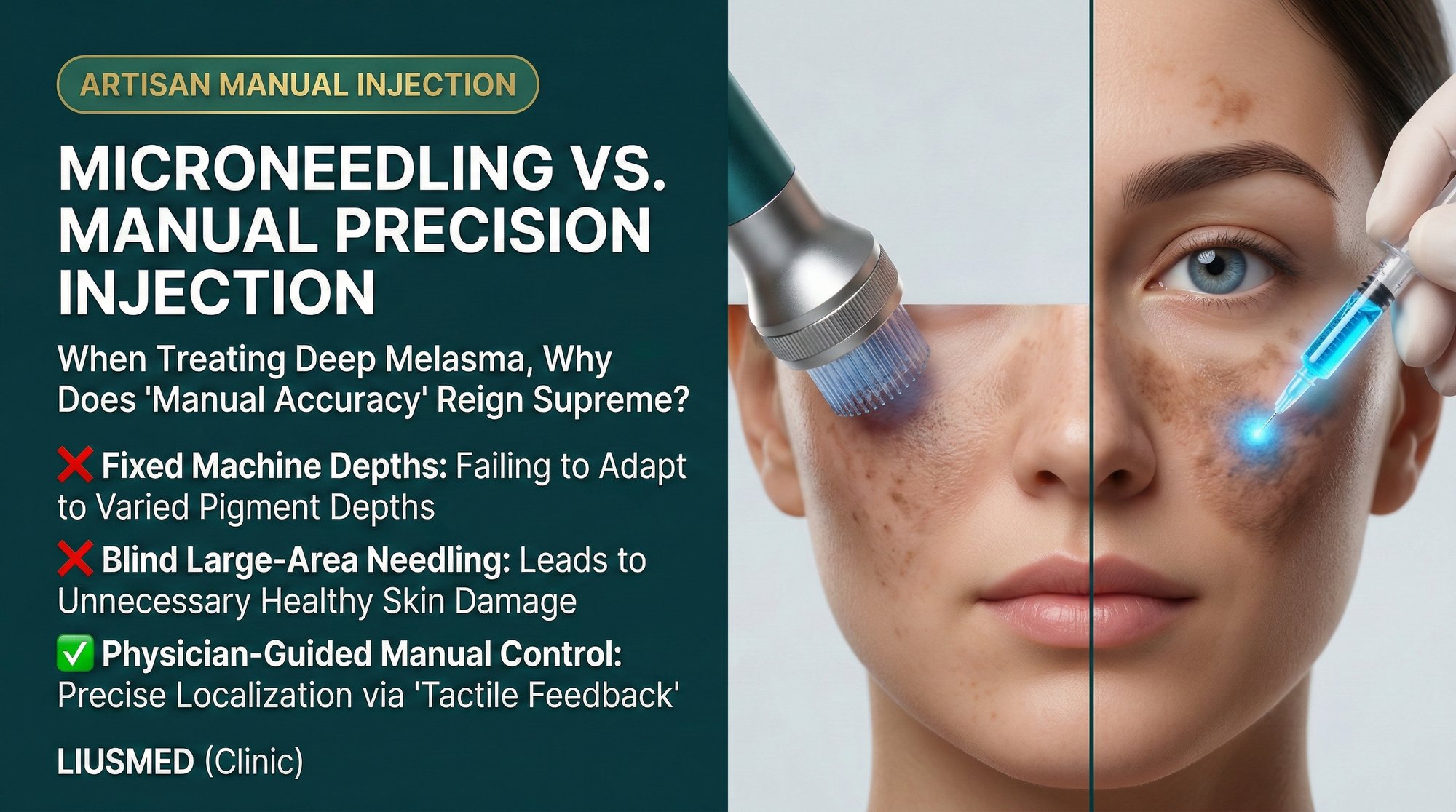
When it comes to delivering therapeutic agents beneath the skin surface for melasma treatment, two main approaches dominate the conversation: microneedling (automated or manual roller devices that create hundreds of microchannels) and manual intradermal injection (hand-held syringe technique where the physician places product at specific depths). Both methods bypass the epidermal barrier. Both can deliver active ingredients to the dermis. But for a condition as nuanced as melasma—where the pathology varies in depth, severity, and inflammatory activity from zone to zone across a single patient's face—the precision of manual hand injection offers measurable advantages over the uniform, broad-field approach of microneedling.
This article compares the two techniques in detail, explains why precision matters for melasma specifically, and outlines the clinical reasoning behind Liusmed Clinic's preference for manual injection.
Table of Contents
- How Microneedling (fine-needle skin stimulation) Works: Strengths and Limitations
- How Manual Intradermal Injection Works
- Why Melasma Demands Variable-Depth Precision
- Head-to-Head Comparison: Microneedling vs. Manual Injection
- The Trauma Question: Less Is More in Inflamed Skin
- When Microneedling May Still Have a Role
How Microneedling Works: Strengths and Limitations
Microneedling devices—whether manual dermarollers, motorized pens (e.g., Dermapen), or fractional radiofrequency microneedling systems—work by puncturing the skin with an array of fine needles at rapid speed. The primary mechanisms include:
Channel Creation for Drug Delivery Each needle puncture creates a transient microchannel through the epidermis and into the upper dermis. When a topical serum is applied during or immediately after microneedling, a portion of the product diffuses through these channels into the dermis—achieving deeper penetration than topical application alone.
Wound-Healing Stimulation The controlled micro-injuries trigger a wound-healing cascade: platelet activation, growth factor release, fibroblast recruitment, and new collagen synthesis. This remodeling response is the basis of microneedling's efficacy for scars, fine lines, and skin rejuvenation.
Limitations Specific to Melasma
The strengths of microneedling in general dermatology become liabilities when applied to melasma:
-
Uniform needle depth: Microneedling devices are set to a single depth across the entire treatment zone. Melasma pathology, however, varies—some areas may have predominantly epidermal involvement at 0.1-0.2 mm, while adjacent zones have dermal involvement at 0.5-1.0 mm. A single depth setting cannot optimally address both.
-
Uncontrolled drug distribution: Product applied topically during microneedling distributes passively through microchannels. The physician cannot control how much product reaches any specific depth or location. Highly vascular areas may absorb product faster; thicker-skinned areas may receive less.
-
Broad-field micro-trauma: Hundreds to thousands of needle punctures create widespread micro-inflammation across the entire treated surface. In melasma skin—where chronic dermal inflammation is a root cause of the disease—adding diffuse micro-trauma carries the risk of triggering inflammatory melanogenesis.
-
Bleeding dilutes active ingredients: At needle depths beyond 0.5 mm, microneedling commonly causes pinpoint bleeding. Blood mixing with the applied serum dilutes the active concentration and may interfere with drug uptake.
How Manual Intradermal Injection Works
Manual intradermal injection (also called hand injection or nappage technique in mesotherapy terminology) uses a fine-gauge needle (typically 30-32 gauge) attached to a syringe. The physician inserts the needle at a controlled angle and depth, depresses the plunger to deliver a precise volume of solution, withdraws, and moves to the next injection point.
The technique allows real-time control over three critical variables:
1. Depth of Delivery The physician adjusts needle insertion angle and depth at each injection point. For an area where the target is the superficial papillary dermis (0.2-0.3 mm), the needle is angled almost parallel to the skin surface. For deeper reticular dermal targets, the angle increases. This adjustment happens dynamically as the physician moves across the treatment area.
2. Volume per Injection Point The amount of solution deposited at each point is controlled by how far the plunger is depressed. The physician can deliver 0.01 mL at one point and 0.05 mL at another, depending on the local tissue need. High-concentration areas receive more product; areas requiring less intervention receive less.
3. Spacing and Pattern The distance between injection points is determined by the physician in real time, based on the distribution and severity of the melasma. Dense, closely-spaced injections for heavily affected zones; wider spacing for transitional areas. This creates a treatment map that mirrors the heterogeneous distribution of melasma rather than imposing a uniform grid.
Why Melasma Demands Variable-Depth Precision
Melasma is not a uniform disease. Even within a single patch on one cheek, histological examination reveals:
- Zones of primarily epidermal pigmentation with relatively intact DEJ (Dermal-Epidermal Junction)
- Zones of mixed pigmentation with partial DEJ damage and early dermal melanin deposition
- Zones of dermal-dominant pigmentation with significant DEJ fragmentation, melanophage accumulation, and dermal vascular changes
- Transitional borders where melasma blends into normal skin
This heterogeneity means that the optimal treatment depth, drug concentration, and level of intervention varies across the affected area. A technique that delivers the same depth, same concentration, and same level of micro-trauma everywhere is, by definition, suboptimal for most of the treatment zone—too deep for some areas, too superficial for others, too aggressive for mildly affected borders, insufficient for densely pigmented central zones.
The Melasma Injection Treatment protocol at Liusmed Clinic leverages this principle. Before treatment, the physician maps the melasma topography—identifying zones of different depth and severity through clinical examination and, where indicated, dermoscopic evaluation. The injection protocol is then customized spatially, with different depths, volumes, and concentrations applied to different zones within the same treatment session.
This level of spatial customization is only possible with manual hand injection. No automated microneedling device offers equivalent real-time, point-by-point adjustment.
Head-to-Head Comparison: Microneedling vs. Manual Injection
| Parameter | Microneedling | Manual Intradermal Injection |
|---|---|---|
| Depth Control | Single preset depth across entire zone | Variable depth adjusted per injection point |
| Volume Control | Passive diffusion—uncontrolled per point | Precise volume delivered per injection point |
| Drug Concentration at Target | Diluted by blood, distributed unpredictably | Concentrated at intended depth and location |
| Spatial Customization | Uniform grid pattern | Physician-determined pattern matching lesion topography |
| Number of Skin Punctures | Hundreds to thousands per cm² | Tens per cm² (only where needed) |
| Micro-Trauma Load | High—broad-field micro-injury | Low—minimal punctures at targeted locations |
| Inflammatory Risk | Higher due to diffuse micro-wounding | Lower due to fewer, more intentional punctures |
| Operator Skill Requirement | Moderate—device does most of the work | High—requires trained hand technique and melasma knowledge |
| Treatment Time | Faster for large areas | Slower—each point is individually placed |
| Bleeding | Common at depths >0.5 mm | Minimal with proper technique at papillary dermal depth |
| Post-Treatment Downtime | Diffuse redness, swelling 24-72 hours | Pinpoint marks, typically resolve within hours |
| Cost of Equipment | Device purchase required | Standard syringe and needle—minimal equipment cost |
The trade-off is clear: microneedling is faster and requires less operator skill, while manual injection is slower but offers dramatically greater precision. For a condition like melasma, where precision determines whether you treat the disease or inadvertently aggravate it, the additional time investment is clinically justified.
The Trauma Question: Less Is More in Inflamed Skin
One of the most important yet underappreciated distinctions between microneedling and manual injection is the total trauma load imposed on the tissue.
Microneedling at a standard clinical density creates approximately 250-300 punctures per square centimeter (for a device with 12 needles operating at moderate speed across a single pass). Over a typical melasma treatment area of 20-30 cm², this translates to 5,000 to 9,000 micro-wounds per session.
Each micro-wound triggers a local inflammatory response: platelet activation, neutrophil recruitment, cytokine release, and eventually fibroblast activation for repair. In healthy skin undergoing rejuvenation treatment, this inflammatory cascade is the desired therapeutic mechanism—it stimulates collagen remodeling and tissue renewal.
In melasma skin, this cascade is counterproductive. The dermis is already chronically inflamed. Mast cells are already hypersensitive. Fibroblasts are already skewed toward inflammatory senescent phenotypes. Adding thousands of micro-inflammatory foci across the entire treatment area risks:
- Mast cell degranulation: Releasing histamine and tryptase that directly stimulate melanogenesis.
- Post-inflammatory melanocyte activation: The wound-healing cascade includes melanocyte-stimulating signals (endothelin-1, SCF, alpha-MSH) that can trigger rebound pigmentation.
- MMP (Matrix Metalloproteinase) release: The wound-healing process upregulates MMP expression, potentially further degrading the already compromised basement membrane.
Manual injection, by contrast, creates only 20 to 50 punctures per square centimeter at targeted locations. The total trauma load is an order of magnitude lower. Each puncture delivers concentrated therapeutic agent rather than merely creating a channel for passive diffusion. The net inflammatory impact on the tissue is dramatically reduced—allowing the anti-inflammatory agents being delivered to work without being overwhelmed by treatment-induced inflammation.
This principle—minimizing iatrogenic trauma in tissue that is already inflamed—is a cornerstone of the repair-over-destruction philosophy that guides the Melasma Injection Treatment approach.
When Microneedling May Still Have a Role
Intellectual honesty requires acknowledging that microneedling is not without merit in the broader context of skin health, even for patients with melasma:
Post-Stabilization Skin Quality Enhancement After the active inflammatory phase of melasma has been controlled through injection therapy and the DEJ has been stabilized, gentle microneedling (shallow depth, low density) may be considered for overall skin texture improvement. The key is sequencing: repair first, rejuvenate second.
Non-Melasma Zones on the Same Face A patient with melasma on the cheeks may also have acne scarring on the temples or forehead. Microneedling may be appropriate for the scarred areas (where collagen remodeling is the goal) while manual injection addresses the melasma zones (where anti-inflammatory precision is the priority). Applying the right tool to the right area, rather than one tool everywhere, exemplifies the personalized approach.
Drug-Free Microneedling for Barrier Function Very superficial microneedling (0.25-0.5 mm) without drug application—sometimes called "dry needling"—creates minimal dermal penetration and primarily stimulates epidermal turnover and barrier function. This may complement a melasma treatment program without significant inflammatory risk, though evidence specific to melasma is limited.
Patient Access Considerations In settings where trained manual injection specialists are not available, microneedling with appropriate drug cocktails may represent the best available alternative. A suboptimal delivery method with a good therapeutic agent is better than no treatment at all. However, patients should understand the limitations and be monitored for signs of inflammatory rebound.
Frequently Asked Questions
Q1: Is manual injection painful? How does it compare to microneedling?
Both procedures involve needles and some discomfort. Microneedling is typically preceded by topical numbing cream (applied 30-45 minutes before treatment), and most patients describe a vibrating, prickling sensation. Manual injection also uses topical anesthesia and involves a brief pinch at each injection point. Many patients find manual injection more tolerable than expected because the total number of punctures is much lower than microneedling—dozens versus thousands.
Q2: How many manual injection sessions are typically needed for melasma?
Treatment frequency and duration depend on melasma severity, depth, and duration. Most patients at Liusmed Clinic undergo a series of four to eight sessions spaced two to four weeks apart for the initial treatment phase, followed by maintenance sessions at longer intervals. This contrasts with microneedling protocols that may require six to twelve sessions due to less efficient drug delivery per session.
Q3: Can I do microneedling at home with a dermaroller and add melasma serums?
Home dermarollers (typically 0.25-0.5 mm needle length) create very superficial channels that primarily enhance epidermal penetration. They do not reach the mid-dermis where melasma pathology resides. Additionally, the sterility, needle quality, and technique of home devices are not comparable to clinical settings. For melasma specifically, home microneedling is unlikely to deliver meaningful benefit and carries risks of irritation and infection if performed improperly.
Q4: What ingredients are used in the manual injection for melasma?
The specific formulation varies based on the individual patient's melasma characteristics. Common components in the Melasma Injection Treatment protocol include tranexamic acid (anti-inflammatory, anti-angiogenic), various peptides and growth factors (to support DEJ repair and modulate fibroblast activity), and antioxidants. The exact combination and concentration are adjusted based on the physician's assessment of each patient's inflammatory status, pigment depth, and treatment response.
Q5: Why don't more clinics offer manual injection for melasma if it is superior?
Manual intradermal injection requires significantly more operator skill and training than microneedling. The physician must understand melasma pathophysiology at a tissue level, be able to assess pigment depth clinically, and possess the hand technique to deliver precise volumes at controlled depths across heterogeneous skin. This is a specialized skill set that not all practitioners have developed. Additionally, manual injection is more time-intensive per session, which affects practice throughput—a business consideration that, unfortunately, can influence treatment selection.
Q6: Can radiofrequency microneedling (like Morpheus8 or Potenza) work for melasma?
Radiofrequency (RF) microneedling adds thermal energy at the needle tip to the mechanical puncture of standard microneedling. For melasma, this is doubly problematic: you get both the broad-field micro-trauma of microneedling and the thermal load of RF (Radiofrequency — radiofrequency heat for collagen tightening) energy in a dermis that is already chronically inflamed. RF microneedling is designed for skin tightening and collagen remodeling—not for inflammatory skin conditions. Using it on active melasma carries a high risk of post-inflammatory hyperpigmentation and disease exacerbation.
About the Author
Dr. Ta-Ju Liu is the founder of Liusmed Clinic in Taipei, Taiwan, where he leads a practice dedicated to regenerative medicine and minimal incision surgery. With dual expertise in dermatology and surgical repair, Dr. Liu developed the clinic's signature repair-over-destruction philosophy after observing that many refractory skin conditions—including melasma, rosacea, and filler complications—share a common root in chronic tissue-level inflammation. His clinical approach prioritizes restoring the skin's native repair mechanisms rather than adding further injury through aggressive interventional techniques.
Disclaimer
This article is provided for educational and informational purposes only and does not constitute medical advice, diagnosis, or treatment. Individual results vary based on skin type, condition severity, and treatment compliance. Always consult a qualified dermatologist or medical professional before beginning any treatment for melasma or other skin conditions. The information presented reflects the clinical perspective of the author and Liusmed Clinic as of the publication date.

Specialties
Credentials
- Kaohsiung Medical University, School of Medicine
- Attending Physician, Dermatology, Kaohsiung Chang Gung Memorial Hospital
- Attending Physician, Aesthetic Center, Kaohsiung Chang Gung Memorial Hospital
- Visiting Physician, Dermatology, Xiamen Chang Gung Hospital
- Visiting Physician, Aesthetic Center, Xiamen Chang Gung Hospital
"For every surgery, I strive to achieve a good outcome through a small incision and refined technique. Minimally invasive surgery is not just a technique — it's a commitment of respect to every patient."
Recovery after any procedure needs peer support too


Want to learn more?
Schedule a consultation for professional evaluation and advice