Nose Filler Shifted or Widened? Causes and Correction Options
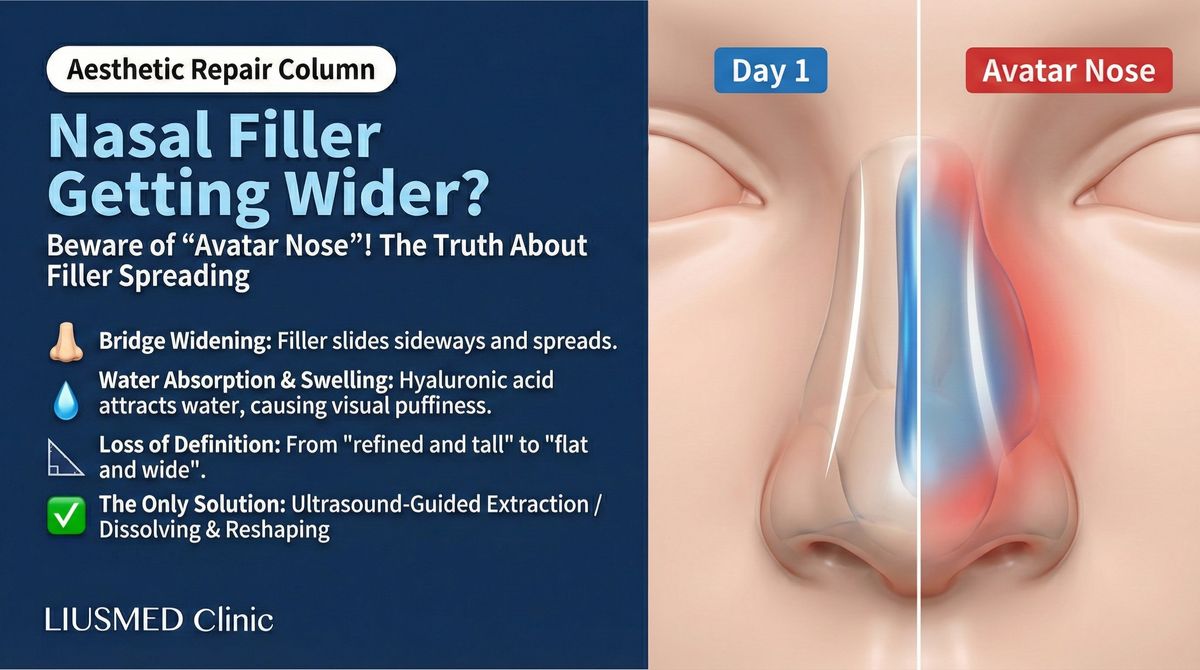
Why Does Nose Filler Shift and Widen Over Time?
Non-surgical rhinoplasty with dermal fillers has become one of the most popular cosmetic procedures worldwide. The appeal is obvious: no surgery, no downtime, and instant results. But for a growing number of patients, the initial improvement gradually transforms into a wider, flatter, or asymmetric nose that looks nothing like what they originally wanted.
Filler migration in the nose is one of the most common reasons patients seek filler revision. Understanding why it happens—and what can be done about it—is essential for anyone considering correction.
How Does Nose Filler Migration Happen?
The Anatomy Problem
The nose presents unique challenges for filler placement:
| Anatomical Factor | Why It Causes Migration |
|---|---|
| Tight skin envelope | Limited space pushes filler laterally under pressure |
| Mobile soft tissue | The nose moves with every facial expression |
| Gravity | Filler naturally tends to settle downward and outward |
| Thin dorsal skin | Little subcutaneous tissue to anchor filler |
| Vascular risk zone | Limits how much and where filler can be safely placed |
The Mechanism of Migration
When filler is injected into the nasal dorsum (bridge), it is placed between the periosteum (bone covering) and the skin. Over time, several forces act on this filler:
- Gravity: Pulls filler inferiorly and laterally
- Muscle movement: Every smile, laugh, and expression applies force
- Tissue compression: Sleeping on one side, wearing glasses, or touching the nose
- Hydrophilic expansion: HA (Hyaluronic Acid — sugar molecule naturally in skin, holds water) fillers absorb water and swell over months
- Repeated injections: Layering filler on top of previous sessions compounds the effect
The result is a gradual lateral spread that transforms a narrow, defined bridge into a broader, less defined structure.
Key Insight: Migration does not happen overnight. It is a gradual process over months to years, which is why many patients do not notice it until it becomes pronounced. Comparing current photos to pre-injection images often reveals the extent of the change.
The "Avatar Nose" Phenomenon
What Is It?
The term "Avatar nose" describes the characteristic appearance of extensive nose filler migration:
- Widened bridge: The nose appears broader from the front view
- Loss of definition: The sharp lines of the nasal dorsum become blurred
- Lateral spread: Filler has migrated to the sides, creating a plateau-like appearance
- Puffy appearance: Water absorption by HA makes the area look swollen
- Profile distortion: From the side, the nose may appear overprojected or unnatural
Why Does It Keep Getting Worse?
Many patients return for "touch-up" injections when they notice their nose filler is fading or shifting. Each additional session adds more material to an already compromised area:
| Injection Session | Cumulative Effect |
|---|---|
| 1st session | Initial improvement, natural appearance |
| 2nd session | Slight widening may begin, still acceptable |
| 3rd session | Widening becomes noticeable, definition decreasing |
| 4th+ sessions | Avatar nose appearance, significant lateral spread |
Each layer of filler pushes the previous layers outward. The tissue envelope stretches, accommodating more and more material. Without dissolution or extraction of old filler before re-injection, the problem compounds with every visit.
Dr. Liu explains: "The most important thing patients need to understand is that nose filler does not simply disappear when it 'wears off.' It migrates, spreads, and accumulates. Patients who have had multiple sessions over years often have far more filler in their nose than they realize."
Which Fillers Are Most Prone to Nose Migration?
Comparison by Material
| Filler Type | Migration Risk | Mechanism |
|---|---|---|
| Hyaluronic acid (HA) | High | Water absorption causes swelling and lateral spread |
| Radiesse (CaHA) | Moderate | Less hydrophilic but can still shift |
| Sculptra (PLLA) | Moderate | Collagen stimulation can create diffuse widening |
| Ellansé (PCL) | Moderate | Less predictable long-term tissue response |
| Silicone | Very high | Permanent, progressive migration over years |
HA fillers are the most commonly used for nose augmentation and also the most prone to migration due to their hydrophilic nature. Over time, HA absorbs tissue water and expands, pushing against the tight nasal skin envelope and spreading laterally.
The Collagen Stimulator Problem
Fillers like Sculptra and Ellanse present a different challenge. Rather than migrating as a gel, they stimulate the body to produce collagen in the injected area. If the collagen grows asymmetrically or excessively, the result can be a diffusely widened nose that is harder to correct than simple HA migration.
How Is Nose Filler Migration Diagnosed?
Clinical Assessment
A thorough evaluation includes:
- Visual comparison: Current appearance versus pre-injection photos
- Palpation: Assessing filler distribution, firmness, and extent
- Profile analysis: Evaluating projection, width, and symmetry
- Patient history: Number of sessions, filler types, injection dates, volumes
Ultrasound Evaluation
High-frequency ultrasound is the definitive diagnostic tool for nose filler migration:
| Information | Why It Matters |
|---|---|
| Filler mapping | Shows exactly where filler has spread |
| Layer identification | Determines which tissue plane the filler occupies |
| Volume estimation | Quantifies how much material needs to be removed |
| Filler type clues | Different materials have different echo characteristics |
| Vascular assessment | Identifies critical blood vessels before any intervention |
Ultrasound often reveals filler in locations far from the original injection site, including the lateral nasal walls, glabella, and even the periorbital area.
Correction Options for Nose Filler Migration
Option 1: Hyaluronidase (enzyme that dissolves HA filler) Dissolution (HA Only)
For patients with recent HA filler migration:
| Advantage | Limitation |
|---|---|
| Non-surgical | Only works on HA fillers |
| Quick procedure | May require multiple sessions |
| No incisions | Cannot selectively dissolve migrated vs. well-placed filler |
| Cost-effective | May dissolve native tissue HA, causing temporary depression |
Important limitations:
- Hyaluronidase dissolves all HA in the treated area—both migrated and well-placed filler
- Multiple sessions may be needed to dissolve all accumulated filler
- The nose may appear significantly deflated after dissolution, requiring time before reassessment
- Not effective for non-HA fillers (Radiesse, Sculptra, Ellanse, silicone)
Option 2: Ultrasound-Guided Extraction
For comprehensive correction, especially with:
- Non-HA fillers
- Failed dissolution attempts
- Long-standing filler accumulation
- Mixed filler types
The Extraction Approach:
- Ultrasound mapping: Comprehensive pre-operative assessment of all filler locations
- Strategic entry points: Pinhole incisions (< 1.5mm) placed in concealed locations—inside the nostril or along the alar crease
- Selective removal: Under real-time ultrasound guidance, migrated filler is targeted and extracted while preserving well-positioned tissue
- Symmetry confirmation: Both sides are assessed and corrected for balanced results
- Completeness check: Post-extraction ultrasound verifies adequate removal
Option 3: Combined Approach
In many cases, the best result comes from combining dissolution and extraction:
- Dissolve first: Hyaluronidase breaks down accessible HA deposits
- Wait and assess: Allow 2–4 weeks for swelling to resolve
- Extract remaining: Ultrasound-guided extraction removes encapsulated or non-HA material
- Final assessment: Evaluate the natural nose shape after all foreign material is removed
What to Expect After Nose Filler Removal
Recovery Timeline
| Period | What to Expect |
|---|---|
| Day 1–3 | Moderate swelling, possible bruising, nasal congestion |
| Week 1 | Swelling begins to resolve, follow-up assessment |
| Week 2–4 | Nose shape refining as tissue contracts |
| Month 1–3 | Continued tissue remodeling, nose narrowing |
| About 3 months | Close to the final result (varies by person); evaluate if further treatment is needed |
Will My Nose Look Flat After Removal?
This is the most common concern. The answer depends on how much filler has been accumulating:
- Minimal accumulation (1–2 sessions): The nose often returns close to its pre-injection shape
- Moderate accumulation (3–4 sessions): Some tissue stretching may have occurred; the nose may appear slightly wider than the original baseline initially, but tissue contracts over 3–6 months
- Extensive accumulation (5+ sessions over years): The tissue envelope may have permanently stretched to some degree; the nose will improve dramatically but may not return to the exact pre-injection state
Dr. Liu's perspective: "Patients are often surprised by how much better their nose looks after filler removal. The widening happens so gradually that they forget what their natural nose looked like. When we remove the migrated filler, the tissue contracts and the nose narrows significantly over the following months."
Can I Have Nose Filler Again After Correction?
If You Want to Re-Inject
Once the tissue has fully settled (at least about 3 months, after a doctor's assessment), re-injection is possible, but several principles should be followed:
| Principle | Rationale |
|---|---|
| Full removal first | Remove all old filler before placing new |
| Conservative volume | Use less than before; the nose does not need large volumes |
| Firmer products | Higher-viscosity HA resists migration better |
| Periosteal placement | Deep placement on bone reduces lateral spread |
| Single session | Avoid accumulative layering over multiple sessions |
| Regular monitoring | Follow up with ultrasound to detect early migration |
Alternative: Surgical Rhinoplasty
For patients who have experienced repeated filler complications, surgical rhinoplasty may offer a more permanent and predictable solution. This is a personal decision that should be discussed with a qualified surgeon after all filler has been removed and the tissue has fully recovered.
Frequently Asked Questions
How do I know if my nose filler has migrated?
Compare your current front-view and profile photos to images taken before your first filler session. Key signs include: widened bridge, loss of shadow definition along the nasal sides, puffy or swollen appearance, and a broader nose from the front view.
Can migrated nose filler cause breathing problems?
In rare cases, extensive filler migration can cause mild nasal obstruction. If you notice changes in your breathing after nose filler, this should be assessed promptly.
Is nose filler removal painful?
The procedure is done under local anesthesia plus gentle pain-relief anesthesia, and you can still talk with the doctor and pause at any time. Post-procedure discomfort is usually mild, though it varies from person to person.
How many sessions are needed for nose filler removal?
Most cases can be addressed in one to two sessions. HA dissolution may require an initial dissolution session followed by extraction of any remaining material 2–4 weeks later. Non-HA fillers typically require a single extraction session.
Restore Your Natural Nose Shape
If your nose has widened, shifted, or lost its definition after filler injections, the problem is solvable. An ultrasound evaluation reveals exactly how much filler is present and where it has migrated, enabling a precise and effective correction plan.
Schedule a consultation for a comprehensive nose filler assessment.
Contact us to book your evaluation
About the Author
Dr. Ta-Ju Liu
- Current Position: Director, Liusmed Clinic
- Specialties: Minimally invasive surgery (lipoma, cyst), hyperhidrosis surgery, thread lifting, filler complication repair
- Experience:
- 15+ years of clinical minimally invasive surgery experience
- Over 10,000 successful minimally invasive cases
- Board-certified dermatologist
- Philosophy: "Nose filler migration is the most common filler complication I treat. The key is thorough removal guided by ultrasound, followed by allowing the tissue to recover naturally before considering any future treatment."
Related Services

Specialties
Credentials
- Kaohsiung Medical University, School of Medicine
- Attending Physician, Dermatology, Kaohsiung Chang Gung Memorial Hospital
- Attending Physician, Aesthetic Center, Kaohsiung Chang Gung Memorial Hospital
- Visiting Physician, Dermatology, Xiamen Chang Gung Hospital
- Visiting Physician, Aesthetic Center, Xiamen Chang Gung Hospital
"For every surgery, I strive to achieve a good outcome through a small incision and refined technique. Minimally invasive surgery is not just a technique — it's a commitment of respect to every patient."
Recovery after any procedure needs peer support too


Want to learn more?
Schedule a consultation for professional evaluation and advice