Why Rosacea Returns a Month After Pulsed Dye Laser (PDL)
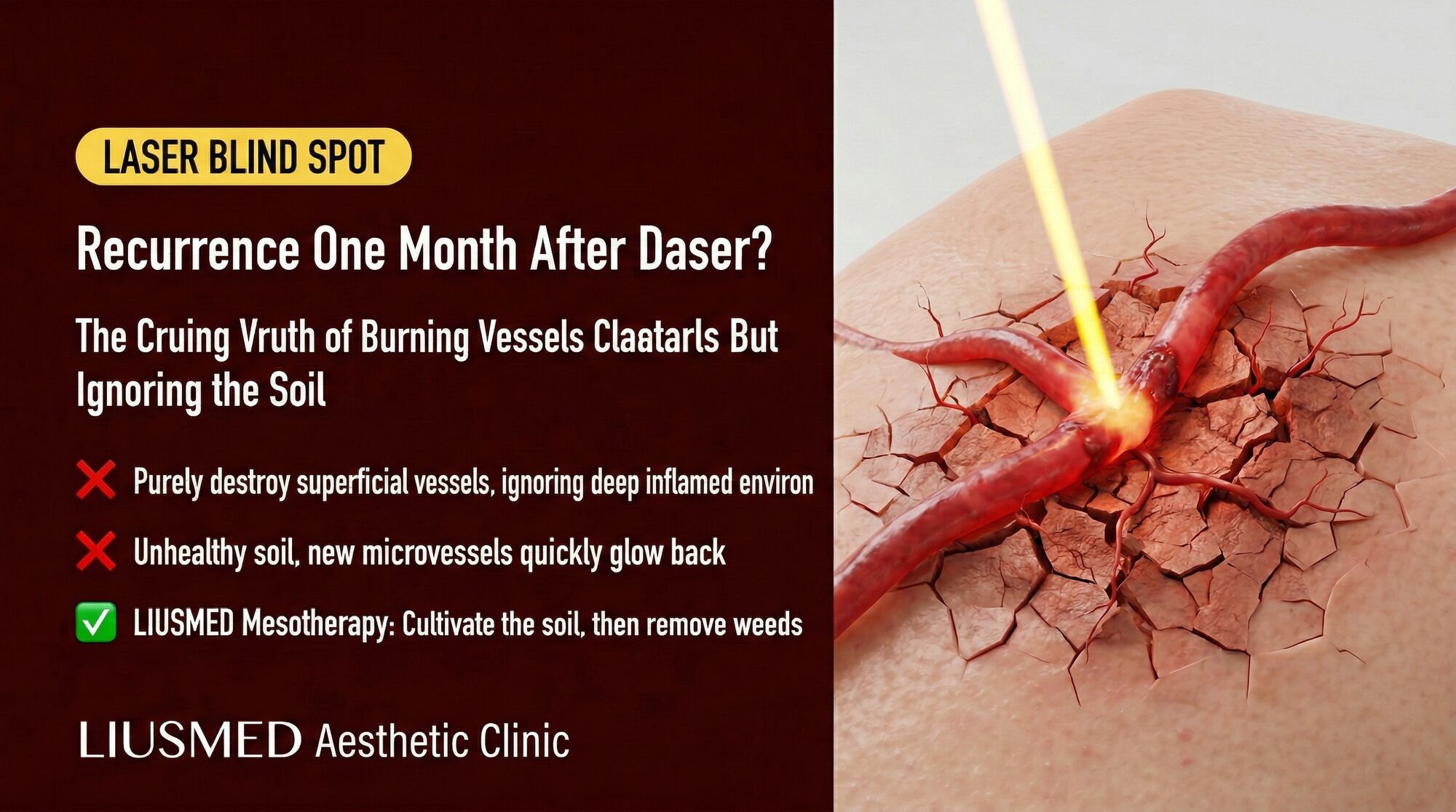
You finally committed to pulsed dye laser (PDL) treatment. For two weeks, your skin looked calmer than it had in years. Then, almost like clockwork, the redness crept back — first along the nose, then across both cheeks. By day thirty, you were right back where you started, wondering if the thousands of dollars you spent simply evaporated through your pores.
You are not alone. This pattern — dramatic initial clearing followed by frustratingly rapid recurrence — is one of the most common experiences reported by rosacea patients who undergo laser-only protocols. The problem is not that pulsed dye laser does not work; it does exactly what it is designed to do. The problem is that destroying blood vessels is only half the equation, and arguably the less important half.
Table of Contents
- How Pulsed Dye Laser Actually Works on Rosacea Vessels
- The Recurrence Timeline: What Happens After PDL
- The "Soil" Concept: Why Perivascular Inflammation Drives Regrowth
- Vessel Destruction vs. Soil Repair: A Head-to-Head Comparison
- What a Comprehensive Rosacea Protocol Should Include
- When PDL Still Has a Role — And When It Does Not
How Pulsed Dye Laser Actually Works on Rosacea Vessels {#how-pulsed-dye-laser-actually-works}
Pulsed dye laser emits light at 585–595 nm, a wavelength preferentially absorbed by oxyhemoglobin within red blood cells. When the laser pulse strikes a dilated capillary, the hemoglobin absorbs the energy, converts it to heat, and the resulting thermal damage collapses the vessel wall. Over the following days, the body's immune system clears the damaged vessel debris through phagocytosis.
This mechanism — called selective photothermolysis — is elegant and genuinely effective at eliminating visible telangiectasia. The key word, however, is "visible." PDL targets vessels that have already formed and dilated to the point where they contribute to surface redness. It does nothing to address the biological signals that caused those vessels to form in the first place.
Think of it this way: if your garden is overrun with weeds, pulling each weed by hand will make the garden look clean. But if the soil is saturated with weed seeds, fertilizer runoff, and conditions that favor weed growth, new weeds will appear within weeks. The garden looks different; the soil has not changed at all.
In rosacea, the "soil" is the perivascular microenvironment — the tissue surrounding each blood vessel. When this tissue remains in a state of chronic low-grade inflammation, it continuously produces signals that tell the body to grow new blood vessels. Destroying the old vessels without calming the soil is a temporary cosmetic fix, not a disease-modifying intervention.
The Recurrence Timeline: What Happens After PDL {#the-recurrence-timeline}
Clinical observation and published follow-up studies reveal a remarkably consistent pattern after PDL treatment for rosacea:
Days 1–3: Purpura (bruising) appears at treatment sites. Redness may paradoxically increase due to the inflammatory response triggered by vessel destruction.
Days 4–14: Purpura fades. Treated areas appear noticeably less red. Patients often report this as the best their skin has looked in months or years.
Days 15–21: Subtle pinkness begins to return in previously cleared areas. Most patients attribute this to external triggers — stress, weather, diet — rather than recognizing it as the beginning of neovascularization.
Days 22–35: Redness returns to approximately 60–80% of pre-treatment levels. Patients realize the improvement was temporary and begin researching repeat treatments.
Days 36–60: Without additional intervention, redness often reaches or exceeds baseline. Some patients report that post-PDL redness is distributed differently — new vessels may form in slightly different locations, creating a mottled appearance that was not present before.
This timeline varies by individual, but the general pattern holds: rapid improvement followed by gradual recurrence within four to eight weeks. The speed of recurrence directly correlates with the degree of underlying perivascular inflammation — more inflamed tissue produces new vessels faster.
The "Soil" Concept: Why Perivascular Inflammation Drives Regrowth {#the-soil-concept}
The molecular biology behind rosacea recurrence after laser treatment centers on a group of signaling molecules collectively known as pro-angiogenic factors. The most important of these is vascular endothelial growth factor (VEGF).
In healthy skin, VEGF (Vascular Endothelial Growth Factor — new blood vessel signal) production is tightly regulated. Small amounts are produced during wound healing and then shut off once new vessels are established. In rosacea-affected skin, however, VEGF production is chronically elevated. Several factors maintain this elevated state:
Mast cell degranulation: Mast cells in rosacea skin are hyperactive. They release histamine, tryptase, and other mediators that directly stimulate VEGF production by surrounding keratinocytes and fibroblasts.
Cathelicidin (LL-37) overexpression: Rosacea skin produces abnormally high levels of the antimicrobial peptide LL-37. While LL-37 is part of the innate immune system, in excess it acts as a potent pro-inflammatory and pro-angiogenic signal.
Matrix metalloproteinase (MMP) imbalance: MMPs, particularly MMP-2 and MMP-9, are elevated in rosacea tissue. These enzymes degrade the extracellular matrix, releasing bound VEGF and making it bioavailable to endothelial cells.
Neurogenic inflammation: Overactive transient receptor potential (TRP) channels in sensory nerve endings release substance P and calcitonin gene-related peptide (CGRP), both of which promote vasodilation and angiogenesis.
When PDL destroys a vessel, the resulting tissue damage actually triggers a wound healing response that temporarily increases VEGF production. In normal skin, this spike is brief and self-limiting. In rosacea skin, the already-elevated baseline VEGF combines with the wound-healing spike to create a powerful angiogenic signal that drives rapid vessel regrowth.
This is the central paradox of laser-only rosacea treatment: the act of destroying vessels can, under certain conditions, accelerate the formation of new ones. The laser addresses the symptom (visible vessels) while inadvertently stimulating the disease mechanism (angiogenesis driven by an inflamed microenvironment).
Vessel Destruction vs. Soil Repair: A Head-to-Head Comparison {#vessel-destruction-vs-soil-repair}
| Factor | PDL Vessel Destruction Only | Soil Repair + Targeted Vessel Treatment |
|---|---|---|
| Immediate redness reduction | Significant (70–90%) | Moderate initially (40–60%) |
| Durability at 30 days | 20–40% improvement retained | 50–70% improvement retained |
| Durability at 90 days | Often returns to baseline | Continued gradual improvement |
| Number of sessions needed | 3–6+ per year indefinitely | Typically fewer sessions over time |
| VEGF levels post-treatment | Temporarily elevated | Gradually reduced |
| Mast cell activity | Unchanged | Modulated downward |
| Skin barrier function | May be compromised | Actively supported |
| Risk of paradoxical worsening | Moderate (thermal accumulation) | Low |
| Long-term cost | High (recurring treatments) | Front-loaded, decreasing over time |
| Patient satisfaction at 6 months | Often disappointed | Generally positive |
The comparison reveals a fundamental difference in treatment philosophy. PDL-only protocols treat rosacea as a vascular problem — an excess of visible vessels that need to be removed. Soil repair protocols treat rosacea as an inflammatory disease with vascular consequences — the vessels are a symptom, and the inflamed microenvironment is the disease.
What a Comprehensive Rosacea Protocol Should Include {#comprehensive-rosacea-protocol}
A treatment approach that addresses the soil rather than just the weeds typically involves several coordinated strategies:
Anti-inflammatory priming: Before any laser or device-based treatment, the perivascular inflammation should be reduced. This may involve targeted pharmacological agents that downregulate mast cell activity, reduce LL-37 overexpression, or modulate TRP channel sensitivity. The goal is to lower baseline VEGF before destroying any vessels.
Barrier repair: Rosacea skin almost universally has a compromised stratum corneum. A damaged barrier allows transepidermal water loss, increases sensitivity to environmental triggers, and perpetuates the inflammatory cycle. Barrier repair using ceramide-dominant formulations, controlled humidity exposure, and elimination of barrier-disrupting products is foundational.
Selective vessel treatment with appropriate parameters: When device-based treatment is indicated, the parameters should be chosen to minimize collateral thermal damage to perivascular tissue. Lower fluences with multiple passes may be preferable to aggressive single-pass protocols. The goal is to close vessels without creating a significant wound-healing response that spikes VEGF.
Post-treatment anti-angiogenic support: After vessel treatment, the tissue should be supported with agents that counteract the wound-healing VEGF spike. This is the critical window where most laser-only protocols fail — the period between vessel destruction and vessel regrowth.
Ongoing maintenance of the microenvironment: Even after visible redness resolves, rosacea remains a chronic condition. The perivascular microenvironment requires ongoing support to prevent relapse. This is not about perpetual treatment but about recognizing that rosacea management is longitudinal, not episodic.
At Rosacea Injection Treatment, we approach rosacea from this soil-first perspective, prioritizing microenvironment stabilization before considering any vessel-targeted interventions.
When PDL Still Has a Role — And When It Does Not {#when-pdl-still-has-a-role}
PDL is not a failed technology. It remains an excellent tool for specific situations:
Appropriate uses: Isolated, stable telangiectasia on non-inflamed skin. Post-inflammatory erythema that has stabilized. Patients who have completed soil repair and have residual cosmetic telangiectasia.
Inappropriate uses: Active inflammatory rosacea with papules and pustules. Diffuse background erythema without discrete telangiectasia. Patients with highly reactive skin who flush frequently. Skin that has not undergone barrier repair. Patients seeking a "one-and-done" solution for chronic rosacea.
The distinction is not whether PDL works — it clearly does for vessel destruction — but whether vessel destruction is what the patient actually needs at that point in their treatment journey. Performing PDL on actively inflamed rosacea skin is like mopping the floor while the faucet is still running. The mopping is effective; the timing is wrong.
For patients who have experienced the frustrating cycle of laser treatment followed by rapid recurrence, the message is clear: the problem was never your skin's failure to respond to the laser. The problem was that the laser was asked to do something it was never designed to do — cure an inflammatory disease by destroying its vascular symptoms.
Frequently Asked Questions
Q1: How many PDL sessions are typically needed before patients realize the redness keeps coming back?
Most patients undergo two to four sessions before recognizing the recurrence pattern. Initial improvement after each session creates optimism, but by the third or fourth treatment — often spanning six to twelve months — the pattern of temporary improvement followed by return becomes unmistakable. Some patients continue for years before seeking alternative approaches.
Q2: Is it possible that my PDL settings were simply wrong, and that is why redness returned?
While suboptimal parameters can reduce PDL efficacy, the recurrence pattern in rosacea is not primarily a settings issue. Even with textbook-perfect parameters that achieve complete photocoagulation of targeted vessels, the underlying angiogenic drive in inflamed tissue will produce new vessels. Better settings may extend the improvement window from four weeks to six or eight weeks, but they cannot overcome chronic perivascular inflammation.
Q3: My dermatologist says I need maintenance PDL every three months indefinitely. Is this normal?
This approach is common but reflects a symptom-management philosophy rather than a disease-modifying one. Quarterly PDL essentially treats each new crop of vessels as they become visible, without addressing why they keep forming. It is analogous to taking pain medication every four hours indefinitely rather than treating the source of pain. It works, but it is neither efficient nor addressing the root cause.
Q4: Can topical treatments alone repair the soil, or do I need injections?
Topical agents can contribute to barrier repair and mild anti-inflammatory effects, but they have limited penetration to the perivascular tissue where the inflammatory signals originate. The dermal inflammation driving angiogenesis occurs at depths that topical formulations reach poorly. More targeted delivery methods, such as those used in Rosacea Injection Treatment, can place anti-inflammatory and anti-angiogenic agents directly where they are needed.
Q5: After PDL, my redness seemed worse than before. Is that possible, or am I imagining it?
You are likely not imagining it. The wound-healing response triggered by PDL includes a VEGF surge that, in already-inflamed rosacea tissue, can stimulate formation of more vessels than were destroyed. Additionally, repeated thermal exposure can damage perivascular supporting structures (pericytes, basement membrane), resulting in vessels that are more dilated and less stable than the originals. This paradoxical worsening is a recognized phenomenon.
Q6: How long does soil repair take before I can expect lasting improvement in redness?
Meaningful microenvironment modulation typically requires eight to twelve weeks of consistent intervention. Barrier repair may show results within four to six weeks, but the deeper perivascular inflammation requires more time. Patients should expect a gradual trajectory of improvement rather than the dramatic-but-temporary results associated with laser vessel destruction. The timeline is longer, but the results are more durable.
About the Author
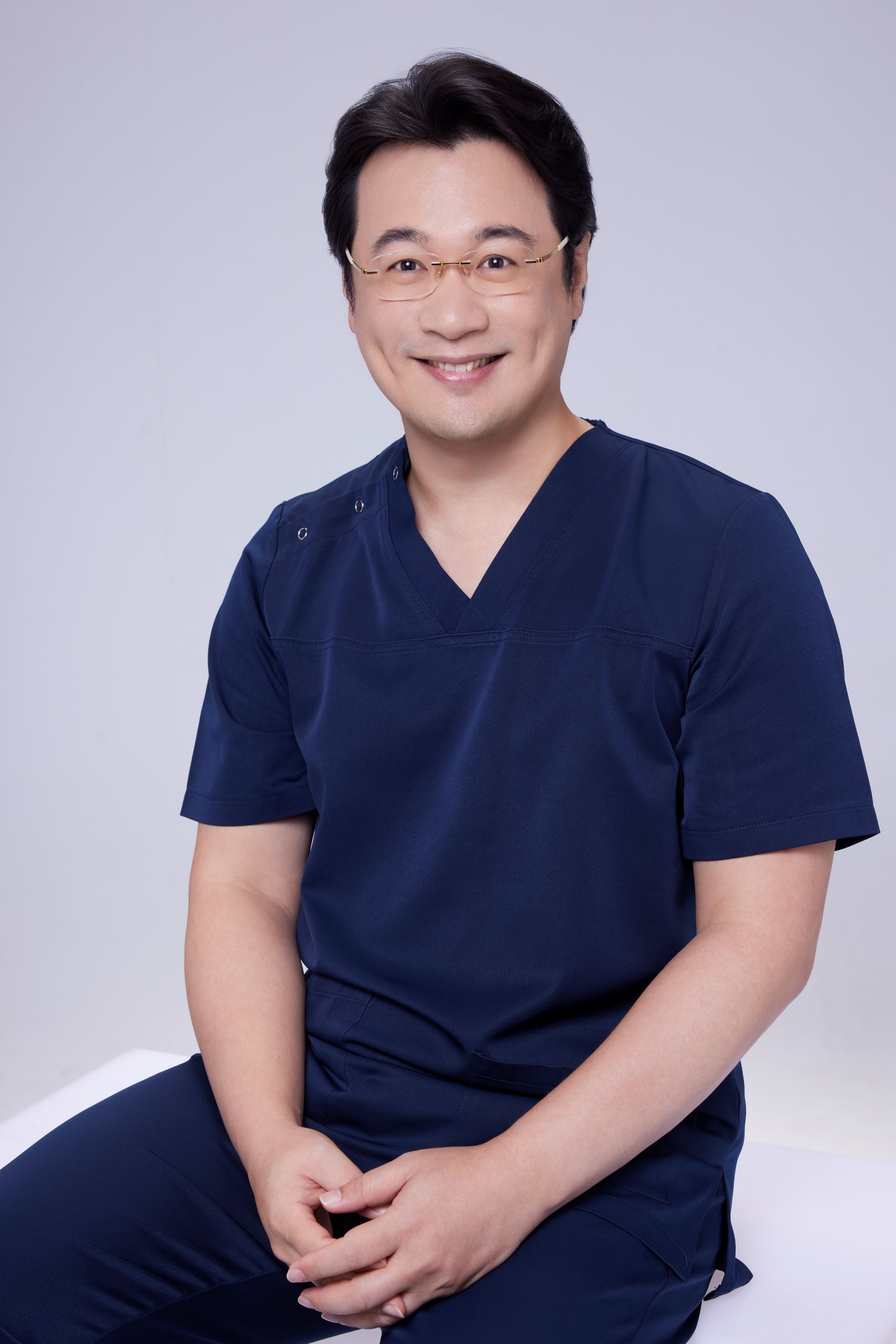
Dr. Ta-Ju Liu is the founder of Liusmed Clinic, a specialized practice focused on regenerative medicine and minimal incision surgery. With advanced training in both dermatological science and surgical technique, Dr. Liu developed the clinic's integrated approach to rosacea management — one that prioritizes microenvironment repair and long-term disease modification over symptomatic vessel destruction. Liusmed Clinic serves patients from across Taiwan and internationally, offering evidence-based protocols for complex skin conditions that have not responded to conventional treatments.
Disclaimer
This article is provided for educational and informational purposes only and does not constitute medical advice, diagnosis, or treatment. Rosacea is a complex condition with significant individual variation. Treatment decisions should be made in consultation with a qualified healthcare provider who can evaluate your specific situation. Results described in this article reflect general clinical patterns and may not apply to every patient. No treatment can guarantee specific outcomes.
Specialties
Credentials
- Kaohsiung Medical University, School of Medicine
- Attending Physician, Dermatology, Kaohsiung Chang Gung Memorial Hospital
- Attending Physician, Aesthetic Center, Kaohsiung Chang Gung Memorial Hospital
- Visiting Physician, Dermatology, Xiamen Chang Gung Hospital
- Visiting Physician, Aesthetic Center, Xiamen Chang Gung Hospital
"For every surgery, I strive to achieve a good outcome through a small incision and refined technique. Minimally invasive surgery is not just a technique — it's a commitment of respect to every patient."
Recovery after any procedure needs peer support too


Want to learn more?
Schedule a consultation for professional evaluation and advice