Peripheral Neuropathy: Regenerative Treatment Options
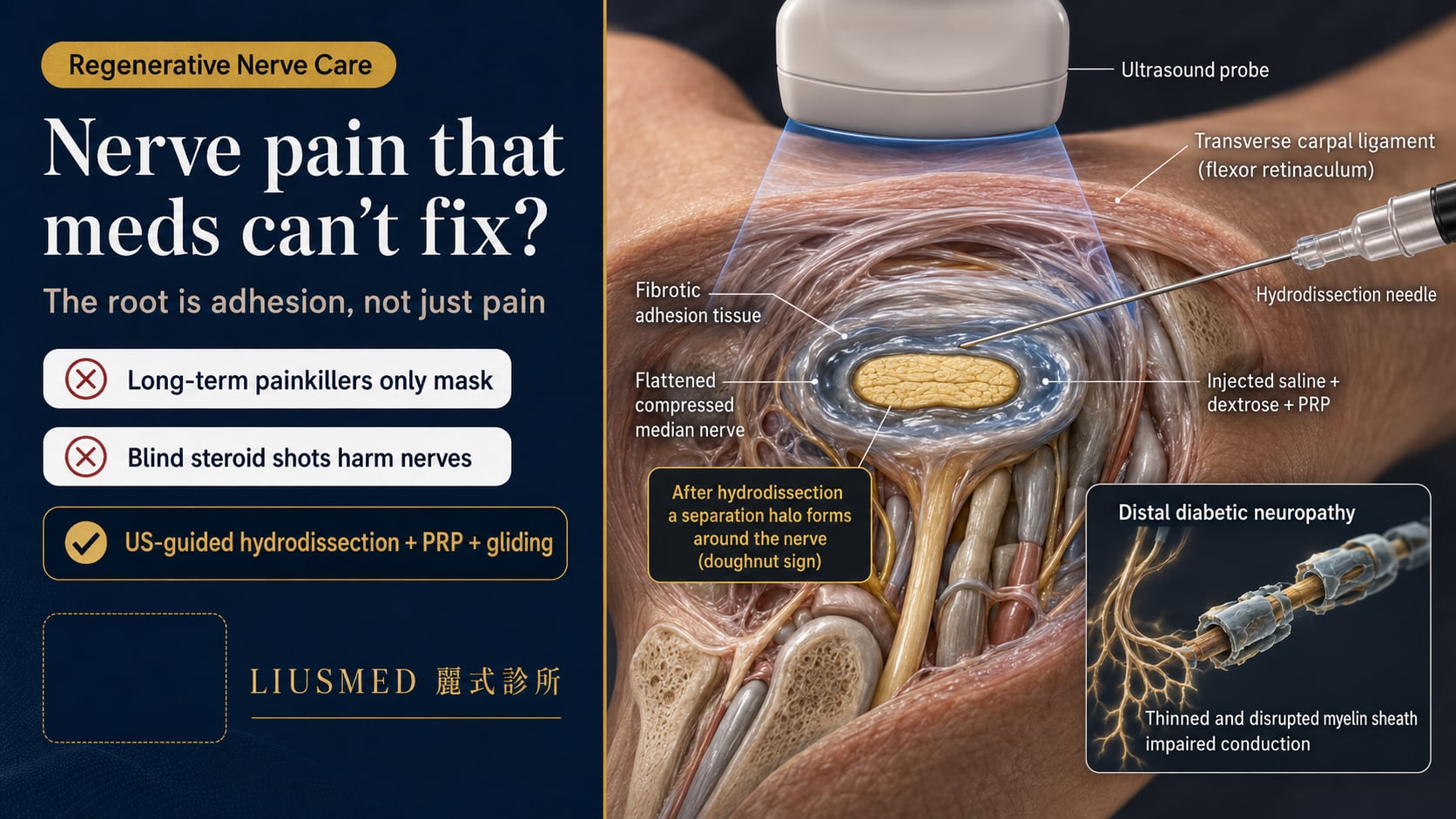
One-Minute Summary
Key Conclusions:
- A core pathology of peripheral neuropathy (nerve damage causing numbness/tingling) is nerve adhesion and compression by surrounding fibrotic tissue — not simply "nerve degeneration itself."
- Ultrasound-guided nerve hydrodissection (ultrasound-guided saline injection to free adhesions) uses precise fluid injection to release nerve adhesions. 2024 literature reviews show meaningful improvements across entrapment neuropathies, especially carpal tunnel syndrome (median nerve compression at wrist).
- Perineural PRP (Platelet-Rich Plasma — concentrate of your own blood platelets rich in growth factors) injection significantly reduces pain and numbness scores in diabetic peripheral neuropathy and improves functional outcomes.
- The two are often combined — hydrodissection releases adhesions, PRP delivers growth factors for nerve repair.
- Indications: carpal tunnel, cubital tunnel, tarsal tunnel, diabetic neuropathy, post-surgical adhesions, post-radiation nerve injury, and more.
Why Do Peripheral Nerves Cause Pain, Numbness, and Weakness?
Many patients believe nerve pain means "the nerve itself is broken." In most situations, the nerve itself is healthy — it is the surrounding environment that has gone wrong:
- Fascial or connective tissue fibrosis compressing the nerve
- Inflammatory mediators accumulating around the nerve
- Ischemia affecting nerve conduction
- Chronic compression thickening the nerve epineurium
These changes are like a person wearing tight shrink-wrap — the nerve is fine, but compressed and dysfunctional.
Key insight: The key to treating peripheral neuropathy is not "repairing the nerve itself" (nerve repair is extremely slow) but "releasing the pressure around the nerve, giving it the chance to self-repair." This is the central tenet of regenerative medicine for neuropathy.
Three Regenerative Options
Option 1: Ultrasound-Guided Nerve Hydrodissection
Mechanism:
Under real-time ultrasound, a fine needle is precisely guided to within 1mm of the nerve and fluid (saline, dextrose, or PRP) is injected to separate adhesive tissue from the nerve. Like using fluid pressure to "loosen the wrapping" around the nerve. This technique is known as perineural injection (ultrasound-guided peri-nerve injection).
Indications (2024 literature reviews show strongest evidence):
- Carpal tunnel syndrome (largest evidence base)
- Cubital tunnel syndrome
- Tarsal tunnel syndrome
- Piriformis syndrome (sciatic nerve compression)
- Adhesive nerve compression (post-surgical, post-traumatic)
Protocol:
- Single injection: mild compression
- 2–3 series: moderate-to-severe, every 2–4 weeks
- Improvement typically felt 1–2 weeks post-injection
Advantages:
- Minimally invasive (fine-needle injection, no incision)
- Real-time ultrasound guidance ensures safety
- Very short recovery, no daily activity disruption
Option 2: Perineural PRP Injection
Mechanism:
PRP is rich in PDGF (Platelet-Derived Growth Factor — platelet-released cell growth signal), VEGF (Vascular Endothelial Growth Factor — new blood vessel signal), IGF-1 (Insulin-like Growth Factor 1 — growth/repair signal molecule), and NGF (Nerve Growth Factor — nerve repair signal)-related components, which can:
- Promote angiogenesis (new blood vessel formation) around the nerve
- Suppress chronic inflammation
- Accelerate epineurium repair
- Some studies suggest myelin regeneration support
Evidence:
- Multiple studies show PRP significantly reduces pain and numbness scores in diabetic peripheral neuropathy, improving function
- Partial supporting evidence for idiopathic neuropathy
- Effects stack when combined with hydrodissection
Protocol:
- Typically 3 sessions × 4-week intervals
- Re-evaluate maintenance need at 6 months
Option 3: Nerve Gliding Exercises
Mechanism:
Healthy nerves normally slide 1–2 cm within tissue. Adhesion limits this glide, producing traction pain. Nerve gliding exercises restore glide via specific positions and movements.
Indications:
- Suitable for all peripheral neuropathies, especially after hydrodissection
- Can be guided by physical therapist; self-practice at home
Protocol:
- 2–3 times daily, 5–10 minutes each
- Continue minimum 8 weeks
Combination: The "Gold Stack" Protocol
For moderate-to-severe neuropathy, a triple strategy is commonly used:
| Phase | Therapy | Purpose |
|---|---|---|
| Week 1 | US-guided hydrodissection + PRP | Release adhesions + deliver growth factors |
| Weeks 2–4 | Nerve gliding exercises | Maintain glide, prevent re-adhesion |
| Week 4 | Second hydrodissection + PRP | Reinforce release |
| Week 8 | Third hydrodissection + PRP | Complete series |
| Post-week 8 | Continued gliding | Long-term maintenance |
Total ~8 weeks, peak improvement at 3–6 months.
Best Candidates
Strongly Recommended
- Carpal tunnel syndrome — nighttime hand numbness waking from sleep, tingling
- Cubital tunnel syndrome — pinky-side numbness, weakness
- Piriformis syndrome — deep gluteal pain radiating to posterior thigh
- Diabetic peripheral neuropathy — foot numbness, burning sensation
- Post-surgical nerve adhesion — persistent post-op nerve pain
- Wishing to avoid nerve decompression surgery
Poor-Response Scenarios
- Severe nerve transection (requires surgical repair)
- Central neuropathy (spinal cord injury, post-stroke sequelae)
- Severely uncontrolled diabetes (HbA1c >9%)
- Severe vascular disease — already-insufficient blood supply
Comparison with Traditional Treatments
| Treatment | Mechanism | Efficacy | Risk | Indication |
|---|---|---|---|---|
| Conservative (rest, splints) | Pressure reduction | Mild | Very low | Early, mild |
| Oral medications (gabapentin, pregabalin) | Neural modulation | Symptom relief | Drowsiness, dizziness, dependency | Most types |
| Local steroid injection | Anti-inflammatory | Short-term significant | Repeated use risks nerve damage | Acute inflammatory phase |
| Nerve decompression surgery | Physical release | Effective for moderate-severe | Surgical risk, recovery | Severe compression |
| Hydrodissection ± PRP | Adhesion release + regeneration | Effective for moderate-severe | Very low | Most entrapment neuropathies |
Key insight: For moderate neuropathy, hydrodissection ± PRP provides a "more fundamental than oral medication, less invasive than surgery" middle option.
Side Effects and Considerations
Common
- Brief soreness at injection site (24–72 hours)
- Transient tingling during procedure
Rare
- Infection (<0.1% with sterile technique)
- Transient nerve irritation (1–2 day symptom flare)
Contraindications
- Injection site infection
- Severe coagulopathy
- Local anesthetic allergy
- Active antiplatelet therapy (PRP efficacy reduced; evaluation needed)
Five Keys to Treatment Success
- Correct diagnosis — experienced physicians using ultrasound and nerve conduction studies must localize entrapment
- Ultrasound quality — high-resolution ultrasound is the foundation of safe and precise hydrodissection
- Physician technique — injection angle, depth, and advance speed all require experience
- PRP preparation quality — standardized, leukocyte-poor preferred
- Adherence to gliding exercises — without post-injection movement, adhesions can reform
Common questions
How is nerve hydrodissection different from a steroid injection?
A steroid injection calms inflammation and dampens symptoms — it can help in the short term, but repeated use carries a risk of nerve damage. Hydrodissection works differently: it uses fluid to free the nerve from the tissue stuck around it, so it addresses the compression itself rather than just the inflammation. That makes it a better fit for recurrent, entrapment-type neuropathy where you want to deal with the structure.
How many sessions does it take, and when will I feel a difference?
It depends on how severe the entrapment is. Mild cases sometimes need a single injection; moderate-to-severe cases are usually planned as 2–3 sessions, every 2–4 weeks. Most people start noticing something 1–2 weeks after an injection, with the full course running about 8 weeks and peak improvement around 3–6 months. Nerves repair slowly, so don't expect an overnight change.
I have diabetic neuropathy — is this suitable for me?
In most cases, yes. Perineural PRP has evidence for reducing pain and numbness and improving function in diabetic peripheral neuropathy. But if your blood sugar has been poorly controlled long-term (HbA1c above 9%), or you already have severe vascular disease with badly reduced blood supply, the response tends to be poorer — those factors need to be assessed together first.
Does the injection hurt, and can I go about my day afterward?
It's a fine-needle injection with no incision, and most people tolerate it well. What's common is some soreness at the injection site for 24–72 hours, or brief tingling during the procedure. Recovery is very short and usually doesn't disrupt daily activities. What really determines safety and precision is the quality of the ultrasound guidance and the physician's technique.
When is injection not enough — when do I still need surgery?
A severe nerve transection needs surgical repair, and central nervous system problems (spinal cord injury, post-stroke sequelae) are outside what these injections can address. That's exactly why the first step has to be an experienced physician using ultrasound and nerve conduction studies to pin down where the entrapment is — so the right problem isn't forced into the wrong treatment.
Conclusion: Regenerative Medicine Provides a "Third Path"
For peripheral neuropathy, traditional options are often a binary choice between "oral medication for symptom relief" or "surgical decompression." Regenerative medicine offers a third path — using precise injection plus autologous growth factors to give the nerve the chance to self-repair.
If you:
- Have tried medications with limited efficacy or side effects
- Are hesitant about surgery and seek a less-invasive option
- Suffer recurrent nerve pain affecting quality of life
- Have diabetic neuropathy and want to slow progression
Consider consulting a regenerative medicine specialist. See our nerve repair regenerative service or book a consultation.
Medical References
- Nerve Hydrodissection as Treatment for Entrapment Neuropathies: Literature Review. PMC12880944.
- Platelet-Rich Plasma Guided Injections: Clinical Application in Peripheral Neuropathies. Frontiers in Surgery. 2014.
- PRP Injections for Diabetic Peripheral Neuropathy: Clinical Evidence Reviews 2023–2025.
- Nerve Hydrodissection for Carpal Tunnel (Carpal Tunnel Syndrome) Syndrome: Systematic Review and Meta-analysis.
Editorial review: Reviewed by Dr. Ta-Ju Liu. Last reviewed 2026-04-27.
Related Services

Specialties
Credentials
- Kaohsiung Medical University, School of Medicine
- Attending Physician, Dermatology, Kaohsiung Chang Gung Memorial Hospital
- Attending Physician, Aesthetic Center, Kaohsiung Chang Gung Memorial Hospital
- Visiting Physician, Dermatology, Xiamen Chang Gung Hospital
- Visiting Physician, Aesthetic Center, Xiamen Chang Gung Hospital
"For every surgery, I strive to achieve a good outcome through a small incision and refined technique. Minimally invasive surgery is not just a technique — it's a commitment of respect to every patient."
Want to learn more?
Schedule a consultation for professional evaluation and advice