Hair Transplant Aftercare: 3/6/12-Month Checklist (2026)
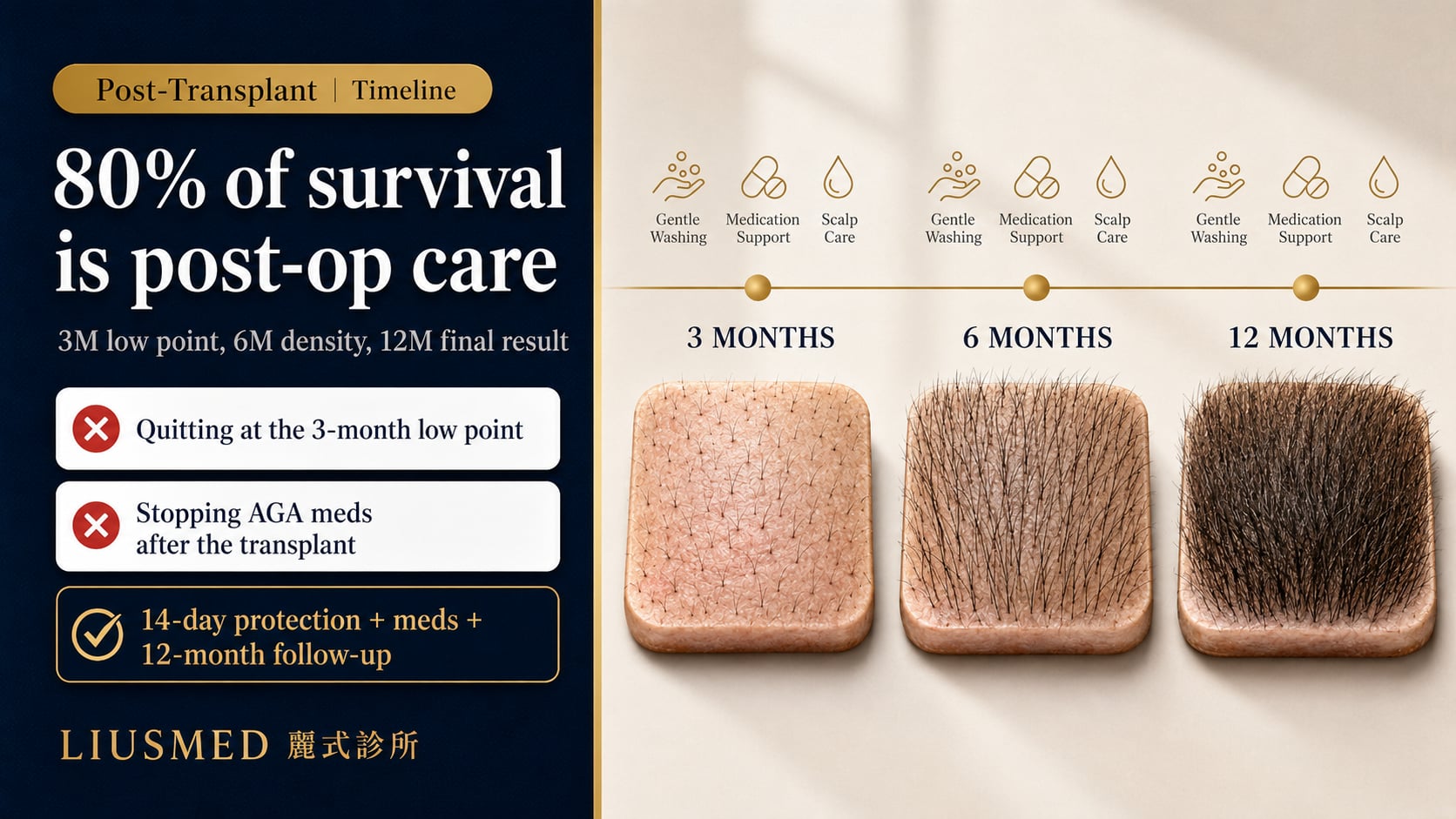
One-Minute Summary
Key Conclusions:
- The first 14 days post-op are the "neovascularization golden window" — any disruption directly affects follicle survival.
- 3 months is the visual "low point": grafted hair has shed and new hair has not yet emerged. Often misjudged as "failure."
- Real density only begins to appear at 6 months, with the 12-month mark being the final result.
- Eighty percent of survival depends on three things: mechanical protection, infection prevention, and native hair medication maintenance.
- Even with perfect graft survival, unmedicated native hair will continue to recede — producing the awkward "transplanted island in receding sea" effect.
Why Post-Op Management Matters More Than Surgery Itself
Many patients focus on "which surgeon" and "FUE vs FUT" but overlook a key fact: surgery only places the follicle; survival depends entirely on post-op environment management.
After implantation, follicles face three life-or-death checkpoints:
- Ischemic phase (0–14 days): no vascular connection yet; survival via tissue fluid diffusion
- Reperfusion phase (14–30 days): new vessels begin to supply, but fragile
- Integration phase (1–6 months): complete integration with recipient site
Key insight: Even the most skilled surgeon cannot "protect follicles" for you post-op — this part requires strict patient-executed post-op management.
Days 0–14: Neovascularization Golden Window (Most Critical)
Do
- Sleep with head elevated: 2–3 pillows, reducing recipient swelling for first 5 days
- Cold compress on forehead, temples (never on graft area): 15–20 min sessions
- Strictly follow prescribed medications: antibiotics, anti-inflammatories, analgesics
- Daily cleansing of recipient site: with physician-recommended gentle cleanser, pat, do not rub, starting day 4–5
- Wear a soft, loose cap outdoors (avoid strong sun)
- Stay well-hydrated (2–2.5 L/day): supports tissue perfusion
Don't
- ❌ Any form of rubbing, scratching, or massaging the recipient site
- ❌ Sleeping prone or on the side compressing recipient
- ❌ Wearing tight helmets, caps, or head wraps
- ❌ Vigorous activity (including brisk walking, gym, sex)
- ❌ Alcohol or smoking (nicotine directly constricts vessels — most damaging)
- ❌ Sauna, steam rooms, prolonged hot showers
- ❌ Coloring, perming, or harsh shampoos
Monitor
- Day 7–10 scab natural shedding — never pick!
- Mild blood spots, slight oozing — normal range
- Excessive redness, obvious purulence, persistent pain — contact clinic immediately
Days 14 to Month 3: "Visual Low Point" (Most Misjudged)
Why "Hair Falls Out"?
Implanted follicles undergo "term shedding" within 2–4 weeks — the shaft sheds but the follicle survives subdermally. This is normal, not surgical failure.
Follicles "rest" subdermally for ~3 months before sprouting new growth — which is why many patients at 3 months mistakenly believe surgery failed.
Do
- Continue physician-recommended shampoo (typically transition back to regular at 3 months)
- If physician advises: start Minoxidil on native areas to prevent shock loss
- Regular protein intake (follicles are largely keratin)
- Resume normal exercise after 6 weeks, but avoid head-impact sports
- Standard comparison photos: front, top, side at months 1, 2, 3
Don't
- ❌ Stop medication or switch products because no visible result yet
- ❌ Accept any "rapid hair growth" promotion
- ❌ Over-massage recipient out of anxiety
- ❌ Apply any "skincare/serum" to recipient zone
Monitor
- 2–4 week term shedding — normal
- Native hair shock loss (~10–30% patients, starts week 3–4) — typically recovers in 3–6 months
- Persistent redness, heavy flaking, follicular inflammation — abnormal, return to clinic
Month 3: First Critical Evaluation Point
What You Should See
- Recipient site largely healed, scarring fading
- Fine hair sprouts beginning (varies — some at 2 months, others at 4 months)
- Native hair shock loss partially recovering
Evaluation Indicators
| Indicator | Normal Range |
|---|---|
| Recipient redness | Resolved |
| Scabbing | Completely shed |
| New hair sprouting | Visible fine hairs |
| Recipient sensation | Gradually returning (some areas may still be numb) |
Follow-Up Action Items
- One follow-up visit: physician evaluates healing and early growth
- Standard comparison photos
- If on medications (Minoxidil / Finasteride): assess side effects and effects
- If PRP (Platelet-Rich Plasma — concentrate of your own blood platelets rich in growth factors) planned: typically first session at this point
Months 3–6: Rapid Growth Phase
Phase Characteristics
- Most follicles exit dormancy and enter anagen
- Hair shifts from "fine vellus" to normal terminal hair
- Visual density rises from 20% to 50–60%
- Some patients see hairline outline restored
Do
- Continue medication therapy (Minoxidil + Finasteride if prescribed)
- 5-minute scalp massage daily: improves microcirculation, but avoid recipient site within 6 months
- Anti-inflammatory diet: omega-3, polyphenols, dark vegetables
- Adequate sleep (≥7 hours): deep sleep is the follicle repair window
- Consider second PRP at 6 months (if part of plan)
Don't
- ❌ Abandon medication if dissatisfied with progress
- ❌ Increase doses unilaterally
- ❌ Color/perm hair (wait at least 6 months)
Month 6: Second Critical Evaluation Point
What You Should See
- Recipient density at 50–70% of final result
- Hair caliber approaching normal
- Hairstyle largely restored, continued thickening through 12 months
Evaluation Indicators
| Indicator | Status |
|---|---|
| Recipient density | 50–70% (vs final) |
| Shaft texture | Approaching normal |
| Visual naturalness | Beginning natural, with subtle differences |
| Native shock loss | Should be fully recovered |
Follow-Up Items
- One follow-up visit: physician evaluates growth and density
- Compare with baseline and 3-month photos
- Discuss long-term maintenance: medication dose? PRP cadence?
Key insight: If density is below expectations, don't immediately consider re-do — additional 30–50% density still develops over the next 6 months. The 12-month assessment is more accurate.
Months 6–12: Stabilization and Densification
Phase Characteristics
- Hair continues thickening (diameter increase)
- Vellus hairs transition to terminal hair
- Hairstyle naturalness near final
- Improved integration with native hair
Do
- Long-term medication maintenance: Finasteride / Minoxidil as native hair insurance
- Routine PRP maintenance (if planned): every 6 months
- Standard photos every 3 months
Month 12: Final Evaluation Point
What You Should See
- 90–100% of final density
- Hair uniform with native in texture
- Hairstyle fully natural
- Both you and others should perceive significant improvement
Evaluation Indicators
| Indicator | Met | Abnormal |
|---|---|---|
| Density vs pre-op expectation | ≥90% | <70% |
| Shaft texture | Indistinguishable from native | Obviously fine |
| Recipient appearance | No visible boundary | Visible "transplant look" |
| Native hair status | Stable or improved | Continued recession |
Follow-Up Items
- Comprehensive evaluation: surgeon and patient jointly conclude outcomes
- Compare with pre-op: objectively assess success
- Discuss long-term care plan
What If Unsatisfied?
- Touch-up procedure: typically 200–500 grafts to fill density
- Review medication adherence
- Assess native hair recession rate
Lifelong Maintenance: Transplant Is Not a "Permanent Solution"
Many patients believe transplant means "no more management needed" — a serious myth.
Three Items That Must Continue
- Finasteride / Minoxidil ongoing use — otherwise native hair recedes, creating "transplant island effect"
- Annual standard photos — monitor overall hair trend
- Follow-up visit every 1–2 years — catch issues early
Key insight: Transplant success should be defined as "transplanted + native hair maintaining satisfactory density 10 years later," not "single-point density at year 1 post-op." Long-term management is the real success factor.
Common questions
My hair looks like it's barely growing at 3 months — did the transplant fail?
This is a really common misunderstanding. The grafted follicles go through term shedding around week 2 to 4 — the shaft falls out but the follicle is still alive under the skin, and it then rests for about 3 months before new hair starts coming through. So looking sparse at 3 months is normal; the real density only starts showing around 6 months. Try not to judge the outcome yet.
What should I be careful about in the first 14 days after surgery?
These 14 days are the neovascularization golden window, so the main thing is just not to disrupt it. Sleep with your head elevated, don't rub, scratch, or massage the graft area, and don't sleep face-down on it. Skip alcohol and smoking for now, since nicotine constricts the blood vessels directly. The scabs usually fall off on their own around day 7 to 10 — don't pick at them.
When will I actually see the full result?
Generally by 6 months you're at roughly 50 to 70 percent of the target density, the hair caliber starts approaching normal, and it keeps thickening from there. It takes about 12 months to get close to the full result. So if it feels too thin partway through, don't rush into a touch-up — quite a bit more usually fills in over the following six months.
Once the transplant is done, is it a one-and-done fix I never have to think about again?
Not really. The transplanted hair is usually stable, but your original hair keeps receding over time if you don't stay on something like Finasteride or Minoxidil, and you can end up with a dense transplanted zone surrounded by hair that's still thinning. So long-term, staying on the medication plus regular check-in photos is what keeps the result holding up.
How long before I can exercise or color my hair again?
Hold off on vigorous exercise for the first 6 weeks — things like the gym or brisk walking. After 6 weeks you can ease back into normal activity, but give head-impact sports a bit longer. For coloring or perming, wait at least 6 months so the scalp and follicles settle first.
Conclusion: You Are the Final Piece
Transplant success formula:
Surgical technique (40%) + Patient physiology (10%) + Post-op management (50%) = Final outcome
In other words: your post-op management impacts the final result more than the surgeon's technique.
If you are planning, just had, or have any post-op questions, see our post-transplant follicle care service or book a consultation.
Medical References
- ISHRS Position Statements on Hair Transplantation Aftercare and Recovery.
- Efficacy of PRP as Adjunct to Hair Transplantation: Systematic Review. PMC12506585. 2025.
- Hair Transplant Recovery Timeline Reviews. Various clinical sources 2023–2025.
- Effectiveness of Combined Oral Minoxidil and Finasteride in Male AGA (Androgenetic Alopecia — male-pattern hair loss). PMC11829753. 2024.
Editorial review: Reviewed by Dr. Ta-Ju Liu. Last reviewed 2026-04-27.
Related Services
Specialties
Credentials
- Kaohsiung Medical University, School of Medicine
- Attending Physician, Dermatology, Kaohsiung Chang Gung Memorial Hospital
- Attending Physician, Aesthetic Center, Kaohsiung Chang Gung Memorial Hospital
- Visiting Physician, Dermatology, Xiamen Chang Gung Hospital
- Visiting Physician, Aesthetic Center, Xiamen Chang Gung Hospital
"For every surgery, I strive to achieve a good outcome through a small incision and refined technique. Minimally invasive surgery is not just a technique — it's a commitment of respect to every patient."
Want to learn more?
Schedule a consultation for professional evaluation and advice