Dark Spots After Pregnancy? Postpartum Melasma & What Helps
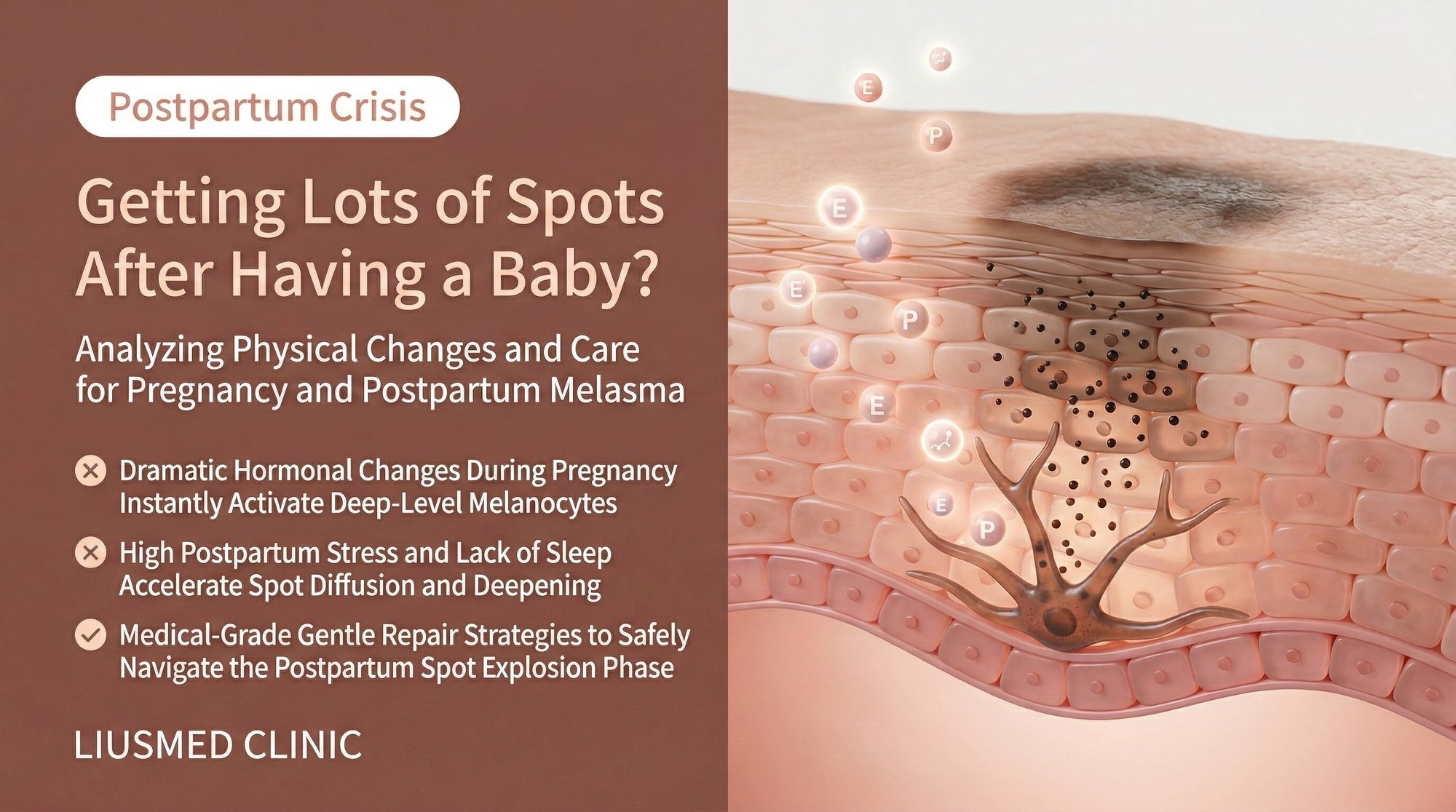
The baby is finally here. The sleepless nights, the constant feedings, the overwhelming joy — and then, one morning, you catch your reflection and notice it: dark, patchy discoloration across your cheeks, forehead, and upper lip that was barely visible during pregnancy but now seems to have intensified. You assumed it would fade after delivery, just like the linea nigra on your belly. Weeks become months. The patches remain. Welcome to postpartum melasma — one of the most common yet least discussed dermatological consequences of pregnancy, and one that can persist for years without appropriate management.
Table of Contents
- The Hormonal Storm: What Pregnancy Does to Your Melanocytes
- Why Melasma Persists — and Sometimes Worsens — After Delivery
- Breastfeeding and Melasma: The Hormonal Extension
- Safe vs. Unsafe Skincare During Breastfeeding
- The Postpartum Treatment Timeline
- When to Seek Professional Treatment
The Hormonal Storm: What Pregnancy Does to Your Melanocytes
Pregnancy is one of the most dramatic hormonal events the human body experiences. Estrogen levels rise to 100 times their normal concentration by the third trimester. Progesterone increases 10-fold. Melanocyte-stimulating hormone (MSH) doubles. Each of these hormones independently stimulates melanin production, and during pregnancy, they rise simultaneously and to unprecedented levels.
The effect on melanocytes is profound and multi-layered. Estrogen binds to estrogen receptors on melanocytes (both ER-alpha and ER-beta subtypes are expressed) and directly upregulates tyrosinase gene transcription — the rate-limiting enzyme in melanin synthesis. Progesterone acts synergistically, enhancing the melanogenic response to estrogen through its own receptor-mediated pathways. MSH binds to melanocortin-1 receptors (MC1R) on melanocytes, activating the cAMP signaling cascade that drives melanin production at the enzymatic level.
The result is visible in virtually every pregnant woman to some degree. The areolae darken. The linea alba becomes the linea nigra. Pre-existing moles and freckles deepen in colour. And in 15 to 50 percent of pregnant women — with prevalence varying by ethnicity and skin type — the diffuse, symmetrical facial hyperpigmentation known as chloasma or the mask of pregnancy develops.
Chloasma most commonly appears during the second or third trimester, when hormonal levels are at their peak. The centrofacial pattern — bilateral cheeks, forehead, nose, and upper lip — reflects the distribution of melanocytes with the highest density of hormonal receptors. The mandibular (jawline) pattern and lateral cheek pattern are less common variants.
What most patients do not realize is that the hormonal stimulation during pregnancy does not simply increase melanin production temporarily. It can cause epigenetic reprogramming of melanocytes — changes to gene expression patterns that persist even after the hormonal stimulus is removed. Specific methylation changes at the tyrosinase gene promoter have been documented in melasma-affected skin, suggesting that pregnancy can permanently alter melanocyte behaviour.
Why Melasma Persists — and Sometimes Worsens — After Delivery
The assumption that pregnancy-related pigmentation will resolve spontaneously after delivery is only partially correct. The linea nigra typically fades within 6 to 12 months postpartum as hormone levels normalize. Areolar darkening gradually reduces. But chloasma follows a different trajectory.
Within the first three months postpartum, estrogen and progesterone levels drop rapidly to pre-pregnancy baselines. MSH levels also decline. If melasma were purely a direct hormonal effect, it should fade during this period. And for approximately 30 percent of affected women, it does — gradually lightening over 6 to 12 months without specific treatment.
For the remaining 70 percent, the melasma persists or even darkens after delivery. Several factors contribute to this persistence.
First, the epigenetic changes described above may have permanently altered the melanocyte activation threshold. Melanocytes that were reprogrammed during pregnancy continue to overproduce melanin at normal hormone levels because their baseline gene expression has shifted.
Second, melanin that has already been deposited in the dermis (pigmentary incontinence) does not resolve with hormone normalization. Dermal melanophages retain pigment for months to years regardless of hormonal status. The deeper the pigment was pushed during pregnancy, the longer it persists postpartum.
Third, the vascular changes that occur during pregnancy — increased angiogenesis driven by elevated VEGF (Vascular Endothelial Growth Factor — new blood vessel signal) — do not fully reverse after delivery. The expanded vascular network in the dermis continues to supply growth factors and inflammatory mediators to melanocytes, maintaining the feed-forward loop described in vascular melasma pathophysiology.
Fourth, the postpartum period introduces new aggravating factors. Sleep deprivation elevates cortisol, which promotes inflammation and indirectly stimulates melanogenesis. Psychological stress — common in the adjustment to new parenthood — further raises stress hormones. Many new mothers neglect sunscreen application due to the demands of infant care, allowing UV exposure to compound the existing problem.
The net result is a condition that was initiated by pregnancy hormones but is now sustained by multiple independent mechanisms — epigenetic changes, dermal pigment deposits, vascular infrastructure, and ongoing environmental triggers.
Breastfeeding and Melasma: The Hormonal Extension
Breastfeeding introduces a specific hormonal profile that further complicates melasma management. Prolactin — the hormone that drives milk production — is elevated throughout the breastfeeding period, and prolactin has documented effects on melanocyte function. While not as potent a melanogenic stimulus as estrogen, prolactin contributes to the overall hormonal milieu that keeps melanocytes active.
More significantly, breastfeeding suppresses ovarian function through the hypothalamic-pituitary axis, creating a relative hypoestrogenic state. This might seem beneficial for melasma — lower estrogen should mean less melanocyte stimulation. However, the hormonal fluctuations that occur as breastfeeding frequency decreases and the menstrual cycle returns can actually trigger melasma flares. Each hormonal shift — whether up or down — represents a perturbation that melanocytes respond to.
Exclusive breastfeeding also limits treatment options. Many of the most effective melasma treatments — including hydroquinone, tretinoin, and systemic tranexamic acid — are either contraindicated or lack sufficient safety data during lactation. This creates a frustrating treatment window where the condition is active and visible but the most potent interventions are unavailable.
The practical recommendation for breastfeeding mothers is to focus on the treatments that are definitively safe during lactation while setting expectations that more aggressive treatment can begin after weaning. This is not a passive waiting period — there is plenty that can be done safely — but it does require patience and strategic planning.
Safe vs. Unsafe Skincare During Breastfeeding
Navigating melasma treatment during breastfeeding requires understanding which ingredients are safe, which are potentially risky, and which are clearly contraindicated.
| Category | Ingredients | Safety During Breastfeeding | Notes |
|---|---|---|---|
| Safe | Azelaic acid (15-20%) | Compatible | Anti-melanogenic and anti-inflammatory; first-line for breastfeeding patients |
| Safe | Vitamin C (L-ascorbic acid) | Compatible | Antioxidant and mild tyrosinase inhibitor; well-tolerated |
| Safe | Niacinamide (4-5%) | Compatible | Inhibits melanosome transfer; anti-inflammatory |
| Safe | Mineral sunscreen (zinc oxide, titanium dioxide) | Compatible | Non-absorbable; essential foundation of treatment |
| Safe | Alpha arbutin | Compatible | Gentle tyrosinase inhibitor; minimal systemic absorption |
| Caution | Glycolic acid (low concentration) | Likely safe at low % | Minimal systemic absorption at typical concentrations; limit to 10% or less |
| Caution | Kojic acid | Limited data | Likely safe topically but insufficient lactation studies |
| Avoid | Hydroquinone | Not recommended | Systemic absorption documented; insufficient lactation safety data |
| Avoid | Tretinoin/retinoids | Contraindicated | Systemic retinoids are teratogenic; topical retinoids avoided as precaution |
| Avoid | High-concentration chemical peels | Not recommended | Systemic absorption risk; inflammatory response may worsen melasma |
| Discuss with MD | Oral tranexamic acid | Case-by-case basis | Enters breast milk in small quantities; risk-benefit discussion with physician |
The safe options, while individually less potent than prescription hydroquinone, can be combined into an effective regimen. A practical breastfeeding-safe melasma routine might include: gentle cleanser, vitamin C serum in the morning, tinted mineral sunscreen as the last morning step, azelaic acid 15 to 20 percent in the evening, and niacinamide-containing moisturizer. This combination addresses multiple melanogenic pathways without exposing the infant to concerning compounds.
The Postpartum Treatment Timeline
Understanding the optimal timing for different treatment interventions helps set realistic expectations and prevents premature frustration.
Months 0-3 postpartum: This is the observation and foundation phase. Hormone levels are in rapid flux, and the melasma may naturally lighten or may paradoxically darken as the hormonal environment shifts. Focus entirely on photoprotection (tinted mineral sunscreen, hat use), gentle skincare, and barrier maintenance. Begin safe topical agents — azelaic acid, vitamin C, niacinamide — to establish the treatment foundation. Do not expect visible improvement during this phase; the goal is to prevent worsening.
Months 3-6 postpartum: Hormonal levels have stabilized to a greater degree. If breastfeeding, continue the safe topical regimen. Improvement from azelaic acid and antioxidants should begin to become visible during this phase, particularly for the epidermal melanin component. If not breastfeeding, prescription options including tretinoin and hydroquinone can be introduced under medical supervision.
Months 6-12 postpartum: This is the period when the melasma trajectory becomes clearer. Women whose melasma will resolve spontaneously will show significant improvement by this point. Women whose melasma will persist will have plateaued or shown only minimal improvement. This is the appropriate time to pursue professional evaluation for treatment-resistant cases.
After weaning: All treatment options become available. For persistent melasma with dermal or vascular components, this is when targeted professional treatments such as Melasma Injection Treatment can be most effectively deployed. The melanocytes have had time to establish their new baseline behaviour, the hormonal environment is stable, and the full therapeutic arsenal is accessible.
After subsequent pregnancies: Women who developed melasma during a first pregnancy have a very high recurrence rate with subsequent pregnancies. Proactive measures — aggressive photoprotection starting in the first trimester, early introduction of pregnancy-safe topical agents — can potentially reduce the severity of recurrence, though complete prevention is usually not possible.
When to Seek Professional Treatment
Self-directed treatment with over-the-counter products is a reasonable starting point for mild postpartum melasma, particularly during the breastfeeding period when prescription options are limited. However, several situations warrant professional evaluation.
If melasma has not shown any improvement after 6 months of consistent topical therapy, professional assessment is needed to determine pigment depth and vascular involvement. As discussed in the context of dermal melanin dropout, epidermal melasma should respond at least partially to topical agents within 8 to 12 weeks. Lack of response suggests a deeper or more complex mechanism.
If the melasma patches have a grey-blue rather than brown colour, significant dermal pigment deposition is likely. Topical agents cannot reach this pigment, and continuing them without additional intervention wastes time.
If there is visible redness or telangiectasia within the pigmented patches, the vascular component is active. This requires treatment that addresses the blood vessel network, not just the melanin.
If the melasma is causing significant psychological distress — and for many new mothers dealing simultaneously with postpartum adjustment, body image changes, and sleep deprivation, it absolutely can — seeking treatment sooner rather than later is appropriate. The emotional burden of visible facial pigmentation is legitimate and should not be minimized.
Professional evaluation at a clinic experienced in melasma management will include Wood lamp assessment, dermatoscopy, and potentially reflectance confocal microscopy to characterize the melasma subtype precisely. This diagnostic information enables a treatment plan targeted to the specific pathophysiology — epidermal, dermal, vascular, or mixed — rather than a generic one-size-fits-all approach.
For postpartum patients with treatment-resistant or complex melasma, Melasma Injection Treatment at Liusmed Clinic offers a targeted intervention that can address the dermal and vascular components that topical therapy cannot reach. This approach is particularly valuable for women who have completed breastfeeding and are ready for comprehensive treatment of persistent pigmentation.
Frequently Asked Questions
Q1: Will my melasma from my first pregnancy get worse with my second pregnancy?
In most cases, yes. Women who developed melasma during a first pregnancy are at high risk for recurrence and often worsening with subsequent pregnancies. The melanocytes have been epigenetically primed by the first hormonal event and respond more readily to the second. Proactive photoprotection from the first trimester can help limit the severity.
Q2: Is it safe to use azelaic acid while breastfeeding?
Yes. Azelaic acid is classified as Pregnancy Category B and is considered compatible with breastfeeding by most dermatological guidelines. Minimal systemic absorption occurs with topical application, and the compound is naturally present in the body as a byproduct of normal fatty acid metabolism. It is the first-line prescription topical treatment for melasma during lactation.
Q3: My melasma appeared after delivery, not during pregnancy. Is that unusual?
It is less common but well documented. The dramatic hormonal shifts that occur in the immediate postpartum period — the rapid decline of estrogen and progesterone, the surge in prolactin — can trigger melasma onset in some women. Postpartum thyroid dysfunction, which occurs in approximately 5 to 10 percent of women, can also contribute to new-onset pigmentation.
Q4: Does sleep deprivation really affect melasma?
Indirectly, yes. Chronic sleep deprivation elevates cortisol levels, increases systemic inflammation, and impairs skin barrier function — all factors that can exacerbate melasma. While sleep deprivation is often unavoidable with a newborn, understanding its contribution can help set realistic expectations about treatment response during the early postpartum months.
Q5: Can I use tinted sunscreen as my makeup during the postpartum period?
Absolutely, and this is actually one of the most practical recommendations for new mothers. Tinted mineral sunscreens containing iron oxides provide UV protection, visible light protection, and cosmetic coverage in a single step. Given the time constraints of caring for a newborn, consolidating photoprotection and cosmetic camouflage into one product improves adherence to both.
Q6: How long after stopping breastfeeding should I wait before starting prescription melasma treatment?
Most dermatologists recommend waiting 2 to 4 weeks after complete cessation of breastfeeding before starting hydroquinone or tretinoin. This allows residual prolactin levels to decrease and gives the hormonal environment time to stabilize. For oral tranexamic acid, the recommendation varies — discuss timing with your prescribing physician based on your individual circumstances.
About the Author
Dr. Ta-Ju Liu is the founder and lead physician at Liusmed Clinic, specializing in regenerative medicine and minimal incision surgery. With particular expertise in hormonally driven pigmentary disorders, Dr. Liu provides comprehensive melasma evaluation and treatment for postpartum patients, integrating safe breastfeeding-compatible protocols with advanced targeted therapies for treatment-resistant cases. Liusmed Clinic is committed to helping new mothers address persistent melasma with evidence-based, safety-conscious approaches.
Disclaimer
This article is provided for educational and informational purposes only and does not constitute medical advice, diagnosis, or treatment. Skincare during pregnancy and breastfeeding requires careful consideration of ingredient safety. Always consult your obstetrician, paediatrician, or dermatologist before starting any new skincare product or treatment during pregnancy or lactation. The safety classifications in this article reflect current medical consensus but may evolve as new research emerges. Individual results from any treatment are not guaranteed.

Specialties
Credentials
- Kaohsiung Medical University, School of Medicine
- Attending Physician, Dermatology, Kaohsiung Chang Gung Memorial Hospital
- Attending Physician, Aesthetic Center, Kaohsiung Chang Gung Memorial Hospital
- Visiting Physician, Dermatology, Xiamen Chang Gung Hospital
- Visiting Physician, Aesthetic Center, Xiamen Chang Gung Hospital
"For every surgery, I strive to achieve a good outcome through a small incision and refined technique. Minimally invasive surgery is not just a technique — it's a commitment of respect to every patient."
Recovery after any procedure needs peer support too


Want to learn more?
Schedule a consultation for professional evaluation and advice