PRP + HA Combined Knee Injection: Evidence & Protocol
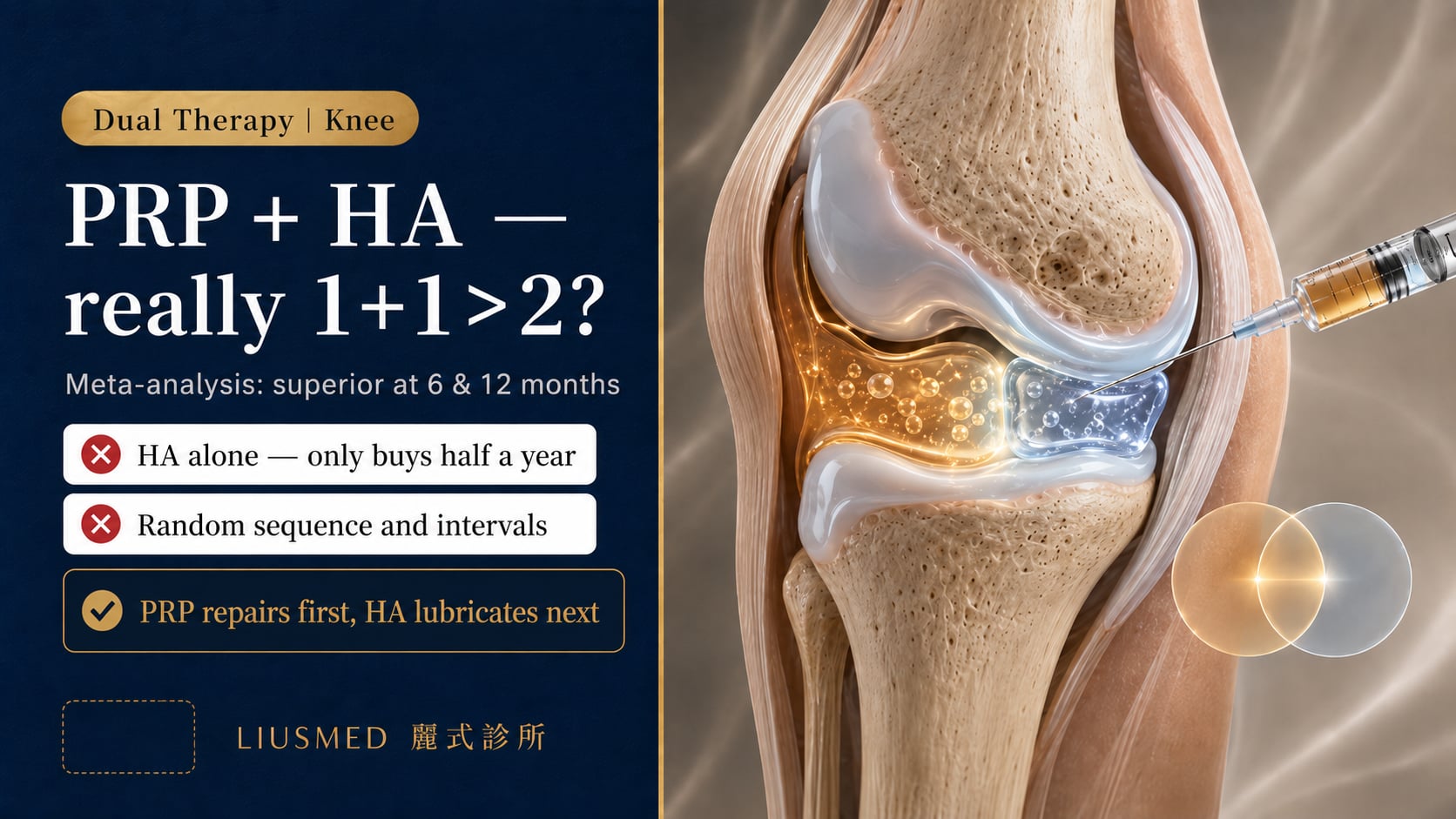
One-Minute Summary
Key Conclusions:
- 2024 BMC Musculoskeletal Disorders meta-analysis: PRP (Platelet-Rich Plasma — concentrate of your own blood platelets rich in growth factors)+HA (Hyaluronic Acid — sugar molecule naturally in skin/joint, holds water) significantly outperforms monotherapy in VAS (Visual Analog Scale — 0–10 line scale for pain rating) and WOMAC (Western Ontario and McMaster Universities Osteoarthritis Index — knee/hip OA pain & function scale) at 6 and 12 months.
- Mechanism complementarity: HA provides lubrication and mechanical cushioning; PRP provides biological regenerative signaling — different mechanisms of action.
- Some studies show PRP+HA better suppresses synovial inflammation than either alone.
- Optimal protocol: Two PRP injections (4 weeks apart) → 4–6 weeks later, three-shot HA protocol. Total duration ~3 months.
- Best for "diminishing HA response", "KL (Kellgren-Lawrence — OA X-ray severity grade 0–4) II–III moderate degeneration", and "high activity demand" patients.
Why Combine PRP and HA?
Each injectable has strengths and limitations:
| Treatment | Strength | Limitation |
|---|---|---|
| HA | Immediate lubrication, cushioning, pain relief | Does not repair cartilage; effect declines; needs re-dose at 4–6 months |
| PRP | Biological regenerative signal, anti-inflammatory, cartilage repair stimulus | Slower onset; possible early swelling; limited mechanical cushioning alone |
| PRP + HA Combined | Combines immediate relief + long-term regeneration, complementary mechanisms | Higher cost, longer protocol |
Key insight: PRP and HA are not "alternatives" but "complementary partners." HA is "lubricating the joint immediately"; PRP is "starting the joint repair program" — different goals, mutually reinforcing.
Evidence: Does Combination Truly Outperform Monotherapy?
2024 BMC Musculoskeletal Disorders Meta-Analysis
Pooled multiple RCTs (Randomized Controlled Trials — gold-standard treatment comparison studies) comparing three arms: HA alone, PRP alone, PRP+HA combination.
Main findings:
| Comparison | VAS Pain Improvement | WOMAC Function Improvement | Statistical Significance |
|---|---|---|---|
| PRP+HA vs HA | 6 months significantly better than HA | Significantly better | p<0.05 |
| PRP+HA vs PRP | 12 months significantly better than PRP | Significantly better | p<0.05 |
| PRP+HA vs dual placebo | Significantly better | Significantly better | p<0.001 |
Synovial Inflammation Suppression
Some studies use MRI (Magnetic Resonance Imaging) to evaluate bone marrow edema:
2024 study: PRP+HA group showed significantly reduced bone marrow edema area at 12 months; HA-alone group showed no significant change.
This suggests PRP+HA may not just provide symptomatic relief but influence disease progression.
Mixed-Evidence Zone
Important note: Some studies show PRP+HA not necessarily superior to PRP alone — especially in <6-month follow-up. The clearest difference is at 6–12+ months.
Mechanism: Why Complementary?
HA's Action Tier
- Physical: increases synovial fluid viscosity, reducing friction
- Cushioning: provides intra-articular "liquid cushion" shock absorption
- Metabolic: some studies show HA suppresses matrix metalloproteinases (MMP)
PRP's Action Tier
- Biological signaling: high-concentration TGF-β (Transforming Growth Factor Beta — fibrosis & repair signal), PDGF (Platelet-Derived Growth Factor — platelet-released cell growth signal), IGF-1 (Insulin-like Growth Factor 1 — growth/repair signal molecule) launch repair programs
- Anti-inflammatory: suppresses IL-1β (Interleukin-1 beta / Interleukin-6), TNF-α (Tumor Necrosis Factor alpha) and other pro-inflammatory cytokines
- Cellular: stimulates chondrocyte and synovial stem cell activity
Why Stack?
- Temporal complementarity: HA acts immediately, PRP slowly but durably
- Spatial complementarity: HA in joint cavity, PRP penetrates cartilage matrix
- Signal complementarity: HA is passive cushioning, PRP is active repair
Optimal Protocol Design
Classic "PRP First + HA After" Protocol
The most clinically adopted approach:
| Week | Injection | Purpose |
|---|---|---|
| 0 | PRP #1 | Launch repair program |
| 4 | PRP #2 | Reinforce biological signal |
| 8 | HA #1 | Begin mechanical lubrication |
| 9 | HA #2 | — |
| 10 | HA #3 | Complete HA standard protocol |
Full protocol ~10 weeks, peak effect at 3–6 months.
Alternative: "PRP+HA Mixed Same-Syringe"
- PRP and HA combined in one syringe
- Some studies support, but PRP coagulation cascade interaction debated
- Most clinicians prefer separate injections
Advanced: Intraosseous + Intra-articular Dual Route
The 2018 Sanchez et al. study showed intraosseous PRP + intra-articular PRP+HA improved severe OA outcomes — consider for advanced cases.
Ideal Candidates
Strong Recommendations
- Diminishing HA response — previous HA effective but increasingly short-lived
- KL II–III moderate degeneration — substantial cartilage to preserve
- 45–65 years, high activity demand — wishing to defer or avoid replacement
- Unilateral knee pain ≥6 months — chronic pain needing multi-mechanism approach
- Budget allows combination protocol
Not Recommended for Combination
- KL I (mild only) — HA alone may suffice
- KL IV severe — replacement evaluation more appropriate
- Severe budget constraints — single therapy is acceptable
- On antiplatelet medications — affects PRP quality, evaluation needed
Cost-Effectiveness vs Single Therapy
| Plan | Relative Per-Session Investment | Effect Duration | Cost-Effectiveness |
|---|---|---|---|
| HA 3-shot alone | Lower | 6–9 months | Short-term, frequent re-doses |
| PRP 3-shot alone | Moderate (about 2–3× HA) | 9–18 months | Mid-to-long term |
| PRP 2-shot + HA 3-shot | Higher | 12–24 months | Best long-term value |
| Knee replacement | Separate | Permanent (15–20 yr wear) | Irreversible |
Key insight: Calculating "cost per pain-free year," combination therapy — though higher upfront — delivers the best long-term value, especially for patients hoping to defer surgery 5–10 years.
Side Effects and Considerations
Common
- 24–72 hour post-injection joint swelling, stiffness
- Brief injection-site discomfort
Rare
- Infection (<0.1% with sterile technique)
- Transient inflammatory flare
Contraindications
- Active infection
- Severe coagulopathy
- HA component allergy (extremely rare)
- Pregnancy/lactation requires careful evaluation
Drug Considerations
- Anticoagulants (warfarin, DOAC): evaluation needed, possible temporary hold
- Antiplatelets (aspirin, clopidogrel): affects PRP quality, discuss with cardiologist
Common questions
Is combining PRP and hyaluronic acid really better than either alone?
It depends on the time frame. Meta-analyses show that after 6 to 12 months, the combination beats HA alone or PRP alone on pain and function scores; but within the first 6 months, the combination doesn't always outperform PRP alone. The gap is clearest from about six months to a year out.
Why use both — how do their mechanisms differ?
Because they do different jobs. HA is like oiling the joint immediately — it provides lubrication and mechanical cushioning and eases pain right away; PRP is like starting the joint's repair program, using growth factors to stimulate cartilage and dampen inflammation, but it works slowly. One is immediate, one is long-acting, and they complement each other.
How is the course scheduled — how many injections?
The most commonly used clinical plan is "PRP first, HA after": one PRP injection at week 0 and week 4, then a three-dose HA course around weeks 8 to 10 — about a ten-week course overall, with the effect usually peaking at three to six months.
Am I a good candidate for the combination?
It suits situations like: HA used to work but wears off faster each time; moderate degeneration (KL II–III, with cartilage still worth saving); forties to sixties with high activity demands; wanting to delay a knee replacement. If the degeneration is very mild, HA alone may be enough; if it's already severe, it's better to get evaluated for joint replacement.
Will it swell afterward — anything to watch for?
The joint may swell and feel stiff for 24 to 72 hours after injection; that's common and passes. Infection is rare (under 0.1% with sterile technique). One thing to flag: if you take anticoagulants or antiplatelet drugs (like aspirin or clopidogrel), tell us beforehand — they affect PRP quality and need evaluation or a discussion with your cardiologist first.
Conclusion: PRP+HA Is the "Gold Combination" for Moderate Knee OA
For patients seeking "immediate symptom relief + simultaneous disease progression deceleration," PRP+HA is currently the most evidence-supported non-surgical combination. It is not a panacea, but for appropriate candidates it offers:
- Longer pain-relief window
- Better functional recovery
- Possible disease progression slowing
- Surgery deferral or avoidance opportunity
If you are considering knee regenerative therapy or wishing to defer replacement, see our joint injection regenerative service or book a consultation.
Medical References
- Effects and safety of PRP and HA combination in knee OA: systematic review and meta-analysis. BMC Musculoskeletal Disorders. 2020.
- Efficiency of intraarticular PRP and HA combination in knee OA: systematic review. ScienceDirect. 2025.
- Treating Knee OA With PRP and HA Combination Therapy: Systematic Review. PubMed PMID (PubMed Identifier): 33831332.
- Clinical Efficacy of PRP and HA Versus HA for Knee OA with MRI Analysis: RCT (Randomized Controlled Trial). MDPI JCM. 2025. PMID: 40429547.
- Comparison of HA and PRP intra-articular injection with combined intra-articular and intraosseous PRP. PubMed PMID: 29388085.
Editorial review: Reviewed by Dr. Ta-Ju Liu. Last reviewed 2026-04-27.
Related Services

Specialties
Credentials
- Kaohsiung Medical University, School of Medicine
- Attending Physician, Dermatology, Kaohsiung Chang Gung Memorial Hospital
- Attending Physician, Aesthetic Center, Kaohsiung Chang Gung Memorial Hospital
- Visiting Physician, Dermatology, Xiamen Chang Gung Hospital
- Visiting Physician, Aesthetic Center, Xiamen Chang Gung Hospital
"For every surgery, I strive to achieve a good outcome through a small incision and refined technique. Minimally invasive surgery is not just a technique — it's a commitment of respect to every patient."
Want to learn more?
Schedule a consultation for professional evaluation and advice