Scalp Microenvironment: Inflammation, Oxidation & Hair Loss
One-Minute Summary
Key Conclusions:
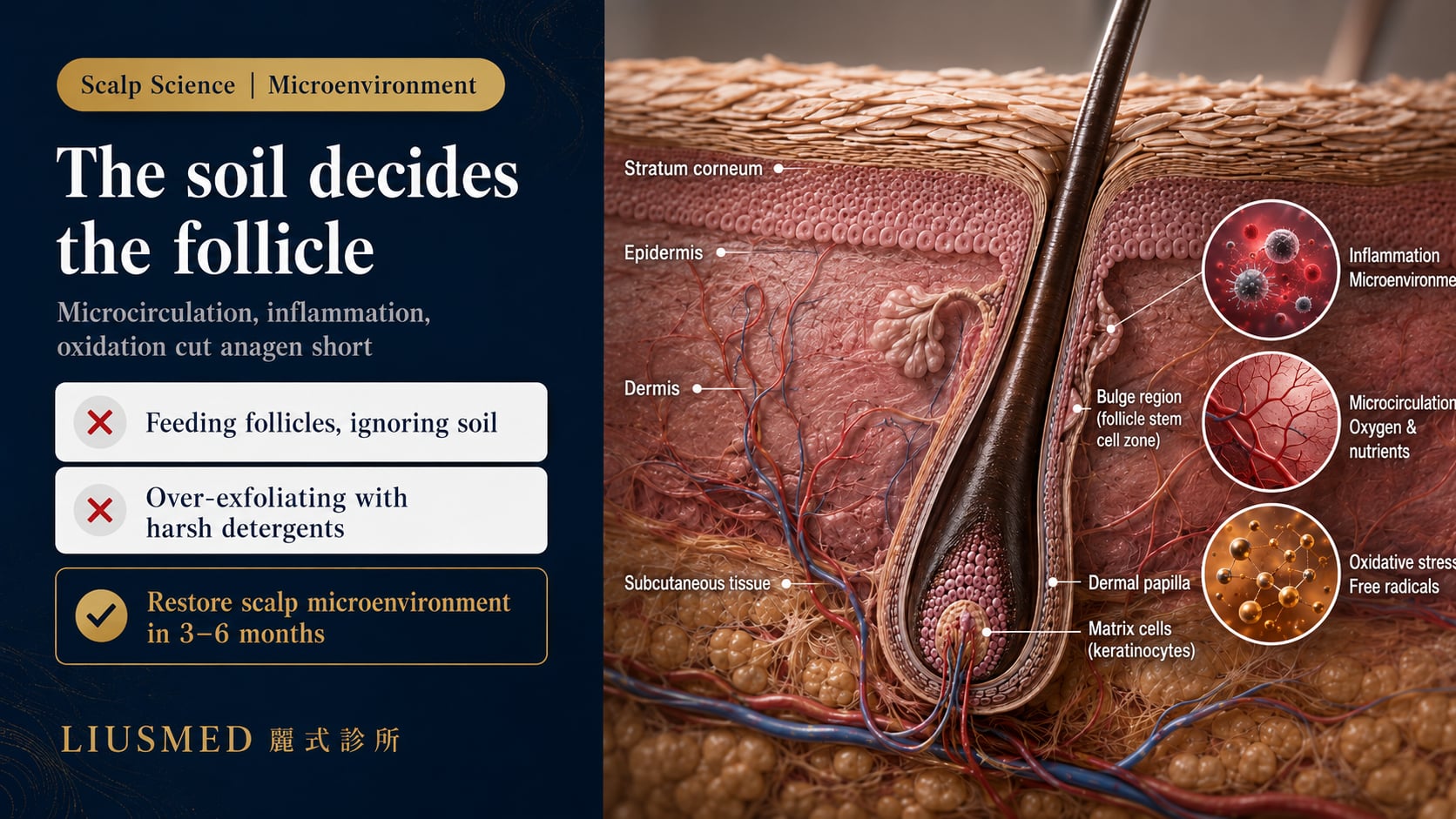
- Scalp microenvironment = skin cells + vessels + immune signals + microbes + biochemical gradients. Together they decide whether follicles maintain a complete growth phase.
- Insufficient microcirculation → follicle hypoxia and nutrient deficit; low-grade inflammation (silent but persistent) → follicles enter telogen prematurely; oxidative stress → matrix keratinocytes attacked by free radicals.
- Three major disruptors: airborne particulates (PM2.5), chronic stress, improper scalp care (over-exfoliation, harsh detergents).
- Part of Minoxidil's efficacy is improving scalp microcirculation — the scientific basis for the "drug + microenvironment" synergy.
- Systematic scalp restoration can significantly reduce shedding and prolong anagen within 3–6 months.
Why "Soil" Matters More Than "Seeds"
Many focus on "feeding follicles" or "stimulating new growth" but overlook a more fundamental fact: follicles have full metabolic, repair, and regenerative capacity — provided their microenvironment is healthy.
The scalp microenvironment is like soil to a plant:
- The same seed cannot thrive in poor soil
- The same follicle cannot maintain complete anagen on a scalp suffering from ischemia, inflammation, or oxidative pressure
Key insight: Improving scalp microenvironment is not "alternative therapy" or "marketing fluff." International research has confirmed microenvironment as a core variable determining long-term follicle performance.
Five Components of Scalp Microenvironment
1. Microcirculation
Scalp blood flow delivers oxygen and nutrients to follicles and removes metabolic waste.
- Healthy microcirculation: 30–50ml/min per 100g tissue
- AGA (Androgenetic Alopecia) patients: crown microcirculation often drops by 30–50%
- Under chronic stress: sympathetic activation further constricts scalp vessels
One of Minoxidil's core mechanisms is dilating scalp vessels and improving microcirculation — the scientific basis for its efficacy in AGA (Androgenetic Alopecia — male-pattern hair loss).
2. Immune Signals (Low-Grade Inflammation)
"Low-grade inflammation" is the most-overlooked scalp problem. It is painless, non-itchy, non-erythematous — yet persists subdermally, continuously pushing follicles prematurely from anagen into telogen.
Common signals:
- Abnormally increased sebum
- Regular flaking (despite frequent washing)
- Mild tenderness when hair is pulled
- Hair becoming finer and shorter without obvious shedding
3. Microbiome
Hundreds of bacterial and fungal species live on the scalp in symbiotic balance. When disrupted:
- Malassezia overgrowth → seborrheic dermatitis, dandruff, inflammatory cascade
- Staphylococcus aureus dominance → folliculitis, perifollicular fibrosis
- Reduced microbial diversity → microenvironment becomes less stable, more vulnerable
4. Oxidative Stress
Follicles, especially anagen-phase matrix keratinocytes, are highly metabolically active and produce abundant reactive oxygen species (ROS). When antioxidant defenses fall short:
- DNA damage accumulates in follicle stem cells
- Apoptosis signals activate
- Follicles transition prematurely to telogen
Modern environmental amplifiers:
- PM2.5 penetrates scalp microcirculation, stimulating ROS
- UV (especially UVA) reaches deep follicle layers
- Smoking, excessive alcohol, chronic insomnia
5. Biochemical Gradients
Local pH, sebum acidity, nutrient concentrations, and growth factor distribution influence follicle phase-switching signals.
How Microenvironment "Shortens Anagen"
The follicle cycles through three phases: anagen → catagen → telogen.
Healthy scalp:
- Anagen: 85–90% (lasting 2–7 years)
- Telogen: 10–15% (lasting 2–4 months)
Compromised microenvironment:
- Anagen ratio drops below 70%
- Anagen duration shortens to 1–2 years or even months
- Telogen ratio rises
The result: increased daily shedding (>100 hairs), reduced density, thinner shafts.
Key insight: "Increased shedding" is not necessarily AGA — it may signal microenvironment deterioration. Distinguishing "pure microenvironment" vs "AGA + microenvironment" requires professional evaluation.
Five Systematic Strategies for Microenvironment Restoration
Strategy 1: Restore Scalp Microcirculation
- 5-minute daily scalp massage: circular fingertip motion without sliding through hair; multiple studies show significant blood flow increase
- Avoid prolonged tight ponytails or pressure: mechanical traction restricts flow
- Proper Minoxidil application: beyond pharmacology, the application massage itself increases circulation
- Regular aerobic exercise: 150 minutes/week of moderate activity improves systemic circulation
Strategy 2: Reduce Low-Grade Inflammation
- Anti-inflammatory diet: omega-3 (deep-sea fish, flaxseed), polyphenols (green tea, berries), curcumin
- Reduce sugar: high-sugar diets accumulate AGEs, amplifying inflammation
- Improve sleep: ≥7 hours/night, with deep sleep being the critical anti-inflammatory window
- Audit products: avoid alcohol, harsh surfactants, excessive fragrance in shampoos
Strategy 3: Balance Scalp Microbiome
- Avoid over-cleansing: daily harsh detergents disrupt flora
- For oily scalp, use 1–2% Ketoconazole shampoo: suppresses Malassezia with mild anti-DHT effect
- Don't use antibacterial shampoos continuously >2 weeks: avoid disrupting flora excessively
- Probiotic supplementation: gut-skin axis research suggests some strains can improve scalp flora
Strategy 4: Reduce Oxidative Stress
- Wear hats for sun protection: UV is a major source of scalp oxidative stress
- Limit outdoor time on high-pollution days; wash hair after returning home
- Quit smoking: nicotine is a strong oxidant and impairs microcirculation
- Antioxidant intake: vitamins C, E, selenium, zinc, Q10
- Topical antioxidant serums: with vitamin E, resveratrol, caffeine — evidence-supported
Strategy 5: Stress and Mental Health Management
Chronic stress raises cortisol, disrupts follicle growth signals, and suppresses immune repair.
- 10 minutes/day deep breathing or meditation
- Consistent sleep schedule
- Seek professional support if needed
Microenvironment Improvement vs AGA Medication: Which First?
For AGA patients, this is not either/or — it is stacked application.
| Scenario | Recommended Stack |
|---|---|
| Early shedding, poor microenvironment | Microenvironment-first; consider Minoxidil 5% trial × 3 months |
| Moderate AGA + poor microenvironment | Finasteride + Minoxidil + microenvironment in parallel |
| Moderate AGA + normal microenvironment | Finasteride + Minoxidil primary; maintain microenvironment |
| Advanced AGA | Medications + PRP primary; microenvironment as long-term maintenance |
Key insight: Even when medication has started, ignoring microenvironment reduces drug efficacy. Drugs act on the follicle itself; microenvironment defines the surrounding "work environment." Synergy yields the best outcome.
Common questions
Why does the same hair-loss medication work less well for me than for other people?
The drug acts on the follicle itself, but whether that follicle can respond depends heavily on the scalp it lives in. If your scalp has poor blood flow, ongoing low-grade inflammation, and high oxidative stress, the soil simply isn't good enough, so even an effective drug gets discounted. The same medication planted in different scalps naturally gives very different results.
What are the signs that my scalp microenvironment is deteriorating?
Common ones are more oil than usual, regular flaking even when you wash often, mild tenderness when you tug your hair, and strands slowly getting finer and shorter without any obvious clumps falling out. These point to low-grade inflammation quietly sitting under the skin — because it doesn't hurt or itch, it's easy to miss. To really sort it out, a scalp assessment is the way to go.
If I'm shedding more every day, does that mean I have AGA?
Not necessarily. More shedding can simply be a signal that your scalp microenvironment is getting worse, not proof of male-pattern hair loss. A pure microenvironment problem and AGA-plus-microenvironment are handled quite differently, so it takes a professional evaluation to tell them apart rather than guessing or self-medicating.
Does scalp massage actually help?
Yes. A daily circular fingertip massage of about five minutes — without sliding and tugging on the strands — has been shown across multiple studies to increase scalp blood flow. Better flow means better oxygen and nutrient supply to the follicles. It's no magic fix, but as a low-cost daily habit for microcirculation, it's well worth doing.
I'm already on hair-loss medication — do I still need to care about the microenvironment?
Yes, and the two stack rather than compete. Medication looks after the follicle itself; the microenvironment looks after the work environment around it. If you only take the drug but leave inflammation and poor circulation unaddressed, the drug's effect gets dragged down. Caring for both together is the more sensible approach.
Conclusion: Treat the Scalp as an Ecosystem
Many "treatment failures" are not "drug ineffectiveness" but unrepaired follicle habitat. When your scalp suffers chronic inflammation, poor circulation, and high oxidative pressure, even the best drug effects are diminished.
If you are facing:
- Increased shedding without obvious bald patches
- Hair-loss medication response below expectation
- Oily, flaky, or sensitive scalp
- Wanting to prevent AGA progression
Begin with a scalp microenvironment assessment to understand your soil. See our hair regrowth and scalp repair service or book a consultation.
Medical References
- Scalp Condition Impacts Hair Growth and Retention via Oxidative Stress. PMC6369642.
- Oxidative stress in hair follicle development and hair growth: Signalling pathways. PMC11196958. 2024.
- The Skin Microenvironment: A Dynamic Regulator of Hair Follicle Development, Cycling and Disease. PMC12467127.
- Signaling pathways in hair aging. Frontiers in Cell and Developmental Biology. 2023.
- Biology of Hair Growth and Influence of External Factors. ULMHS. 2025.
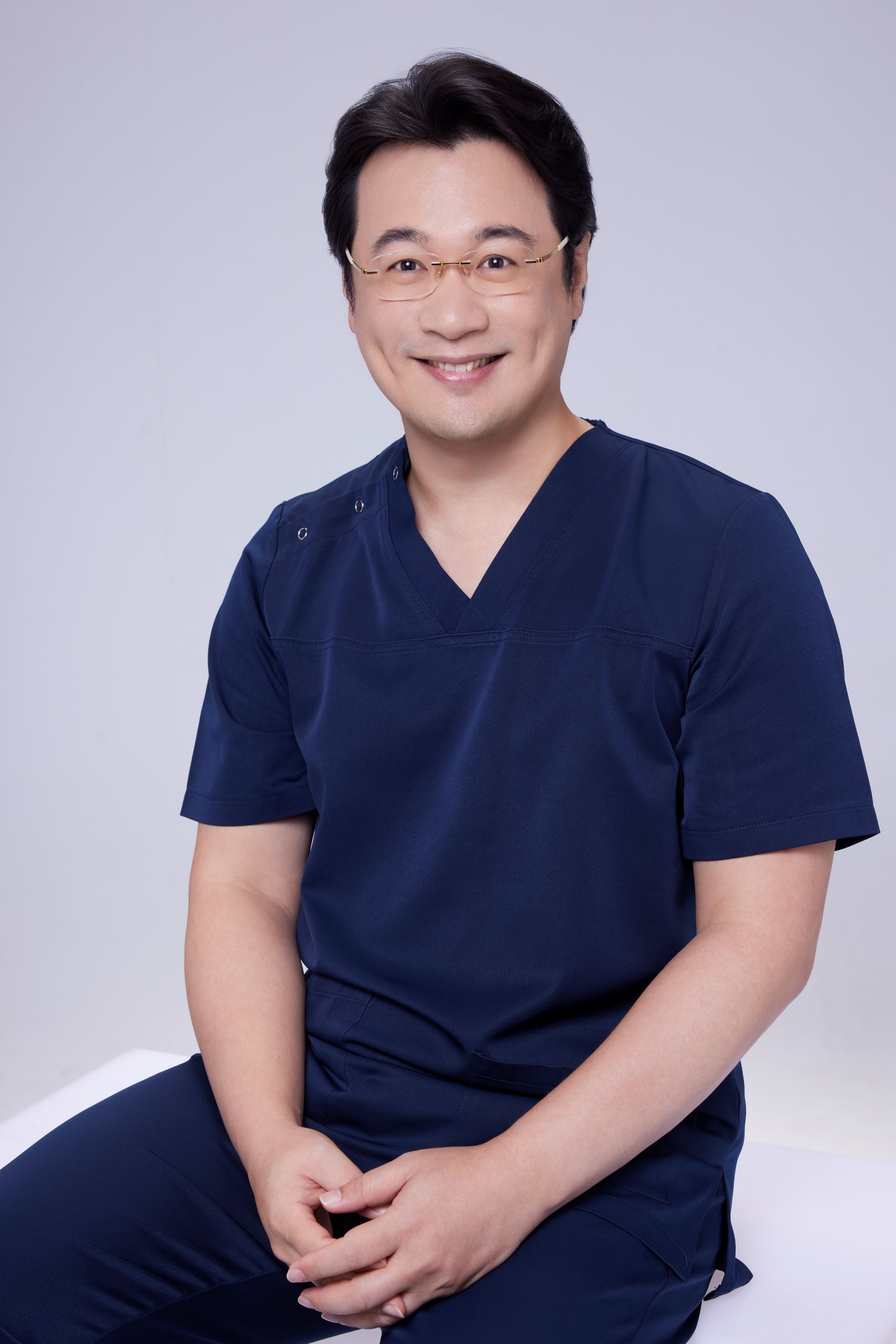
Editorial review: Reviewed by Dr. Ta-Ju Liu. Last reviewed 2026-04-27.
Related Services
Specialties
Credentials
- Kaohsiung Medical University, School of Medicine
- Attending Physician, Dermatology, Kaohsiung Chang Gung Memorial Hospital
- Attending Physician, Aesthetic Center, Kaohsiung Chang Gung Memorial Hospital
- Visiting Physician, Dermatology, Xiamen Chang Gung Hospital
- Visiting Physician, Aesthetic Center, Xiamen Chang Gung Hospital
"For every surgery, I strive to achieve a good outcome through a small incision and refined technique. Minimally invasive surgery is not just a technique — it's a commitment of respect to every patient."
Want to learn more?
Schedule a consultation for professional evaluation and advice