Sculptra Nodules Won't Dissolve After Steroids? What Helps
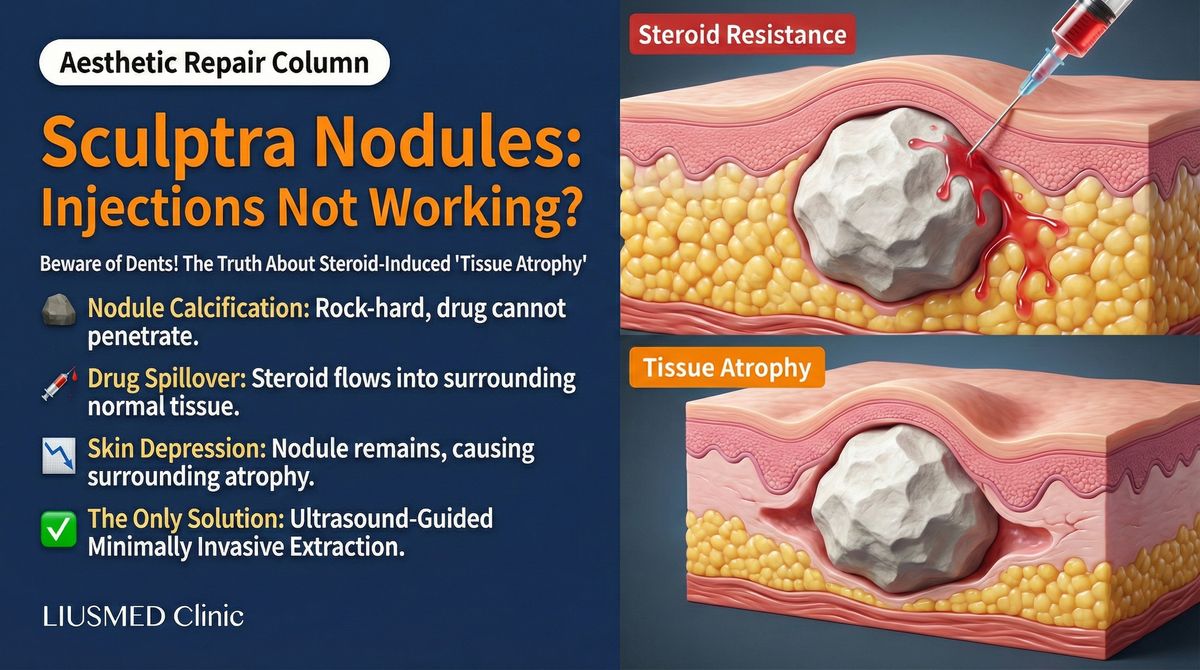
Why Won't My Sculptra Lumps Go Away After Steroid Injections?
You had Sculptra injected months or years ago, and nodules developed. Your doctor treated them with steroid injections—possibly multiple rounds—and perhaps even 5-fluorouracil (5-FU). But the lumps are still there. They may have softened slightly, but they have not resolved. You are running out of options, and the frustration is mounting.
This is a scenario we see regularly. Steroid and 5-FU treatments have a ceiling of effectiveness against encapsulated Sculptra nodules, and understanding why helps clarify what treatment can actually work.
Understanding Sculptra and Why Nodules Form
What Is Sculptra?
Sculptra is an injectable containing poly-L-lactic acid (PLLA) microparticles suspended in a water-based solution. Unlike hyaluronic acid fillers that provide immediate volume, Sculptra works by stimulating the body to produce its own collagen over several months.
| Characteristic | Detail |
|---|---|
| Active ingredient | Poly-L-lactic acid (PLLA) |
| Mechanism | Collagen stimulation, not direct filling |
| Duration | 2–3 years or longer |
| Dissolvable | No enzyme or medication available |
| FDA-approved uses | Facial volume restoration, HIV lipoatrophy |
Why Do Sculptra Nodules Form?
Nodule formation with Sculptra occurs through several mechanisms:
| Cause | Mechanism |
|---|---|
| Insufficient dilution | Concentrated PLLA particles cluster and provoke stronger tissue reaction |
| Inadequate massage | Uneven distribution creates focal areas of high PLLA concentration |
| Wrong injection plane | Superficial placement in areas with thin tissue coverage |
| Patient susceptibility | Individual variation in foreign body response |
| High-risk areas | Periorbital region, lips, nose—areas with thin skin and limited tissue |
The Encapsulation Process
When PLLA (Poly-L-Lactic Acid (Sculptra) — particle injection stimulating collagen) particles concentrate in one area, the body responds with a foreign body granulomatous reaction:
- Macrophages surround the PLLA particles
- Giant cells form to engulf the foreign material
- Fibroblasts deposit collagen around the inflammatory focus
- A fibrous capsule forms, walling off the material
- The encapsulated nodule becomes a self-contained structure
Once this capsule is fully formed, the PLLA particles inside are effectively shielded from external treatments.
Key Insight: Encapsulation is the body's defense mechanism against foreign material. Once complete, the capsule wall acts as a barrier that prevents medications—including steroids—from reaching the PLLA particles inside.
Why Steroids and 5-FU Reach Their Limits
How Steroids Work on Nodules
Intralesional corticosteroids (typically triamcinolone acetonide) work by:
- Suppressing the inflammatory response around the nodule
- Reducing collagen synthesis by fibroblasts
- Softening the fibrous tissue through anti-inflammatory action
Why Steroids Fail on Encapsulated Nodules
| Stage | Steroid Effectiveness |
|---|---|
| Early inflammatory nodule (< 6 months) | Moderate to good—can reduce active inflammation |
| Partially encapsulated (6–12 months) | Limited—capsule restricts drug penetration |
| Fully encapsulated (> 12 months) | Poor—steroid cannot reach the PLLA core |
| Calcified or fibrotic (> 24 months) | Minimal—dense tissue blocks all penetration |
The fundamental problem: steroids work on the inflammatory component, but once encapsulation is complete, the primary issue is structural, not inflammatory. No amount of anti-inflammatory medication can dissolve a mature fibrous capsule.
The 5-FU Addition
5-Fluorouracil is sometimes combined with steroids in an attempt to inhibit fibroblast proliferation and reduce the fibrous capsule. While this can provide modest additional benefit in early nodules:
- Its penetration through mature capsules is limited
- It does not dissolve existing fibrous tissue
- Repeated injections carry risks of tissue damage
- Results are inconsistent for established nodules
Dr. Liu explains: "Steroids and 5-FU are reasonable first-line treatments for early Sculptra nodules. But if two or three rounds of injections have not significantly improved the lump, continuing the same approach is unlikely to yield different results. The capsule is simply too well-formed for medication to penetrate effectively."
The Risks of Repeated Steroid Injections
Tissue Atrophy (tissue shrinkage and weakening): A Growing Concern
Each steroid injection carries cumulative risks that worsen with repetition:
| Complication | Description | Reversibility |
|---|---|---|
| Skin atrophy | Thinning of the skin overlying the nodule | Partially reversible over 6–12 months |
| Fat atrophy | Loss of subcutaneous fat around the injection site | Slowly reversible, may need filling |
| Telangiectasia | Visible dilated blood vessels on the skin surface | Often permanent |
| Hypopigmentation | Loss of skin color at the injection site | May improve but often persists |
| Dermal depression | Visible dip or crater around the nodule | May require secondary correction |
The Paradox of Over-Treatment
Repeated steroid injections can create a situation worse than the original nodule:
- The lump persists because the capsule is intact
- The surrounding tissue deteriorates from steroid effects
- The skin becomes thinner and more fragile
- Future extraction becomes more technically challenging due to compromised tissue quality
The Definitive Solution: Ultrasound-Guided Micro-Extraction
Why Physical Removal Works
When medications cannot penetrate the capsule, the logical solution is to bypass the capsule entirely through physical extraction. Ultrasound-guided micro-extraction:
- Directly accesses the encapsulated nodule through a pinhole incision
- Physically separates the capsule and PLLA material from surrounding tissue
- Removes the entire structure—capsule, PLLA particles, and granulomatous tissue
- Confirms completeness with real-time ultrasound verification
The Extraction Process
Pre-Operative Assessment:
- Detailed history: injection dates, volumes, areas, previous treatments
- Physical examination: palpation of all nodules, skin quality assessment
- Ultrasound mapping: location, depth, size, capsule characteristics, proximity to vital structures
The Procedure:
| Step | Detail |
|---|---|
| Anesthesia | Local anesthesia at and around the nodule, plus gentle pain-relief anesthesia |
| Entry point | Pinhole (1-2mm), no incision, in a concealed location |
| Approach | Ultrasound guides the instrument to the capsule |
| Separation | Careful blunt dissection separates the capsule from normal tissue |
| Extraction | The encapsulated material is removed through the pinhole |
| Verification | Ultrasound checks what has been removed and what remains |
| Closure | No sutures needed for the pinhole |
Post-Operative Care:
- Light pressure for 24 hours
- Ice application for the first 48 hours
- Avoid strenuous activity for 1 week
- Follow-up at about 14 days, 1 month, and 3 months
What Makes This Different From Surgical Excision?
Traditional surgical excision involves a larger incision and wider tissue removal. Micro-extraction differs in several important ways:
| Factor | Traditional Excision | Micro-Extraction |
|---|---|---|
| Wound size | 5–15mm incision | 1-2mm pinhole |
| Tissue removal | Wider margins | Targeted capsule only |
| Scarring | Visible scar likely | Virtually invisible |
| Anesthesia | May require general or regional anesthesia | Local anesthesia plus gentle pain-relief anesthesia |
| After the procedure | An incision wound also has to heal | Small pinhole, but swelling and bruising still occur, settling in about 2–3 weeks |
| Guidance | Visual or blind | Real-time ultrasound |
Recovery and Expected Outcomes
Post-Extraction Timeline
| Period | What to Expect |
|---|---|
| Day 1–3 | Mild swelling, possible bruising, manageable discomfort |
| Week 1 | Swelling resolving, follow-up assessment |
| Week 2–4 | Tissue remodeling, contour improvement |
| Month 1–3 | Progressive recovery, tissue softening |
| About 3 months | Close to the final result; assess whether volume restoration is needed |
Managing Expectations
- Volume change: The area will appear flatter after nodule removal. This is normal and expected.
- Tissue quality: If multiple steroid injections were administered previously, the overlying skin may be thinner. Recovery of skin quality takes additional time.
- Secondary treatment: Volume restoration with safe HA (Hyaluronic Acid — sugar molecule naturally in skin, holds water) filler can be considered after at least about 3 months, once the result is close to final and has been reassessed.
- Recurrence: Complete extraction has a very low recurrence rate. Follow-up ultrasound at 3 months confirms the outcome.
Dr. Liu's approach: "For patients who have been through multiple rounds of failed steroid treatment, I focus on two things: removing the nodule definitively, and assessing whether the surrounding tissue needs time or additional support to recover. The goal is not just lump removal but overall aesthetic restoration."
When Should You Stop Steroid Treatment and Consider Extraction?
Decision Framework
| Situation | Recommendation |
|---|---|
| First steroid injection, some improvement | Reasonable to try one more round |
| Two rounds with minimal change | Strongly consider extraction |
| Three or more rounds, lump persists | Stop steroids, proceed to extraction |
| Skin thinning or atrophy developing | Stop steroids immediately, assess for extraction |
| Multiple nodules in different areas | Comprehensive assessment with extraction planning |
The earlier you transition to extraction, the better the tissue quality and the easier the procedure.
Frequently Asked Questions
Can Sculptra nodules resolve on their own?
PLLA is biodegradable and eventually breaks down over 2–3 years. However, once a mature capsule has formed, the fibrous tissue itself does not resolve. Patients may notice some softening over years, but the nodule typically remains palpable.
Is the extraction procedure painful?
Under local anesthesia plus gentle pain-relief anesthesia, most patients report only mild pressure during the procedure. Post-operative discomfort is minimal and manageable with standard pain relief.
What if I have nodules in multiple locations?
Multiple nodules can be addressed in a single session or staged over several appointments, depending on the number and location. A comprehensive ultrasound assessment determines the optimal approach.
Will the Sculptra I had still produce collagen after the nodule is removed?
The collagen that has already been produced by Sculptra in healthy areas remains intact. Extraction targets only the problematic nodules, not the normally distributed PLLA.
Move Beyond Repeated Failed Treatments
If steroid injections have not resolved your Sculptra nodules after two or three attempts, continued pharmacological treatment is unlikely to succeed. An ultrasound evaluation can determine the degree of encapsulation and guide you toward a definitive solution.
Schedule a consultation to assess your Sculptra nodules and explore extraction options.
Contact us to book your evaluation
About the Author
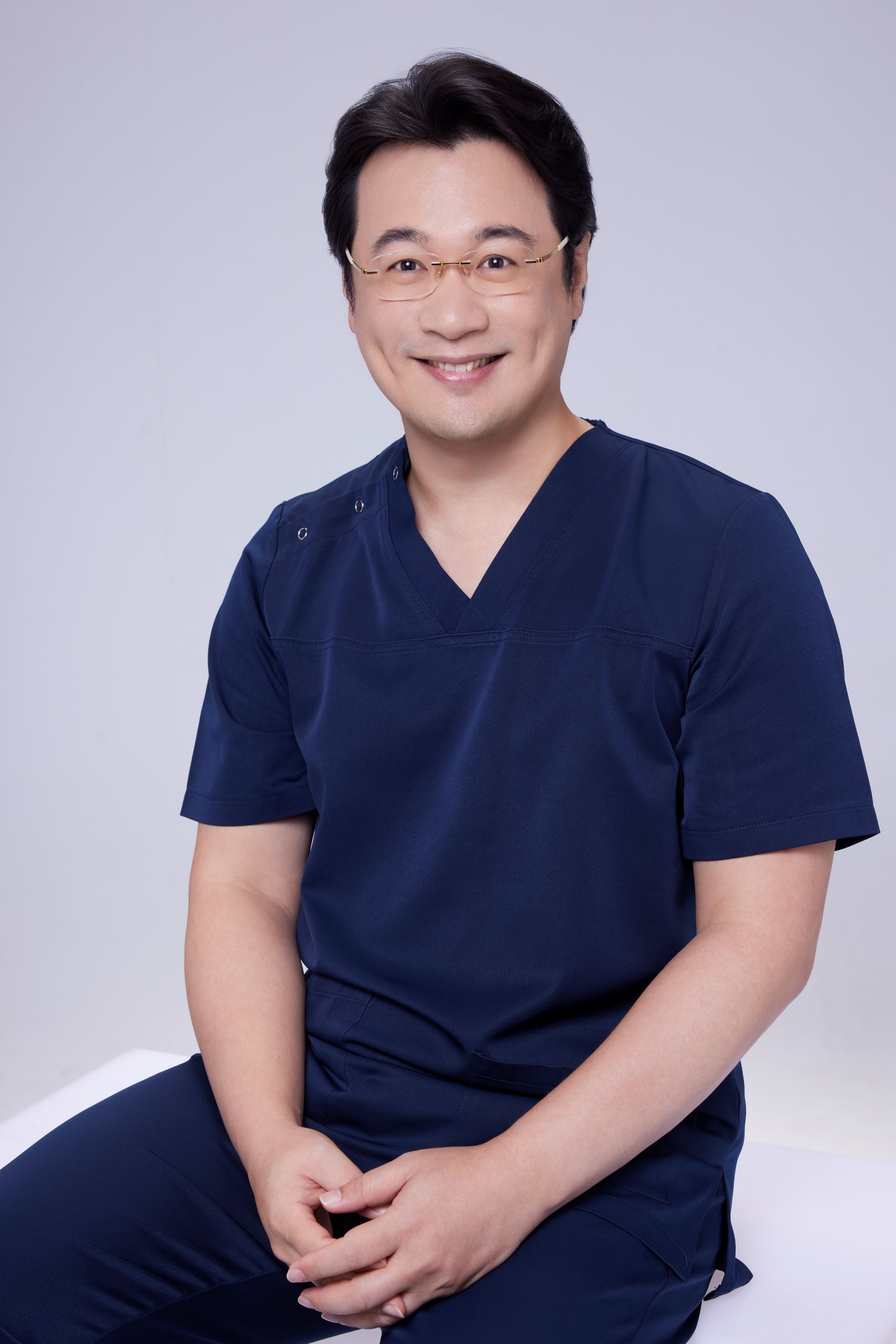
Dr. Ta-Ju Liu
- Current Position: Director, Liusmed Clinic
- Specialties: Minimally invasive surgery (lipoma, cyst), hyperhidrosis surgery, thread lifting, filler complication repair
- Experience:
- 15+ years of clinical minimally invasive surgery experience
- Over 10,000 successful minimally invasive cases
- Board-certified dermatologist
- Philosophy: "When medications have reached their limit, patients need a clear path forward—not more of the same treatment. Micro-extraction provides that definitive answer for encapsulated Sculptra nodules."
Related Services
Specialties
Credentials
- Kaohsiung Medical University, School of Medicine
- Attending Physician, Dermatology, Kaohsiung Chang Gung Memorial Hospital
- Attending Physician, Aesthetic Center, Kaohsiung Chang Gung Memorial Hospital
- Visiting Physician, Dermatology, Xiamen Chang Gung Hospital
- Visiting Physician, Aesthetic Center, Xiamen Chang Gung Hospital
"For every surgery, I strive to achieve a good outcome through a small incision and refined technique. Minimally invasive surgery is not just a technique — it's a commitment of respect to every patient."
Recovery after any procedure needs peer support too


Want to learn more?
Schedule a consultation for professional evaluation and advice