Skin Darker After Laser Toning? Why Melasma Rebounds (PIH)
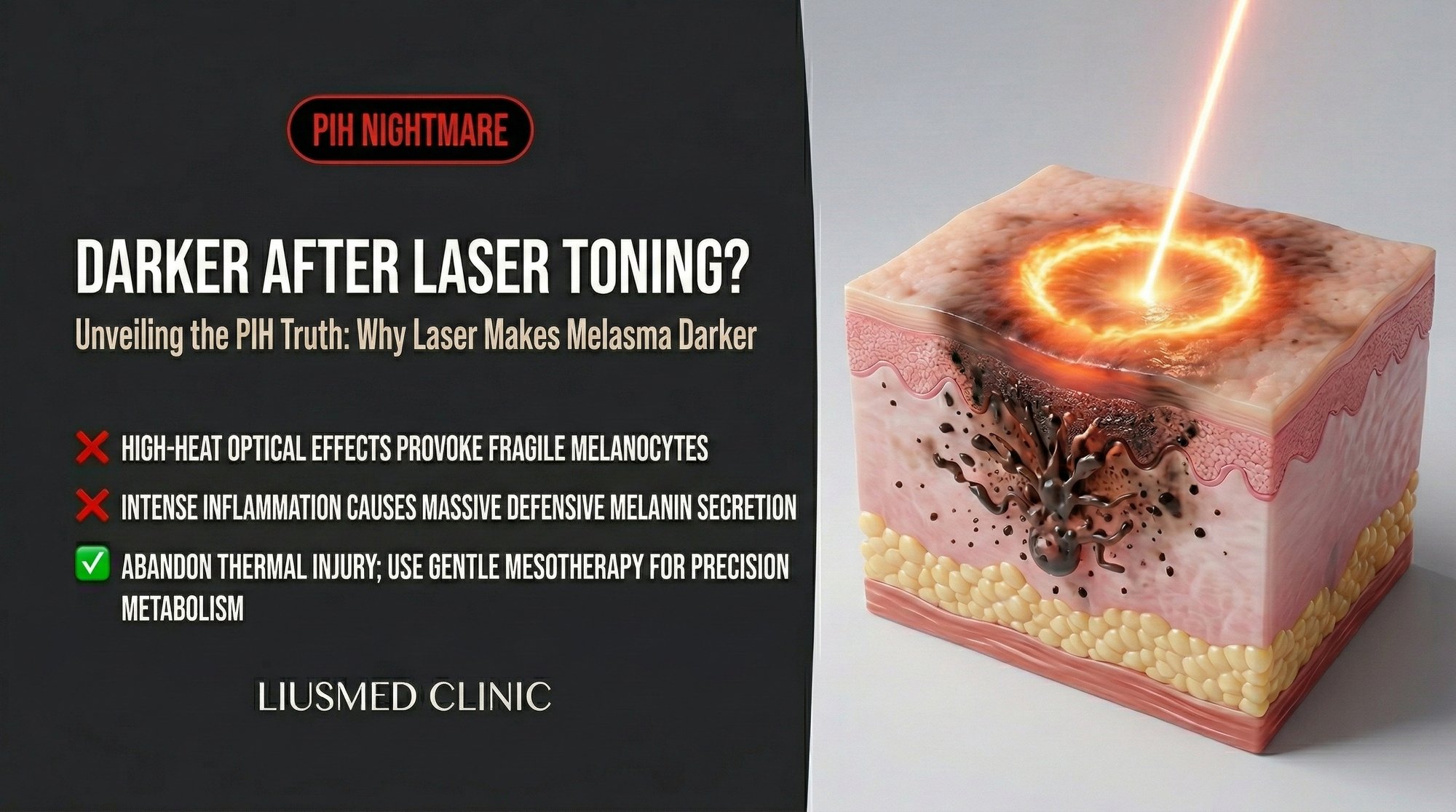
You followed the treatment plan religiously. Ten sessions of toning laser, spaced two weeks apart, each one promising to chip away at those stubborn patches of melasma across your cheeks. The first few sessions seemed hopeful: your skin looked a shade brighter, the pigment appeared to be lifting. Then, somewhere around session six or seven, something shifted. The mirror told a different story. Your melasma was not only back; it was darker, wider, and angrier than before.
You are not imagining things. And you are not alone.
This is the PIH (Post-Inflammatory Hyperpigmentation) rebound phenomenon, and it is one of the most frustrating yet predictable complications of repeated low-fluence Q-switched (Q-switched laser) Nd:YAG (Erbium-doped Yttrium-Aluminum-Garnet laser) laser therapy, commonly marketed as "toning laser" or "laser toning." Understanding why it happens is the first step toward breaking free from the cycle.
Table of Contents
- How Toning Laser Is Supposed to Work
- Why PIH Rebound Happens: The Science of Melanocyte Irritation
- The Cumulative Damage Model: Why More Sessions Make It Worse
- Recognizing the Warning Signs Before It Gets Worse
- Toning Laser vs. Targeted Melasma Injection: A Comparison
- Breaking the Cycle: What to Do After PIH Rebound
How Toning Laser Is Supposed to Work
The concept behind toning laser is deceptively simple. A Q-switched Nd:YAG laser delivers energy at 1064 nm wavelength using low fluence (typically 1.5 to 3.5 J/cm2) across a large spot size. The theory is that sub-threshold energy can gradually shatter melanin granules without causing visible tissue damage, allowing the body's macrophages to clear pigment over multiple sessions.
When it was introduced, this approach gained massive popularity across East Asia because it seemed gentle, required no downtime, and could be repeated frequently. Clinics packaged it into courses of ten, twenty, or even thirty sessions.
The problem is that melanocytes in melasma skin are fundamentally different from those in simple sun spots or lentigines. Melasma melanocytes are hyperactive, sitting within an environment of chronic inflammation, vascular abnormality, and disrupted basement membrane. They do not respond to repeated laser energy the same way normal melanocytes do.
Why PIH Rebound Happens: The Science of Melanocyte Irritation
Post-inflammatory hyperpigmentation occurs when trauma to the skin triggers melanocytes to produce excess melanin as part of the wound-healing cascade. In the context of toning laser, each session delivers subclinical thermal and mechanical stress to the epidermis and upper dermis. While this stress is invisible to the naked eye, it is not invisible to your melanocytes.
Research published in dermatology journals has documented that repeated low-fluence laser exposure causes several measurable changes in melasma skin. First, it increases the expression of stem cell factor (SCF) and endothelin-1 in keratinocytes, both of which are potent melanocyte activators. Second, it upregulates tyrosinase activity, the rate-limiting enzyme in melanin synthesis. Third, it induces mast cell degranulation in the dermis, releasing histamine and other inflammatory mediators that further stimulate pigment production.
In simple terms, each session of toning laser is like poking a hornet's nest. The first few pokes might seem to scatter the hornets, but eventually the colony responds with overwhelming force.
The result is a paradox: the laser initially clears some superficial melanin, creating the illusion of improvement. But beneath the surface, it is simultaneously reprogramming melanocytes to produce more pigment than before. When this tipping point is crossed, the rebound becomes clinically visible, and it is often worse than the original melasma.
The Cumulative Damage Model: Why More Sessions Make It Worse
One of the most dangerous myths in aesthetic medicine is that if a treatment is not working, you simply need more of it. This thinking drives patients to undergo twenty, thirty, or even fifty sessions of toning laser, each one adding cumulative subclinical damage.
The cumulative damage model works as follows. Each laser session creates a micro-inflammatory event in the skin. In healthy skin with normal melanocytes, this inflammation resolves cleanly. In melasma skin, each inflammatory event leaves behind a residue of activated signaling molecules. These molecules do not fully clear between sessions if treatments are spaced too closely. Over time, the baseline level of melanocyte activation creeps higher and higher.
Additionally, repeated laser exposure can damage the dermal-epidermal junction and thin the epidermis. This structural weakening allows UV radiation to penetrate more deeply, further stimulating melanogenesis. Some patients report that their skin becomes more sun-sensitive after a course of toning laser, which is not a coincidence but rather a direct consequence of epidermal thinning.
There is also a vascular component. Studies have shown that melasma lesions have increased dermal vascularity compared to surrounding normal skin. Repeated laser treatments can paradoxically increase this vascular density through angiogenic signaling triggered by thermal stress, creating a more favorable environment for melanocyte hyperactivity.
Recognizing the Warning Signs Before It Gets Worse
Not every patient who undergoes toning laser will experience PIH rebound, but certain warning signs should prompt an immediate pause in treatment:
-
Confetti-like depigmentation: Small white spots appearing within or around treated areas indicate melanocyte destruction. This is a sign of excessive cumulative energy delivery and often precedes severe rebound.
-
Increased sensitivity and redness: If your skin becomes persistently pink or reactive between sessions, the inflammatory load is exceeding your skin's capacity to recover.
-
Darkening after initial improvement: The classic rebound pattern occurs when early brightening reverses around session five to eight. This inflection point signals that melanocyte activation has overtaken melanin clearance.
-
Widening of pigmentation: If melasma patches appear to be spreading beyond their original borders, the inflammatory signaling has become diffuse rather than localized.
-
Visible capillaries: New or more prominent blood vessels on the cheeks indicate vascular remodeling, a sign of chronic subclinical inflammation.
If you notice any of these signs, continuing treatment is likely to worsen the condition rather than improve it. The appropriate response is to stop laser therapy immediately and shift to a fundamentally different treatment strategy.
Toning Laser vs. Targeted Melasma Injection: A Comparison
| Factor | Toning Laser | Targeted Melasma Injection |
|---|---|---|
| Mechanism | External energy shatters melanin granules | Microinjection delivers anti-inflammatory and melanogenesis-inhibiting agents directly to the dermal-epidermal junction |
| PIH Risk | High with repeated sessions; cumulative inflammatory burden | Minimal; avoids thermal trauma to epidermis |
| Vascular Component | May worsen dermal vascularity | Can include vascular-normalizing agents |
| Treatment Frequency | Every 1-2 weeks for 10-30+ sessions | Typically 3-6 sessions spaced 3-4 weeks apart |
| Basement Membrane | May damage with repeated exposure | Supports structural repair of dermal-epidermal junction |
| Melanocyte Behavior | Initial suppression followed by rebound activation | Modulates melanocyte signaling environment without destruction |
| Skin Barrier Impact | Cumulative thinning and sensitization | Preserves epidermal integrity |
| Suitability After PIH Rebound | Contraindicated until inflammation resolves | Often used as a recovery strategy after laser failure |
The fundamental difference is philosophical. Toning laser treats melasma as a pigment problem to be destroyed. Melasma Injection Treatment treats melasma as an inflammatory microenvironment problem to be modulated. For patients who have experienced PIH rebound, this distinction is not academic; it is the difference between continued deterioration and genuine recovery.
Breaking the Cycle: What to Do After PIH Rebound
If you are reading this article because your skin is darker after toning laser, here is what the evidence supports:
Step one: Stop all laser treatments immediately. This includes not only toning laser but also picosecond, fractional, and IPL (Intense Pulsed Light) devices. Your melanocytes are in a hyperactivated state, and any additional energy-based treatment risks making things worse.
Step two: Commit to aggressive sun protection. This means broad-spectrum SPF (Sun Protection Factor) 50+ sunscreen reapplied every two hours during sun exposure, plus physical barriers such as wide-brimmed hats and UV-blocking umbrellas. Sun protection is not optional during recovery; it is the single most important factor in preventing further darkening.
Step three: Allow a cooling-off period. Most dermatologists recommend waiting at least three to six months after the last laser session before initiating any new melasma treatment. This allows the inflammatory milieu to subside and gives melanocytes time to return to a less reactive state.
Step four: Seek a comprehensive evaluation. A proper melasma assessment should include Wood's lamp examination to determine the depth of pigment (epidermal, dermal, or mixed), evaluation of the vascular component, and a thorough history of all previous treatments. This evaluation informs whether Melasma Injection Treatment or another approach is most appropriate for your specific situation.
Step five: Address the underlying drivers. Melasma is not caused by a lack of laser. It is driven by hormonal influences, UV exposure, heat, and chronic inflammation. Any effective long-term strategy must address these root causes rather than simply chasing pigment with energy devices.
The recovery timeline varies. Mild PIH rebound may resolve in three to six months with strict sun protection alone. Severe rebound with structural skin changes may require twelve months or more of careful management. Patience is essential, and any provider who promises rapid reversal of laser-induced PIH should be approached with skepticism.
Frequently Asked Questions
Q1: How do I know if my darkening is PIH rebound or just my melasma getting worse naturally?
PIH rebound typically follows a pattern of initial improvement followed by sudden worsening that coincides with ongoing laser sessions. The darkening often appears more intense and may have a slightly different hue (more brown-gray) compared to the original melasma. If the darkening began or accelerated during your laser treatment course rather than after sun exposure or hormonal changes, PIH rebound is the most likely explanation.
Q2: Will the PIH rebound eventually fade on its own if I stop laser treatment?
In many cases, yes. Epidermal PIH (which appears brown and is more superficial) tends to resolve within three to twelve months with strict sun protection and cessation of the offending treatment. Dermal PIH (which appears blue-gray) can take longer, sometimes one to two years, and may require active intervention with targeted therapies to fully resolve.
Q3: My clinic says I just need a few more sessions to "push through" the darkening phase. Is that true?
This is one of the most dangerous pieces of advice in aesthetic dermatology. There is no evidence that continuing laser treatment through a PIH rebound phase leads to eventual clearance. On the contrary, additional sessions during active rebound are likely to deepen and entrench the hyperpigmentation while causing further structural damage to the skin. If your provider suggests this approach, consider seeking a second opinion.
Q4: Can I use topical treatments like hydroquinone to help with the rebound?
Short-term use of hydroquinone (4% or lower, limited to eight to twelve weeks) may help suppress melanogenesis during the recovery period. However, hydroquinone addresses the symptom rather than the underlying inflammatory driver. It should be used under medical supervision and is best viewed as a bridge therapy rather than a standalone solution. Long-term unsupervised use carries its own risks, including ochronosis.
Q5: Is toning laser ever appropriate for melasma?
In carefully selected patients with predominantly epidermal melasma who have not responded to first-line topical therapy, a limited course of toning laser (fewer than five sessions) with conservative parameters may provide some benefit. However, the risk-benefit ratio worsens significantly with repeated sessions, and it should never be the first-line treatment for melasma. For patients with mixed or dermal-predominant melasma, or those with Fitzpatrick (Fitzpatrick Skin Type) skin types III-V, the risk of PIH rebound is substantially higher.
Q6: How does the melasma injection approach avoid the PIH rebound problem?
The Melasma Injection Treatment approach delivers therapeutic agents directly into the affected tissue without generating the thermal or mechanical trauma that triggers melanocyte hyperactivation. Because it works by modulating the inflammatory microenvironment and melanocyte signaling rather than by destroying pigment with energy, it does not carry the same risk of paradoxical worsening. This makes it particularly suitable for patients who have already experienced PIH rebound from laser treatments.
About the Author
Dr. Ta-Ju Liu is the founder of Liusmed Clinic, a specialized center for regenerative medicine and minimal incision surgery in Taiwan. With dual expertise in dermatology and surgical repair, Dr. Liu has developed targeted treatment protocols for patients who have experienced complications from previous aesthetic procedures, including laser-induced melasma worsening. His approach emphasizes understanding the biological mechanisms behind treatment failures and applying evidence-based strategies for recovery.
Disclaimer
This article is provided for educational and informational purposes only and does not constitute medical advice. Individual skin conditions vary significantly, and treatment outcomes depend on numerous patient-specific factors. Always consult a qualified dermatologist or medical professional before making decisions about melasma treatment. The information presented here reflects current medical understanding as of the publication date and may be updated as new research becomes available.

Specialties
Credentials
- Kaohsiung Medical University, School of Medicine
- Attending Physician, Dermatology, Kaohsiung Chang Gung Memorial Hospital
- Attending Physician, Aesthetic Center, Kaohsiung Chang Gung Memorial Hospital
- Visiting Physician, Dermatology, Xiamen Chang Gung Hospital
- Visiting Physician, Aesthetic Center, Xiamen Chang Gung Hospital
"For every surgery, I strive to achieve a good outcome through a small incision and refined technique. Minimally invasive surgery is not just a technique — it's a commitment of respect to every patient."
Recovery after any procedure needs peer support too


Want to learn more?
Schedule a consultation for professional evaluation and advice