Trigger Point Treatment: PRP vs Prolotherapy vs Dry Needling
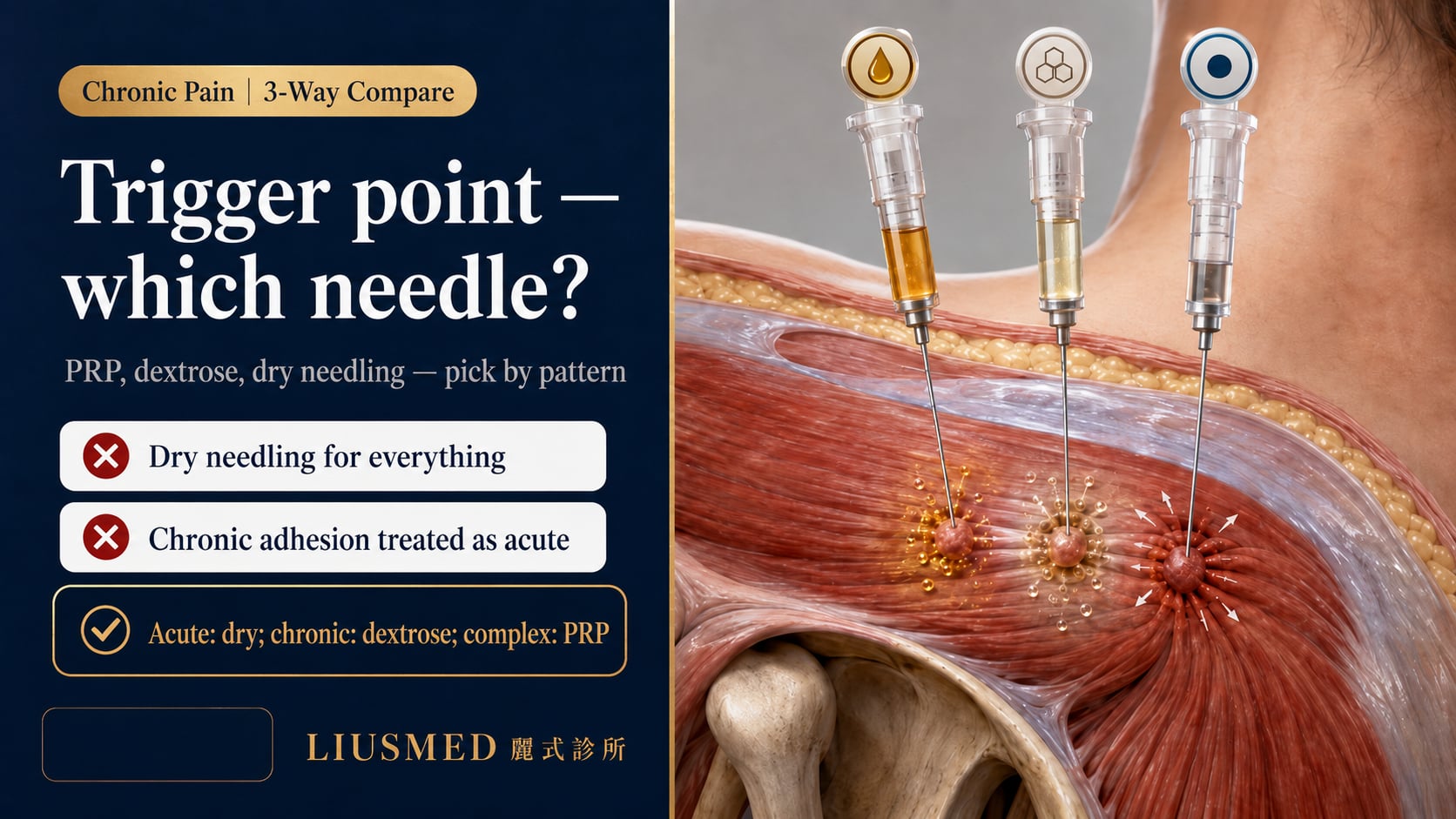
One-Minute Summary
Key Conclusions:
- Dry needling (medication-free needle into muscle trigger point): economical, entry-level option; effective for short-term myofascial pain but more prone to relapse.
- Dextrose prolotherapy (dextrose injection to stimulate local healing): best for "chronic degeneration at musculotendinous junctions"; gentle collagen stimulation.
- PRP (Platelet-Rich Plasma — concentrate of your own blood platelets rich in growth factors): a 2022 RCT (Randomized Controlled Trial — gold-standard treatment comparison study) showed superior long-term outcomes vs dry needling for severe chronic myofascial pain, especially in patient satisfaction.
- Clinical decision logic: depends on pain duration, severity, and presence of structural degeneration.
- Common foundation: all three therapies outperform "pain medications without addressing the source."
What Is Myofascial Pain? Why Is It So Hard to Treat?
Myofascial pain syndrome (MPS — recurring muscle trigger point pain) is one of the most common causes of chronic pain. Its hallmark is the "trigger point" (Myofascial Trigger Point — palpable muscle knot) — a tense knot within muscle that, when pressed:
- Hurts
- Refers pain to a distant area
- Elicits a local twitch response in specific muscles
Why is it hard to treat?
- Multifactorial pathogenesis: ischemia, inflammation, neural sensitization, and postural imbalance all contribute
- Chronification: untreated MPS develops "central sensitization" (nervous system pain-amplification), changing the pain system itself
- Single-modality therapies are often insufficient: medications, rehabilitation, and massage each have limits
Key insight: Chronic myofascial pain treatment requires precision intervention at the trigger point — this is the value of injection therapies.
Three Mainstream Injection Therapies
Therapy A: Dry Needling
Mechanism:
A fine needle (no injectate) penetrates the trigger point, eliciting a local twitch response that disrupts abnormal electrophysiological loops.
Strengths:
- Economical (no medication cost)
- Rapid effect on short-term myofascial pain
- Very few side effects
- Short procedure time
Limitations:
- Effects typically diminish after 1–3 months
- Limited efficacy for severe degeneration or structural problems
- "Treatment soreness" notable on day of and day after
Best Indications:
- Short-to-mid-term myofascial tension
- Upper back, neck-shoulder, low back trigger points
- Patients sensitive to medication side effects
- Budget considerations
Therapy B: Dextrose Prolotherapy
Mechanism:
Inject 12.5–25% dextrose solution at the trigger point and surrounding tendon/ligament insertions. Dextrose causes a mild inflammatory response, stimulating collagen synthesis and promoting repair of chronically degenerated tissue.
Strengths:
- Best for "chronic degeneration at musculotendinous junctions"
- Unique advantage for ligamentous laxity and chronic fascial pain
- Moderate cost
- Few side effects
Limitations:
- Slower onset (typically 4–8 weeks)
- More painful injection
- For pure trigger points (no structural degeneration), efficacy is not necessarily superior to dry needling
Best Indications:
- Chronic low back pain with ligamentous laxity
- Chronic neck pain with facet joint dysfunction
- Chronic post-injury musculotendinous junction pain
- Recurrent injury sites
Therapy C: PRP Injection
Mechanism:
PRP delivers high-concentration growth factors (PDGF — Platelet-Derived Growth Factor; TGF-β — Transforming Growth Factor Beta; VEGF — Vascular Endothelial Growth Factor; IGF-1 (Insulin-like Growth Factor 1) — Insulin-like Growth Factor 1):
- Stimulates stem cell activation
- Promotes angiogenesis (new blood vessel formation)
- Suppresses chronic inflammation
- Accelerates tissue repair
Evidence (2022 RCT):
Comparing PRP vs dry needling for masseter trigger points: PRP group showed significantly superior pain improvement and patient satisfaction.
Strengths:
- Best long-term outcomes for severe chronic pain
- Autologous-blood source, no foreign-body rejection
- Simultaneously addresses inflammation and promotes repair
- Some studies show effects lasting 6–12 months
Limitations:
- Higher cost
- Slower onset (peak 4–8 weeks)
- Requires autologous blood draw
- Brief swelling at injection site
Best Indications:
- Severe chronic myofascial pain (>6 months)
- Patients with diminishing response to dry needling or medications
- Athletes and high-demand activities
- Budget allowing pursuit of best long-term outcomes
Comprehensive Comparison
| Comparison | Dry Needling | Dextrose Prolotherapy | PRP |
|---|---|---|---|
| Onset time | 24–72 hours | 4–8 weeks | 4–8 weeks |
| Peak effect | 2–4 weeks | 8–12 weeks | 12–16 weeks |
| Duration | 1–3 months | 3–6 months | 6–12 months |
| Injection pain | Moderate | Moderate-high | Moderate |
| Side effect risk | Very low | Low | Low |
| Per-session cost (USD) | $50–100 | $100–200 | $300–500 |
| Recommended sessions | 3–6 | 3–6 | 3 |
| Mild pain | ✓ First choice | △ | △ Overkill |
| Chronic degeneration | △ | ✓ First choice | ✓ |
| Severe chronic pain | △ | ✓ | ✓ First choice |
Clinical Decision Framework: Which to Choose?
Decision Tree
Step 1: How long has the pain persisted?
- <3 months: consider dry needling (economical entry)
- 3–6 months: trial dry needling 1–2 sessions; upgrade if insufficient
- >6 months: consider dextrose prolotherapy or PRP directly
Step 2: Structural degeneration on imaging?
- No structural degeneration, pure myofascial tension: dry needling or PRP
- Structural degeneration (chronic tendon/ligament injury): dextrose prolotherapy or PRP
Step 3: Budget and time
- Budget-limited: start with dry needling
- Moderate budget: dextrose prolotherapy
- Budget allows + best long-term outcome priority: PRP
Stepwise Strategy (Most Common)
Many physicians use "try simple first, upgrade if insufficient":
- Month 1: dry needling × 4 sessions
- Evaluate: ≥50% improvement → continue maintenance
- <50% improvement: upgrade to dextrose prolotherapy × 3 sessions
- Still insufficient: consider PRP × 3 sessions
- Still insufficient: evaluate neurological or structural causes, multidisciplinary consultation
Can Therapies Be Combined?
In some scenarios yes, but not the same site simultaneously:
Sequential Use (Time-Spaced)
- Phase 1: dry needling for rapid acute tension release
- Phase 2 (4 weeks later): PRP or prolotherapy to launch long-term repair
Different Sites Simultaneously
- Cervical trigger points: dry needling
- Rotator cuff tendons: PRP
- In the same treatment plan
Key insight: Chronic multifocal myofascial pain often requires a "whole-body treatment strategy" — not just one injection point. Combine with posture correction, strength training, and lifestyle adjustment for the long-term solution.
Common Success Factors
Regardless of injection choice, the following affect success:
Physician Side
- Precise trigger point localization: palpation, ultrasound, EMG verification
- Correct injection technique: angle, depth, retrograde release
- Reasonable protocol design: number, intervals, evaluation points
- Integrated treatment plan: injection is one component
Patient Side
- Adherence to rehab exercises: moderate activity within 24 hours post-injection
- Posture and lifestyle adjustment: remove pain-causing factors
- Patience for onset: especially PRP and prolotherapy
- Track pain scores: helps physician adjust the plan
- Adequate sleep and nutrition: foundation for tissue repair
When to Consider Other Approaches?
Injection therapy is not a panacea. Consider alternative paths if:
- Pain dominated by radiculopathy (e.g., disc herniation compressing nerve) → nerve decompression-related treatment
- Severe postural etiology (scoliosis, pelvic misalignment) → posture therapist required
- High psychological component (depression, chronic stress) → psychological therapy integration
- Pain is inflammatory disease (rheumatoid, ankylosing spondylitis) → rheumatology
Frequently Asked Questions
How do I actually choose between the three — dry needling, prolotherapy, and PRP?
It mostly comes down to three things: how long you've hurt, how severe it is, and whether there's structural degeneration. Pain under three months with simple muscle tightness — dry needling is economical and a good entry point. Pain over six months, or more severe — prolotherapy or PRP come into consideration directly. If imaging shows chronic degeneration of tendon or ligament, prolotherapy or PRP fit better. There's no single "best"; it's matched to your situation.
Which one works fastest?
Dry needling is the fastest — you often feel something within a day to three days — but the effect is also shorter, usually fading within one to three months. Prolotherapy and PRP are slower to kick in, often taking four to eight weeks to show, but they tend to last longer — PRP has studies showing effects out to six to twelve months. So "fast" and "lasting" are often a trade-off; faster isn't automatically better.
Why not just take painkillers?
Painkillers can dampen the pain of the moment, but they don't address where the pain comes from — the trigger point is still there. That's the shared value of these three injections: they intervene directly at the trigger point, and all three outperform "painkillers alone without touching the source." Left long enough, myofascial pain can also central-sensitize and get harder to treat, which is why the point is to work at the source.
Will one session fix it? How many will I need?
Usually not one. A common clinical approach is a "ladder" — start with the simpler, more economical dry needling, do a few sessions over a month and reassess; if improvement is enough, maintain, if not, step up to prolotherapy or PRP. And injection is only one piece — combined with posture correction, strength training and sleep, the long-term result holds better. A single shot is rarely the whole answer.
When can injections not help, and I should see another specialist?
A few situations. If the pain comes mainly from nerve-root compression (like a disc herniation pressing a nerve), that points to nerve-decompression care. Severe postural causes (scoliosis, pelvic misalignment) need postural therapy. A large psychological component (chronic stress, mood) calls for integrated psychological treatment. And if the pain is fundamentally an inflammatory disease (rheumatoid arthritis, ankylosing spondylitis), that needs rheumatology. So the consultation first sorts out where the pain is coming from, then decides whether injection is a fit.
Conclusion: "No Best Therapy, Only the Best Fit"
Every chronic pain patient differs in pain nature, cause, and severity. The three injection therapies each have ideal contexts:
- Dry needling: rapid, economical, entry-level
- Dextrose prolotherapy: chronic degeneration, structural laxity
- PRP: severe chronic, long-term outcome priority
Correct selection requires professional evaluation of your specific situation. See our muscle fascia pain regenerative service or book a consultation.
Medical References
- Comparative Efficacy of PRP and Dry Needling for Trigger Points in Masseter Muscle: RCT. PubMed PMID (PubMed Identifier): 36445907. 2022.
- Dry Needling Versus Trigger Point Injection for Neck Pain: Systematic Review and Meta-Analysis. PubMed PMID: 34114639.
- Comparison of dry needling and trigger point injections in TMJ myofascial pain. PMC6797918.
- Trigger Point Injection: Background, Indications, Contraindications. Medscape.
- Comparison of lidocaine, botulinum toxin, and dry needling to trigger points. Rheumatology International.
Editorial review: Reviewed by Dr. Ta-Ju Liu. Last reviewed 2026-04-27.
Related Services

Specialties
Credentials
- Kaohsiung Medical University, School of Medicine
- Attending Physician, Dermatology, Kaohsiung Chang Gung Memorial Hospital
- Attending Physician, Aesthetic Center, Kaohsiung Chang Gung Memorial Hospital
- Visiting Physician, Dermatology, Xiamen Chang Gung Hospital
- Visiting Physician, Aesthetic Center, Xiamen Chang Gung Hospital
"For every surgery, I strive to achieve a good outcome through a small incision and refined technique. Minimally invasive surgery is not just a technique — it's a commitment of respect to every patient."
Want to learn more?
Schedule a consultation for professional evaluation and advice