Manual Tranexamic Acid Injection Reaches the Dermis
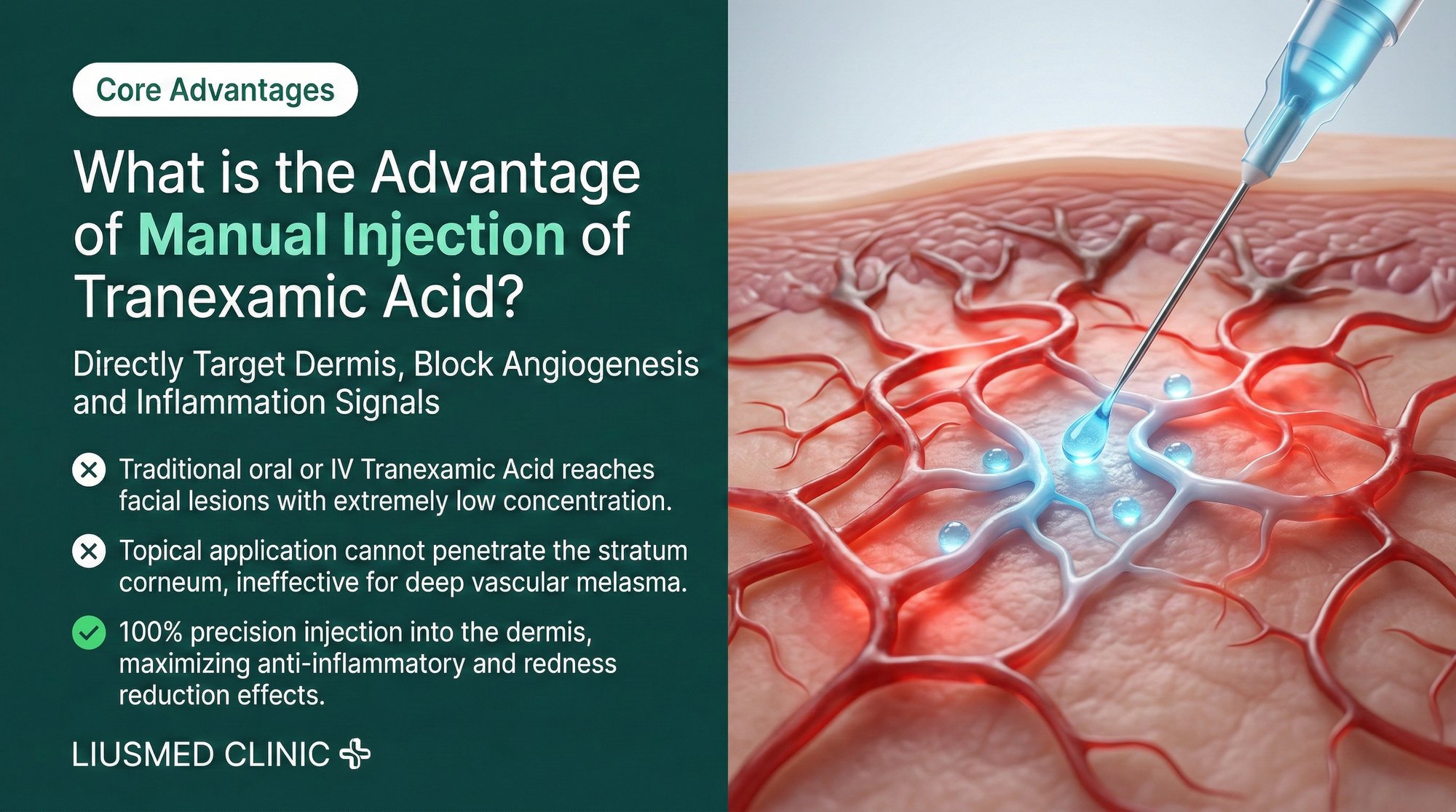
Oral tranexamic acid (TXA) works for melasma: in a placebo-controlled trial, three months of pills lowered melasma severity scores by 49%, against 18% on placebo. Injecting TXA into the skin has been compared with pills in randomized trials, and the improvement was about the same. So the case for manual injection is not that it beats the pill. It is that the drug stays in the melasma area, the physician can adjust depth and dose from one spot to the next, and PRP can be placed in the dermis at the same time to work on the local skin environment. This article explains how Dr. Ta-Ju Liu uses manual injection at Liusmed Clinic and where pills, creams, and injections each fit.
Table of Contents
- Tranexamic Acid: From Operating Room to Melasma Clinic
- The Vascular Dimension of Melasma: Why TXA (Tranexamic Acid) Works
- Oral vs. Topical vs. Intradermal: Three Delivery Routes Compared
- Manual Injection Technique: Precision at the Vascular Target
- Anti-Angiogenic and Anti-Inflammatory Mechanisms of Intradermal TXA
- Safety Profile and Practical Considerations
- References
Tranexamic Acid: From Operating Room to Melasma Clinic
Tranexamic acid (TXA) was originally developed as a hemostatic agent — a drug that stops bleeding by inhibiting the breakdown of fibrin clots. For decades, its primary use was in surgery, trauma care, and the management of heavy menstrual bleeding. The molecule works by blocking the lysine-binding sites on plasminogen, preventing its conversion to plasmin.
The connection to melasma was discovered somewhat serendipitously. Clinicians noticed that patients taking oral TXA for menstrual bleeding experienced unexpected lightening of their melasma. This observation led to formal clinical investigation, and by the early 2010s, multiple studies had confirmed that oral TXA at low doses (typically 250 mg twice daily) produced significant improvement in melasma severity scores.
The mechanism linking a hemostatic drug to pigment reduction was not immediately obvious. But as researchers investigated further, they uncovered a crucial connection: the plasminogen/plasmin system is not only involved in clot breakdown — it also plays a central role in inflammation, angiogenesis, and melanocyte signaling. By inhibiting plasminogen activation, TXA simultaneously interrupts multiple pathological pathways that drive melasma.
This discovery reframed melasma as a condition with a significant vascular and inflammatory component, not merely a disorder of melanin production. It also raised a practical question: if TXA acts on dermal blood vessels and inflammatory cells, does it matter whether it is swallowed or placed directly in the skin?
The Vascular Dimension of Melasma: Why TXA Works
The recognition that melasma has a vascular component was a paradigm shift in dermatology. Histological studies comparing melasma skin to adjacent normal skin have documented several consistent vascular abnormalities.
Melasma lesions contain a significantly higher density of blood vessels compared to non-lesional skin. These vessels are often immature, with increased permeability and a tendency to leak plasma proteins and inflammatory mediators into the surrounding dermis. Dermoscopic examination reveals characteristic arborizing telangiectasias within melasma patches that are absent in normal surrounding skin.
The molecular driver of this abnormal vascularity is VEGF (Vascular Endothelial Growth Factor — new blood vessel signal), which is found at elevated levels in melasma skin. VEGF is produced by keratinocytes, mast cells, and fibroblasts in response to UV radiation and inflammatory stimuli. It promotes the growth of new blood vessels (angiogenesis) and increases the permeability of existing vessels.
These leaky, proliferating vessels create a self-reinforcing cycle. They deliver more inflammatory cells and mediators to the dermis, which stimulates more VEGF production, which drives more vessel growth. The resulting inflammatory microenvironment continuously activates melanocytes, sustaining pigment overproduction regardless of surface-level treatments.
TXA interrupts this cycle at a critical junction. By blocking plasminogen activation, it reduces the conversion of pro-enzymes that activate VEGF signaling. It also directly inhibits the release of arachidonic acid and prostaglandins from keratinocytes, further dampening the inflammatory cascade.
Oral vs. Topical vs. Intradermal: Three Delivery Routes Compared
Oral TXA has placebo-controlled evidence behind it. The practical question is how the routes differ, and the trials comparing them give a less dramatic answer than the pharmacology suggests.
Oral TXA has placebo-controlled trials behind it. About 34% of an oral dose is absorbed (Pilbrant 1981), and the drug is distributed through the whole body. Even so, it works: in Del Rosario 2018, three months of oral TXA lowered mMASI by 49% versus 18% on placebo. Three months after stopping, the reduction had fallen to 26% versus 19% on placebo, so most of the difference was gone. Because it acts on the whole body, consensus guidance advises avoiding it in people with a history of, or high risk for, blood clots and in those using combined hormonal contraceptives (Godse 2023).
Topical TXA is a hydrophilic molecule, which makes it hard to push through the skin barrier. Formulations and strengths vary widely, and delivery enhancement strategies (liposomal encapsulation, microneedling-assisted delivery) have been explored with variable success. This article does not rank it against oral or injected TXA.
Intradermal TXA injection places the drug directly into the dermis, skipping both gut absorption and the skin barrier. It is tempting to assume that a higher local concentration means a better result, but we found no human study that has measured TXA levels in the skin after injection and compared them with oral dosing. The trials compared outcomes instead:
- Sharma 2017 compared oral tranexamic acid (250 mg twice daily) with local microinjections every four weeks for 12 weeks and found both equally effective.
- El Hadidi 2021 compared oral treatment with two strengths of intradermal microinjection for 8 weeks and found no significant difference.
- Meta-analyses disagree. A network meta-analysis (Liang 2024) found oral better in the short term and no difference by route in the long term; a meta-analysis of randomized trials (Chen 2025) found injection more effective, while patient satisfaction was higher with oral treatment.
What injection does offer is control: the drug is used only where the melasma is, and depth, dose, and added ingredients such as PRP can be adjusted by area.
| Parameter | Oral TXA | Topical TXA | Intradermal TXA (Manual Injection) |
|---|---|---|---|
| Clinical evidence | Placebo-controlled trials (3 months: −49% vs −18%) | Varies by formulation; not compared here | Head-to-head randomized trials against oral: similar improvement; meta-analyses disagree |
| Where it acts | Whole body | Where applied | Injected area only |
| After stopping treatment | Tends to slip back (most of the gap to placebo gone 3 months later) | — | Melasma can also return; no placebo-controlled follow-up after stopping |
| Clotting considerations | Avoid with high clot risk or combined hormonal contraceptives | — | Clotting safety of injected TXA not studied separately; same screening as for pills |
| What can be adjusted | Daily dose | Where you apply it | Depth, dose, and PRP by area |
| Frequency | Daily oral dosing | Daily application | Every 3-4 weeks |
Manual Injection Technique: Precision at the Vascular Target
The manual injection technique used in the Melasma Injection Treatment is specifically designed to deliver TXA to the superficial dermis where pathological angiogenesis and inflammation are concentrated.
The physician uses a fine-gauge needle (typically 30G or 32G) and performs serial puncture or nappage technique — a series of rapid, shallow injections spaced approximately 2 to 3 millimeters apart across the treatment area. The injection depth is controlled by the angle of needle insertion and the tactile feedback felt through the syringe.
This is the main reason Dr. Liu injects by hand rather than with an automated device. No trial has compared the two for melasma; the difference is in what the physician can control. The superficial dermis is only approximately 0.3 to 0.5 mm below the skin surface. The margin between effective delivery and either too-superficial (epidermal bleb) or too-deep (subcutaneous) placement is measured in fractions of a millimeter.
An experienced practitioner can feel the tissue resistance change as the needle tip enters the papillary dermis. This real-time feedback allows continuous adjustment of depth, which is essential because skin thickness varies across facial regions: the periorbital skin may be less than 1 mm thick, while the malar cheek is significantly thicker.
The manual approach also allows the physician to modulate the injection volume and pressure based on the tissue response. Areas of dense fibrosis (common in long-standing melasma) require more volume and pressure to achieve adequate tissue diffusion, while thinner, more elastic areas require less. Machine protocols usually set depth and volume for the whole session, which makes this kind of spot-by-spot adjustment harder.
Each treatment session delivers TXA directly to the perivascular space of the superficial dermal plexus — the exact location where pathological angiogenesis and vascular leak are occurring. This is what manual injection offers: control over where and how deep the drug goes.
Anti-Angiogenic and Anti-Inflammatory Mechanisms of Intradermal TXA
When TXA reaches the dermal vasculature at therapeutic concentrations, it engages multiple interconnected mechanisms:
Plasminogen activation inhibition. TXA binds to the lysine-binding sites on plasminogen, preventing its conversion to plasmin by tissue plasminogen activator (tPA) and urokinase plasminogen activator (uPA). Plasmin is a potent activator of multiple downstream pathways including MMP (Matrix Metalloproteinase) activation, VEGF release, and pro-inflammatory cytokine processing. By blocking plasmin generation, TXA simultaneously reduces all of these pathological signals.
VEGF signaling reduction. With reduced plasmin activity, the proteolytic release of VEGF from extracellular matrix stores is diminished. Additionally, plasmin normally activates matrix metalloproteinases (MMPs) that further release matrix-bound VEGF. This dual blockade results in a significant reduction in local VEGF availability, slowing the formation of new pathological blood vessels.
Mast cell stabilization. Mast cells are key inflammatory mediators in melasma, releasing histamine, tryptase, and VEGF. TXA has been shown to reduce mast cell degranulation, decreasing the release of these pro-inflammatory and pro-angiogenic mediators. This is particularly relevant because mast cell density is significantly elevated in melasma lesions.
Prostaglandin pathway suppression. TXA inhibits the release of arachidonic acid from keratinocyte cell membranes, reducing the production of prostaglandin E2 (PGE2). PGE2 directly stimulates melanocyte dendricity (the extension of melanocyte processes that transfer melanin to surrounding keratinocytes) and melanin synthesis.
Tyrosinase activity reduction. Through the reduction of UV-induced plasmin activity, TXA indirectly decreases the expression and activity of tyrosinase — the rate-limiting enzyme in melanin synthesis. This provides an anti-melanogenic effect that complements the anti-vascular and anti-inflammatory actions.
The convergence of these mechanisms explains why TXA is effective for melasma while being fundamentally different from traditional depigmenting agents. Rather than blocking a single step in melanin production, TXA addresses the upstream vascular and inflammatory environment that drives the melasma process. The pathway is the same whether TXA is swallowed or injected; what differs is where the drug acts and whether it can be adjusted by area.
Safety Profile and Practical Considerations
The total dose per session is small (typically 50 to 100 mg, spread across the treatment area). That said, the clotting safety of injected TXA has not been studied on its own, so it cannot simply be called safer than pills. Before treatment, Dr. Liu screens for clotting history, clotting disorders, and medications such as estrogen-containing contraceptives, using the same standard as for oral TXA.
Local side effects are mild and transient. Small papules and redness at injection sites usually settle within 2 to 4 hours; for a small number of people with sensitive skin, it takes 1 to 2 days. Minor bruising can occur but is infrequent with proper technique and fine-gauge needles.
The Melasma Injection Treatment protocol spaces sessions 3 to 4 weeks apart, allowing adequate time for the biological response to each treatment to develop.
Contraindications for intradermal TXA are few but important. Patients with a history of thromboembolic disease, active deep vein thrombosis, or known hypercoagulable states should not receive TXA by any route without careful medical evaluation. Treatment is not recommended during pregnancy or breastfeeding. Concurrent use of estrogen-containing contraceptives warrants discussion, because consensus guidance advises against oral TXA in that situation and there is no separate safety data for injection.
For patients already taking oral TXA, the clinic often plans the two together rather than swapping one for the other: pills for the whole body, manual injection for the local environment. In Dr. Liu's outpatient experience, oral TXA alone usually takes one to two months to show and the effect is real but modest, which is why it is generally paired with the injection. That is the clinic's observation, not a trial result, and results vary from person to person.
Frequently Asked Questions
Q1: Why not just take oral tranexamic acid pills for melasma?
Pills are a reasonable option, and in randomized trials they improved melasma about as much as injection did (Sharma 2017, El Hadidi 2021). Melasma tends to return after any treatment stops, pills or injections. Injection is a different tool rather than a stronger one: it keeps the drug in the melasma area and lets the physician adjust depth, dose, and PRP by area. Many patients at the clinic use both; the mix depends on melasma type and clotting risk.
Q2: Is intradermal TXA injection painful?
The treatment uses very fine needles (30G or 32G), and most patients describe the sensation as mild pinpricks. Topical numbing cream is applied for 20 to 30 minutes before the procedure. The treatment itself typically takes 30 to 50 minutes, and any discomfort resolves immediately after the procedure.
Q3: Can intradermal TXA cause blood clots?
The dose per session is small — typically 50 to 100 mg — but the clotting safety of injected TXA has not been studied separately, so it is not assumed to be risk-free. Patients are screened with the same standard used for oral TXA: a history of blood clots, clotting disorders, and estrogen-containing contraceptives all need to be discussed at consultation.
Q4: How does TXA injection compare to laser treatment for melasma?
Unlike many lasers, TXA does not rely on heat, which matters because heat can trigger rebound pigmentation in melasma. This article does not compare the two directly; which fits depends on melasma type.
Q5: Can I use topical TXA products alongside the injection treatment?
Topical TXA products can serve as a gentle maintenance tool between injection sessions. They work differently from injection and are not a replacement for it. Your physician will advise on incorporating topical products into your between-session skincare routine.
Q6: How soon will I see results from intradermal TXA treatment?
In Dr. Liu's experience, many patients can see the melasma lightening within the first month; a full course is usually 3 to 4 sessions, 3 to 4 weeks apart. That is the clinic's experience, and results vary from person to person. The vascular component — redness within the melasma — often improves first, followed by gradual lightening of the pigmented component as the inflammatory drive is suppressed and natural pigment turnover proceeds.
References
- Del Rosario E, Florez-Pollack S, Zapata L Jr, et al. Randomized, placebo-controlled, double-blind study of oral tranexamic acid in the treatment of moderate-to-severe melasma. J Am Acad Dermatol. 2018;78(2):363-369. PMID 28987494 / DOI 10.1016/j.jaad.2017.09.053
- Pilbrant A, Schannong M, Vessman J. Pharmacokinetics and bioavailability of tranexamic acid. Eur J Clin Pharmacol. 1981;20(1):65-72. PMID 7308275 / DOI 10.1007/BF00554669
- Sharma R, Mahajan VK, Mehta KS, et al. Therapeutic efficacy and safety of oral tranexamic acid and that of tranexamic acid local infiltration with microinjections in patients with melasma: a comparative study. Clin Exp Dermatol. 2017;42(7):728-734. PMID 28649780 / DOI 10.1111/ced.13164
- El Hadidi H, Mosaad R, Ragab N. The efficacy of oral vs different dilutions of intradermal tranexamic acid microinjections in melasma - A randomized clinical trial. Dermatol Ther. 2021;34(3):e14924. PMID 33651442 / DOI 10.1111/dth.14924
- Liang R, Luo H, Pan W, et al. Comparative efficacy and safety of tranexamic acid for melasma by different administration methods: A systematic review and network meta-analysis. J Cosmet Dermatol. 2024;23(4):1150-1164. PMID 38059683 / DOI 10.1111/jocd.16104
- Chen LY, Kang YN, Hoang KD, et al. Intradermal Injection of Tranexamic Acid for the Treatment of Adult Melasma: A Systematic Review and Meta-Analysis of Randomized Controlled Trials. Facial Plast Surg Aesthet Med. 2025;27(4):305-312. PMID 39574359 / DOI 10.1089/fpsam.2024.0187
- Godse K, Sarkar R, Mysore V, et al. Oral Tranexamic Acid for the Treatment of Melasma: Evidence and Experience-Based Consensus Statement from Indian Experts. Indian J Dermatol. 2023;68(2):178-185. PMID 37275826 / DOI 10.4103/ijd.ijd_266_22
About the Author
Dr. Ta-Ju Liu
- Current Position: Director, Liusmed Clinic
- Experience:
- Board-certified dermatologist in Taiwan
- 15+ years of clinical minimal incision surgery experience
- Approach to melasma: Injecting by hand is not about beating the pill; it is about treating only the melasma area and working on the local environment with PRP. How oral and injected TXA are combined depends on melasma type and clotting risk.
Disclaimer
This article is provided for educational and informational purposes only. It does not constitute medical advice, diagnosis, or treatment. Individual results vary, and all medical procedures carry inherent risks. Patients with a history of thromboembolic disease, pregnancy, or known hypercoagulable conditions should consult their physician before considering any TXA-based treatment. The information presented reflects clinical experience and published research as of the date of publication.

Specialties
Credentials
- Kaohsiung Medical University, School of Medicine
- Attending Physician, Dermatology, Kaohsiung Chang Gung Memorial Hospital
- Attending Physician, Aesthetic Center, Kaohsiung Chang Gung Memorial Hospital
- Visiting Physician, Dermatology, Xiamen Chang Gung Hospital
- Visiting Physician, Aesthetic Center, Xiamen Chang Gung Hospital
"For every surgery, I strive to achieve a good outcome through a small incision and refined technique. Minimally invasive surgery is not just a technique — it's a commitment of respect to every patient."
Recovery after any procedure needs peer support too


Want to learn more?
Schedule a consultation for professional evaluation and advice