Can Tranexamic Acid and Microbotox Treat Rosacea? The Science of Blocking VEGF and Neurogenic Inflammation
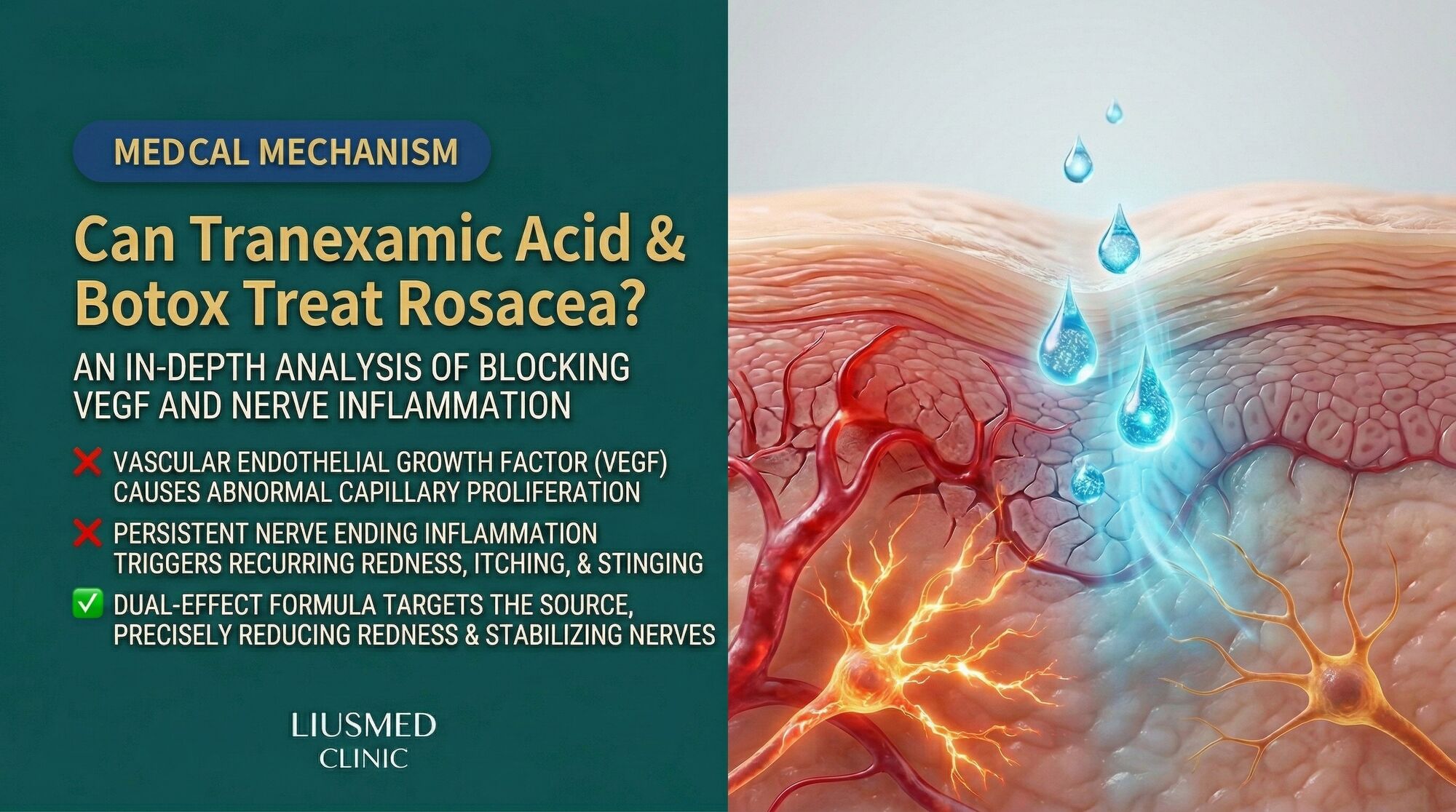
When patients hear that tranexamic acid and botulinum toxin are being used to treat rosacea, the reaction is usually confusion. Tranexamic acid is known as a bleeding control drug. Botulinum toxin is associated with wrinkle reduction. Neither sounds like a rosacea therapy. But rosacea is not a simple redness problem -- it is a disease driven by abnormal blood vessel growth and overactive nerve signaling. When you understand the molecular pathways involved, the pharmacological logic of TXA (Tranexamic Acid) and microbotox becomes not just reasonable but compelling.
This article unpacks the science: how these two agents work at the tissue level, why they target the specific mechanisms that sustain rosacea, and what distinguishes their use in the Liusmed protocol from cosmetic applications.
Table of Contents
- The Two Engines of Rosacea: VEGF (Vascular Endothelial Growth Factor — new blood vessel signal) and Neurogenic Inflammation
- Tranexamic Acid: From Hemostasis to Anti-Angiogenesis
- Microbotox: Calming the Neural Storm in the Dermis
- Synergy: Why the Combination Outperforms Either Agent Alone
- Dosing, Dilution, and Safety Considerations
- Addressing Common Misconceptions
The Two Engines of Rosacea: VEGF and Neurogenic Inflammation
To understand why TXA and microbotox are effective against rosacea, we first need to understand the two self-reinforcing pathological loops that sustain the disease:
Loop 1: VEGF-driven angiogenesis. Vascular endothelial growth factor (VEGF) is the master regulator of new blood vessel formation. In rosacea skin, VEGF is chronically overexpressed due to several converging triggers: UV exposure activates VEGF in keratinocytes; mast cell degranulation releases stored VEGF; the overactive innate immune peptide LL-37 stimulates VEGF production in multiple cell types; and hypoxia-inducible factor (HIF-1alpha), which is upregulated during inflammatory episodes, is a potent VEGF transcription driver.
The result is a tissue environment saturated with pro-angiogenic signaling. New capillaries sprout into the papillary dermis, existing vessels dilate, and the vascular density of rosacea skin increases progressively. This is not just cosmetic -- the expanded vascular network brings more inflammatory cells into the tissue, releases more mediators, and generates more heat, perpetuating the cycle.
Loop 2: Neurogenic inflammation. Rosacea skin contains an abnormally high density of sensory nerve fibers expressing TRPV1 (transient receptor potential vanilloid 1) channels. These fibers are exquisitely sensitive to heat, capsaicin, alcohol, and emotional stress -- the classic rosacea triggers. When activated, they release neuropeptides including substance P, calcitonin gene-related peptide (CGRP), and vasoactive intestinal peptide (VIP).
These neuropeptides cause vasodilation, increase vascular permeability, activate mast cells, and recruit inflammatory cells. Substance P in particular binds NK1 receptors on endothelial cells to promote vasodilation and on mast cells to trigger degranulation. CGRP is one of the most potent vasodilators known. Together, they create a neurally driven inflammatory response that operates independently of the adaptive immune system.
Crucially, these two loops reinforce each other. VEGF-driven vessels provide more surface area for neurogenic mediators to act upon. Neurogenic inflammation activates mast cells that release more VEGF. Breaking either loop alone provides partial relief; breaking both simultaneously is the pharmacological rationale behind the TXA-microbotox combination.
Tranexamic Acid: From Hemostasis to Anti-Angiogenesis
Tranexamic acid is a synthetic lysine analog that competitively inhibits plasminogen activation. In surgical and trauma medicine, this means it prevents clot breakdown by blocking the conversion of plasminogen to plasmin. But plasmin does far more than dissolve fibrin clots:
Plasmin activates MMPs. Plasmin converts pro-MMP (Matrix Metalloproteinase)-1, pro-MMP-3, and pro-MMP-9 into their active forms. These matrix metalloproteinases degrade collagen IV (the basement membrane), collagen I and III (the dermal matrix), and fibronectin. By blocking plasmin formation, TXA reduces the enzymatic destruction of the skin's structural framework.
Plasmin releases VEGF from the extracellular matrix. VEGF is stored in a latent form bound to heparan sulfate proteoglycans in the extracellular matrix. Plasmin cleaves these bonds, liberating free VEGF to bind its receptors on endothelial cells and stimulate angiogenesis. TXA, by reducing plasmin activity, keeps more VEGF sequestered and unavailable for signaling.
Plasmin activates TGF-beta inappropriately. In the inflammatory context of rosacea, plasmin-activated TGF-beta drives fibrosis and aberrant tissue remodeling rather than organized repair. TXA modulates this activation, shifting the tissue response toward healthier remodeling.
Direct anti-inflammatory effects. Independent of its anti-plasmin activity, TXA has been shown to reduce the production of pro-inflammatory cytokines including IL-6 (Interleukin-1 beta / Interleukin-6) and TNF-alpha in keratinocytes, and to inhibit mast cell tryptase activity. These effects contribute to a generalized calming of the inflammatory microenvironment.
When delivered via mesotherapy directly into the papillary dermis, TXA achieves local tissue concentrations far exceeding what oral or topical administration can provide. This allows potent anti-angiogenic and anti-inflammatory effects at the target site without systemic exposure.
Microbotox: Calming the Neural Storm in the Dermis
The term "microbotox" refers to the intradermal injection of highly diluted botulinum toxin type A -- typically at one-tenth to one-twentieth the concentration used for muscular wrinkle treatment. At these dilutions, the toxin does not cause visible muscle relaxation. Instead, it acts on autonomic and sensory nerve terminals within the dermis itself.
Inhibition of acetylcholine release. Botulinum toxin blocks the SNARE complex proteins required for vesicular acetylcholine release at nerve terminals. In the dermis, cholinergic nerve fibers innervate blood vessels, sweat glands, and sebaceous glands. By reducing acetylcholine release, microbotox decreases neurally mediated vasodilation -- the mechanism behind flushing.
Reduction of neuropeptide release. Beyond acetylcholine, botulinum toxin has been shown to inhibit the release of substance P and CGRP from sensory nerve endings. This directly addresses the neurogenic inflammation loop described above. Fewer neuropeptides means less vasodilation, less mast cell activation, and less inflammatory cell recruitment.
Sebaceous gland modulation. Rosacea patients often have overactive sebaceous glands contributing to the papulopustular phenotype. Microbotox reduces sebaceous secretion by blocking cholinergic innervation of the glands, improving oiliness and reducing the substrate for Demodex proliferation and bacterial colonization.
Pore size reduction. Through a combination of reduced sebaceous activity and decreased perifolicular edema, microbotox produces a visible reduction in apparent pore size, improving overall skin texture.
The key pharmacological insight is that microbotox in the dermis does not work the same way as standard botulinum toxin in muscle. The target is neural signaling at the cutaneous level -- a fundamentally different application that addresses the neurogenic component of rosacea that no topical medication or laser can reach.
Synergy: Why the Combination Outperforms Either Agent Alone
The combined use of TXA and microbotox in the Liusmed Rosacea Injection Treatment is not merely additive -- the two agents address complementary pathological mechanisms and create conditions that enhance each other's effectiveness.
| Mechanism | TXA Alone | Microbotox Alone | TXA + Microbotox Combined |
|---|---|---|---|
| VEGF reduction | Strong (blocks plasmin-mediated VEGF release) | Indirect (reduces mast cell VEGF via neural calming) | Maximal suppression from two pathways |
| Neurogenic vasodilation | Minimal direct effect | Strong (blocks ACh, substance P, CGRP) | Strong neural calming + reduced vessel responsiveness |
| Mast cell stabilization | Moderate (tryptase inhibition) | Moderate (reduced neural activation of mast cells) | Enhanced stabilization from dual mechanism |
| MMP reduction | Strong (blocks plasmin-MMP activation) | Indirect (less inflammation = less MMP stimulus) | Comprehensive protease suppression |
| Basement membrane protection | Strong | Moderate | Maximal matrix preservation |
| Sebaceous modulation | None | Strong | Strong |
The pharmacological synergy means that lower doses of each agent can be used when combined, reducing the risk of any single-agent side effect while achieving a broader and more complete therapeutic effect. This is a core principle of the Liusmed formulation: multi-target, moderate-dose, maximum coverage.
Dosing, Dilution, and Safety Considerations
The safety profile of intradermal TXA and microbotox depends critically on proper dosing and dilution:
Tranexamic acid dosing. The concentration used for mesotherapy is typically 4% to 5% (40-50 mg/mL), with total volumes per session ranging from 1 to 3 mL distributed across the affected facial zones. This delivers a substantial local dose while keeping systemic absorption minimal. Patients with a history of thromboembolic disease require careful evaluation, though the risk with localized intradermal delivery is orders of magnitude lower than with systemic oral or intravenous administration.
Microbotox dilution. The dilution for intradermal use is significantly higher than for muscular injection -- typically 2 to 4 units per mL of saline, compared to 25 to 50 units per mL for standard cosmetic use. Total doses per session range from 10 to 30 units distributed across the full treatment area. At these dilutions, the botulinum toxin diffuses through the papillary dermis affecting neural terminals without penetrating to the underlying muscles of facial expression.
Combination formulation. When TXA and microbotox are combined in the same syringe, compatibility and stability must be verified. The acidic pH of TXA solutions can potentially affect botulinum toxin stability, so formulation preparation follows strict protocols regarding mixing order, dilution ratios, and time from preparation to injection.
Contraindications. The combined protocol is contraindicated in patients with known allergy to botulinum toxin or tranexamic acid, active skin infection at the treatment site, pregnancy or breastfeeding, and history of neuromuscular disorders (myasthenia gravis, Lambert-Eaton syndrome). Patients on anticoagulant therapy require individual risk assessment.
Expected side effects. Mild pinpoint bleeding, temporary erythema, and slight swelling at injection sites are common and typically resolve within 24 to 48 hours. Bruising occurs in approximately 10% to 15% of sessions and resolves within five to seven days. No cases of facial muscle paralysis have been observed at the microbotox dilutions used in the protocol.
Addressing Common Misconceptions
Several misunderstandings commonly arise when patients learn about TXA and microbotox for rosacea:
Misconception: TXA causes blood clots. Oral tranexamic acid at high systemic doses does carry a modest thrombotic risk, which is why it is used cautiously in patients with clotting histories. Intradermal TXA at mesotherapy doses produces negligible systemic absorption. The local anti-plasmin effect is confined to the treated tissue. No thromboembolic events have been reported in published mesotherapy TXA studies.
Misconception: Botox will freeze my face. The microbotox dilutions used in this protocol are designed to act on dermal neural terminals, not on facial muscles. Patients retain full facial expression and movement. The effect is subclinical from a motor perspective -- what changes is the neural signaling that drives flushing and inflammation, not the muscles that create facial expression.
Misconception: These are off-label uses and therefore unproven. Both TXA and botulinum toxin are well-established pharmaceuticals with decades of safety data. Their application in dermal injection for rosacea is indeed off-label, as are many evidence-based dermatological treatments. Off-label does not mean unsupported; it means the specific indication has not undergone the regulatory approval process, often because the commercial incentive to fund large trials is insufficient. The mechanistic rationale and accumulating clinical evidence support their use in this context.
Misconception: I can get the same effect from oral TXA. Oral tranexamic acid achieves systemic distribution, meaning the drug reaches every tissue at a low, uniform concentration. Intradermal delivery achieves tissue concentrations at the treatment site that are many times higher than oral dosing can produce, with far less systemic exposure. The dose-response relationship for anti-angiogenic effects is concentration-dependent, making local delivery substantially more effective for the specific goal of suppressing dermal VEGF activity.
For patients interested in a pharmacologically grounded approach to rosacea that targets the disease's molecular engines rather than its visible consequences, the Rosacea Injection Treatment at Liusmed Clinic integrates these agents into a structured protocol designed for progressive, sustainable improvement.
Frequently Asked Questions
Q1: How quickly does tranexamic acid start reducing redness after injection?
TXA begins inhibiting plasmin activity immediately upon delivery into the tissue. However, the downstream effects -- reduced VEGF release, decreased MMP activation, and suppressed angiogenic signaling -- take time to translate into visible redness reduction. Most patients notice decreased flushing intensity within one to two weeks of the first session, with progressive improvement over subsequent treatments as the cumulative anti-angiogenic effect builds.
Q2: Does microbotox wear off like regular Botox, requiring repeated treatments?
The duration of microbotox's neural effects in the dermis is similar to its muscular effects -- approximately three to four months per session. However, unlike cosmetic Botox where the wrinkle simply returns when the effect wears off, the neural calming provided by microbotox creates a window during which inflammation subsides and tissue repair can proceed. Each treatment session builds on the structural repair achieved during previous sessions. Over time, the need for ongoing microbotox decreases as the inflammatory cycle is interrupted and the tissue environment normalizes.
Q3: Can tranexamic acid worsen melasma or cause skin lightening?
TXA is actually used therapeutically for melasma because it inhibits melanocyte-stimulating plasmin activity. In rosacea patients who also have melasma, TXA can provide a dual benefit. It does not cause unwanted skin lightening in patients without hyperpigmentation. The melanocyte effects are modulatory, normalizing overactive pigmentation rather than suppressing baseline pigment production.
Q4: Is there a risk of developing resistance to microbotox over time?
Antibody formation against botulinum toxin is a recognized phenomenon with repeated high-dose muscular injections. At the microbotox doses used in dermal therapy (10-30 units per session), the risk of neutralizing antibody development is extremely low. No cases of treatment resistance at microbotox doses have been documented in the published literature.
Q5: Can I combine this treatment with my prescribed rosacea medications?
In most cases, yes. Topical metronidazole, azelaic acid, and ivermectin can generally be continued alongside the injection protocol. Oral doxycycline at anti-inflammatory doses (40mg modified release) is also compatible. Patients on oral isotretinoin should discuss timing with their physician, as isotretinoin affects wound healing and may influence the tissue response to mesotherapy. Your treating physician will review your full medication list during consultation.
Q6: Are there any long-term risks of repeated TXA injections into the skin?
Long-term safety data for intradermal TXA is still accumulating, as the technique is relatively recent compared to oral and intravenous use. The available evidence from melasma treatment studies using repeated intradermal TXA over twelve months or longer has not identified adverse effects beyond transient injection-site reactions. TXA does not accumulate in tissue, is rapidly metabolized, and does not cause fibrosis or atrophy at the injection site. Ongoing monitoring and documentation of outcomes contribute to the growing safety profile.
About the Author
Dr. Ta-Ju Liu is the founder of Liusmed Clinic, specializing in regenerative medicine and minimal incision surgery. His pharmacologically driven approach to rosacea treatment reflects a commitment to understanding disease mechanisms at the molecular level and translating that understanding into precise, targeted interventions. Dr. Liu's clinical protocols integrate established pharmaceutical agents in novel delivery methods to achieve tissue-level outcomes that conventional approaches cannot provide.
Disclaimer
This article is provided for educational and informational purposes only and does not constitute medical advice, diagnosis, or treatment. The pharmacological mechanisms described are based on published research and clinical observation but do not guarantee specific outcomes for individual patients. Both tranexamic acid and botulinum toxin are used off-label in the context described. Always consult a qualified healthcare provider before beginning any new treatment. Individual responses to therapy vary based on disease severity, duration, and individual biological factors.

Specialties
Credentials
- Kaohsiung Medical University, School of Medicine
- Attending Physician, Dermatology, Kaohsiung Chang Gung Memorial Hospital
- Attending Physician, Aesthetic Center, Kaohsiung Chang Gung Memorial Hospital
- Visiting Physician, Dermatology, Xiamen Chang Gung Hospital
- Visiting Physician, Aesthetic Center, Xiamen Chang Gung Hospital
"For every surgery, I strive to achieve a good outcome through a small incision and refined technique. Minimally invasive surgery is not just a technique — it's a commitment of respect to every patient."
Recovery after any procedure needs peer support too


Want to learn more?
Schedule a consultation for professional evaluation and advice