Under-Eye Filler Extraction: The Most Delicate Zone for Minimally Invasive Surgery
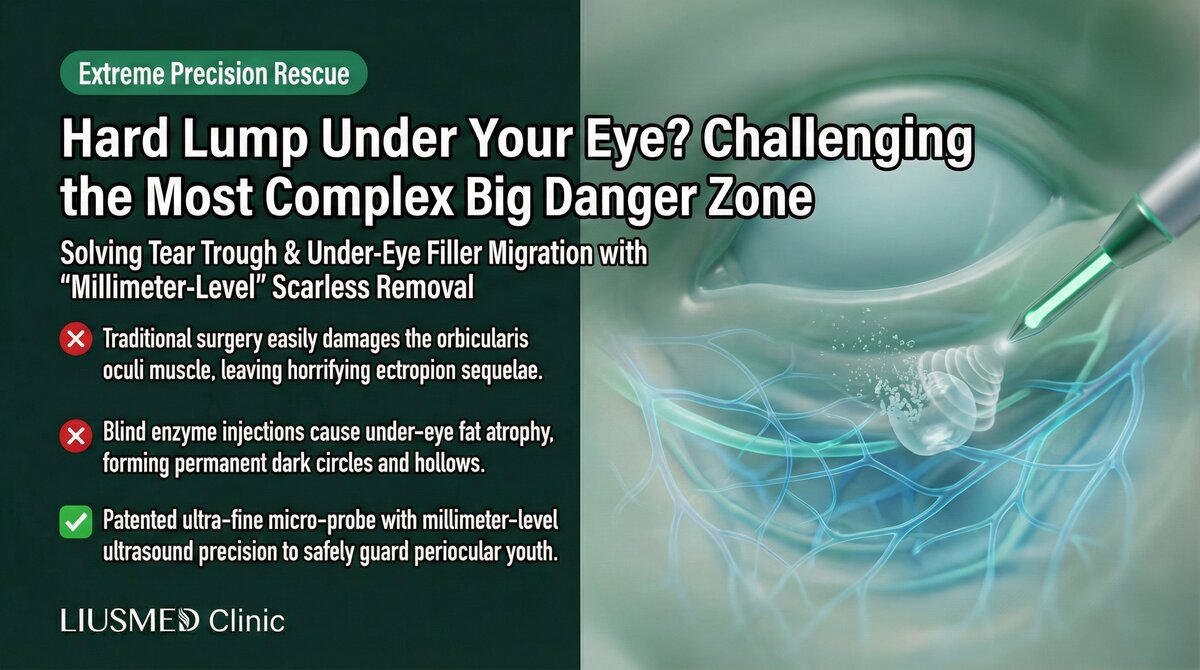
The Periorbital Zone: The Most Delicate Surgical Area on the Face
The periorbital area is called the "most delicate zone for minimally invasive surgery" because it combines multiple anatomical challenges: extremely thin skin (approximately 0.5 mm — the thinnest on the face), dense vasculature, precise nerve distribution, and severely limited operating space.
Every maneuver in this area requires millimeter-level precision.
Key Insight: Under-eye filler extraction tests not only surgical skill but also the physician's ultrasound image interpretation ability. In a space only millimeters thick, ultrasound is the only tool capable of providing real-time three-dimensional navigation.
Common Types of Periorbital Filler Problems
| Problem Type | Presentation | Common Cause |
|---|---|---|
| Tyndall effect | Skin shows blue-gray discoloration | HA injected too superficially |
| Lump formation | Palpable nodule under the eye | Filler aggregation or fibrosis |
| Worsened eye bags | More puffy appearance | Improper injection location or volume |
| Asymmetry | Different appearance under each eye | Uneven injection amounts |
| Granuloma | Persistent swelling and inflammation | Foreign body reaction or infection |
| Skin atrophy | Thinning and depression of under-eye skin | Long-term foreign body stimulation |
For more on the Tyndall effect, see Tyndall Effect in Tear Trough (hollow groove under lower eyelid) Filler. For granuloma rescue, see Under-Eye Filler Granuloma Rescue.
Special Challenges of Periorbital Extraction
Anatomical Challenges
| Challenge | Detail | Clinical Significance |
|---|---|---|
| Extremely thin skin | Approximately 0.5 mm | Slight misstep risks skin damage |
| Orbicularis oculi muscle | Directly beneath the skin | Damage may affect eye closure |
| Orbital fat | Adjacent to pathologic fat herniation | Must differentiate filler from native fat |
| Infraorbital nerve | Emerges from infraorbital foramen | Injury causes mid-face sensory abnormality |
| Angular artery system | Courses near medial canthus | Injury may cause significant hemorrhage |
| Lacrimal sac and duct | Deep to medial canthus | Injury affects tear drainage |
Ultrasound Advantages in the Periorbital Area
In such a confined, delicate space, ultrasound guidance advantages are amplified:
- Precise depth localization: Pinpoints filler within a 0.5–5 mm operating space
- Real-time vascular monitoring: Tracks the angular artery and its branches
- Thickness assessment: Real-time skin thickness measurement avoids operating at dangerously thin points
- Residual confirmation: Verifies clearance within an extremely small area
Surgical Workflow for Periorbital Extraction
Pre-Operative Precision Assessment
| Assessment Item | Method | Purpose |
|---|---|---|
| Filler location | High-frequency ultrasound scan | Confirm depth and extent |
| Filler type | Ultrasound image interpretation | Determine extraction strategy |
| Skin thickness | Ultrasound measurement | Assess safe operating space |
| Vascular course | Color Doppler | Plan safe pathway |
| Contralateral comparison | Bilateral ultrasound comparison | Set treatment goals |
Key Surgical Execution Points
- Micro-incision design: Typically hidden at the eye corner or natural crease
- Continuous ultrasound guidance: Full-procedure ultrasound monitoring
- Ultra-fine instrumentation: Using the finest specialized instruments
- Segmented extraction: Small amounts each time with repeated ultrasound confirmation
- Real-time symmetry assessment: Continuous comparison with the contralateral side
Key Insight: The most important principle in periorbital extraction is "conservative over aggressive." In this area, the difficulty of correcting over-extraction hollowing or skin damage far exceeds that of leaving a small amount of residual filler.
Regional Differences in Periorbital Treatment
| Area | Difficulty | Special Considerations | Risk Level |
|---|---|---|---|
| Medial canthus/Tear trough | Highest | Angular artery, lacrimal sac, ultra-thin skin | High |
| Mid under-eye | High | Infraorbital nerve, orbicularis oculi | Medium-High |
| Lateral canthus | Medium-High | Slightly more space, but still requires precision | Medium |
| Lower eyelid | High | Orbicularis function protection | Medium-High |
Post-Operative Recovery
| Timeline | Expected Presentation | Management |
|---|---|---|
| Days 1–3 | Notable swelling, possible bruising | Ice packs, elevated head during sleep |
| Week 1 | Swelling reduced ~50% | Avoid rubbing eyes |
| Week 2 | Mostly resolved | Concealer use acceptable |
| Month 1 | Basic recovery | Evaluate interim results |
| Month 3 | Tissue stabilized | Assess if supplementation needed |
Conclusion: Delicate Areas Demand Delicate Techniques
Periorbital filler extraction is one of the most technically demanding procedures in filler revision. In the thinnest, most delicate area of the entire face, ultrasound guidance is not a "bonus" but a necessity. Only under real-time imaging navigation can the physician safely and precisely operate within millimeter-scale spaces.
If you have concerns about periorbital filler, contact Liusmed Clinic for a professional evaluation.
Related reading: Tyndall Effect in Tear Trough Filler, Skin Atrophy (tissue shrinkage and weakening) After Injection
Related Services

Specialties
Credentials
- Kaohsiung Medical University, School of Medicine
- Attending Physician, Dermatology, Kaohsiung Chang Gung Memorial Hospital
- Attending Physician, Aesthetic Center, Kaohsiung Chang Gung Memorial Hospital
- Visiting Physician, Dermatology, Xiamen Chang Gung Hospital
- Visiting Physician, Aesthetic Center, Xiamen Chang Gung Hospital
"For every surgery, I strive to achieve a good outcome through a small incision and refined technique. Minimally invasive surgery is not just a technique — it's a commitment of respect to every patient."
Recovery after any procedure needs peer support too

Want to learn more?
Schedule a consultation for professional evaluation and advice