Under-Eye Puffiness: Aging or Filler Migration? Ultrasound Reveals the Answer
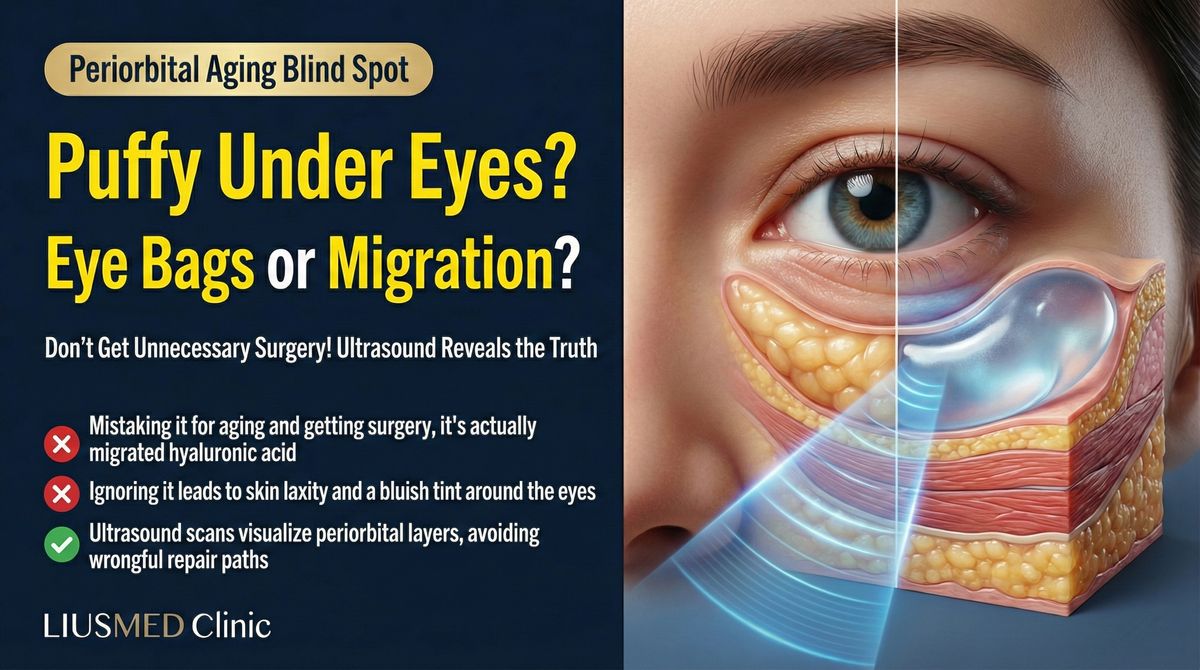
That Puffiness Under Your Eyes—Is It Aging or a Filler Problem?
You notice a fullness under your eyes in the mirror. Not quite a pronounced eye bag, but an extra layer of "thickness." You cannot remember when it started—is it gradual aging, or has the tear trough filler you received years ago migrated?
This question is more common than you think, and the answer directly determines what you should do.
True Eye Bags vs. Filler-Induced Pseudo Eye Bags
| Feature | True Eye Bags (Aging) | Pseudo Eye Bags (Filler Migration) |
|---|---|---|
| Cause | Orbital septum laxity, orbital fat prolapse | Filler migration from tear trough or mid-cheek to the eye bag zone |
| Progression | Gradual over years | May appear months after injection |
| Texture | Soft, more obvious looking upward | Firmer, palpable filler mass |
| Symmetry | Usually roughly symmetric | May be notably asymmetric |
| Dynamic variation | Worsens with fatigue, fluid retention | Relatively fixed, independent of body state |
| Skin color | May show darkening | May show Tyndall effect blue translucency |
| Treatment | Eye bag surgery (fat repositioning/removal) | Filler removal |
Key Insight: If you surgically treat filler-induced pseudo eye bags as if they were true eye bags, not only does it fail to solve the problem (the bulge is filler, not fat), but the surgeon may encounter unexpected filler material. Conversely, if you inject hyaluronidase for true eye bags thinking it is a filler problem, you dissolve native tissue rather than filler.
Ultrasound—Answers in 10 Minutes
In the under-eye region, ultrasound clearly differentiates orbital fat (specific echo pattern distinct from filler), filler material (each type has unique ultrasound characteristics), tissue edema (clearly distinguishable from filler aggregates), and tear trough ligament position and tension.
This is why ultrasound assessment is our first step for under-eye issues—because a wrong diagnosis leads to wrong treatment.
When Filler Migration Is Confirmed
Treatment depends on filler type and condition:
- HA (no capsule): Ultrasound-guided precise hyaluronidase
- HA (encapsulated): Ultrasound-guided pinhole extraction
- Non-HA filler: Ultrasound-guided pinhole extraction
- Combined with true eye bags: Address filler first, then assess further needs
The periorbital region is one of the most delicate areas of the face. Our ultrasound-guided pinhole extraction is particularly valuable here—ultrasound reveals the precise structures (nerves, vessels, muscles) in real time, ensuring no critical structures are damaged during extraction.
Preventing Tear Trough (hollow groove under lower eyelid) Filler Complications
- Volume is key: The tear trough zone is extremely thin; 0.1ml difference can cause problems
- Choose the right product: Soft, low-hydrophilic products suit the periorbital area
- Correct injection plane: Supraperiosteal is the safest plane
- Physician expertise: Periorbital injection requires deep knowledge of orbital anatomy
- Manage expectations: Tear troughs are not solved by "filling up"; over-filling creates under-eye puffiness
Key Insight: Tear trough filling appears simple but is one of the most technically demanding filler procedures. Thin skin, small space, dense neurovascular structures, and highly visible filler placement errors—these characteristics amplify any injection deviation. See also Tyndall effect in tear troughs and skin atrophy after injection.
Common questions
How can I tell if the puffiness is aging or filler? Can I tell just by looking?
Looks alone aren't reliable. True eye bags tend to be soft, worse when you're tired or retaining fluid, and roughly symmetric; filler-induced pseudo eye bags feel firmer, you may be able to palpate a mass, they can be noticeably asymmetric, and they stay relatively fixed. But these clues overlap, so the fastest and most definitive answer is an ultrasound scan — about ten minutes to sort it out.
Why do I need an ultrasound? Can't you just treat it?
Because if the diagnosis is wrong, the whole treatment direction is wrong. Treat migrated filler as if it were true eye bags and operate, and you're removing filler, not fat — surgery won't fix it. Go the other way and inject hyaluronidase for true eye bags thinking it's filler, and you dissolve your own tissue. Ultrasound clearly separates orbital fat, filler, edema, and the tear trough ligament, which is why it's our first step for any under-eye problem.
If it's confirmed as filler migration, how is it removed? Will it damage the eye area?
It depends on the filler type. Uncapsulated HA gets ultrasound-guided, precisely targeted hyaluronidase; encapsulated HA or non-HA filler gets minimally invasive, ultrasound-guided single-pinhole extraction. The periorbital area is dense with nerves and vessels, and ultrasound shows those delicate structures in real time — the whole point is to avoid touching anything important during removal.
I've had tear trough filler and want more — how do I lower the risk of migration?
A few principles: keep the volume small — the tear trough is very thin and a 0.1ml difference can cause problems; choose a soft, low-hydrophilic product; place it in the supraperiosteal plane, which is relatively safe; and see a physician who knows orbital anatomy. And one point that's often missed — tear troughs aren't solved by "filling up." Over-filling is itself a cause of under-eye puffiness.
The puffiness looks minor — do I even need to do anything?
If it doesn't bother you and you're not concerned, you don't necessarily have to touch it. What matters first is knowing what it actually is — aging or filler. If you're unsure, one ten-minute ultrasound can spare you weeks of guessing and anxiety, and whether or how to treat it can be decided from what the scan actually shows.
Not Sure? Come for a Scan
If you are uncertain whether under-eye puffiness is aging or a filler issue, the fastest answer is an ultrasound. Ten minutes of examination can spare you weeks of guessing and anxiety.
Schedule a consultation and let us use ultrasound to reveal what is really happening under your eyes.
Related Reading
- Why Do Fillers Migrate? The Science of Displacement
- Tyndall Effect: The Blue Glow Problem in Tear Trough Filler
- Skin Atrophy (tissue shrinkage and weakening) After Filler Injection
Related Services

Specialties
Credentials
- Kaohsiung Medical University, School of Medicine
- Attending Physician, Dermatology, Kaohsiung Chang Gung Memorial Hospital
- Attending Physician, Aesthetic Center, Kaohsiung Chang Gung Memorial Hospital
- Visiting Physician, Dermatology, Xiamen Chang Gung Hospital
- Visiting Physician, Aesthetic Center, Xiamen Chang Gung Hospital
"For every surgery, I strive to achieve a good outcome through a small incision and refined technique. Minimally invasive surgery is not just a technique — it's a commitment of respect to every patient."
Recovery after any procedure needs peer support too


Want to learn more?
Schedule a consultation for professional evaluation and advice