Why Cross-Linked Hyaluronic Acid Lasts Longer Than Claimed
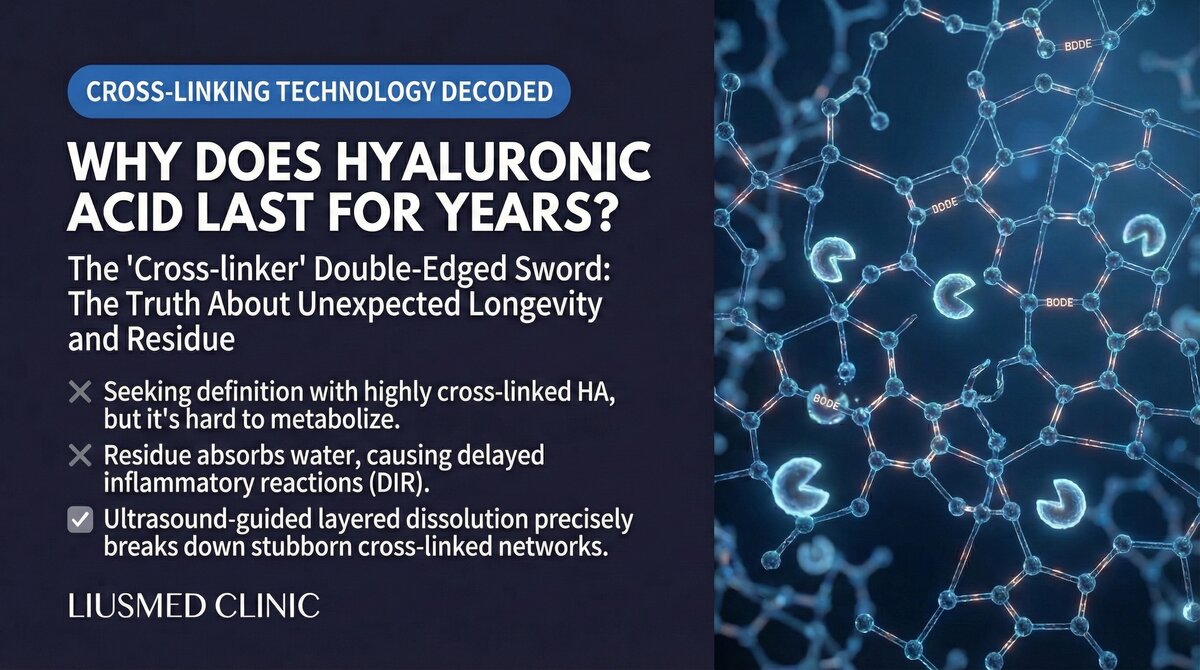
Your "Short-Acting" HA (Hyaluronic Acid — sugar molecule naturally in skin, holds water) May Last Longer Than You Think
"Hyaluronic acid is absorbable — it will be metabolized by your body in 6 to 18 months." This is one of the most frequently heard statements in aesthetic consultations. It provides a sense of security: if you are unhappy, just wait; if there is a problem, hyaluronidase can dissolve it.
But this statement conceals an important scientific fact: modern HA fillers achieve their months- to years-long effects through cross-linking technology. And the very essence of cross-linking is making HA harder to break down. For how HA itself is classified as a material and how the various brands differ, the filler-revision site has a more detailed hyaluronic acid encyclopedia page.
Key Insight: Native hyaluronic acid has a half-life of only 1–2 days in the body. The reason filler-grade cross-linked HA can persist for 6–18 months or longer is precisely because chemical cross-linking makes it resist enzymatic degradation — but this also means its "absorbability" is dramatically reduced, and residues may persist for years.
The Chemistry of Cross-Linking
From Native HA to Filler
Native hyaluronic acid is a linear polysaccharide composed of alternating glucuronic acid and N-acetylglucosamine units. Human skin naturally contains abundant HA, but it is continuously degraded by endogenous hyaluronidase, with a half-life of approximately 24–48 hours.
If unmodified HA were injected directly into skin, it would be degraded within days — providing zero filling effect. To create a filler, HA must undergo cross-linking.
BDDE (1,4-Butanediol Diglycidyl Ether — HA cross-linker for elasticity): The Most Common Cross-Linker
The vast majority of HA fillers use 1,4-butanediol diglycidyl ether (BDDE) as the cross-linking agent. BDDE's dual epoxide groups can react simultaneously with hydroxyl groups on two HA molecular chains, creating chemical bridges between chains.
| Cross-Linking Property | Low Cross-Linked Product | High Cross-Linked Product |
|---|---|---|
| BDDE concentration | Lower | Higher |
| Gel firmness (G' value) | Low (soft) | High (firm) |
| Enzymatic resistance | Lower | Higher |
| Labeled duration | 6–9 months | 12–24 months |
| Actual persistence | Possibly 1–3 years | Possibly 2–5+ years |
| Typical use | Lips, tear troughs | Nose bridge, chin, cheekbones |
The Relationship Between Cross-Link Density and Persistence
Higher cross-link density means more chemical bonds between HA chains, creating a tighter three-dimensional network. This structure creates a physical barrier against hyaluronidase — enzyme molecules have difficulty accessing HA chains protected within the network interior.
Think of the difference between a sponge and a piece of rubber. A sponge (low cross-linking) has many open pores that water (enzyme) can easily penetrate; rubber (high cross-linking) has a dense structure that water cannot easily infiltrate.
Why Hyaluronidase (enzyme that dissolves HA filler) Cannot Always Fully Dissolve Cross-Linked HA
This is a critical issue that many patients and physicians overlook. Hyaluronidase is considered the "antidote" for HA fillers — inject it and the problem dissolves away. The reality is far more complex.
Factors Affecting Enzymatic Efficiency
Cross-link density: Highly cross-linked products have significantly greater resistance to enzymatic degradation. Clinically, some highly cross-linked HA may require multiple high-dose hyaluronidase injections for only partial dissolution.
Encapsulation effect: Over time, the body forms a fibrous capsule around filler deposits. This capsule becomes a physical barrier preventing enzyme molecules from reaching the filler. For more detail on why encapsulation causes dissolvers to fail.
Filler bolus size: For large filler deposits, enzyme can only degrade from the surface inward. The core region, being farther from the enzyme source, degrades at a significantly reduced rate.
Tissue vascularity: Enzyme activity and diffusion are affected by local blood flow. In areas with sparse vasculature, enzyme delivery efficiency is lower.
Key Insight: Hyaluronidase is not a "magic eraser." For highly cross-linked, encapsulated, or large-bolus HA residues, enzymatic dissolution may be only partially effective, or even completely ineffective. This is why some patients can still feel residual material after multiple hyaluronidase injections.
Clinical Imaging Evidence: The Scale of Persistence
MRI (Magnetic Resonance Imaging) and Ultrasound Findings
Multiple studies using MRI and high-resolution ultrasound to track "expired" HA have found surprising persistence rates:
- Detectable HA residue at 2–3 times the labeled duration
- Residue morphology typically presents as irregular fragments or encapsulated nodules
- In some cases, HA signal is detectable more than 5 years after injection
These findings directly contrast with the myth of complete HA absorption.
Cross-Linking Differences Among HA Brands
Different HA filler brands use different cross-linking technologies and formulations, resulting in significantly different persistence characteristics:
| Technology Platform | Cross-Linking Method | Characteristics | Persistence Tendency |
|---|---|---|---|
| NASHA technology | Minimal modification, large particles | Gel particle type | May form palpable boluses |
| Vycross technology | High/low molecular weight mixed cross-linking | High cohesivity, soft | Residue may be more dispersed |
| CPM technology | Continuous optimal cross-linking | Uniform gel | More uniform persistence |
| OBT technology | Optimized balance | High G' value | Structural persistence prominent |
| RHA technology | Preserved natural structure | High elasticity | Different behavior in dynamic areas |
Cross-Linking Byproducts and Persistence
Residual Cross-Linker
BDDE is not completely consumed in the cross-linking reaction. Residual unreacted BDDE content is an important indicator of product quality. Regulatory agencies in various countries set upper limits for residual BDDE, but even within standards, trace amounts remain.
Potential effects of residual BDDE:
- May become an antigen recognized by the immune system
- Long-term low-dose tissue exposure effects are not fully established
- May participate in triggering local inflammatory responses
Degradation Intermediates
Cross-linked HA degradation is not a single-step process. During enzymatic and hydrolytic degradation, various intermediates are produced — including HA fragments that still carry cross-linked structures. These fragments are harder to clear than native HA and may persist in tissue long-term.
Implications for Clinical Repair
Understanding the persistence science of cross-linked HA has important implications for repair strategies:
The Necessity of Ultrasound Assessment
Before considering any repair or re-injection, high-resolution ultrasound can:
- Confirm whether old HA residues exist
- Assess residue distribution, size, and degree of encapsulation
- Determine whether residues are causing current symptoms
- Provide precise localization data for subsequent treatment
Learn more about the filler repair evaluation process.
Physical Removal vs. Enzymatic Dissolution
For encapsulated or highly cross-linked HA residues:
- Enzymatic dissolution may have limited effect, requiring repeated high-dose injections
- Excessive hyaluronidase risks dissolving native HA in surrounding normal tissue
- Ultrasound-guided minimally invasive extraction can physically remove residues directly, avoiding the uncertainty of enzymatic dissolution
The Cumulative Risk of Filler Migration
Residual cross-linked HA does not just "sit quietly." It may:
- Slowly migrate over time
- Interact with newly injected fillers
- Be displaced to new positions when tissue is under pressure or trauma
Common questions
Once the labeled time is up, does the filler fully metabolize away?
The 6-to-18-month figure on the box describes how long the visible filling effect lasts, not when the material actually leaves your tissue. When researchers track it with MRI and high-resolution ultrasound, they still pick up residue at two to three times the labeled duration, and in some cases HA signal shows up more than five years after injection. So it's not safe to assume it all disappears.
If I'm unhappy with the result, can I just dissolve it with hyaluronidase?
It's not always that simple. When the residue is highly cross-linked, already wrapped in a fibrous capsule, or sitting as a large bolus, the enzyme may only work partway — some people can still feel material after several injections. Think of it as a tool that helps dissolving along, not an eraser that removes anything on demand.
Why is cross-linked HA so hard to break down?
The cross-linker (such as BDDE) ties the HA chains into a three-dimensional mesh, and the enzyme struggles to reach the chains protected inside it. The denser the cross-linking, the tighter that mesh and the more it resists enzymatic breakdown — which is exactly why it lasts, but also why the body clears it slowly.
I've had several HA injections over the years — what should I check before the next one?
It's worth getting a high-resolution ultrasound first to see how much old residue has actually built up, where it sits, and whether it's encapsulated. Knowing what's already in there makes the decision about whether and how to inject again far more grounded than just topping up.
If the enzyme can't dissolve it, is there another way to deal with the residue?
Yes. For encapsulated or highly cross-linked residue, ultrasound-guided minimally invasive extraction can physically remove the material rather than relying on repeated high-dose enzyme injections and hoping it dissolves. Which approach suits you still depends on a physician actually reviewing your imaging.
Advice for Consumers
After understanding the persistence science of cross-linked HA, the following recommendations can help you make better decisions:
-
Do not assume HA will completely disappear. The labeled duration represents only the duration of "visible effects," not the disappearance of the substance.
-
Get an assessment before repeat injections. If you have received multiple HA injections over the past few years, an ultrasound assessment before your next injection can reveal cumulative residue status.
-
Hyaluronidase is not omnipotent. If you plan to "dissolve and redo," understand that enzymatic dissolution may not completely clear all residues.
-
Choose a physician with image-guidance capability. Whether for injection or repair, a physician who can see filler location under ultrasound can make more precise decisions.
If you currently have any questions related to HA persistence, please contact us for an assessment. Learn about our filler repair services.
Key Insight: Cross-linking technology is the foundation that makes HA fillers work. But the same technology that makes fillers last also makes them harder for the body to clear and harder for enzymes to fully dissolve. Acknowledging this duality is the starting point for a truly scientific understanding of HA fillers.

Specialties
Credentials
- Kaohsiung Medical University, School of Medicine
- Attending Physician, Dermatology, Kaohsiung Chang Gung Memorial Hospital
- Attending Physician, Aesthetic Center, Kaohsiung Chang Gung Memorial Hospital
- Visiting Physician, Dermatology, Xiamen Chang Gung Hospital
- Visiting Physician, Aesthetic Center, Xiamen Chang Gung Hospital
"For every surgery, I strive to achieve a good outcome through a small incision and refined technique. Minimally invasive surgery is not just a technique — it's a commitment of respect to every patient."
Recovery after any procedure needs peer support too


Want to learn more?
Schedule a consultation for professional evaluation and advice