When Can Failed Aesthetics Be Repaired? Ultrasound-Guided Evaluation
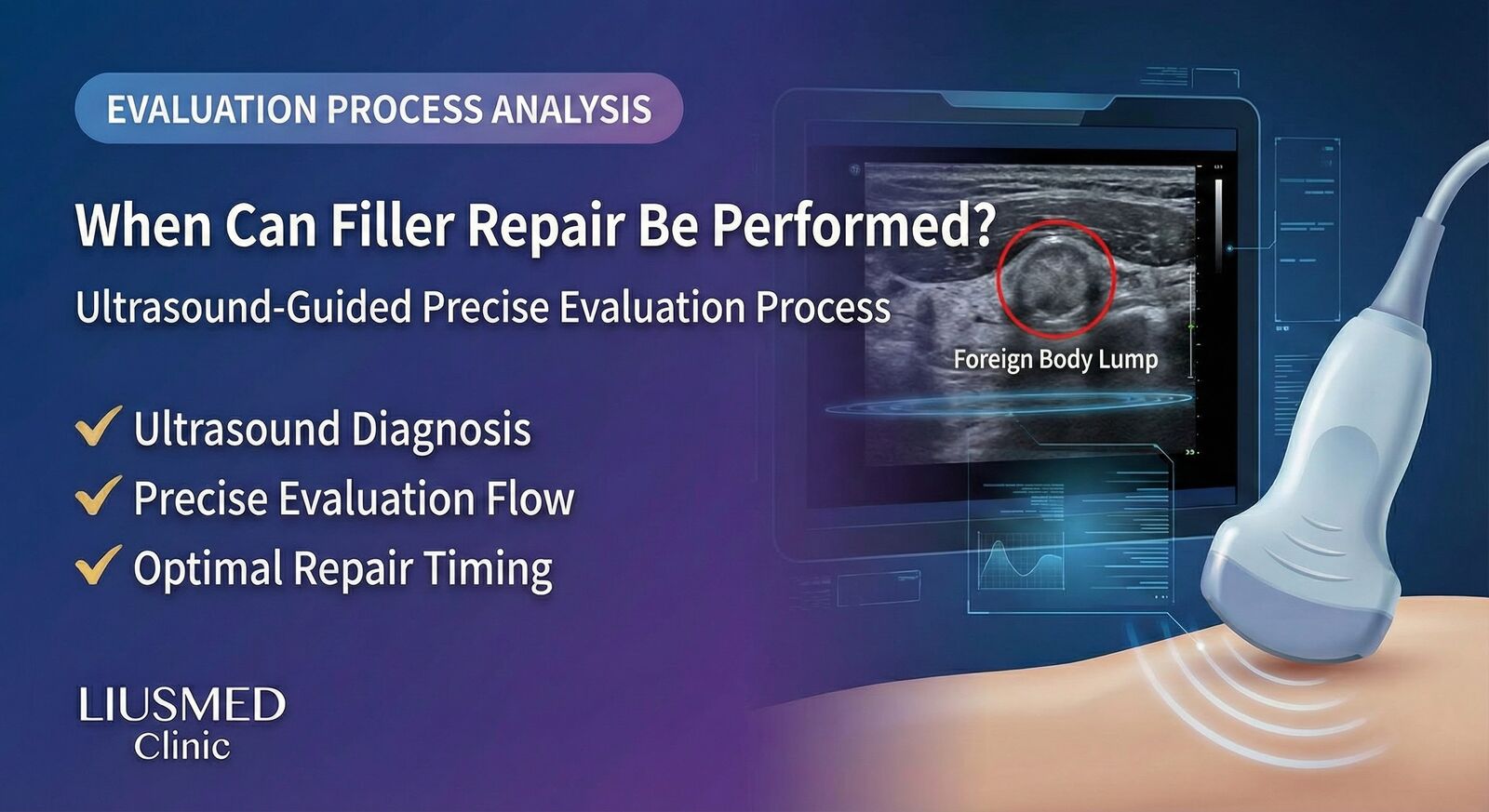
The Importance of Proper Evaluation
After aesthetic filler complications, not every problem needs immediate treatment, and not all problems can be treated. Professional evaluation helps determine the problem type, severity, and optimal treatment timing—avoiding hasty interventions that could cause greater harm.
When Should You Seek Repair Evaluation?
Situations Requiring Evaluation
| Problem Type | Symptom Description |
|---|---|
| Unsatisfactory appearance | Wrong shape, asymmetry, unnatural look after filling |
| Lump formation | Palpable lumps, bumps |
| Migration | Filler moved to other locations |
| Persistent swelling | Swelling lasting more than 2 weeks post-injection |
| Pain/discomfort | Continued pain at injection site |
| Color changes | Bluish skin (Tyndall effect) |
| Inflammation/infection | Redness, swelling, heat, pain, pus |
Emergency Situations (Seek Immediate Care)
| Warning Sign | Possible Cause | Urgency |
|---|---|---|
| Vision changes/blindness | Vascular occlusion | 🚨 Extremely urgent (within hours) |
| Skin turning white/purple | Vascular compression | 🚨 Urgent (within 24 hours) |
| Severe pain | Vascular issue | 🚨 Urgent |
| Fever + spreading redness | Severe infection | 🚨 Urgent |
⚠️ Note: Vision problems or signs of skin necrosis require immediate medical attention. Delay may cause permanent damage.
Complete Evaluation Process
Step 1: Detailed History Taking
| Question | Purpose |
|---|---|
| When was the injection? | Determine filler status |
| Where was it done? | Assess clinic reliability |
| What was injected? | Confirm filler type |
| How much? | Estimate filler volume |
| When did problems start? | Determine problem nature |
| Previous treatments? | Understand treatment history |
Common Situations:
- Many patients don't know what was injected
- Some products claimed to be "hyaluronic acid" are actually other substances
- Illegitimate injectors often don't provide detailed information
Step 2: Physical Examination
| Exam Component | Assessment Content |
|---|---|
| Inspection | Appearance, symmetry, color |
| Palpation | Firmness, borders, depth, tenderness |
| Dynamic assessment | Changes with facial expression |
| Surrounding tissue | Impact on adjacent structures |
Step 3: Ultrasound Evaluation (Critical!)
Why Is Ultrasound Necessary?
| Advantage | Explanation |
|---|---|
| Non-invasive | Can see inside without cutting |
| Real-time imaging | Visualize filler immediately |
| Precise localization | Determine location, depth, extent |
| Material identification | Different fillers have different imaging features |
| Guide treatment | Can perform procedures under ultrasound |
Filler Identification on Ultrasound
| Filler | Ultrasound Features | Identification Difficulty |
|---|---|---|
| Hyaluronic Acid | Hypoechoic, homogeneous, clear borders | Easy |
| Radiesse | Hyperechoic dots, posterior shadow | Easy |
| Collagen | Low to medium echogenicity | Medium |
| Growth Factor Lump | Mixed echogenicity, irregular | Medium |
| Silicone/Oil | Hyperechoic, "snowflake" phenomenon | Harder (diffuse distribution) |
| PMMA | Hyperechoic, encapsulated | Medium |
Step 4: Diagnosis and Classification
Based on evaluation results, problems are classified:
| Category | Description | Treatment Direction |
|---|---|---|
| A. Dissolvable | Hyaluronic acid-related issues | Consider hyaluronidase |
| B. Needs Surgery | Non-dissolvable fillers | Plan Liusmed minimally invasive pinhole extraction |
| C. Needs Waiting | Inflamed or too recent | Control inflammation first |
| D. Cannot Treat | Too diffuse or too risky | Explain limitations, conservative approach |
Determining Repair Timing
Optimal Timing for Different Situations
| Problem Type | Recommended Timing | Reason |
|---|---|---|
| Vascular emergency | Immediately | Rescue tissue survival |
| Infection | 1-2 weeks after controlling infection | Avoid spreading infection |
| Inflammatory lump | 4-6 weeks after inflammation subsides | Easier to handle when stable |
| Simple lump | Anytime | Earlier is better |
| HA problems | Try dissolution immediately | Fresh filler dissolves better |
| Unsatisfactory appearance | 1-3 months after stabilizing | Confirm it's a real problem, not swelling |
Risks of Treating Too Early
| Risk | Explanation |
|---|---|
| Swelling not resolved | May mistake normal swelling for a problem |
| Inflammation spread | Surgery during inflammation may worsen it |
| Fragile tissue | Unstable tissue is hard to manage |
| Misjudgment | Still changing, difficult to assess accurately |
Risks of Waiting Too Long
| Risk | Explanation |
|---|---|
| Fibrosis | Longer lumps exist, harder they become |
| Spreading | Migrating fillers may spread further |
| Tissue damage | Long-term compression may cause atrophy |
| Psychological burden | Long-term distress affects quality of life |
💡 Dr. Liu's Advice: "Faster isn't always better, and longer waiting isn't always safer. The optimal timing depends on each specific situation. That's the value of professional evaluation."
Possible Outcomes After Evaluation
Outcome 1: Recommend Immediate Treatment
| Situation | Treatment Approach |
|---|---|
| HA problems | Hyaluronidase injection |
| Stable lump | Schedule Liusmed minimally invasive pinhole extraction |
| Clear appearance issue | Discuss repair options |
Outcome 2: Recommend Waiting Before Treatment
| Situation | Wait Time | Reason |
|---|---|---|
| Still inflamed | 4-6 weeks | Wait for inflammation to resolve |
| Recently injected | 1-3 months | Wait for swelling to stabilize |
| Needs anti-inflammatory treatment | After treatment completion | Avoid infection spread |
Outcome 3: Cannot Be Treated Currently
| Situation | Explanation |
|---|---|
| Widespread silicone oil | Cannot completely clear, can only improve |
| Risk outweighs benefit | May cause greater harm |
| Unrealistic expectations | Cannot achieve expected result |
Frequently Asked Questions
Q1: How long does the evaluation take?
A1: A complete evaluation takes about 30-60 minutes, including:
- History taking: 10-15 minutes
- Physical exam: 5-10 minutes
- Ultrasound evaluation: 15-20 minutes
- Discussion of options: 10-15 minutes
Q2: How much does evaluation cost?
A2: Varies by clinic, typically includes:
- Consultation fee
- Ultrasound examination fee
- Advisory fee
Recommend confirming costs when booking.
Q3: I don't know what was injected—can I still be evaluated?
A3: Yes. Ultrasound can help identify filler types:
- Different materials have different ultrasound characteristics
- Combined with history and physical exam for diagnosis
- If still uncertain, most conservative approach is used
Q4: After evaluation, must I get treated at the same clinic?
A4: Not necessarily. The evaluation report serves as reference. You can:
- Have treatment at the evaluating clinic
- Seek other opinions with the information
- Decide not to treat for now
Q5: I had problems from a "hyaluronic acid" bought online—can I be evaluated?
A5: Yes, but note:
- Products from unknown sources are often not real hyaluronic acid
- Illegal injections have high infection and foreign body reaction risks
- May require more complex treatment
- Results may be limited
⚠️ Important Reminder: Buying injectable products online and self-injecting or having non-professionals inject is extremely risky and illegal.
What Does an Evaluation Report Include?
Standard Evaluation Report Contents
-
Basic Information
- Injection time, location, substance (if known)
-
Problem Description
- Symptoms, location, severity
-
Examination Findings
- Physical exam results
- Ultrasound images and interpretation
-
Diagnosis
- Filler type (confirmed or suspected)
- Problem classification
-
Recommended Plan
- Treatment method
- Expected outcome
- Risk explanation
- Timing recommendation
-
Cost Explanation
- Treatment cost range
- Possible additional costs
How to Prepare for Your Evaluation Appointment
Recommended Documents to Bring
| Document | Purpose |
|---|---|
| Previous injection records | Confirm filler type and amount |
| Photos (before and after) | Compare changes |
| Previous treatment records | Understand treatment history |
| Current medication list | Assess surgical risks |
Prepare Your Questions
Recommended questions for the doctor:
- Can my problem be treated?
- What's the treatment method?
- What are the risks?
- What results can I expect?
- What's the approximate cost?
- How long is recovery?
Conclusion
| Key Point | Explanation |
|---|---|
| Evaluate before treating | Don't rush treatment, understand the problem first |
| Ultrasound is essential | Precise evaluation requires imaging assistance |
| Timing matters | Both too early and too late carry risks |
| Be realistic | Not all problems can be perfectly solved |
| Choose an expert | Repair requires more experience than initial injection |
Related Reading
About the Author
Dr. Ta-Ju Liu
- Current Position: Director, Liushi Clinic
- Specialties: Minimal incision surgery (lipoma, cyst), hyperhidrosis surgery, thread lifting
- Experience:
- 15+ years of clinical minimal incision surgery experience
- Over 10,000 successful minimal incision cases
- Board-certified dermatologist
- Philosophy: "The first step in aesthetic repair is accurate evaluation. Only by understanding the full picture can we develop the right treatment strategy."
Still unsure about getting an evaluation? You're welcome to first describe your situation anonymously on the Patient Q&A Forum, or browse Dr. Liu's Community for more repair-related information.
Related Services

Specialties
Credentials
- Kaohsiung Medical University, School of Medicine
- Attending Physician, Dermatology, Kaohsiung Chang Gung Memorial Hospital
- Attending Physician, Aesthetic Center, Kaohsiung Chang Gung Memorial Hospital
- Visiting Physician, Dermatology, Xiamen Chang Gung Hospital
- Visiting Physician, Aesthetic Center, Xiamen Chang Gung Hospital
"For every surgery, I strive to achieve a good outcome through a small incision and refined technique. Minimally invasive surgery is not just a technique — it's a commitment of respect to every patient."
Recovery after any procedure needs peer support too


Want to learn more?
Schedule a consultation for professional evaluation and advice