Sudden Redness and Swelling Years After Filler? Immune Rejection and Infection Risks Explained
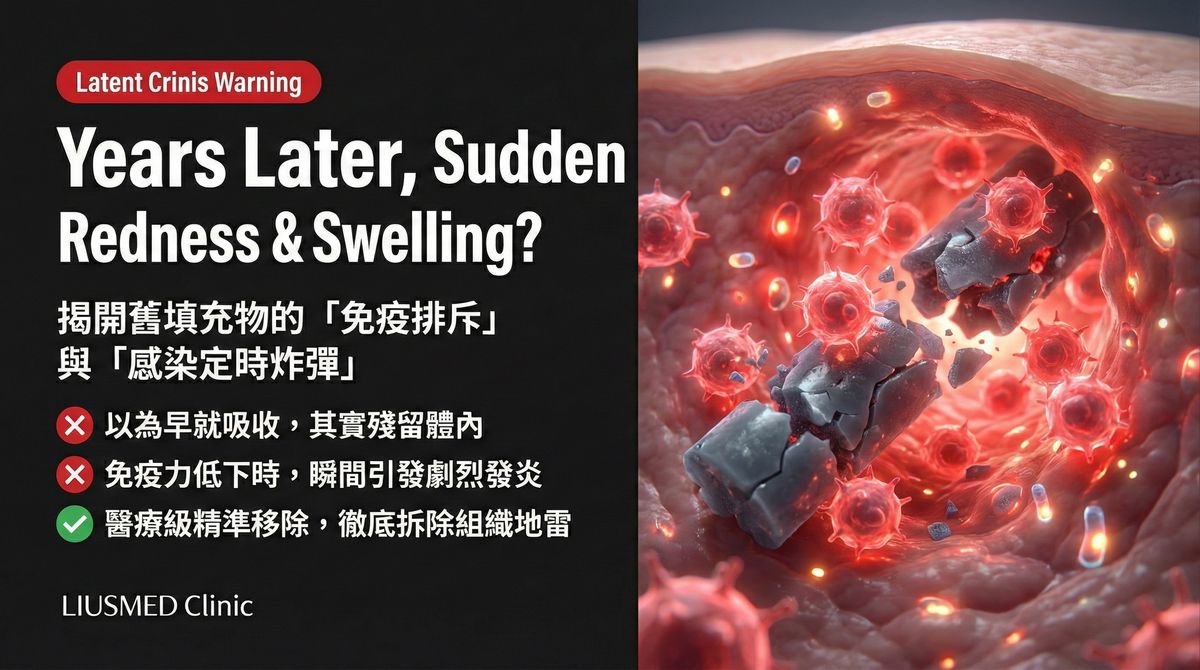
Filler Injected Years Ago—Why Is It Suddenly Swollen?
Three years ago you had filler in your nasolabial folds. Or five years ago you augmented your cheeks. Everything was uneventful—until one day you look in the mirror and see that area suddenly red and swollen. It feels warm, perhaps even painful. You think in alarm: "How can something I had done years ago suddenly cause problems now?"
This scenario is more common than you might think. Filler-related delayed reactions can first appear months, years, or even more than a decade after injection. Understanding the mechanisms is the first step toward correct management.
Why Did It Stay "Quiet" for So Long Before Erupting?
Three Possible Mechanisms
Sudden redness and swelling years later is usually driven by one of three mechanisms (or their combination):
| Mechanism | Trigger Pattern | Typical Timeframe | Prognosis |
|---|---|---|---|
| Biofilm reactivation | An illness, vaccine, dental work or facial trauma upsets a balance that had held | Months to many years after injection | Antibiotics calm flares; lasting control usually means removing the colonized filler |
| Immune-mediated foreign body reaction | Immune changes, or changes on the filler surface | Months to years | Depends on severity |
| Degradation product reaction | Material breakdown releasing fragments | Often years, as slower materials break down | Depends on material type |
Mechanism 1: Biofilm Reactivation
The Sleeping Enemy Awakens
This is the pattern we see most often in clinic. As discussed in our biofilm article, bacteria may attach to the filler surface on the day of injection, forming a protected dormant colony. Normally, your immune system and the biofilm maintain a delicate equilibrium—bacteria remain inactive, the immune system maintains low-level surveillance.
But this balance can be disrupted:
- Systemic infection: Influenza, COVID-19, pneumonia temporarily redirecting immune resources
- Immunosuppression: Immunosuppressive medications, chronic stress, malnutrition
- Vaccination: Vaccine-induced systemic immune activation causing cross-reactivity at filler sites; delayed reactions to HA filler after COVID-19 vaccination have been documented (Munavalli et al., 2022), and we cover the pattern in swelling after a cold or a vaccine
- Local trauma: Facial impact, surgery, or other treatments disturbing the local environment
- Hormonal changes: Pregnancy, menopause, or hormonal therapies altering immune function
Key Insight: Biofilm reactivation is not a "new infection"—it is an infection that has existed since injection day, becoming active again when conditions change. This is why antibiotics only temporarily control symptoms and cannot cure the condition. The definitive solution is physical removal of the biofilm-harboring filler.
How to Recognize Biofilm Reactivation
Biofilm reactivation has characteristic features:
- Recurrent episodes—swelling resolves then returns
- Antibiotics provide temporary relief but symptoms recur after discontinuation
- Swelling correlates with overall health status
- Swelling location corresponds to the original injection site
A negative culture does not rule biofilm out. Bacteria living in a biofilm often won't grow on routine culture. In one study of long-lasting nodules after polyacrylamide gel that had all grown nothing on culture, a special staining method still found bacteria in biopsies from seven of eight patients, sitting in clumps within the gel (Bjarnsholt et al., 2009).
Mechanism 2: Immune-Mediated Foreign Body Reaction
Your Immune System Finally "Sees" the Filler
Even the most biocompatible filler material remains foreign to the human body. In most cases, the immune system develops "immune tolerance"—acknowledging the filler's presence without attacking it.
But this tolerance may collapse years later:
- Filler surface changes: Over time, protein deposition on the filler surface alters its immunological profile
- Filler fragmentation: As filler begins to degrade, new antigenic surfaces are exposed
- Immune system changes: Autoimmune disease flare, new allergen exposure, or altered immune function
- Cross-reactivity: Infection or vaccine-induced immune responses inadvertently targeting filler
Foreign body reaction differs from biofilm:
- Typically presents as diffuse, uniform swelling rather than focal nodules
- May be accompanied by systemic allergic symptoms (rash, itching)
- Antibiotics are completely ineffective
- Corticosteroids may temporarily help but carry long-term side effects
Mechanism 3: Degradation Product Reaction
Breakdown Fragments Triggering New Problems
Different filler materials degrade through different pathways, producing different fragments:
| Filler Type | Degradation Mode | Fragment Characteristics | Reaction Risk |
|---|---|---|---|
| Hyaluronic acid (HA) | Enzymatic degradation | Small polysaccharide molecules | Lower |
| Poly-L-lactic acid (PLLA) | Hydrolytic degradation | Lactic acid molecules | Moderate |
| Polycaprolactone (PCL) | Slow hydrolysis | Caprolactone fragments | Moderate |
| Calcium hydroxylapatite (CaHA) | Phagocytic degradation | Calcium phosphate particles | Moderate-high |
| PMMA/Silicone | Non-degradable | Not applicable | Persistent foreign body reaction |
Some fillers release microparticles or chemical byproducts during degradation that trigger new immune responses. This tends to happen once the material is actively breaking down, which for slowly degrading products can be years after injection.
Key Insight: "Degradable" does not mean "safely disappears." The degradation process itself can be a source of complications, particularly when degradation products provoke excessive immune reactions. See does hyaluronic acid truly get completely absorbed?
Telling the Three Apart
In practice the three mechanisms overlap, and more than one can be active at once. These are the clues we put together:
| Clue | Biofilm reactivation | Immune foreign body reaction | Degradation product reaction |
|---|---|---|---|
| Recent trigger | Infection, vaccine, dental work, facial trauma | New medication, autoimmune flare, infection or vaccine | Often nothing obvious; timing follows the material breaking down |
| Pattern | Firm, tender swelling, often at one site, coming and going | More diffuse, often several treated areas at once, sometimes itchy | Firm nodules or swelling where the material sits |
| Antibiotics | Help for a while, then it returns | No effect | Little effect |
| Ultrasound | Filler with inflamed tissue around it, sometimes a fluid pocket | Inflammation around filler, often in more than one area | Irregular or fragmented material with inflammation around it |
| Culture | Often negative, even when bacteria are there | Negative | Negative |
No single test settles it. History plus ultrasound usually narrows it down enough to choose the next step.
HA Versus Collagen Stimulators: Different Kinds of Late Lump
With hyaluronic acid, a late problem usually shows up as swelling or inflamed nodules, and hyaluronidase can act on the HA itself. Collagen stimulators behave differently. PLLA (Sculptra), PCL (Ellansé) and CaHA (Radiesse) can form firm, non-inflamed nodules where material has clumped, and true granulomas can appear months or years later. Hyaluronidase does nothing to these materials, so removal is planned differently: see can Ellansé be removed? and the filler-revision site's Sculptra granuloma removal guide.
The Correct Management Process
First: Red Flags That Mean Go to an Emergency Department Now
Most delayed swelling is not an emergency. These are:
- Vision changes, eye pain, or a drooping eyelid
- Skin turning white, dusky blue-purple or mottled, with severe pain. This usually happens during or shortly after an injection rather than years later, but if you have just had a top-up and see it, go now. See vascular occlusion: why it is an emergency.
- Fever with redness that is spreading fast, or swelling that affects breathing or swallowing
For any of these, go to the nearest emergency department. Don't wait for a filler appointment.
Step 1: Do Not Panic, But Do Not Wait
Sudden redness and swelling is understandably concerning, but in most cases it can be controlled with proper management. What you should do:
- Document symptoms: Photograph the extent, color, and temporal changes of swelling
- Recall triggering events: Recent illness, vaccination, major stress, or health changes
- Recall injection history: When, what material, and where it was injected
- Schedule evaluation: Arrange prompt assessment with a physician equipped with ultrasound
Step 2: Ultrasound Assessment
Ultrasound plays an irreplaceable role in this setting:
- Confirm whether filler remains in its original position—or has migrated
- Assess for fluid collection (abscess or effusion)
- Evaluate the degree and extent of surrounding tissue inflammation
- Check for capsule formation
- Exclude other possible diagnoses
Step 3: Strategy Based on Diagnosis
Different causes require entirely different treatments:
Biofilm infection:
- If there is a pocket of pus, it may need draining straight away.
- Otherwise, the acute inflammation is brought down first with appropriate antibiotics.
- Once it has settled, ultrasound-guided removal of the filler harboring the biofilm is planned. Removing it in the middle of a hot flare is harder: swelling blurs the boundaries and inflamed tissue is fragile, so the result is less clean and less even.
- If antibiotics keep failing, especially after injections at an unlicensed venue or with an unknown product, atypical (non-tuberculous) mycobacteria need to be considered. They need specific cultures and a different, longer course of treatment. We cover this in foreign body reactions, biofilm and NTM.
Immune-mediated reaction:
- Mild: Immunomodulatory treatment, observation
- Moderate: May require local corticosteroid injection
- Severe: Consider filler removal
Degradation product reaction:
- Assess amount and condition of residual filler
- Remove residual material if needed to eliminate the reaction source
What You Should NOT Do
Common Mistakes
- Self-medicating with antibiotics: Taking antibiotics without physician evaluation is not only potentially ineffective (if it is not infection) but may mask the real problem
- Blind hyaluronidase injection "to see if it helps": Without ultrasound, you do not know where the problem is or whether hyaluronidase can reach it
- Hot compresses: If the cause is infection, heat accelerates bacterial activity and inflammation
- Massage: If filler has migrated or an abscess is present, massage only spreads the problem
- Ignoring it: "It swelled before and resolved on its own"—each recurrence may be worse than the last
Risk Comparison by Filler Material
Not all fillers carry equal delayed reaction risk. Understanding your injected material helps assess your risk level:
| Material | Delayed Reaction Risk | Removability | Notes |
|---|---|---|---|
| Hyaluronic acid | Low–moderate | Hyaluronidase + physical extraction | Most common, but not zero risk |
| Poly-L-lactic acid | Moderate | Physical extraction only | Degradation phase may trigger reactions |
| Polycaprolactone | Moderate | Physical extraction only | Long-lasting but not permanent |
| Calcium hydroxylapatite | Moderate–high | Physical extraction only | Calcification increases removal difficulty |
| PMMA | High | Physical extraction only, difficult | Permanent material, reactions may persist |
| Silicone | High | Extremely difficult | May integrate with tissue |
These ratings are broad clinical impressions, not measured rates. Studies that compare delayed-reaction rates across materials in the same way don't exist, so treat the table as a rough guide.
Key Insight: A material's "longevity" and "safety" are not the same thing. Longer-lasting fillers mean longer foreign body exposure and a wider window for complications. See lumps found years after injection.
Common questions
Why is filler I had years ago only swelling up now?
Because delayed reactions can genuinely surface for the first time months or years after the injection. It is usually one of three things: a dormant biofilm becoming active again, your immune system starting to react to the filler as a foreign body, or the filler's breakdown products setting off inflammation. Often something recent — an illness, a vaccine, a stretch of heavy stress — tips the balance that had been holding.
Will antibiotics just fix it?
If it is a biofilm, antibiotics can quiet the symptoms for a while, but they do not clear the source, so it tends to flare again once you stop. And if it is not an infection at all but an immune reaction, antibiotics do nothing. That is why we do not keep handing them out before working out what is actually going on.
Can I just have it dissolved with hyaluronidase?
Not blindly. Without ultrasound first, you do not know where the filler sits, whether it is even hyaluronic acid, or whether the enzyme can reach it. Injecting on a guess can miss the problem entirely. We look with ultrasound, then decide.
Can I use a hot compress or massage it while it is swollen?
Better not, until you know the cause. If it is an infection, heat can speed the inflammation up; if the filler has migrated or there is a pocket of fluid, massage just spreads it. It feels like you are helping, but it can make things worse.
Is this an emergency?
Usually not, but some signs are. Vision changes, skin turning white or blue-purple with severe pain, fever with fast-spreading redness, or trouble breathing or swallowing all mean going to the nearest emergency department straight away.
How do I know if it is biofilm or an immune reaction?
You often can't tell on your own, and sometimes both are involved. Swelling that eases on antibiotics and comes back when you stop points toward biofilm; diffuse swelling in several treated areas that ignores antibiotics points toward an immune reaction. Ultrasound and your history narrow it down from there.
Why is ultrasound so important here?
Because it lets us actually see what is going on — whether the filler is still in place or has moved, whether fluid is collecting, how inflamed the surrounding tissue is, and whether a capsule has formed. The different causes need completely different handling, and you can only aim the treatment properly once you can see the problem.
A Message for Those Facing This Suddenly
You may be experiencing panic—a treatment you thought was long behind you has suddenly struck years later. I understand the shock and frustration.
But I also want you to know: you are not alone. Delayed reactions are not rare in clinical practice, and many cases improve substantially once they are correctly diagnosed and managed.
The key is not to guess on your own and not to delay. Find a physician who can "see" your problem with ultrasound. When you can see it, you can treat it.
Schedule a consultation and let us face this challenge together.
References
- Bjarnsholt T, Tolker-Nielsen T, Givskov M, Janssen M, Christensen LH. Detection of bacteria by fluorescence in situ hybridization in culture-negative soft tissue filler lesions. Dermatol Surg. 2009;35 Suppl 2:1620-1624. PMID 19709133 / DOI 10.1111/j.1524-4725.2009.01313.x
- Alhede M, Er Ö, Eickhardt S, et al. Bacterial biofilm formation and treatment in soft tissue fillers. Pathog Dis. 2014;70(3):339-346. PMID 24482426 / DOI 10.1111/2049-632X.12139
- Munavalli GG, Guthridge R, Knutsen-Larson S, et al. COVID-19/SARS-CoV-2 virus spike protein-related delayed inflammatory reaction to hyaluronic acid dermal fillers: a challenging clinical conundrum in diagnosis and treatment. Arch Dermatol Res. 2022;314(1):1-15. PMID 33559733 / DOI 10.1007/s00403-021-02190-6
- Signorini M, Liew S, Sundaram H, et al. Global Aesthetics Consensus: avoidance and management of complications from hyaluronic acid fillers—evidence- and opinion-based review and consensus recommendations. Plast Reconstr Surg. 2016;137(6):961e-971e. PMID 27219265 / DOI 10.1097/PRS.0000000000002184
- Lemperle G, Gauthier-Hazan N. Foreign body granulomas after all injectable dermal fillers: part 2. Treatment options. Plast Reconstr Surg. 2009;123(6):1864-1873. PMID 19483588
- Wortsman X. Identification and complications of cosmetic fillers: sonography first. J Ultrasound Med. 2015;34(7):1163-1172. PMID 26112618 / DOI 10.7863/ultra.34.7.1163
Related Reading
- Biofilm: Why Your Filler Keeps Swelling Years Later
- Found a Lump Years After Injection? Do Not Rush to Dissolve
- Why Dissolvers Fail: The Encapsulation Problem
Related Services

Specialties
Credentials
- Kaohsiung Medical University, School of Medicine
- Attending Physician, Dermatology, Kaohsiung Chang Gung Memorial Hospital
- Attending Physician, Aesthetic Center, Kaohsiung Chang Gung Memorial Hospital
- Visiting Physician, Dermatology, Xiamen Chang Gung Hospital
- Visiting Physician, Aesthetic Center, Xiamen Chang Gung Hospital
"For every surgery, I strive to achieve a good outcome through a small incision and refined technique. Minimally invasive surgery is not just a technique — it's a commitment of respect to every patient."
Recovery after any procedure needs peer support too


Want to learn more?
Schedule a consultation for professional evaluation and advice