Female Intimate Regenerative Therapy: A Complete Overview of Four Modalities (Mesotherapy, PRP, Vaginal Laser, Shockwave)
Summary
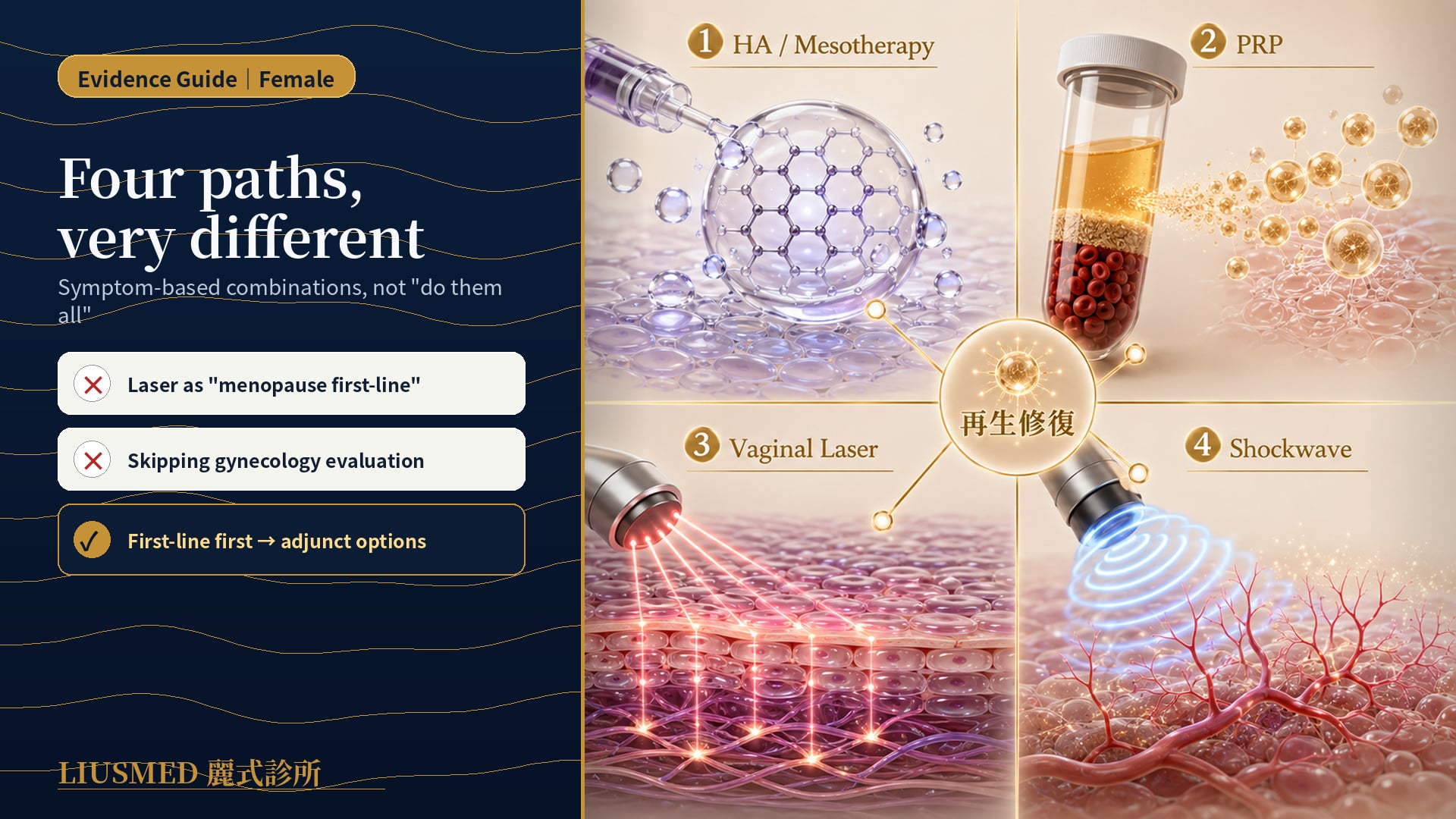
"Non-surgical intimate regeneration" is not a single therapy — it's a portfolio of symptom-targeted interventions. Postmenopausal dryness, dyspareunia (painful intercourse), burning, recurrent infections, laxity, stress urinary incontinence (SUI — leakage on cough/sneeze/exertion), and select vulvar conditions (e.g., vulvar lichen sclerosus — chronic autoimmune vulvar skin scarring) map to four evidence tracks: hand-injected mesotherapy (shallow micro-injection of nutrients/meds; crosslinked hyaluronic acid (HA — sugar molecule naturally in skin, holds water) mucosal injection), autologous PRP (Platelet-Rich Plasma — concentrate of your own blood platelets rich in growth factors), vaginal laser (CO₂ — Carbon Dioxide Laser, 10600nm; / Er:YAG — Erbium-doped Yttrium-Aluminum-Garnet, 2940nm ablative skin laser), and extracorporeal shockwave therapy (ESWT — non-invasive deep-tissue shockwave).
Their evidence levels are uneven. Drawing on Maturitas 2025 multicenter RCT (crosslinked HA injection), AHRQ (Agency for Healthcare Research and Quality) 2024 comparative effectiveness review (energy-based therapies), BMC Women's Health 2025 PRP double-blind RCT, and Scientific Reports 2021 SUI PRP prospective study, this article lays out the evidence profile of each modality and offers a "symptom classification → treatment combination" clinical framework. This article makes no efficacy promises and does not replace gynecology / urogynecology evaluation.
1. What are GSM (Genitourinary Syndrome of Menopause) / VVA (Vulvovaginal Atrophy)? Why is "non-surgical intimate regeneration" even a topic?
Genitourinary Syndrome of Menopause (GSM — menopausal vaginal/urinary symptoms) and vulvovaginal atrophy (VVA — vulvar/vaginal tissue atrophy) refer to chronic, progressive symptoms on urogenital tissue due to declining estrogen, including:
- Vulvovaginal: dryness, burning, dyspareunia, mucosal thinning, loss of elasticity
- Urinary: frequency, urgency, recurrent UTIs, partial SUI
- Sexual: reduced lubrication, sensitivity, and satisfaction (commonly measured by FSFI — Female Sexual Function Index, 19-item female sexual function score)
First-line therapy remains moisturizers and lubricants, vaginal low-dose estrogen (when not contraindicated), and behavioral and pelvic-floor rehabilitation. This is the consensus of the 2025 AUA (American Urological Association)/SUFU guideline and recent Menopause systematic reviews.12
The position of "non-surgical regeneration" is this — when first-line therapy falls short, or when patients cannot use vaginal estrogen due to personal preference or contraindications (hormone-sensitive cancer history), physicians may discuss it as an additive option. This framing is important: any marketing that promotes injection / laser / shockwave as "first choice for menopause" is an overclaim.
2. The Four Modalities: Logic, Indications, Evidence
2.1 Hand-injected Mesotherapy (Crosslinked HA Mucosal Injection)
Mechanism: Injecting crosslinked or non-crosslinked hyaluronic acid into the submucosa of the vulva / vagina at multiple, shallow, layered points, leveraging HA's hydration and biological scaffold effects to improve dryness and mucosal elasticity.
Hand-injection vs machine injection — clinical difference:
- Hand injection allows real-time adjustment of depth and dose based on mucosal thickness, pain response, and vascular distribution
- Machine injection uses fixed needle count and depth — more uniform over large areas, but less individualized
- Hand injection also allows custom formulation (HA concentration, cross-linking degree, or adjunctive amino acids, vitamins, coenzymes) — hence the term "mesotherapy"
Core evidence:
- Maturitas (2025) multicenter single-blind RCT: 116 menopausal women randomized to a single crosslinked HA mucosal injection or placebo; at 12 weeks, the HA group showed significantly better most bothersome symptom (MBS), dryness, dyspareunia, and FSFI; tolerability was good.3
- Arch Dermatol Res (2025) pilot RCT (n=20) comparing HA vs PRP injection: both effective; the HA group showed greater sexual function improvement with no complications reported (very small sample — exploratory signal).4
- J Low Genit Tract Dis (2022) pilot RCT: vaginal HA suppositories vs vaginal estrogen — both improved GSM over 12 weeks with no significant between-group difference — positions HA as a viable non-hormonal alternative.5
Reasonable expectations: Reproducible symptom improvement signal; longer-term data accumulating; not permanent.
2.2 Autologous PRP Injection
Mechanism: Centrifuge autologous blood to concentrate platelets; inject into vulvar / vaginal mucosa or vestibule / posterior wall, releasing growth factors (PDGF — Platelet-Derived Growth Factor; TGF-β — Transforming Growth Factor Beta; VEGF — Vascular Endothelial Growth Factor, etc.) that stimulate tissue repair.
Core evidence:
- BMC Women's Health (2025) double-blind RCT (n=60): PRP vs saline — at 4 months, PRP group FSFI rose from baseline ~9.2 to 19.0 (controls only to 9.7); lubrication, satisfaction, and pain subscales all significantly better.6
- Obstetrics & Gynecology (2025) single-arm pilot: breast cancer survivors with GSM (cannot use estrogen) received 7 mL PRP distributed across 35 points on the vaginal canal and posterior fourchette; 6-month multi-scale improvement — safe, feasible signal (no control).7
- Scientific Reports (2021) prospective study (n=20): in female SUI, A-PRP injection into the anterior vaginal wall corresponding to mid-urethra, monthly × 3 — ICIQ-SF (International Consultation on Incontinence Questionnaire — Short Form, short urinary-incontinence questionnaire) improvement sustained to 6 months.8
- Andrology / systematic review: PRP for female sexual function and SUI shows improvement signals, but studies vary dramatically in preparation system (platelet fold), injection maps, dose, and protocol — limiting reproducibility.9
Key limitations:
- Platelet fold varies 2–8× across commercial kits / centrifuge protocols
- No standardized injection-point map
- Activation methods (with or without CaCl₂ → PRFM — Platelet-Rich Fibrin Matrix, gel-form PRP with slow growth-factor release) differ by study
Liusmed's position on PRP: "documentable SOP." Platelet fold, injection-point map, per-point dose, and needle gauge are all recorded in the chart and transparent to patients.
2.3 Vaginal Laser (CO₂ / Er:YAG)
Mechanism: Fractional laser (pixelated laser leaving intact zones) energy to stimulate mucosal remodeling and neovascularization (new blood vessel formation) — widely marketed as "menopause laser."
Core evidence — please read carefully:
- AHRQ (2024) comparative effectiveness review (68 core studies): CO₂ laser vs sham mostly showed "very small differences or uncertain results"; vs vaginal estrogen also mostly no meaningful difference; adverse event reporting limited.10
- Menopause (2025) systematic review (32 studies): concordant conclusion — CO₂ laser vs sham mostly small differences, certainty of evidence (COE) low.11
- JAMA Network Open (2023) double-blind sham RCT: in breast cancer survivors on AI-induced GSM, CO₂ laser vs sham showed limited difference on primary symptom endpoints.12
- American Journal of Obstetrics & Gynecology (2025) double-blind sham RCT (n=144): Er:YAG vaginal laser for female SUI "not superior to sham" at 6 months.13
Clinical interpretation: Vaginal laser isn't "ineffective" — high-quality evidence shows its effects may not exceed sham or vaginal estrogen. That's why we do not position vaginal laser as a flagship regenerative therapy. If pursued, informed consent and research-style follow-up are essential.
2.4 Extracorporeal Shockwave Therapy (ESWT)
Mechanism: Low-energy shockwaves mechanically stimulate the pelvic floor, urethral support structures, or vestibule to enhance blood flow and tissue repair.
Core evidence:
- ESWT for female SUI: meta-analysis (2025, 4 studies, n=287) — ICIQ-SF improvement ~3.8 points (exceeding MCID — Minimal Clinically Important Difference, smallest treatment improvement patient notices — of 2.5), but high heterogeneity — no single SOP can be distilled.14
- ESWT for provoked vestibulodynia (PVD) / dyspareunia: Journal of Sexual Medicine (2021) RCT — low-intensity shockwave at introitus / vestibule feasible and safe, improving insertional pain and sexual function; but energy density, pulse count, and point map reporting inconsistent.15
Reasonable expectations: Improvement signal present but parameters not standardized; treat as additive, not first-line.
3. Side-by-Side Comparison Table
| Dimension | Hand-injected Mesotherapy (HA) | Autologous PRP Injection | Vaginal Laser | Extracorporeal Shockwave |
|---|---|---|---|---|
| Mechanism | Mucosal hydration + scaffold | Growth-factor tissue repair | Laser thermal stimulation of collagen / mucosa | Mechanical wave stimulation of blood flow / repair |
| Primary indications | GSM dryness, dyspareunia | GSM, sexual function, partial SUI | GSM (weak evidence), SUI (negative evidence) | SUI, vestibulodynia |
| Core evidence | RCT (Maturitas 2025) | Double-blind RCT (BMC 2025) | Sham-RCTs show limited difference | Meta-analysis (high heterogeneity) |
| Evidence grade (OCEBM simplified) | 1b | 1b | 1a (mostly negative) | 1a–1b |
| Typical protocol | Single session or 3 sessions | 1–3 sessions | 3 sessions / 4–8 wk interval | Varies by study |
| Customizability | High (formula, depth, points) | Moderate (preparation, points) | Low (fixed parameters) | Low (fixed parameters) |
| Usable in hormone-contraindicated patients | Yes | Yes (breast cancer survivor pilot supports) | Yes (but benefit uncertain) | Yes |
| Common side effects | Injection pain, bruising, transient swelling | Injection pain, bruising, spotting | Burning sensation, transient discharge | Transient soreness at treatment site |
| Long-term safety data | Accumulating (Maturitas extension) | Small studies predominate | Limited (AHRQ notes) | Limited |
4. Symptom Classification → Treatment Combination
Scenario A: Menopausal dryness and dyspareunia
- First-line: vaginal low-dose estrogen (if not contraindicated), moisturizers, lubricants
- If first-line falls short: discuss hand-injected mesotherapy (crosslinked HA) as additive
- If estrogen contraindicated (breast cancer survivor, progestin sensitivity, personal preference): hand-injected HA or PRP are discussable non-hormonal options37
Scenario B: Decreased sexual function satisfaction (low FSFI)
- First-line: sexual counseling, ruling out psychological / partner factors, pelvic floor rehabilitation
- Structural / vascular factors predominant: PRP injection has double-blind RCT support (BMC 2025)6
- Prefer non-blood products: HA showed greater sexual function improvement in a small RCT4
Scenario C: Stress urinary incontinence (SUI)
- First-line: pelvic floor exercises (Kegel), lifestyle adjustment, weight management
- Moderate severity, surgery not preferred: ESWT has meta-analysis support (improvement exceeds MCID)14; PRP at the mid-urethra corresponding region has small prospective support8
- Vaginal laser — use caution: double-blind sham RCT shows no superiority over sham at 6 months13
Scenario D: Laxity (vaginal laxity)
- This is a "perception-type" symptom with relatively limited evidence
- Lasers in Medical Science (2022) small sham RCT showed RF (Radiofrequency) + PEMF may improve VLQ and FSFI short-term, but small sample, population different from GSM16
- Clinical stance: first exclude prolapse or pelvic floor insufficiency (structural issues), then discuss additive options
Scenario E: Vulvar Lichen Sclerosus
This is an indication requiring particular caution:
- First-line remains ultrapotent topical corticosteroid (clobetasol 0.05%) — dermatology / gynecology guideline consensus
- Regenerative therapy here is research / trial-level adjunctive option, requiring dermatology co-management
- 2025 Clinical Case Reports case report showed autologous ADSC (Adipose-Derived Stem Cells — stem cells harvested from fat tissue) after special processing injection may improve symptoms — but exploratory (n=1)17
Our position: We do not position regenerative therapy as first-line for vulvar lichen sclerosus. If the patient wishes to explore, it's as an adjunctive option under informed consent, with ongoing co-management by dermatology / gynecology.
5. Female Physician + Chaperone Protocol (Not "Cleared Room")
Why are the privacy protocols different for women's vs men's pages?
The male intimate shockwave + PRP page uses a "treatment-room clear" protocol — only the male physician is in the treatment room with the patient. This is designed around male patients' specific anxiety about "third parties present."
The female intimate regenerative pathway does not use the same protocol. Here's why:
- The chaperone system is an important medical-ethics mechanism to protect female patients — strongly recommended by international obstetric and gynecologic bodies (ACOG — American College of Obstetricians and Gynecologists, RCOG)
- "No third party" during a female intimate evaluation / treatment can actually increase medico-legal risk and post-treatment psychological burden
- Our approach: female physician as primary + female nurse as chaperone throughout
Specific protocol:
- LINE anonymous consultation initially answered by female nurse / patient educator
- On-site evaluation and treatment performed by female physician, female nurse chaperone present throughout
- Treatment-room door / window privacy in place; all entries / exits controlled by the female nurse
- VIP appointment window can provide full before-and-after buffer time (the buffer requires dedicated staffing and flow arrangements)
This isn't "sacrificing privacy" — it's "privacy and ethics design calibrated to specialty and gender differences."
6. Reasonable Expectations and Risk Disclosure
6.1 Universal reasonable expectations
- Not permanent: All regenerative therapies wane over time — periodic reassessment needed
- Individual variation is large: Same protocol can yield significantly different responses
- Symptom improvement ≠ structural reversal: most scales are subjective (FSFI, VHI, VSQ, ICIQ-SF, etc.)
- Complete the course: limited effect from a single session does not mean unsuitable — may need full protocol cadence
6.2 Universal risks
- Injection-type (HA, PRP): injection pain, bruising, spotting, transient swelling or increased discharge; rare infection, allergy
- Energy-type (laser, shockwave): transient redness / soreness, transient discharge; very rare burn or mucosal injury
- Contraindications: active infection, untreated malignancy, severe coagulopathy, active skin disease at treatment site, pregnancy or possible pregnancy, recent vaginal or pelvic surgery
6.3 Our commitments
- Objective scale tracking: we assess improvement objectively with international scales (FSFI, VSQ, VHI, ICIQ-SF, etc.), so your subjective experience has a comparable baseline
- Transparent records: PRP preparation multiples, activation method, and injection layers are all documented — traceable and comparable
- Precise compliant terminology: we use Taiwan-medical-advertising-compliant terms such as "symptom improvement," "tissue repair," and "functional adjunct"
- Individualized physician assessment: whether, how, at what dose, and with what spacing to combine is decided case by case by the physician based on your classification and exam results — not a one-size-fits-all package
7. Decision Flow
8. Seven Questions to Ask Your Gynecologist
- What is my symptom classification? GSM / laxity / SUI / mixed?
- Is vaginal estrogen contraindicated for me? If so, why?
- For my symptom type, what's the evidence-level difference between hand-injected HA and PRP?
- If choosing PRP, what's the platelet fold of your preparation system? Will you report it to me?
- If choosing HA injection, is it crosslinked or non-crosslinked? What's the formulation?
- Which scales (FSFI, VHI, VSQ, ICIQ-SF) will we use to assess efficacy? How often will we follow up?
- If results fall short, what are the backup options and referral pathways?
Honest physicians will not evade these questions. If a clinic simply answers "just do it" or "guaranteed rejuvenation" — be cautious. That contradicts the existing evidence level and may violate Taiwan medical advertising law.
9. Ten Commonly Asked Questions
Q1. What's the difference between "hand-injected skin booster" and "machine skin booster"? Hand injection allows real-time adjustment of depth and dose based on mucosal thickness, pain response, and vascular distribution; machine injection uses fixed needle count and depth — more uniform but less individualized. Because intimate areas have wide anatomical variation and complex neurovascular distribution, hand injection offers practical advantages in safety and customization.
Q2. Can PRP and hand-injected skin booster be combined? In principle, they can be done in sequential sessions or as layered injections in the same session (HA scaffold + PRP growth factors). There is no large RCT proving "combination > monotherapy." Whether and how to combine — physician decision per case based on symptom classification, coagulation, allergy, and infection history. No add-ons for the sake of it.
Q3. I'm a breast cancer survivor — can I receive this? For breast cancer survivors with hormone contraindications preventing vaginal estrogen use, PRP is a safe and feasible signal in the Obstetrics & Gynecology 2025 pilot7. Must still be co-assessed with the oncologist and gynecologist.
Q4. When can I resume sexual activity? Generally advise avoiding sexual activity, swimming, and bathtub soaking for 48–72 hours — follow individual physician's post-treatment instructions.
Q5. How long does one session last? No guarantee. Maturitas 2025 RCT showed a single crosslinked HA injection still effective at 12 weeks; extension studies evaluating longer-term data3. PRP commonly uses 4–6 months as a follow-up milestone.
Q6. Can I receive treatment during my period? Advise avoiding treatment during menstruation. If on anticoagulants, with coagulation disorders, or acute infection — treat the underlying issue first.
Q7. Is vaginal laser outdated? Not outdated — rather, high-quality evidence shows limited benefit for GSM and SUI101113. We choose not to market laser prominently, but if you have already consulted another physician and would like to discuss, we are open to evaluation.
Q8. Does national health insurance cover these? Currently, regenerative therapies in Taiwan are all self-pay. Actual cost and treatment planning are explained case-by-case at evaluation — no "limited-time offer" marketing.
Q9. I don't want my partner to know — can I consult anonymously? You can ask 3 anonymous questions via LINE, answered by a female patient educator. On-site evaluation still requires minimum identification and medical record to comply with regulations.
Q10. Will one session be enough? Not necessarily. Most studies use "course" as the evaluation unit (e.g., PRP monthly × 3, vaginal laser × 3 every 4–8 weeks). Single-session expectations should be discussed thoroughly with the physician before treatment.
Common questions
Can non-surgical intimate regeneration replace vaginal estrogen or other first-line treatment?
Better not to think of it that way. For dryness and painful sex, first-line is still moisturizers and lubricants, vaginal low-dose estrogen (when it isn't contraindicated), and pelvic floor rehab. Jumping straight to injections or laser before trying those is doing it backwards. Regeneration sits as an additive option — we bring it up when first-line falls short, or when you can't use vaginal estrogen because of a hormone contraindication. Anyone marketing it as the go-to for menopause is overstating it.
Hand-injected mesotherapy, PRP, vaginal laser, shockwave — which one should I pick?
There's no one-size answer; it depends on your symptom type. Dryness and painful sex, low sexual-function satisfaction, stress urinary incontinence, and laxity each point to different combinations, and the evidence behind each differs too. What we do is classify your symptoms first, rule out things like infection or prolapse, then let the physician decide whether and how to combine anything based on your situation — not push a fixed package the moment you walk in.
Is there real evidence behind these, or is it just marketing?
There is evidence, but the four modalities aren't on the same tier. Hand-injected HA and PRP each have randomized controlled trial support; for vaginal laser, the higher-quality studies actually show limited benefit, which is why we don't lead with it; shockwave has meta-analysis behind it, but the studies vary a lot. We don't overstate results — we walk you through how strong the evidence is, and its limits, during informed consent. If a clinic just tells you "trust us, it works," be careful.
I have a hormone contraindication, such as a breast cancer history — do I have any non-hormonal options?
Yes. When a hormone-related concern means you can't use vaginal estrogen, hand-injected HA and PRP are non-hormonal directions worth discussing, and PRP has shown a safe, feasible signal in a small study of breast cancer survivors. This still needs to be assessed together with your oncologist and gynecologist before you decide — it isn't something to go ahead with on your own.
Why does the female intimate treatment use a female nurse chaperone throughout instead of clearing the room?
Because privacy is designed differently for women and men here. The chaperone system exists to protect female patients, and international ob-gyn bodies recommend it; conversely, having no third party present can actually raise medico-legal risk and leave a heavier psychological burden afterward. So it's a female physician as primary plus a female nurse present the whole time, with door and window privacy in place and entries and exits controlled by the nurse.
10. Back to Process: Our Position
We do not package female intimate regeneration as a "one-shot fix" or "fountain-of-youth rejuvenation." Our trust anchors:
- Female physician + female nurse chaperone protocol — protecting your privacy and medical safety
- Symptom classification → customized course — not a fixed-package sales model; HA, PRP, ESWT combinations are physician decisions
- Evidence transparency — evidence grade, expected outcomes, and limitations for each modality clearly disclosed in informed consent
→ Service page: Female Intimate PRP + Hand-Injected Mesotherapy → Related reading (male): Oral Meds vs Shockwave vs PRP — Complete Comparison for Male Erectile Function
If you'd prefer to understand before deciding, ask 3 anonymous questions via LINE. We won't record your real name until you decide to book an in-person evaluation — no selling, no promises, no "rejuvenation" marketing.
References
Medical Disclaimer
This article is for health education reference only and does not replace gynecology / urogynecology evaluation. Evidence levels differ significantly across the therapies and indications discussed — some are still in research accumulation — outcomes vary individually and no specific result can be guaranteed. Special populations (vulvar lichen sclerosus, breast cancer survivors with GSM, active skin conditions) require multi-specialty co-management (dermatology / gynecology / oncology). All treatment decisions should rest on individual physician evaluation, informed consent, and shared decision-making.
Related Services
Footnotes
-
Kaufman MR, et al. AUA/SUFU Guideline: Genitourinary Syndrome of Menopause. Journal of Urology, 2025. DOI (Digital Object Identifier): 10.1097/JU.0000000000004589 ↩
-
Davis ER, et al. Systematic review of energy-based therapies for GSM. Menopause, 2025. ↩
-
Marchand Lamiraud F, et al. Cross-linked hyaluronic acid vaginal injection in postmenopausal women: a multicenter, single-blind, placebo-controlled RCT. Maturitas, 2025. DOI: 10.1016/j.maturitas.2025.108264 ↩ ↩2 ↩3
-
Ragy S, et al. Hyaluronic acid vs platelet-rich plasma injection for vulvovaginal atrophy: a pilot RCT. Archives of Dermatological Research, 2025. DOI: 10.1007/s00403-025-03820-z ↩ ↩2
-
Vaginal hyaluronic acid suppositories vs vaginal estrogen for GSM: pilot RCT. Journal of Lower Genital Tract Disease, 2022. ↩
-
Hamid ASA, et al. Platelet-rich plasma vs saline injection for postmenopausal VVA: double-blind RCT (n=60). BMC Women's Health, 2025. DOI: 10.1186/s12905-025-04076-5 ↩ ↩2
-
Chen AH, et al. Platelet-rich plasma for GSM in breast cancer survivors: a prospective single-arm pilot study. Obstetrics & Gynecology, 2025. DOI: 10.1097/AOG.0000000000006081 ↩ ↩2 ↩3
-
Long CY, et al. Autologous platelet-rich plasma injection for female stress urinary incontinence. Scientific Reports, 2021. DOI: 10.1038/s41598-020-80598-2 ↩ ↩2
-
Dankova I, et al. Platelet-rich plasma for female sexual dysfunction and urinary incontinence: systematic review. 2023. ↩
-
Agency for Healthcare Research and Quality (AHRQ). Comparative Effectiveness Review: Treatments for Genitourinary Syndrome of Menopause. 2024. ↩ ↩2
-
Prodromidou A, et al. CO₂ laser vs sham for GSM: systematic review and meta-analysis. 2023. ↩ ↩2
-
Mension E, et al. CO₂ laser vs sham in breast cancer survivors on aromatase inhibitors: a double-blind RCT. JAMA Network Open, 2023. ↩
-
Lee P, et al. Er:YAG vaginal laser vs sham for female stress urinary incontinence: double-blind RCT (n=144). American Journal of Obstetrics & Gynecology, 2025. DOI: 10.1016/j.ajog.2024.11.021 ↩ ↩2 ↩3
-
Xi T, et al. Extracorporeal shockwave therapy for female stress urinary incontinence: systematic review and meta-analysis. 2025. ↩ ↩2
-
Gruenwald I, et al. Low-intensity shockwave therapy for provoked vestibulodynia: RCT. Journal of Sexual Medicine, 2021. ↩
-
Wattanakrai P, et al. Radiofrequency + PEMF for vaginal laxity: double-blind sham RCT. Lasers in Medical Science, 2022. DOI: 10.1007/s10103-021-03438-3 ↩
-
Mezzana P. Adipose-derived stem cells for vulvar lichen sclerosus: case report. Clinical Case Reports, 2025. ↩

Specialties
Credentials
- Kaohsiung Medical University, School of Medicine
- Attending Physician, Dermatology, Kaohsiung Chang Gung Memorial Hospital
- Attending Physician, Aesthetic Center, Kaohsiung Chang Gung Memorial Hospital
- Visiting Physician, Dermatology, Xiamen Chang Gung Hospital
- Visiting Physician, Aesthetic Center, Xiamen Chang Gung Hospital
"For every surgery, I strive to achieve a good outcome through a small incision and refined technique. Minimally invasive surgery is not just a technique — it's a commitment of respect to every patient."
Want to learn more?
Schedule a consultation for professional evaluation and advice