Oral Meds vs Shockwave vs PRP: A Complete Comparison for Male Erectile Function (EAU Evidence-Based)
Summary
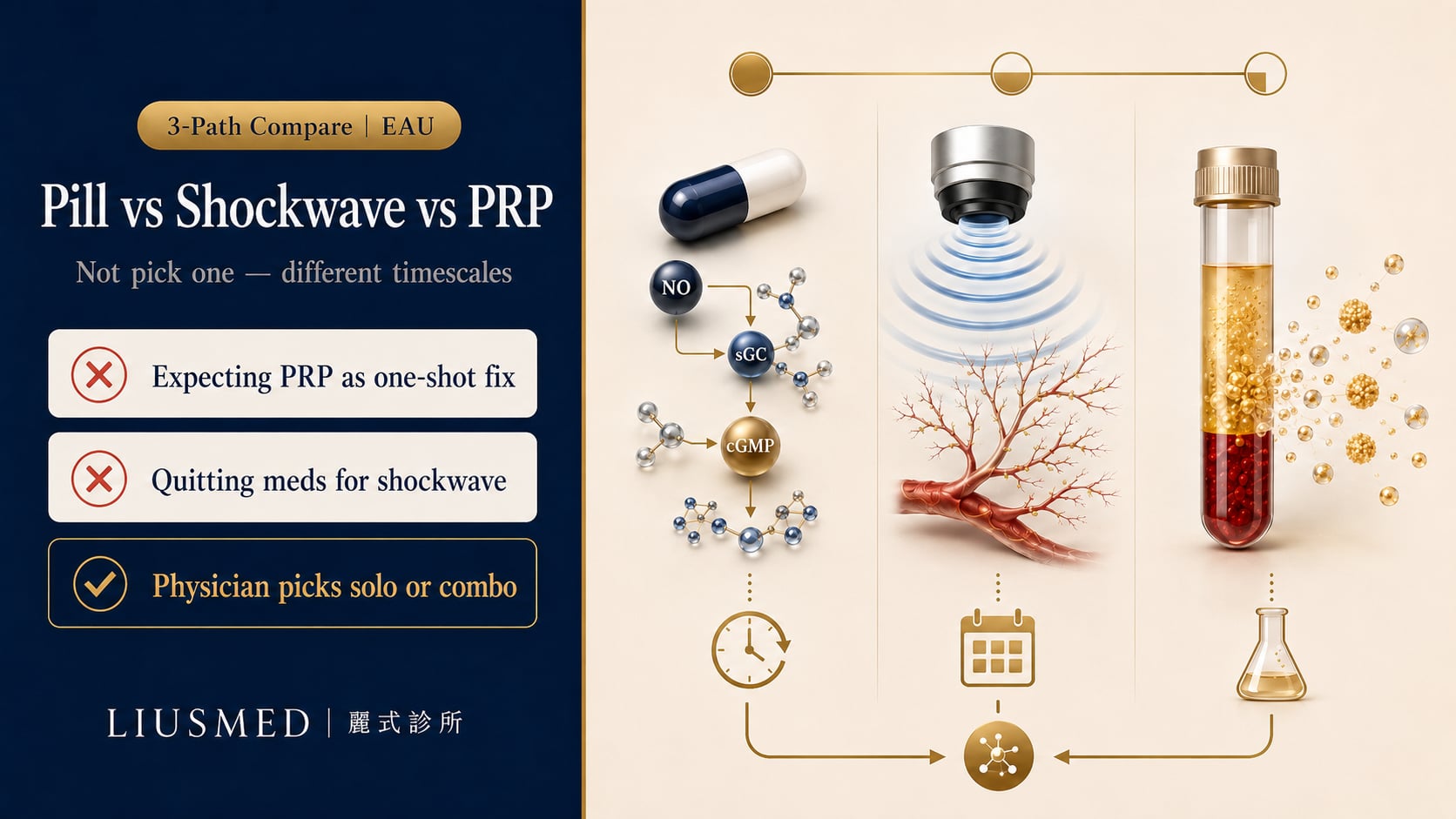
The most common forum question isn't "do I have ED (Erectile Dysfunction — difficulty maintaining erection)?" — it's "should I take pills, try shockwave, or get PRP (Platelet-Rich Plasma)?" These three paths — oral PDE5 (Phosphodiesterase Type 5 — enzyme blocked by Viagra/Cialis) inhibitors, low-intensity extracorporeal shockwave therapy (LI-SWT — sound-wave pulses inducing new blood vessels), and autologous platelet-rich plasma (PRP — concentrate of your own blood platelets rich in growth factors) injection — differ sharply in mechanism, evidence level, protocol cadence, and cost. Any answer framed as "which is best" oversimplifies the question.
This article uses the European Association of Urology (EAU — European urology medical society) guidelines and recent systematic reviews as anchors to unpack the three options, who they suit, common side effects, and reasonable expectations. You'll also get a clinic-ready "7 questions to ask your physician" checklist. This article makes no efficacy promises and does not replace physician evaluation.
1. Why Compare? Three Paths Solve Different Problems
| Path | Core Logic | Nature |
|---|---|---|
| PDE5 inhibitors (Viagra, Levitra, Cialis) | On-demand or daily low-dose, inhibit PDE5 to enhance NO (Nitric Oxide — vasodilator signal molecule) -cGMP (cyclic GMP — NO downstream signal) pathway → improved erection | Symptom relief |
| Low-intensity shockwave (LI-SWT) | Micro-mechanical stimulation → angiogenesis (new blood vessel formation) and endothelial repair | Underlying-cause modulation (evidence accumulating) |
| PRP injection (intracavernosal) | Growth factors in autologous platelet concentrate → tissue repair signaling | Investigational / adjunctive |
Key clarification: Pills are used the day of, taken before intercourse. Shockwave and PRP are course-based, aiming to help you maintain function with less or no medication. They address different time scales and mechanisms, so the typical clinical decision isn't "pick one of three" but "which fits you now, and what combinations make sense later."
2. Evidence Levels: What the Guidelines Say
2.1 PDE5 Inhibitors: First-line, Grade A Evidence
The EAU Sexual and Reproductive Health guidelines list PDE5 inhibitors as the first-line drug therapy for organic ED, with high-level evidence and strong recommendation. Sildenafil (Viagra), tadalafil (Cialis), vardenafil (Levitra), and avanafil all belong here — they differ in onset time and duration of action (tadalafil lasts up to 36 hours).
Long-term safety data are extensive. Primary contraindications are concurrent nitrate use (for angina), severe cardiovascular instability, and severe hepatic or renal impairment.1
2.2 Low-Intensity Shockwave (LI-SWT): Taiwan MOHW-Approved, TAAM-Listed First-Line Option
LI-SWT was formally approved by Taiwan MOHW for ED in 2015; the Taiwan Andrological Association listed it the same year as a first-line option or adjunct to oral medication, and the EAU incorporated it into guidelines in 2015.12 Taiwan's average clinical satisfaction is ~75%; local cohort research (Tzou KY et al., 2021, PMID — PubMed Identifier — 34829899, n=69) shows significant IIEF (International Index of Erectile Function)-5 (International Index of Erectile Function — 5-item erectile function questionnaire), EHS, and quality-of-life improvement (p<0.001) at all follow-up points after 12 sessions.
Campbell et al. (Translational Andrology and Urology, 2019) supports that LI-SWT produces significant IIEF-5 improvement in mild vasculogenic ED. Chung and Wang (Expert Review of Medical Devices, 2021) noted that patient comfort is the practical key to completing the full protocol — the reason we prioritize comfort and work to reduce discomfort during treatment.23
2.3 PRP Injection: Research Accumulating Steadily, Used as Shockwave Enhancement
Evidence for PRP in ED is accumulating steadily. Recent RCTs (e.g., Poulios et al., Journal of Sexual Medicine, 2021) suggest PRP offers modest IIEF improvement over placebo, with a positive literature trend.4 EAU currently lists PRP as an investigational option — meaning mainstream guidelines are still observing larger trials.
Clinically, we offer PRP as a shockwave enhancement option, with physician evaluation determining whether to combine. Progress is tracked objectively via IIEF-5, and preparation parameters are documented transparently.
One-line summary: Pills (Grade A, rapid symptom relief) + Shockwave (MOHW-approved, first-line option) + PRP (enhancement, accumulating evidence) — all three can be combined case by case. Full protocol completion + comfortable experience is the key to outcomes.
3. Side-by-Side Comparison Table (Clinic-Ready)
| Dimension | PDE5 Inhibitors | Low-Intensity Shockwave (LI-SWT) | PRP Injection |
|---|---|---|---|
| Action type | Symptom relief | Underlying-cause (investigational) | Investigational / adjunctive |
| When used | 30–60 min before intercourse | Scheduled course (weekly or biweekly) | Course (spaced sessions) |
| Typical protocol | On-demand / daily | 6–12 sessions per phase | 1–3 sessions per phase |
| Guideline position | First-line, Grade A | MOHW-approved; TAAM first-line option | Accumulating evidence; shockwave enhancement |
| Cost structure (relative) | Accumulates with frequency; long-term cost may exceed a single session | A 6–12-session phase totals roughly 6–10x a single session, varying by session count and whether PRP is added; actual fee disclosed case-by-case via LINE or in person | Per case evaluation |
| Common side effects | Headache, flushing, dyspepsia, nasal congestion, visual disturbance | Transient soreness at treatment site, capillary bruising | Transient injection-site pain, bruising, swelling |
| Major contraindications | Nitrate use, severe CV disease, severe hepatic/renal impairment | Active infection, severe coagulopathy, penile implant | Severe coagulopathy, active infection, active malignancy |
| Physician evaluation required | Yes | Yes | Yes |
| Impact on intercourse timing | Must pre-dose | Avoid vigorous activity 24–72 hrs post | Same |
Costs reflect Taiwan market reference ranges; actual pricing per clinic disclosure.5
4. Three Common Clinical Scenarios
Scenario A: "Pills work, but I don't want to rely on them forever"
- Typical profile: Age 40–55, good PDE5 response, concerned about long-term dependence or side effects, moderate partner pressure
- Reasonable discussion: With your physician, evaluate shockwave as a medication-reduction strategy, combined with lifestyle modification (blood pressure, lipids, glucose, sleep, weight, smoking cessation)
- Reasonable expectation: Shockwave research suggests possible improvement but does not guarantee discontinuation; results vary individually
Scenario B: "Pills don't work well, or side effects are hard to tolerate"
- Typical profile: Unstable PDE5 response; intolerable headache or visual disturbance
- Reasonable discussion: First confirm whether this is true PDE5 non-response (some patients have wrong dose or timing); then evaluate shockwave suitability. For severe vasculogenic ED, shockwave alone has limited effect
- Reasonable expectation: PRP here is investigational / adjunctive — informed consent is essential
Scenario C: "I want to try regenerative therapy — where do I start?"
- Typical profile: Young to middle-aged, mild symptoms, prefer non-pharmacologic options
- Reasonable discussion: Per EAU position, shockwave first, then consider PRP combination; PRP alone as first-line for ED lacks high-quality evidence
- Reasonable expectation: Neither is permanent; IIEF-5 follow-up recommended; some patients may still need on-demand medication
5. Monotherapy vs Combination: Research vs Practice
Studies combining LI-SWT and PRP remain limited, mostly small prospective studies or expert opinion. Recent systematic reviews (e.g., Andrology, 2023) conclude that combination may offer synergy but samples are insufficient — larger RCTs are needed.6
Our compliance position: We do not market a default "shockwave + PRP" package. Whether to combine, how, at what dose, and with what spacing — decided case by case by the physician based on your vascular status, IIEF-5 scores, and comorbidities. We do not add-on for the sake of adding on.
6. Cost in a Long-Term Lens
Per-session pricing is surface-level. Consider these variables together:
- Timeline: Long-term oral medication over 3–5 years can exceed the cost of a single course
- Completeness: If shockwave is interrupted due to pain and full pulse count is not delivered, research-suggested improvement may be affected
- Combination: Whether to add PRP is a physician call; do not self-prescribe "add-ons"
- Partner cost: Delayed care itself is a cost — relationship strain, anxiety, sleep
This isn't marketing — it's real life economics. Over a 3-year horizon, choices look different.
7. How to Choose: A Simplified Decision Sketch
This is a discussion framework, not a diagnostic flowchart. Actual selection requires physician synthesis of history, scales, and necessary investigations.
8. Seven Questions to Ask Your Physician
At your next evaluation, ask directly:
- What severity is my IIEF-5? Is there a mixed psychogenic component?
- Based on my vascular and hormonal results, is shockwave within "reasonable trial" range?
- If we try shockwave, what energy density, pulse count, and cadence do you recommend? On what basis?
- Would you recommend combining PRP from the start? If yes, why? If no, under what circumstances would you add it?
- If I'm currently using PDE5, should dosing change during the course?
- How long until efficacy can be assessed? What objective metric (e.g., IIEF-5) will you track?
- If results fall short, what are the backup options?
A good physician will not evade these questions. If a clinic simply answers "just do it" or "we guarantee results," be cautious — that does not match the existing evidence level.
9. Five Commonly Searched Details
Q1. Will I feel a difference after one shockwave session? Some patients describe transient engorgement, but this is not the same as efficacy. Research-suggested IIEF-5 improvement is typically evaluated weeks after completing a course.
Q2. Can PRP fully replace pills? Current evidence does not support this claim. EAU explicitly limits PRP for ED to trial settings; marketing PRP as a pill replacement is an overclaim.
Q3. Do I still need pills during shockwave? Depends. Some patients continue on-demand PDE5 during the course; post-course, the physician reassesses whether to reduce medication.
Q4. How long does efficacy last? Taiwan clinical data show most patients sustain meaningful improvement for a year or more. We track with IIEF-5 and can add booster sessions as needed to maintain results.
Q5. Who is clearly not suited for regenerative therapy? Active infection, severe coagulopathy, penile implant, active Peyronie's disease, active malignancy, or purely psychogenic ED are relative or absolute non-candidates for regenerative therapy alone.
Common questions
Pills, shockwave, or PRP — which one should I start with?
There's no single right answer. It depends on your severity, your IIEF-5 score, and your vascular and hormonal workup. Oral PDE5 medication is the guideline first-line drug and works fast; if you'd rather go a non-drug route, we usually assess shockwave first and then look at whether to add PRP. All of this has to be decided after a physician evaluation.
After shockwave, can I cut down on pills or stop them altogether?
Some people do head in that direction. You can talk with your physician about using shockwave as a medication-reduction strategy, while also looking after blood pressure, lipids, glucose, sleep, weight, and smoking. That said, the research shows possible improvement — it doesn't mean you'll definitely be able to stop, and responses genuinely vary from person to person.
Do shockwave and PRP always have to be done together?
Not necessarily. We don't push a default "shockwave + PRP" package. Whether to combine them, at what dose, and how far apart is a case-by-case call the physician makes after looking at your vascular status, IIEF-5 score, and any other conditions. We don't add on for the sake of adding on.
If my problem is mainly psychological, will shockwave help?
If the assessment points mainly to a psychogenic cause, shockwave on its own isn't appropriate as a first-line choice, and the focus there is psychological therapy. Shockwave works more on the vascular and tissue side, so the first step is sorting out which kind of cause is driving things.
During treatment, will anyone else be in the room?
Throughout evaluation and treatment, only the male physician is in the room performing it himself — no nursing staff coming in and out. Privacy is a real hurdle for many people with intimate treatment, and this is our basic protocol.
10. Back to Process: Our Position
Liusmed Clinic does not take a "which is best" marketing stance. We anchor trust on three pillars:
- Treatment-room privacy protocol: During evaluation and treatment, only the male physician is present in the treatment room — no nursing staff entering
- Low-discomfort PRP: Usually intravenous gentle pain relief (confirm with the front desk) plus a buffering technique to reduce sharp pain; some discomfort may still occur
- Complete the protocol: No add-ons for the sake of it; combination, dose, and cadence are physician decisions
→ See also: Male Intimate Shockwave + PRP Complete Guide: EAU Guidelines, LI-SWT Systematic Reviews, and Treatment-Room Privacy Protocol → Service page: Male Intimate Shockwave + PRP
If you'd prefer to understand before deciding, you can ask 3 anonymous questions via LINE — no real name required. On-site evaluation is grounded in IIEF-5 and necessary investigations, with decisions made together — no selling, no promises, no "which is best."
References
Medical Disclaimer
This article is for health education reference only and does not replace physician evaluation. PDE5 inhibitors are prescription medications — do not self-prescribe or share others' medications. Low-intensity shockwave and PRP for erectile dysfunction have different evidence levels, with some still accumulating — outcomes vary individually and no specific result can be guaranteed. All treatment decisions should rest on individual physician evaluation, informed consent, and shared decision-making.
Related Services
Footnotes
-
Salonia A, et al. EAU Guidelines on Sexual and Reproductive Health — Erectile Dysfunction. European Association of Urology, 2024. https://uroweb.org/guidelines/sexual-and-reproductive-health ↩ ↩2
-
Campbell JD, et al. Systematic review of low-intensity extracorporeal shock wave therapy for erectile dysfunction. Translational Andrology and Urology, 2019. PMID: 31807437 ↩ ↩2
-
Chung E, Wang J. A state-of-art review of low intensity extracorporeal shock wave therapy and lithotripter machines for the treatment of erectile dysfunction. Expert Review of Medical Devices, 2021. PMID: 33583307 ↩
-
Poulios E, et al. Platelet-rich plasma (PRP) improves erectile function: a double-blind, randomized, placebo-controlled clinical trial. Journal of Sexual Medicine, 2021. DOI (Digital Object Identifier): 10.1016/j.jsxm.2021.02.008 ↩
-
Taiwan Chang Gung Memorial Hospital and Taipei City Hospital published self-pay pricing for "Low-intensity Extracorporeal Shockwave Therapy — Male Erectile Dysfunction." ↩
-
Masterson TA, et al. Platelet-rich plasma for the treatment of erectile dysfunction: a systematic review and meta-analysis. Andrology, 2023. ↩

Specialties
Credentials
- Kaohsiung Medical University, School of Medicine
- Attending Physician, Dermatology, Kaohsiung Chang Gung Memorial Hospital
- Attending Physician, Aesthetic Center, Kaohsiung Chang Gung Memorial Hospital
- Visiting Physician, Dermatology, Xiamen Chang Gung Hospital
- Visiting Physician, Aesthetic Center, Xiamen Chang Gung Hospital
"For every surgery, I strive to achieve a good outcome through a small incision and refined technique. Minimally invasive surgery is not just a technique — it's a commitment of respect to every patient."
Want to learn more?
Schedule a consultation for professional evaluation and advice