Facial Overfilled Syndrome: The Gold Standard for Diagnosis and Treatment
Introduction
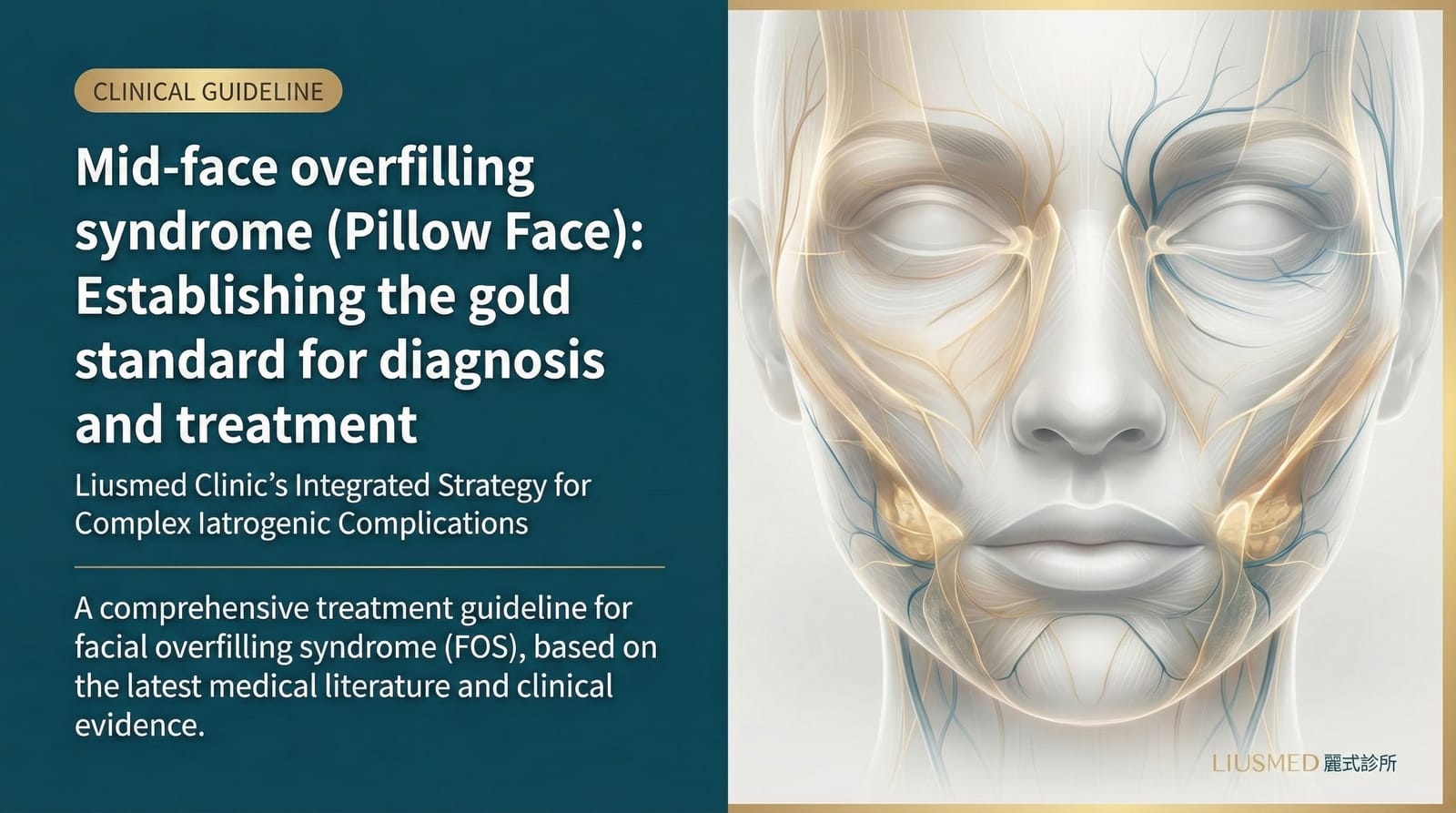
This is a professional guideline based on the latest medical literature and clinical evidence for the prevention, diagnosis, and treatment of Facial Overfilled Syndrome (FOS).
What is FOS?
FOS is not simply an aesthetic mistake—it is a complex iatrogenic condition.
It refers to complications following soft tissue filler injections, presenting as excessive mid-face volume, disproportionate features, unnatural expressions, and smile distortion. Patients often exhibit a "mask-like" appearance with loss of natural facial contours.
The Core Problem
The treatment challenge of FOS far exceeds expectations because it involves not only the filler material itself but also:
- Complex anatomical structures
- Long-term biological reactions
- Lymphatic dysfunction
Our Position
Resolving FOS requires an integrated system that transcends single techniques.
Liusmed Clinic has established a comprehensive guideline covering prevention, precision diagnosis, and tiered treatment.
Root Causes of FOS
Cause One: The Extremely Complex Anatomy of the Mid-Face
Key Ligamentous Structures
Deep support structures that penetrate from bone to skin, including:
- Cutaneous ligaments
- Zygomatic-maxillary ligaments
- Orbital ligaments
Superficial Fat Pad Compartments
Four independent fat pads form the malar region:
- Infraorbital fat compartment
- Medial cheek fat compartment
- Middle cheek fat compartment
- Nasolabial fat compartment
Incorrect injection can cause structural displacement.
Dense Vascular Network
Highly variable vascular networks interwoven with ligaments make removal procedures extremely risky.
Cause Two: Overlooked Pathological Mechanisms
Lymphatic Obstruction and "Morning Edema"
Mechanism: Excessive filler (especially highly hydrophilic hyaluronic acid) physically compresses the fragile superficial lymphatic network, obstructing tissue fluid drainage.
Clinical Presentation: This is the root cause of many patients' complaints of "face being particularly swollen in the morning, improving by afternoon." The problem is not just filler volume but fluid dynamics disruption.
The Role of Biofilm
Mechanism: Long-standing nodules or recurrent inflammation are often caused by low-virulence bacteria forming biofilm on the filler surface. This protective layer shields bacteria from immune attack and prevents drug penetration.
Treatment Implications: The presence of biofilm explains why steroid or enzyme injections alone are often ineffective or lead to recurrence. For biofilm infections, physical removal is often necessary.
Clinical Diagnosis
Static Assessment
- Topographical changes in the infraorbital-medial region
- Excessive lower mid-face fullness with disproportionate zygomatic arch widening
- Nasal widening and excessive forehead projection
- "Sunset Eyes" phenomenon
Dynamic Assessment (Key Indicators)
| Indicator | Description |
|---|---|
| Unnatural expressions | Overfilled areas become most apparent during facial muscle activity |
| Smile distortion | Small chunks of filler form visible bulges beneath contracting muscles |
| Objective measurements | Changes in oral commissure vertical and horizontal positions relative to anatomical landmarks |
Effective treatment can elevate the oral commissure by 0.60 cm vertically and 0.30 cm horizontally, significantly improving unnatural smiles.
The Current Treatment Dilemma
The current aesthetic repair market has a significant Treatment Gap, leaving most moderate to severe FOS patients without ideal treatment options.
Level 1 Treatment: Drug Injection
| Method | Limitations |
|---|---|
| Hyaluronidase | Ineffective for fibrotic nodules |
| Steroid injection | Completely ineffective for biofilm or non-HA materials |
Level 3 Treatment: Open Surgery
| Method | Limitations |
|---|---|
| Traditional facelift | Major trauma, inevitable scarring |
| Direct excision | Long recovery, most patients strongly resist |
A huge treatment vacuum exists between Level 1 and Level 3.
The Liusmed FOS Treatment Guideline
Core Philosophy
We don't offer a single therapy—we provide a complete management system. The Liusmed FOS Treatment Guideline is an evidence-based closed-loop process.
Three Pillars
- Precision Diagnosis: High-frequency ultrasound as the gold standard for all assessments, "seeing" the problem before treatment
- Tiered Treatment: Standardized FOS classification system matching pathology types to optimal treatment protocols
- Prevention First: Preventing FOS at the source through deep anatomical education and advanced injection techniques
Guideline Pillar One: High-Frequency Ultrasound
At Liusmed Clinic, ultrasound is not just an auxiliary tool—it is the gold standard starting point for all treatments.
Pre-operative Assessment
- Localization and characterization: Clear visualization of filler location, volume, and material
- Fibrosis degree evaluation
Intra-operative Guidance
- Precision targeting: Guiding needles directly into masses
- Vascular avoidance: Real-time Doppler vessel identification
Post-operative Follow-up
- Objective assessment of removal degree
- Recovery monitoring
Guideline Pillar Two: FOS Classification and Treatment Protocol
Providing Precise Solutions for Complex Problems
We classify FOS into three types with corresponding treatment strategies, aiming for efficacy with the least trauma possible.
Type I: Fluid Type / Recent Filling
| Item | Description |
|---|---|
| Pathology | Pure hyaluronic acid, good fluidity, no significant fibrosis |
| Primary Treatment | Ultrasound-guided enzyme injection. Precise dissolution, avoiding over- or under-treatment. When injection is ineffective, minimally invasive removal can be combined |
Type II: Encapsulated / Nodular / Fibrotic Type
| Item | Description |
|---|---|
| Pathology | Formed nodules, masses, biofilm, or caused by non-degradable materials (e.g., collagen stimulators) |
| Primary Treatment | Liusmed Minimally Invasive Removal |
Type III: Structural Laxity Type
| Item | Description |
|---|---|
| Pathology | FOS combined with sagging due to ligament laxity or post-removal tissue descent |
| Combined Treatment | Liusmed Minimally Invasive Removal + subsequent tissue tightening treatment |
Core Technique: Liusmed Minimally Invasive FOS Removal
Technical Positioning
Designed specifically to bridge the "Treatment Gap," it is used for complex FOS. Combining "interventional ultrasound" concepts, it keeps the removal visualized while staying minimally invasive.
Core Principle
Through a single needle puncture, under real-time ultrasound guidance, safely remove excessive filler, fibrotic masses, or granulomas.
Technical Advantages
| Advantage | Description |
|---|---|
| Safety | Clear avoidance of infraorbital nerve and facial artery |
| Precision | Direct lesion-targeted destruction and removal, preserving healthy tissue |
| Efficacy | Can handle materials that drugs cannot dissolve |
| Minimal Invasiveness | No surgical incision, virtually no scar, short recovery |
Technical Analysis: Precision Dissection and Removal
Not Just "Aspiration," But "Precision Dissection and Removal"
The key to success lies in a precise "breakdown + removal" protocol, not simple negative pressure suction.
1. Visualize & Map
Comprehensive ultrasound scanning to precisely locate mass extent, depth, and surrounding neurovascular structures
2. Micro-dissection
Creating a safe separation plane, pushing nerves and vessels away
3. Mechanical Breakdown
Using minimally invasive instruments
4. Aspirate & Remove
Extracting filler and hardened tissue, completing FOS removal
"Addition After Subtraction": Post-Removal Cavity Management and Tissue Rebalancing
Successful repair is not just about "removal"—it's about managing post-removal tissue response to prevent facial collapse.
Patient's Greatest Concern
Will the skin become loose or sunken after filler removal?
Our Solution
"Removal + Tissue Adaptation/Tightening" Combined Protocol
Phase One (Subtraction)
Precise removal of inappropriate volume and fibrotic tissue
Phase Two (Addition/Reshaping)
Based on patient needs, selecting optimal materials to promote natural tissue tightening and contour reshaping
Our Philosophy: The goal is not to return you to the starting point, but to establish a healthier, more natural foundation for rejuvenation.
Guideline Pillar Three: Prevention Over Treatment
Establishing New Standards of Excellence in Injection
Liusmed Clinic's ultimate goal is to make repair unnecessary. We are committed to promoting anatomy-based preventive injection strategies.
Layered Injection Approach
| Layer | Material | Purpose |
|---|---|---|
| Periosteal Layer (Deep) | Non-migrating materials | Ligament structure reinforcement, fat pad support |
| Fat Layer (Middle) | Dynamic soft materials | Moderate volume supplementation, avoiding excess |
| Dermal Layer (Superficial) | Micro-molecular materials | Skin quality and fine line improvement |
Implementation Principles
- Less is More: Strict control of single injection volume (<0.5 mL/site), with 2-4 week follow-up evaluation
- Ultrasound Standardization: Incorporating ultrasound into standard mid-face filling assessment protocols
- Patient Education: Establishing aesthetic consensus centered on natural results
Liusmed's Core Philosophy
Solving the Pain Points of Long-term FOS/Overfilled Patients
| Core Philosophy | Description |
|---|---|
| Precision Diagnosis | Integrating ultrasound into every aspect of diagnosis and treatment, establishing visualized, quantifiable scientific evidence |
| Tiered Treatment | The "Liusmed FOS Treatment Guideline" provides clear tiered pathways for complex FOS |
| Standard Repair Technique | Liusmed "Minimally Invasive FOS Removal" is developed for Type II nodular/fibrotic FOS |
| Patient Management Philosophy | From prevention education to "addition after subtraction," providing full-cycle long-term solutions |
Common questions
What exactly is FOS?
FOS stands for Facial Overfilled Syndrome. It isn't simply "too much filler" — it's excess mid-face volume and lost proportion, an unnatural expression, a kind of "mask look." What makes it tricky is that it involves complex anatomy, long-term biological reactions, and impaired lymphatic drainage all at once, so it's harder to manage than it seems — not as simple as "just dissolve it."
Why is my face especially puffy in the morning and less so by afternoon?
This is often a sign of overfilling. Too much filler — especially highly water-absorbing hyaluronic acid — physically compresses the superficial lymphatic channels and slows the return of tissue fluid. After lying flat all night, fluid pools, so you wake up visibly swollen and it eases once you're up and moving. So it isn't only a "volume" problem; it's fluid flow getting blocked.
Why won't hyaluronidase dissolve my lump?
Because hyaluronidase only works on pure hyaluronic acid. If the lump has already fibrosed, has a biofilm on its surface, or was never HA in the first place (materials like collagen stimulators), then hyaluronidase and steroid injections often work poorly or relapse easily. In that situation it usually has to be physically removed — injections alone won't shift it.
Does removing FOS always mean open surgery and a visible scar?
Not necessarily. What's genuinely high-trauma and scarring is traditional open surgery. The minimally invasive removal we use is done under real-time ultrasound guidance through a single needle entry — no surgical incision, so the mark is usually inconspicuous and recovery is short. Ultrasound lets us steer clear of the infraorbital nerve and facial artery while working directly on the lump.
After the filler is removed, will my face sag or look hollow?
This is the concern we hear most, which is why we don't just "remove." Removal is the subtraction; after it comes the "addition" — depending on your situation, tissue re-adhesion or tightening so the tissue draws back in and redistributes, keeping the face from collapsing. The goal isn't to put you back to square one, but to rebuild a healthier, more natural foundation.
Conclusion: Industry Transformation
From "Blind Filling" to "Precision Repair and Natural Reshaping"
The challenge of mid-face Facial Overfilled Syndrome (FOS) reveals the limitations of traditional aesthetic medicine models.
Liusmed Clinic's mission is to establish FOS repair standards centered on safety, evidence, and natural aesthetics.
Elevating aesthetic medicine from an art of "addition" to a precision science that understands "subtraction" and "reshaping."
Liusmed Clinic Minimally Invasive FOS Repair Treatment—solving the real problems of long-term FOS/overfilled patients.
Complete Clinical Guideline
Below is the comprehensive FOS (Facial Overfilled Syndrome) diagnosis and treatment guideline compiled by Liusmed Clinic based on years of clinical experience. It covers a complete framework from prevention, diagnosis to tiered treatment, serving as a professional reference for managing complex overfilling issues.
👆 Click image to enlarge for full details
Further Reading
Related Articles
- Face Looks 'Fake' After Fat Transfer? Minimally Invasive Fat Removal
- Filler Lumps & Overfilling Can Be Fixed! Minimally Invasive Removal
Service Pages
Specialties
Credentials
- Kaohsiung Medical University, School of Medicine
- Attending Physician, Dermatology, Kaohsiung Chang Gung Memorial Hospital
- Attending Physician, Aesthetic Center, Kaohsiung Chang Gung Memorial Hospital
- Visiting Physician, Dermatology, Xiamen Chang Gung Hospital
- Visiting Physician, Aesthetic Center, Xiamen Chang Gung Hospital
"For every surgery, I strive to achieve a good outcome through a small incision and refined technique. Minimally invasive surgery is not just a technique — it's a commitment of respect to every patient."
Recovery after any procedure needs peer support too


Want to learn more?
Schedule a consultation for professional evaluation and advice