Face Looks 'Fake' After Fat Transfer? Blame the Technique
Introduction: A Stranger in the Mirror
Last week, an anxious young woman walked into my clinic. Before she even sat down or spoke, I could sense her distress. She whispered to me: "Dr. Liu, my face... looks strange."
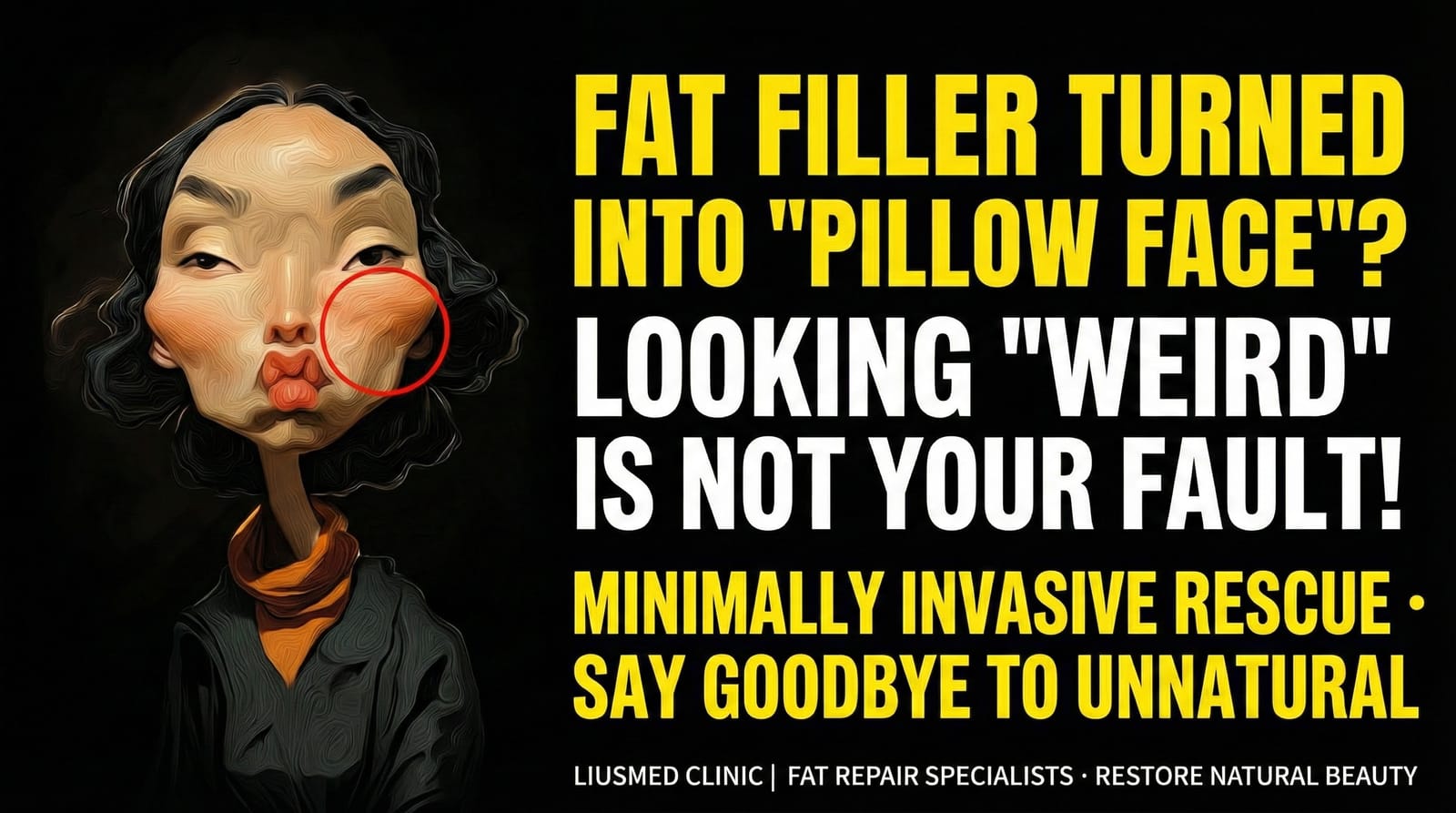
Six months ago, she had mid-face fat grafting at another clinic. Her expectations were fullness, youthfulness, and naturalness. But as the recovery period passed, she noticed the reflection in the mirror becoming increasingly unfamiliar:
- Her apple cheeks were too prominent—when she smiled, they looked like two stiff, unnatural lumps.
- Her facial contours became disharmonious, losing their original smooth lines.
- In photos, her face appeared to "float," filled with an unnatural, plastic look.
When she returned to the original clinic to inquire, the responses only made her feel more helpless:
"This is normal, just wait and it will become natural." "Fat naturally swells like this."
Finally, she was told: "This is your body's constitution problem."
But that simply isn't true.
Why Does Fat Transfer Fail? Unveiling the Truth Behind "Pillow Face"
Many patients ask me: "Dr. Liu, why do some doctors advise against fat grafting? Or why does it sometimes result in 'bread face' (pillow face)?"
The answer is quite straightforward—autologous fat transfer has an extremely high technical threshold. It's not simply about injecting fat. It tests three crucial skills of the physician:
1. Technical Threshold of "Fat Harvesting + Purification"
Fat harvesting and purification form the foundation of the entire procedure. If the extracted fat cells are damaged or improperly purified, no amount of grafting will survive—and it may even cause inflammation or lumps.
2. Inability to Master "Correct Layers" and "Precise Dosage"
This is the most critical point. Fat must be placed in the correct anatomical layers (deep support, superficial refinement), and the dosage must be precise to the milliliter.
- Too superficial: Causes surface irregularities and a grainy texture.
- Too much volume: Directly leads to "pillow face," making the face appear swollen and crowded.
3. Uncertainty About "Survival Rate" Leading to Over-filling
Many physicians, unable to predict their fat survival rates, often overfill with the mindset of "it will absorb anyway" to compensate for potential loss.
The results are often disastrous: Too much becomes pillow face; too little shows no effect.
Once fat is placed in the wrong layer or over-injected, it can cause fat necrosis, calcification, and lumping. These technical errors are often dismissed with a simple "it's your body's constitution," leaving patients with endless anxiety.
My Commitment: Fat Is the Best Material—If the Technique Is Right
In my practice, the situations described above have never occurred.
For fifteen years, I have consistently believed: Fat is the first choice for large-area facial volumization.
When the technique is correct, it is the most natural, softest, and safest material—completely derived from your own body. It perfectly addresses:
- Forehead and temple hollowing
- Sunken cheeks
- Deflated apple cheeks
- Tear troughs, nasolabial folds, and marionette lines
The key is: precision.
Case Rescue: Restoring Natural Facial Contours
Returning to this young woman's case.
After careful palpation and evaluation, I discovered her mid-face issues were:
- Too much fat was grafted without considering dynamic facial expressions.
- The placement was too superficial and concentrated, creating a visible bulge.
- Mild pillow face had already developed.
No wonder she felt something was "off." For her condition, we performed a combination repair treatment:
| Treatment | Description |
|---|---|
| Minimally Invasive Fat Removal | Using extremely fine incisions to precisely remove excess, locally accumulated stubborn fat deposits |
| Fat Dissolution | Targeting scattered, superficial small areas of pillow face for delicate adjustment, restoring even facial contours |
One Month Post-Op: The Truth Revealed
At her follow-up appointment, she looked at the comparison photos. Her facial contours had smoothed out, her apple cheeks were no longer jarring, and her entire face had returned to a youthful, soft, and harmonious state.
She couldn't help but say: "So it wasn't that my face was strange—there really was too much fat."
Common questions
After fat grafting my face looks puffy and unnatural — is this my body's constitution?
Most of the time, no. When a face turns stiff or unnatural, it usually comes down to the fat being placed in the wrong layer or the wrong amount going in, not something you were born with. "It's your constitution" is often just a way of brushing a technical problem aside.
Why does fat grafting turn into pillow face or bread face?
Usually because too much was injected, or it was placed too superficially and too concentrated. Fat sitting where it shouldn't bulges out when you smile, so the face looks swollen and crowded. It also ties back to the doctor's harvesting and purification skill, and whether they can gauge how much fat will survive.
If too much fat has already been put in, can it still be removed?
Yes. Like the young woman in this article, we use minimally invasive fat removal to take out the excess, locally pooled fat through very small incisions, and fat dissolution to fine-tune the scattered, shallower lumps — bringing the facial contours back to something even.
So is fat a bad material I should avoid from now on?
Not at all. When the technique is right, fat is a very natural, soft material that comes entirely from your own body, and it works for the forehead, cheeks, apple cheeks, tear troughs and nasolabial folds. The problem was never the material; it's whether it was placed with precision.
How long until my face looks natural again after the repair?
Recovery speed varies from person to person. The case here came back one month post-op with smoother contours and apple cheeks that no longer stood out. Your own result depends on your condition, and we go over it together at your follow-up.
To Those Currently Feeling Anxious
I want to say to everyone who feels their face looks "unnatural":
When your facial contours become stiff or strange, it's usually not your fault, nor is it your body's constitution. The technique simply needs to be more precise.
If you're facing complications from fat grafting, or feel something is "not quite right" about your face, welcome to Liusmed Clinic for a consultation. You don't need to doubt yourself—we will use professional techniques to help you find your "natural" self again.
📋 Professional Clinical Treatment Guideline
Want to learn more about how we diagnose and treat FOS (Facial Overfilled Syndrome) and pillow face issues?
Based on years of clinical experience, Liusmed Clinic has compiled a comprehensive diagnosis classification and treatment protocol guideline.
👉 View Complete Clinical Treatment Guideline (on the Filler Complications Repair page)
Contact Us
Liusmed Clinic
- Taipei: 02-2709-2669
- Kaohsiung: 07-349-6680
- Taipei Tonghua: 02-2755-7728 (NHI-contracted)
- LINE: message us in any language
- Website: https://www.liusmed.com
Further Reading
Related Articles
- Facial Overfilled Syndrome: The Gold Standard for Diagnosis and Treatment
- Filler Lumps & Overfilling Can Be Fixed! Minimally Invasive Removal
Service Pages
Disclaimer: This article is for informational purposes only. Medical treatments vary by individual. Please consult a professional physician for specific treatment plans.
Specialties
Credentials
- Kaohsiung Medical University, School of Medicine
- Attending Physician, Dermatology, Kaohsiung Chang Gung Memorial Hospital
- Attending Physician, Aesthetic Center, Kaohsiung Chang Gung Memorial Hospital
- Visiting Physician, Dermatology, Xiamen Chang Gung Hospital
- Visiting Physician, Aesthetic Center, Xiamen Chang Gung Hospital
"For every surgery, I strive to achieve a good outcome through a small incision and refined technique. Minimally invasive surgery is not just a technique — it's a commitment of respect to every patient."
Recovery after any procedure needs peer support too


Want to learn more?
Schedule a consultation for professional evaluation and advice