Menopausal Itch vs Vulvar Lichen Sclerosus Explained
Summary
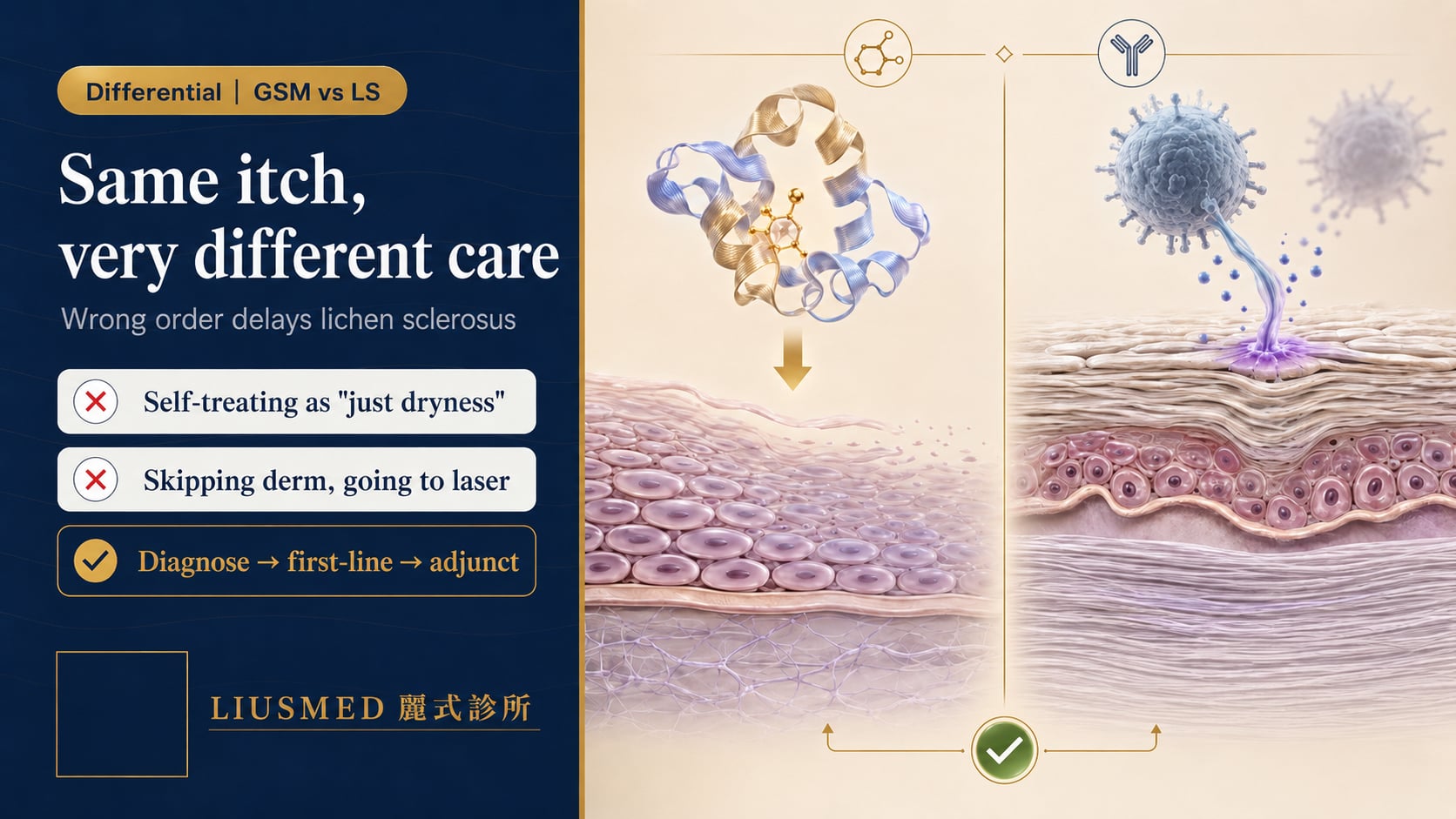
"Vulvar itching, dryness, burning, dyspareunia (painful intercourse)" are the most common postmenopausal complaints — but these symptoms do not equal a single disease. The two most commonly confused diagnoses are:
- Genitourinary Syndrome of Menopause (GSM — menopausal vaginal/urinary symptoms): chronic symptom cluster related to estrogen decline
- Vulvar Lichen Sclerosus (LS — chronic autoimmune vulvar skin scarring): a chronic autoimmune-related skin condition with potential for vulvar cancer
The wrong treatment order can delay LS diagnosis, and untreated LS increases long-term risk of vulvar squamous cell carcinoma (SCC — a type of skin cancer arising from squamous cells) by ~3–5%.1
That's why we address both in this article — diagnose first, treat second. Anchored to the 2025 AUA (American Urological Association)/SUFU GSM guideline, British Association of Dermatologists (BAD) LS guideline, AHRQ (Agency for Healthcare Research and Quality) 2024 comparative effectiveness review, and recent RCTs — this article walks you through how to distinguish the two and their respective treatment orders. This article makes no diagnostic promises and does not replace dermatology / gynecology evaluation.
1. First, What Are These Two Conditions?
1.1 GSM (Genitourinary Syndrome of Menopause)
Etiology: Estrogen decline → vaginal mucosa thinning, loss of elasticity, reduced lubrication
Typical symptoms:
- Vaginal dryness, burning
- Dyspareunia
- Urinary frequency, urgency, recurrent UTIs
- Vaginal mucosa appearance: pale, thin, reduced rugae (a "mirror-like" change)
Epidemiology: 50–70% of postmenopausal women affected; only ~25% seek treatment.2
Course: Progressive and persistent — does not self-resolve and requires ongoing management.
1.2 Vulvar Lichen Sclerosus (LS)
Etiology: Autoimmune-related; exact mechanism still under investigation — possible links to genetic, endocrine, and autoimmune comorbidities
Typical symptoms:
- Severe vulvar itching (worse at night — a classic feature)
- Skin whitening, thinning, atrophy with a "tissue-paper" quality
- Well-demarcated white patches, often in a figure-of-8 distribution (vulvar + perianal)
- Structural change: labia minora atrophy, clitoral phimosis, introital stenosis
- Fragile skin with fissuring, bleeding, crusting
Epidemiology: Female prevalence ~1–3%, any age; two peaks — postmenopausal and prepubertal.3
Course: Chronic, with risk of vulvar squamous cell carcinoma (SCC) — this is the key difference. Recent studies estimate a lifetime vulvar SCC risk of ~3–5% in inadequately treated LS, while regular use of ultrapotent corticosteroid significantly reduces that risk.1
2. How to Distinguish Them — Six Discriminating Features
| Feature | GSM | Vulvar Lichen Sclerosus (LS) |
|---|---|---|
| Chief complaint intensity | Dryness / burning > itching | Itching >> others, worse at night |
| Skin color | Pale, uniform | Well-demarcated white patches |
| Skin texture | Thin, poor elasticity | "Tissue-paper," fragile, crusting |
| Structural change | Reduced rugae | Labia atrophy, clitoral phimosis, introital stenosis |
| Distribution | Vulva + vagina | Vulva + perineum + perianal (figure-of-8) |
| Response to estrogen | Marked improvement | Limited response (corticosteroid is required) |
Key point: If you have "itching worse at night" or "well-demarcated white patches," please have a physician evaluate further for LS — do not assume it's menopausal dryness.
2.1 Who Should Be Evaluated for LS?
- Severe vulvar itching persisting > 6 weeks
- Vulvar skin color / texture abnormalities (whitening, atrophy, fissuring)
- Structural changes at clitoris or labia minora
- History of autoimmune diseases (thyroid disease, vitiligo, lichen planus, etc.)
- No improvement with vaginal estrogen therapy after 4–12 weeks
Important: LS diagnosis requires skin punch biopsy histopathology — appearance alone is not diagnostic. Any clinic that claims "regenerative therapy can cure LS" based on appearance alone is making an overclaim.
3. GSM Treatment Ladder
3.1 First-line: OTC + Topical Estrogen
The 2025 AUA/SUFU GSM guideline recommends these first-line options:2
- Over-the-counter: long-lasting vaginal moisturizers (2–3 times weekly) + water-based lubricant during sexual activity
- Topical low-dose estrogen: vaginal tablets, creams, or rings — high-quality evidence
- DHEA (prasterone) vaginal inserts: an option for those with estrogen contraindications
- Oral ospemifene: a selective estrogen receptor modulator
Topical estrogen advantage: very low systemic absorption; still partially considered for breast cancer survivors (joint evaluation with oncology required).
3.2 Second-line: Non-hormonal Options and Regenerative Therapy Discussion
If first-line falls short at 4–12 weeks:
- Hand-injected mesotherapy (shallow micro-injection of nutrients/meds; crosslinked HA — Hyaluronic Acid, sugar molecule naturally in skin, holds water — mucosal injection): Maturitas 2025 multicenter RCT (Randomized Controlled Trial — gold-standard treatment comparison study) showed 12-week improvement in dryness, dyspareunia, and FSFI (Female Sexual Function Index — 19-item female sexual function score)4
- Autologous PRP (Platelet-Rich Plasma — concentrate of your own blood platelets rich in growth factors) injection: BMC 2025 double-blind RCT showed significant FSFI improvement; Obstetrics & Gynecology 2025 pilot shows a safe, feasible signal for breast cancer survivors with GSM56
- Vaginal laser: AHRQ 2024 and Menopause 2025 systematic reviews show limited difference vs sham, low evidence certainty78 — not our flagship option
→ See also: Female Intimate Regenerative Therapy — Complete Overview of Four Modalities
4. Vulvar Lichen Sclerosus Treatment Ladder — Corticosteroid Must Come First
4.1 First-line: Ultrapotent Topical Corticosteroid (Cannot Be Skipped)
The British Association of Dermatologists (BAD) LS guideline and recent systematic reviews agree:910
- Preferred: clobetasol propionate 0.05% ointment
- Standard course: 12 weeks continuous application (daily initially → taper to maintenance)
- Long-term maintenance: 1–2 times weekly, lifelong
Why is corticosteroid first-line and not skippable?
- High-quality RCTs and reviews show that ultrapotent corticosteroid not only controls symptoms but also lowers long-term vulvar SCC risk1
- No regenerative therapy (PRP, HA, stem cells, ADSC, etc.) — regardless of how it's marketed — can replace corticosteroid as first-line for LS
4.2 Second-line: Calcineurin Inhibitors
- Tacrolimus 0.1% ointment or pimecrolimus 1% cream
- For patients intolerant of corticosteroid or with localized long-term adverse effects
- Lower evidence level than corticosteroid, but viable as an adjunct
4.3 Third-line / Adjunct: Regenerative Therapy (Specific Scenarios Only)
Please read this carefully — this is the only reasonable positioning of regenerative therapy in LS:
- Autologous PRP injection for LS: recent pilot studies and small RCTs suggest possible symptom improvement in steroid-refractory patients, but small samples, short follow-up, heterogeneous protocols11
- Autologous adipose-derived stem cells (ADSC — stem cells harvested from fat tissue): Clinical Case Reports 2025 case report showed symptom improvement — exploratory evidence (n=1)12
- Exosome / stem cell products without sufficient trial evidence: "research / trial-level" — should be conducted only under compliant IRB trials or clinical research frameworks
Our position (explicit):
- Regenerative therapy is not first-line for LS
- If a patient is already on regular corticosteroid under dermatology and some symptoms remain, regenerative therapy can be discussed as an adjunct
- Any LS patient receiving regenerative therapy must simultaneously maintain dermatology corticosteroid therapy, with joint follow-up by dermatology and gynecology
- We will not recommend reducing or discontinuing corticosteroid because PRP was added — this is a medical red line
4.4 When Is Surgical Evaluation Needed?
- Severe introital stenosis affecting intercourse or urination
- Suspected malignant change (non-healing ulcer, nodule, bleeding plaque)
- Structural deformity severely affecting quality of life
Surgical options — per gynecology / surgery, case by case.
5. Red-flag Symptoms of LS: When to Seek Immediate Care
If any of the following appear, arrange immediate dermatology or gynecology evaluation:
- Non-healing ulcer or wound on the vulva (> 2 weeks)
- New nodule or lump, or irregular surface plaque
- Recurrent bleeding or weeping
- Change in pain quality (e.g., itching transitioning to persistent burning pain)
- Worsening despite corticosteroid use
These may be early signs of vulvar SCC — biopsy confirmation is needed.
6. Can GSM and LS Coexist?
Yes — and it's common. Postmenopausal women with LS may have worsened mucosal thinning and dryness due to estrogen decline, stacking GSM and LS symptoms. The treatment strategy becomes:
- LS first: control LS with ultrapotent corticosteroid
- GSM in parallel: topical estrogen can be used simultaneously — confirm with your dermatologist that corticosteroid and estrogen application sites and timing don't conflict
- Regenerative therapy as reinforcement: HA or PRP as symptom improvement adjunct, not replacing the main treatments
7. Ten Commonly Asked Questions
Q1. I have vulvar itching but no white patches — is it definitely not LS? Not necessarily. Early LS may present only as itching; white patches and structural changes may appear later. Persistent itching > 6 weeks warrants evaluation.
Q2. Is LS contagious? No. LS is autoimmune-related, non-infectious, not transmitted by sexual activity or contact.
Q3. Will LS resolve on its own? No. LS is a chronic disease; untreated, it progresses and increases cancer risk. Regular corticosteroid controls symptoms and significantly reduces risk.
Q4. Will long-term corticosteroid use thin my skin? When used per guideline dose (12-week initial course, tapering to 1–2 times weekly maintenance), long-term safety in LS patients is acceptable910. Frequency and dose must be adjusted by a dermatologist — do not self-discontinue or self-increase.
Q5. I heard PRP can cure LS — is that true? This is an overclaim. Current PRP for LS research is "research / trial-level"; conclusions generally indicate "possible adjunct to corticosteroid" — cannot replace corticosteroid, and cannot "cure."
Q6. I'm a breast cancer survivor who cannot use vaginal estrogen — what options remain?
- OTC moisturizers and lubricants as baseline
- DHEA (prasterone) vaginal inserts — discuss with oncology
- Oral ospemifene as an option
- Hand-injected HA or PRP as discussable non-hormonal adjuncts46
Q7. Does LS affect pregnancy? LS itself does not affect conception; structural changes (e.g., introital stenosis) may need additional evaluation. Treatment during pregnancy must be co-decided with obstetrics.
Q8. Will a vulvar biopsy leave a scar? Vulvar biopsy is a small tissue sample (punch biopsy, 3–4 mm) — heals well, usually no visible scar. To confirm LS and rule out malignant change, this is necessary.
Q9. Do I need biopsy confirmation before regenerative therapy? Yes. Any patient with suspected LS should have a pathology diagnosis and be on first-line dermatology corticosteroid therapy before undergoing regenerative therapy. Performing PRP and claiming "LS cure" without pathology confirmation violates medical ethics.
Q10. Can corticosteroid and PRP be used simultaneously? Yes. After PRP injection, advise pausing topical corticosteroid at the injection site for 48–72 hours to minimize infection risk; other sites continue per plan. Coordination is physician-led.
8. Seven Questions to Ask Your Dermatologist / Gynecologist
- Is my condition GSM, LS, or both?
- If LS is suspected, does it need biopsy confirmation? Timing and location?
- How will the first-line corticosteroid course be structured? Maintenance dose and follow-up cadence?
- Do I have autoimmune comorbidities that need concurrent evaluation?
- If I want to try regenerative therapy as an adjunct, is it appropriate? Under what conditions?
- If we combine corticosteroid, estrogen, and PRP / HA — what order and contraindications?
- How often will we follow up? What do we track (symptoms, skin condition, cancer risk assessment)?
9. Back to Process: Our Cross-Specialty Collaboration Position
Our position on LS is unambiguous:
- Dermatology first, then regenerative: we recommend LS patients obtain confirmed diagnosis and be on regular corticosteroid under dermatology first
- Co-management: if the dermatologist considers PRP or HA as adjunctive, we design the plan jointly with dermatology
- No promises: regenerative therapy for LS is research / trial-level — we cannot promise any symptom improvement magnitude
- No replacement: Under no circumstances will we recommend replacing corticosteroid with PRP.
→ Service page: Female Intimate PRP + Hand-Injected Mesotherapy → Related reading: Female Intimate Regenerative Therapy — Complete Overview of Four Modalities
If you'd prefer to understand before deciding, ask 3 anonymous questions via LINE. We won't record your real name until you decide to book an in-person evaluation — no selling, no promises, no crossing medical ethics red lines.
References
Medical Disclaimer
This article is for health education reference only and does not replace dermatology / gynecology evaluation. Vulvar lichen sclerosus is a chronic autoimmune-related condition with cancer risk; diagnosis requires pathology biopsy, and first-line treatment is ultrapotent topical corticosteroid — under no circumstances should regenerative therapy replace corticosteroid. GSM and LS can coexist; treatment strategy requires cross-specialty joint decision-making. All treatment decisions should rest on individual physician evaluation, informed consent, and shared decision-making.
Related Services
Common questions
How do I tell menopausal dryness apart from vulvar lichen sclerosus?
They really do look alike, but there are a few clues. GSM tends to be more about dryness and burning and responds well to topical estrogen. Lichen sclerosus is usually intense itching that gets worse at night, with well-demarcated white patches and skin that feels thin and papery. To be sure which one it is, a physician needs to look, and sometimes a skin biopsy is needed.
What's the first-line treatment for GSM?
Following the 2025 AUA/SUFU guideline, you start with vaginal moisturizers plus a lubricant, then add topical low-dose estrogen where appropriate — that last one has the stronger evidence. If estrogen isn't suitable, DHEA vaginal inserts or oral ospemifene can be discussed. These come first; regenerative therapy is only considered later.
Why does lichen sclerosus always need a corticosteroid — can't I just do regenerative therapy?
Because an ultrapotent topical corticosteroid does more than calm symptoms; used regularly over the long term it also lowers the risk of vulvar squamous cell cancer, and that's backed by good-quality studies. Regenerative therapy for this condition is still research-level, so it can only be an adjunct, not a substitute. We also won't tell you to cut back or stop the steroid just because PRP was added.
Can GSM and lichen sclerosus happen at the same time?
Yes, and after menopause it's fairly common. Falling estrogen makes the mucosa thinner and drier, so the two sets of symptoms stack up. The general approach is to get the lichen sclerosus under control with the corticosteroid first, run topical estrogen alongside for the GSM, and check with your dermatologist that the application sites and timing don't clash. HA or PRP sits on top as a symptom add-on.
My vulva keeps itching — how long before I should get it checked for LS?
If severe itching hasn't settled after about six weeks, or the skin is turning pale, atrophic or fissured, or the clitoris or labia are changing shape, don't just write it off as menopausal dryness — see a dermatologist or gynecologist. And if there's a non-healing ulcer, a new lump, or repeated bleeding, get seen sooner.
Footnotes
-
Lee A, Bradford J, Fischer G. Long-term management of adult vulvar lichen sclerosus: a prospective cohort study of 507 women. JAMA Dermatology, 2015. DOI (Digital Object Identifier): 10.1001/jamadermatol.2015.0643 (long-term regular topical steroid reduces vulvar SCC risk) ↩ ↩2 ↩3
-
Kaufman MR, et al. AUA/SUFU Guideline: Genitourinary Syndrome of Menopause. Journal of Urology, 2025. DOI: 10.1097/JU.0000000000004589 ↩ ↩2
-
Kirtschig G, et al. Evidence-based (S3) Guideline on Vulvar Lichen Sclerosus. Journal of the European Academy of Dermatology and Venereology (JEADV), 2015 (EuroGuiDerm/EADV guideline basis) ↩
-
Marchand Lamiraud F, et al. Cross-linked hyaluronic acid vaginal injection in postmenopausal women: a multicenter, single-blind, placebo-controlled RCT. Maturitas, 2025. DOI: 10.1016/j.maturitas.2025.108264 ↩ ↩2
-
Hamid ASA, et al. Platelet-rich plasma vs saline injection for postmenopausal VVA (Vulvovaginal Atrophy): double-blind RCT (n=60). BMC Women's Health, 2025. DOI: 10.1186/s12905-025-04076-5 ↩
-
Chen AH, et al. Platelet-rich plasma for GSM in breast cancer survivors: a prospective single-arm pilot study. Obstetrics & Gynecology, 2025. DOI: 10.1097/AOG.0000000000006081 ↩ ↩2
-
Agency for Healthcare Research and Quality (AHRQ). Comparative Effectiveness Review: Treatments for Genitourinary Syndrome of Menopause. 2024. ↩
-
Davis ER, et al. Systematic review of energy-based therapies for GSM. Menopause, 2025. ↩
-
Lewis FM, et al. British Association of Dermatologists guidelines for the management of lichen sclerosus. British Journal of Dermatology, 2018. DOI: 10.1111/bjd.16241 ↩ ↩2
-
Chi CC, et al. Topical interventions for genital lichen sclerosus. Cochrane Database of Systematic Reviews, 2011 (Cochrane systematic review supports clobetasol as first-line) ↩ ↩2
-
Tedesco M, et al. PRP for vulvar lichen sclerosus: pilot studies and small RCTs. Recent systematic review summaries (high preparation and point-map heterogeneity) ↩
-
Mezzana P. Adipose-derived stem cells for vulvar lichen sclerosus: case report. Clinical Case Reports, 2025. ↩
Specialties
Credentials
- Kaohsiung Medical University, School of Medicine
- Attending Physician, Dermatology, Kaohsiung Chang Gung Memorial Hospital
- Attending Physician, Aesthetic Center, Kaohsiung Chang Gung Memorial Hospital
- Visiting Physician, Dermatology, Xiamen Chang Gung Hospital
- Visiting Physician, Aesthetic Center, Xiamen Chang Gung Hospital
"For every surgery, I strive to achieve a good outcome through a small incision and refined technique. Minimally invasive surgery is not just a technique — it's a commitment of respect to every patient."
Want to learn more?
Schedule a consultation for professional evaluation and advice