Lipoma vs Cyst: How to Tell These Two Lumps Apart
Introduction
In our clinic, patients often come in anxiously after discovering a lump on their body, asking: "Doctor, is this a lipoma or a cyst? Could it become cancer?"
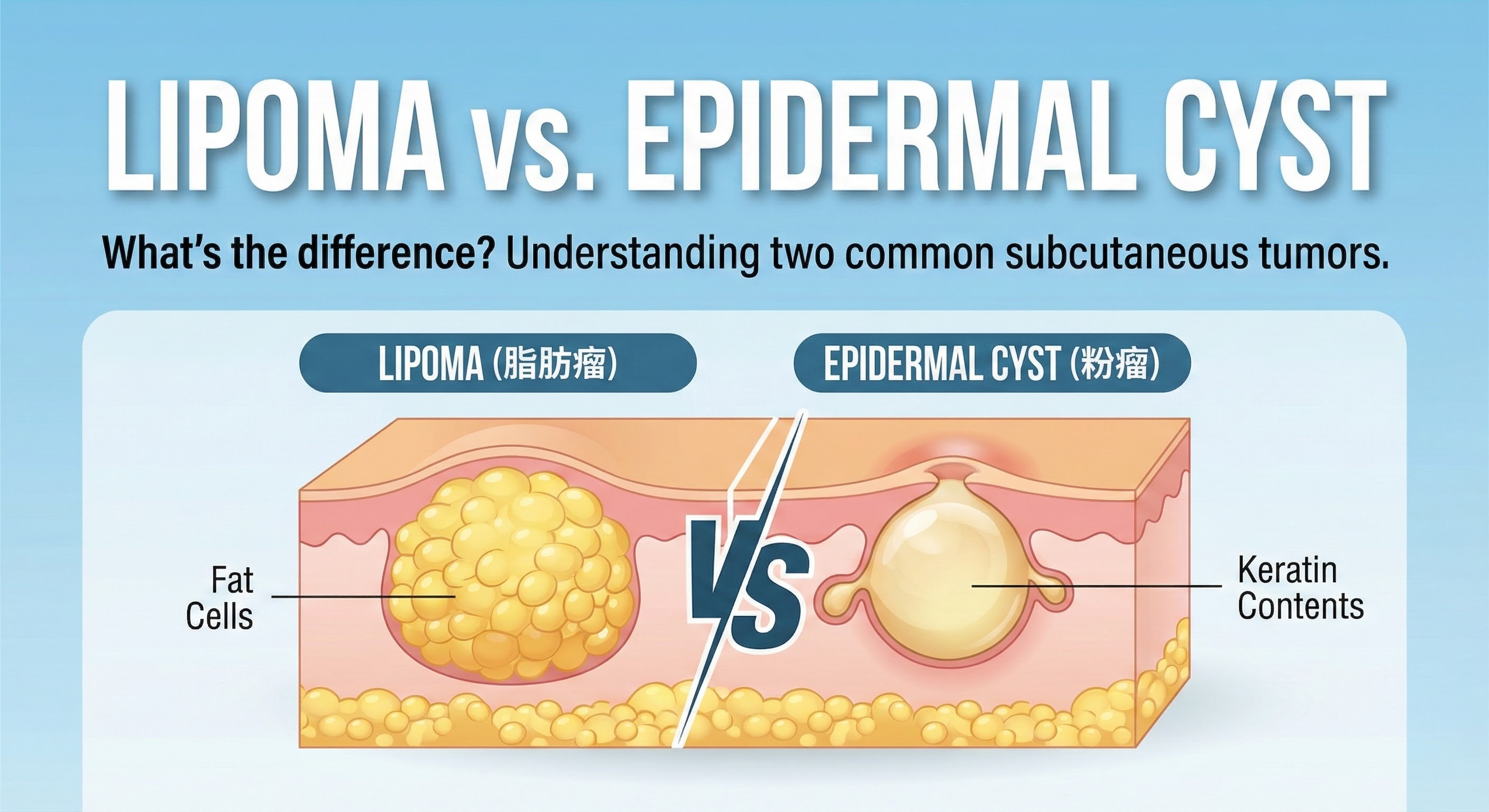
Both are very common benign subcutaneous tumors. Although they appear similar, their causes and characteristics are completely different. Let's understand the differences between these two types of tumors.
What is a Lipoma?
Lipoma is a benign tumor composed of mature fat cells and is one of the most common soft tissue tumors.
Characteristics of Lipoma
| Feature | Description |
|---|---|
| Texture | Soft, elastic, like "soft dough" |
| Borders | Clear, can move the entire mass |
| Growth Rate | Slow, usually takes years to noticeably enlarge |
| Pain | Usually painless |
| Common Locations | Trunk, limbs, neck |
| Common Age | 40-60 years old |
Causes of Lipoma
The exact cause is currently unknown, but may be related to:
| Possible Factor | Description |
|---|---|
| Genetic Factors | More common in those with family history; some patients develop multiple lipomas |
| Trauma | May trigger lipoma growth after injury |
| Constitution | Not directly related to obesity; thin people can develop them too |
What is an Epidermal Cyst?
Epidermal Cyst, commonly called a "sebaceous cyst," forms when epidermal skin cells become trapped in the dermis layer, creating a cyst filled with keratin.
Characteristics of Epidermal Cyst
| Feature | Description |
|---|---|
| Texture | Harder, sometimes can feel the contents |
| Borders | Clear, often has a small central opening (blackhead) |
| Growth Rate | Variable, sometimes enlarges rapidly |
| Pain | Red, swollen, hot, and painful when inflamed |
| Common Locations | Face, neck, back, behind ears |
| Common Age | 20-40 years old |
Causes of Epidermal Cyst
| Possible Factor | Description |
|---|---|
| Blocked Hair Follicles | Follicle opening blocked, keratin cannot drain |
| Blocked Sebaceous Glands | Sebum accumulates forming a sac |
| Trauma | Epidermal cells implanted into dermis |
| Oily Skin | More common in those with active sebaceous glands |
Lipoma vs Epidermal Cyst: Quick Comparison
| Comparison | Lipoma | Epidermal Cyst |
|---|---|---|
| Composition | Fat cells | Keratin, sebum |
| Depth | Deep subcutaneous fat | Superficial dermis |
| Texture | Soft, elastic | Harder, sometimes fluctuant |
| Surface Features | Smooth, no opening | May have central opening (blackhead) |
| Inflammation | Almost never | Easily inflamed and infected |
| Odor | None | Foul smell when squeezed (cheese-like) |
| Recurrence | Very low after complete removal | May recur if cyst wall not completely removed |
| Common Age | 40-60 years | 20-40 years |
| Gender Ratio | Similar in both genders | Slightly more common in males |
How to Self-Assess Initially?
While the most accurate diagnosis requires professional medical evaluation, you can make a preliminary assessment:
Likely a Lipoma if:
- ✅ Feels soft, like an eraser or dough
- ✅ Can move the entire mass, clear borders
- ✅ Unchanged for years or grows very slowly
- ✅ Never inflamed or painful
- ✅ Smooth skin surface, no opening
Likely an Epidermal Cyst if:
- ✅ Feels harder, like a small ball or marble
- ✅ Has a black dot in the center (opening)
- ✅ Has been inflamed before, red and swollen
- ✅ White discharge or odor when squeezed
- ✅ Located on face, behind ears, back, or other areas with active sebaceous glands
⚠️ Note: Self-assessment is for reference only. Definitive diagnosis requires professional evaluation through palpation and ultrasound examination.
Is Treatment Necessary?
Lipoma
| Situation | Recommendation |
|---|---|
| Small, asymptomatic | Can observe and monitor |
| Continuously growing | Surgery recommended |
| Affecting appearance | Surgery recommended |
| Compressing nerves causing discomfort | Surgery recommended |
| Suspected malignant changes | Surgery required with pathology examination |
Epidermal Cyst
Early treatment is recommended for the following reasons:
| Risk | Description |
|---|---|
| Recurrent Inflammation | Cysts easily become infected and inflamed |
| Treatment Difficulty | Cannot operate during inflammation; must treat infection first |
| Larger Wound | The longer you wait, the bigger it gets, the larger the surgical wound |
| Increased Scarring | Repeated inflammation causes surrounding tissue fibrosis |
⚠️ Important: Once an epidermoid cyst becomes inflamed, the inflammation must be treated before surgical removal. Definitive surgery cannot be performed during the inflammatory period.
Liusmed Minimally Invasive Surgery Advantages
Whether it's a lipoma or epidermoid cyst, we use minimally invasive techniques:
Minimally Invasive Lipoma Surgery
| Advantage | Description |
|---|---|
| Ultra-small Incision | Incision ratio < 20% (international standard is 33%) |
| Complete Removal | Ensures complete tumor removal, reduces recurrence |
| Quick Recovery | Can return to work the next day |
| Aesthetic Scarring | Professional cosmetic suturing minimizes scarring |
Minimally Invasive Epidermal Cyst Surgery
| Advantage | Description |
|---|---|
| Minimal Incision | Incision ratio approximately 1:1 (traditional requires larger incision) |
| Complete Sac Removal | Ensures entire cyst wall is removed, prevents recurrence |
| Cosmetic Closure | Professional suturing technique minimizes scarring |
| Same-Day Return | Short procedure time, no hospitalization required |
Frequently Asked Questions
Q1: Can lipomas or epidermoid cysts become cancer?
A: Both are benign tumors with extremely low risk of malignant transformation. However, if you notice the lump growing rapidly, changing in texture, or becoming painful, seek medical evaluation promptly.
Q2: Can I squeeze an epidermoid cyst myself?
A: Strongly not recommended. Squeezing can lead to:
- Bacterial infection, potentially causing cellulitis
- Cyst sac rupture, spreading contents and worsening inflammation
- Even if contents are expelled, the sac remains, guaranteeing recurrence
Q3: What happens if I don't treat a lipoma?
A: Most lipomas grow slowly and are not dangerous in the short term. However, long-term observation may lead to:
- Continued growth, requiring larger surgical wound
- Compression of surrounding tissues or nerves
- Cosmetic concerns causing distress
Q4: Can surgery be performed on an inflamed epidermoid cyst?
A: No. An inflamed cyst has swollen tissue and unclear borders, making complete sac removal impossible. Medication must be used to control inflammation first, then surgery can be scheduled after swelling subsides.
Conclusion
Although both lipomas and epidermoid cysts are benign tumors, they have different characteristics and require different treatment approaches. If you discover an unknown lump on your body, we recommend:
- Don't squeeze it yourself: Especially epidermoid cysts - squeezing can cause infection
- Seek medical evaluation early: Professional doctors can diagnose through palpation and ultrasound
- Choose a professional team: Minimally invasive surgery works through a small incision, balancing appearance and recovery
If you have any questions, please feel free to schedule a consultation!
Related Links

Specialties
Credentials
- Kaohsiung Medical University, School of Medicine
- Attending Physician, Dermatology, Kaohsiung Chang Gung Memorial Hospital
- Attending Physician, Aesthetic Center, Kaohsiung Chang Gung Memorial Hospital
- Visiting Physician, Dermatology, Xiamen Chang Gung Hospital
- Visiting Physician, Aesthetic Center, Xiamen Chang Gung Hospital
"For every surgery, I strive to achieve a good outcome through a small incision and refined technique. Minimally invasive surgery is not just a technique — it's a commitment of respect to every patient."
Want to learn more?
Schedule a consultation for professional evaluation and advice