Scar Treatment Guide: Atrophic, Keloid & Surgical Scar Classification
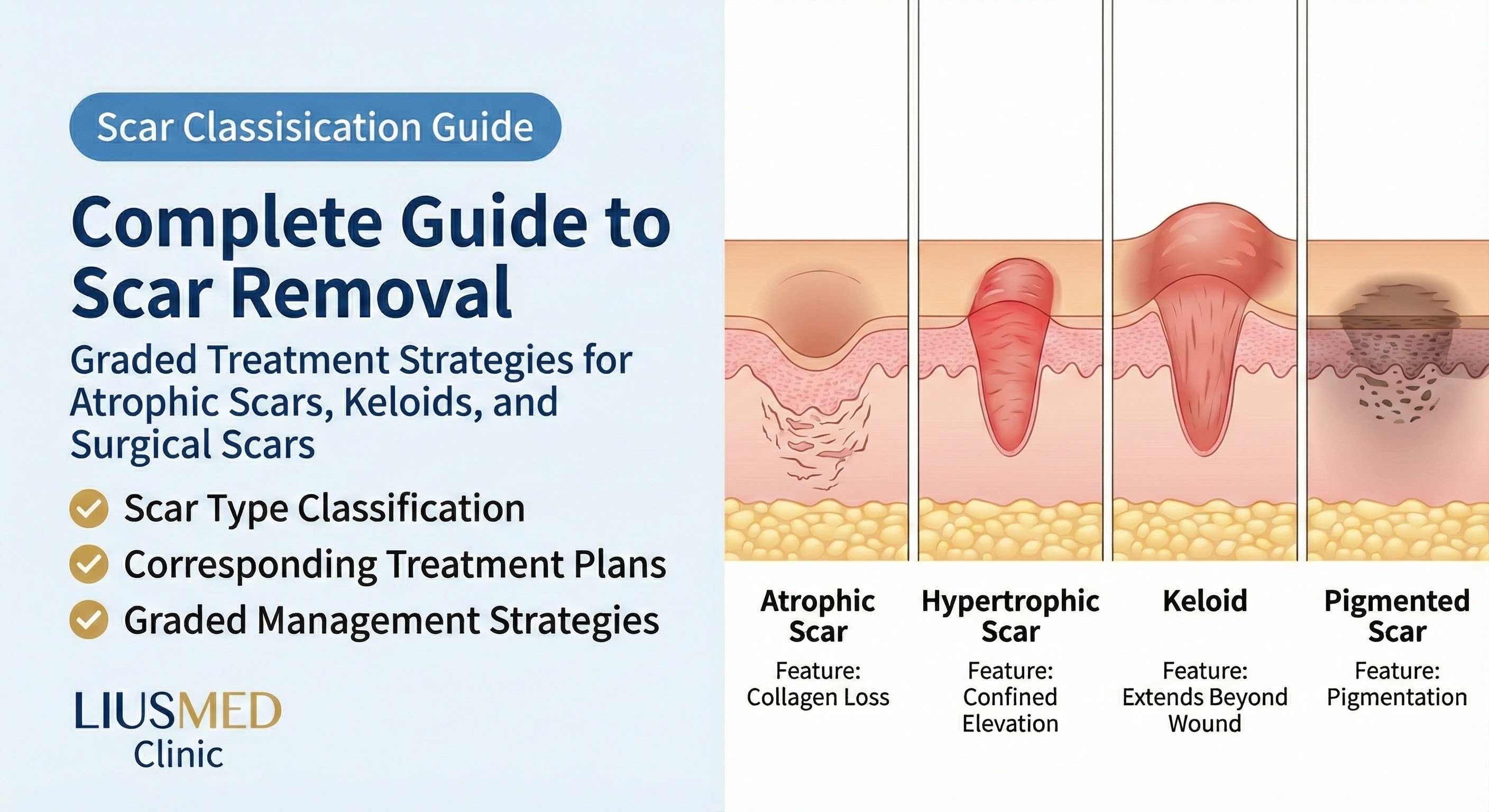
Scars Are Not One Disease, But a Group of Problems
The most common mistake in scar treatment is using the same method for all scars. Atrophic scars, hypertrophic scars, keloids, and surgical scars each have different causes and characteristics, requiring targeted treatment. This article provides detailed classification and treatment strategies for each scar type.
Scar Types Overview
| Type | Appearance | Cause | Treatment Difficulty |
|---|---|---|---|
| Atrophic scars (indented) | Depressed | Tissue loss | Medium |
| Hypertrophic scars | Raised but within wound boundaries | Excessive repair | Medium |
| Keloids | Raised and extends beyond wound | Constitutional factors | High |
| Pigmented scars | Abnormal color (dark or light) | Pigmentation or loss | Medium |
| Contracture scars | Contracted, pulling | Large area wounds | High |
Atrophic Scars (Indented Scars)
Common Causes
- Post-acne inflammation
- Chickenpox
- Trauma
- Surgery
Atrophic Scar Subtypes
| Type | Characteristics | Description |
|---|---|---|
| Ice pick | Deep, narrow, V-shaped | Like holes from an ice pick |
| Rolling | Wide, shallow, wave-like | Uneven skin surface |
| Boxcar | Square, sharp edges | Like punch holes |
Treatment Strategies
| Scar Type | First-Line Treatment | Other Options |
|---|---|---|
| Ice pick | TCA chemical peel / Subcision | Laser, filler |
| Rolling | Subcision / HA filler | Laser |
| Boxcar | Fractional laser / Skin grafting | Filler, excision |
Laser Treatment Options
| Laser Type | Mechanism | Suitable For |
|---|---|---|
| Fractional laser | Fractionated resurfacing | Mild to moderate scars |
| Picosecond laser | Stimulates collagen | Mild scars |
| CO2 laser | Vaporization resurfacing | Deeper scars |
| Erbium:YAG laser | Precision ablation | Moderate scars |
💡 Dr. Liu's Advice: "Atrophic scars usually require multiple treatments and combination approaches. Expecting major improvement from a single session is unrealistic—20-30% improvement each time is already good."
Hypertrophic Scars
Characteristics
- Raised above skin surface
- Limited to original wound boundaries
- Reddish color
- May be itchy
Difference from Keloids
| Feature | Hypertrophic Scar | Keloid |
|---|---|---|
| Extent | Within wound | Beyond wound |
| Timeline | Usually regresses in 6-18 months | Continues growing |
| Prognosis | Better | Harder to treat |
Treatment Strategies
| Phase | Treatment Approach |
|---|---|
| Prevention phase | Silicone sheets/gel, pressure therapy |
| Early (< 6 months) | Steroid injection, silicone products |
| Stable (> 1 year) | Laser, surgical excision (cautiously) |
Steroid Injection
| Item | Details |
|---|---|
| Medication | Triamcinolone (Kenacort) |
| Frequency | Every 4-6 weeks |
| Sessions | 3-5 times |
| Effectiveness | 50-70% improvement |
| Side effects | Skin atrophy, pigment changes |
Keloids
Characteristics
- Raised and extends beyond original wound
- Continues to enlarge
- May be itchy or painful
- Prone to recurrence
High-Risk Groups
- Darker skin tones
- Teenagers to middle-aged adults
- Family history of keloids
- Common sites: ears, shoulders, chest
Treatment Strategy (Combination Therapy)
| Treatment | Effectiveness | Notes |
|---|---|---|
| Surgical excision | High recurrence (50%+) | Must combine with other treatments |
| Steroid injection | Moderate | Post-surgical adjunct |
| Radiation therapy | Reduces recurrence to 10-20% | Within 24-48 hours post-surgery |
| Pressure therapy | Adjunctive | Long-term post-surgical use |
| Cryotherapy | Adjunctive | Suitable for small keloids |
| 5-FU injection | Adjunctive | Anti-fibrotic |
Optimal Combination Protocol
Surgical excision + Post-op radiation (within 24-48hr) + Steroid injection + Silicone compression
                            ↓
                    Recurrence rate drops to 10-20%
⚠️ Important: People with keloid tendency may form new keloids from any wound. Surgery is not recommended unless necessary; if surgery is needed, always combine with adjunctive treatments.
Surgical Scars
Factors Affecting Scar Appearance
| Factor | Impact |
|---|---|
| Wound tension | High tension → wider scar |
| Wound direction | Along skin lines → finer scar |
| Suturing technique | Precise alignment → smaller scar |
| Post-op care | Proper care → lighter scar |
| Individual constitution | Keloid tendency → more visible scar |
Prevention Strategies
| Phase | Measures |
|---|---|
| Pre-op | Assess constitution, design incision |
| Intra-op | Reduce tension, precise suturing |
| Post-op | Steri-strips, silicone products, sun protection |
Post-Surgical Scar Care Timeline
| Phase | Care Focus |
|---|---|
| Before suture removal | Wound cleaning, avoid pulling |
| 2-4 weeks after sutures | Steri-strips |
| 1-3 months | Silicone sheets/gel |
| 3-6 months | Continue silicone, massage |
| After 6 months | Evaluate if further treatment needed |
Pigmented Scars
Types
| Type | Appearance | Cause |
|---|---|---|
| Hyperpigmentation | Darker than surrounding | Post-inflammatory melanin increase |
| Hypopigmentation | Lighter than surrounding | Melanocyte damage |
Treatment Strategies
Hyperpigmentation:
- Sun protection (most important!)
- Brightening products (Vitamin C, arbutin)
- Laser (Picosecond, Q-switched)
- Usually fades over time
Hypopigmentation:
- Difficult to treat
- Fractional laser (stimulates pigment)
- Concealer (makeup)
- Micropigmentation (permanent)
Contracture Scars
Characteristics
- Scar contracts and tightens
- Affects movement and function
- Common after burns
Treatment
- Physical therapy (stretching)
- Pressure garments
- Surgical reconstruction (Z-plasty or W-plasty)
- Skin grafting
Treatment Methods Summary
Non-Surgical Treatments
| Method | Suitable Scars | Effectiveness |
|---|---|---|
| Silicone products | Hypertrophic, keloid, prevention | Moderate |
| Steroid injection | Hypertrophic, keloid | Moderate |
| Laser | Various (depends on laser type) | Varies |
| Filler | Atrophic scars | Temporary |
| Microneedling | Shallow atrophic scars | Moderate |
| Chemical peel | Ice pick scars | Moderate |
Surgical Treatments
| Method | Suitable Scars | Considerations |
|---|---|---|
| Direct excision | Localized scars | Use caution with keloid tendency |
| Subcision | Rolling atrophic scars | Releases fibrous bands |
| Flap reconstruction | Contracture scars | For large areas |
| Skin grafting | Severe scars | Creates new scar |
Choosing Treatment by Scar Type
| Your Scar Is... | First-Line Treatment |
|---|---|
| Shallow acne scars | Fractional laser, microneedling |
| Deep acne scars | Subcision + laser |
| New surgical scar | Silicone products + Steri-strips |
| Old surgical scar | Laser or surgical scar revision |
| Hypertrophic scar | Steroid injection + silicone |
| Keloid | Combination therapy (surgery + radiation + injection) |
| Hyperpigmentation | Sun protection + brightening + laser |
Frequently Asked Questions
Q1: Can scars be completely removed?
A1: Unfortunately, scars cannot be "completely removed." Treatment goals are to make scars:
- Lighter
- Flatter
- Softer
- Less noticeable
Expecting "completely invisible" is usually unrealistic.
Q2: How many laser treatments are needed?
A2: Depends on scar type and severity:
- Mild atrophic scars: 3-5 sessions
- Moderate atrophic scars: 5-8 sessions
- Severe atrophic scars: 8-10+ sessions
Each session is spaced about 4-8 weeks apart.
Q3: Can keloids be cured permanently?
A3: Keloid is a constitutional issue—"cure" is difficult. Combination therapy can:
- Remove existing keloids
- Reduce recurrence rate to 10-20%
- But cannot change constitution
Avoiding unnecessary wounds is the best prevention.
Q4: Do silicone products really work?
A4: Yes, substantial research supports silicone product effectiveness:
- Softens scars
- Reduces thickness
- Prevents hypertrophy and keloids
But requires:
- Daily use 12+ hours
- Continued use for 2-6 months
- Cannot combat severe scars
Q5: How soon after surgery can I do laser treatment?
A5:
| Scar Type | Recommended Timing |
|---|---|
| Pigmented scars | After 3 months |
| Atrophic scars | After 6 months |
| Hypertrophic scars | After 12 months (once stable) |
Laser too early may stimulate scar growth.
Conclusion
| Scar Type | Core Treatment |
|---|---|
| Atrophic | Filler + laser + subcision |
| Hypertrophic | Steroid injection + silicone |
| Keloid | Surgery + radiation + injection |
| Pigmented | Sun protection + brightening + laser |
| Surgical | Prevention-focused (silicone products) |
Related Reading
About the Author
Dr. Ta-Ju Liu
- Current Position: Director, Liushi Clinic
- Specialties: Minimal incision surgery (lipoma, cyst), hyperhidrosis surgery, thread lifting
- Experience:
- 15+ years of clinical minimal incision surgery experience
- Over 10,000 successful minimal incision cases
- Board-certified dermatologist
- Philosophy: "The first step in scar treatment is proper classification. Only by understanding what type of scar you have can you choose the right treatment approach."
Related Services
Specialties
Credentials
- Kaohsiung Medical University, School of Medicine
- Attending Physician, Dermatology, Kaohsiung Chang Gung Memorial Hospital
- Attending Physician, Aesthetic Center, Kaohsiung Chang Gung Memorial Hospital
- Visiting Physician, Dermatology, Xiamen Chang Gung Hospital
- Visiting Physician, Aesthetic Center, Xiamen Chang Gung Hospital
"For every surgery, I strive to achieve a good outcome through a small incision and refined technique. Minimally invasive surgery is not just a technique — it's a commitment of respect to every patient."
Recovery after any procedure needs peer support too


Want to learn more?
Schedule a consultation for professional evaluation and advice