Preventing Post-Op Scar Formation: When to Use Silicone & Scar Gels
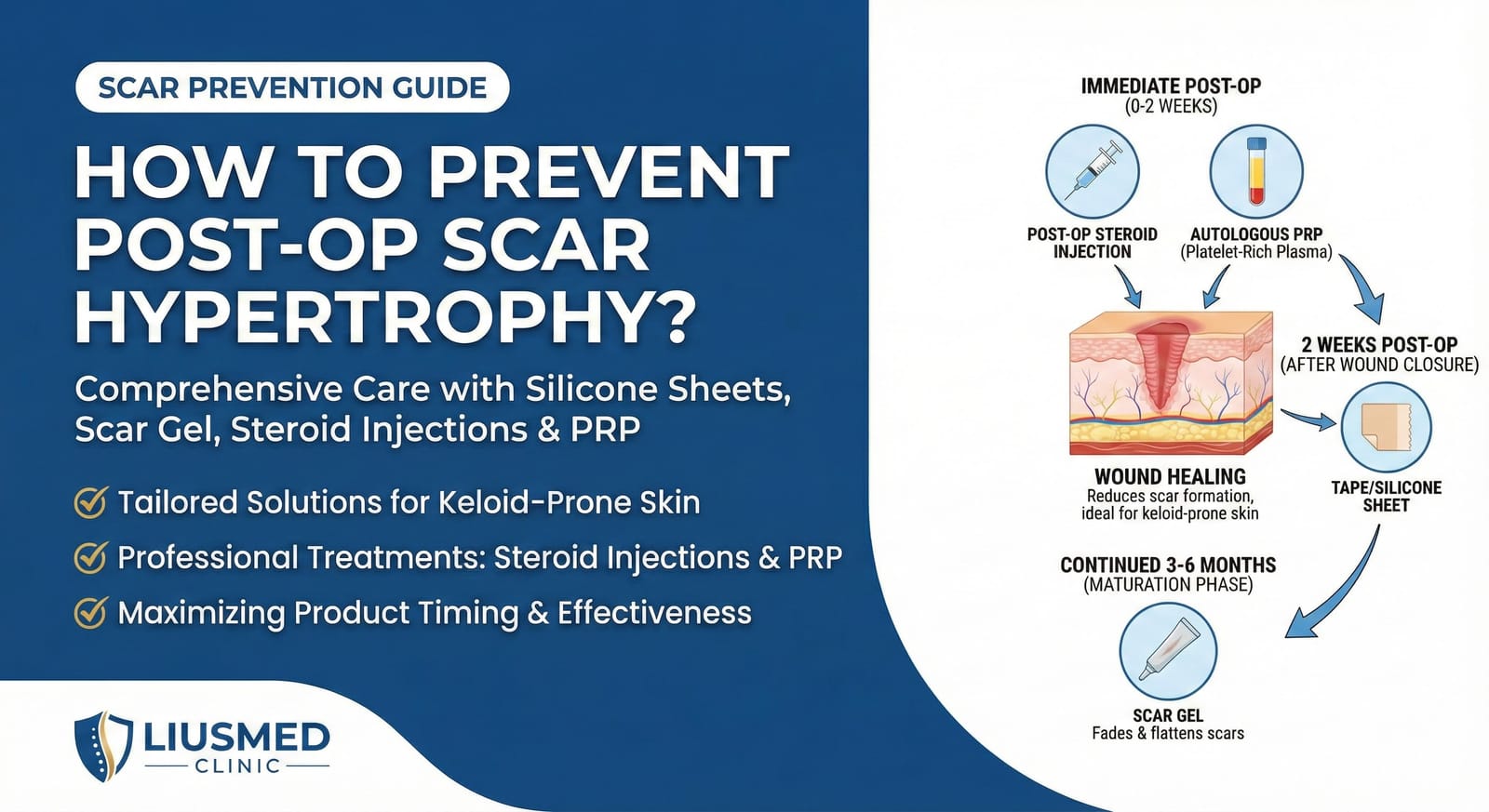
Prevention Is Better Than Cure
Scar prevention comes down to one measure with solid evidence behind it: start silicone as soon as the wound has fully closed, and keep using it for several consecutive months. The 2002 international clinical recommendations on scar management listed silicone gel sheeting and intralesional corticosteroids as the two options with enough evidence to support evidence-based recommendations at the time (Mustoe TA, et al. Plast Reconstr Surg. 2002;110(2):560-571. PMID 12142678).
The strength of that evidence deserves to be stated plainly. A 2013 Cochrane review of 20 trials and 873 people found a risk ratio of 0.46 (95% CI 0.21-0.98) for silicone gel sheeting preventing hypertrophic scarring in scar-prone people, while noting that the trials were of poor quality and highly susceptible to bias, leaving the evidence weak (O'Brien L, Jones DJ. Cochrane Database Syst Rev. 2013;(9):CD003826. PMID 24030657). So silicone is the thing most worth doing, and how much it changes any individual scar varies.
What follows is what each scar-prevention product actually is, how they differ, when to start, and how long to keep going.
The Critical Period of Scar Formation
Wound Healing Timeline
| Phase | Time | What Happens | Prevention Focus |
|---|---|---|---|
| Inflammatory phase | 0-7 days | Debris clearance | Wound cleaning, prevent infection |
| Proliferative phase | 1-4 weeks | Collagen formation | Reduce tension, start silicone |
| Remodeling phase | 1-12 months | Collagen reorganization | Continue silicone, massage |
| Maturation phase | 6-24 months | Scar stabilization | Maintain care |
Golden Prevention Period
- Most important time: 2 weeks - 6 months post-op
- High-risk period: 1-3 months post-op (scars most likely to become raised)
💡 Dr. Liu emphasizes: "Scar prevention must start early. Waiting until the scar has already formed makes treatment much harder. Start from the day of suture removal."
Scar Prevention Products Overview
Main Product Types
| Product | Form | Suitable For |
|---|---|---|
| Steri-strips | Tape | Early post-suture removal |
| Silicone sheets | Sheets | Linear scars |
| Silicone gel | Gel/cream | Irregular scars, facial use |
| Pressure therapy | Elastic bandages/garments | Large area scars |
Steri-Strips (Paper Tape)
Steri-strips are medical tape applied across a closed wound after suture removal to take tension off the skin. They contain no silicone and are not a scar-removal product. Their job is to pull the two sides of the wound toward each other during the weeks before the scar sets, so the wound is less likely to be stretched wide. They cover the 2-4 weeks before silicone takes over.
Several names refer to much the same thing, and this is where patients most often buy the wrong item:
| Name | What it means | Difference |
|---|---|---|
| Steri-strips / surgical tape | Tension-relieving tape used after surgery | The usual clinical term |
| Suture-free / closure strips | Same category | Emphasises replacing sutures for closure |
| Tension-relief tape | Same category | Emphasises sharing skin tension |
| Paper tape (micropore) | General medical fixation tape | Adhesion and stretch are designed for fixation, not tension relief |
| Silicone sheet | A silicone scar dressing | Not the same thing. Starts only once the wound has fully closed, roughly 2 weeks after suture removal |
When to Use
- Start time: Immediately after suture removal
- Duration: 2-4 weeks (bridging to silicone products)
Function
- Reduces wound tension
- Protects wound
- Provides physical pressure
Correct Usage
| Step | Instructions |
|---|---|
| 1. Clean skin | Ensure dry and oil-free |
| 2. Cut tape | Length extends 1cm beyond wound on each end |
| 3. Application direction | Perpendicular to wound, creating lateral tension |
| 4. Overlap | Each strip overlaps 1/3 |
| 5. Replacement frequency | Every 2-3 days, or once it lifts and the tack goes |
Important Notes
- Don't apply along the wound direction (no tension-reducing effect)
- Getting wet does not strip the adhesive — no need to peel it off in a panic; the signal to change is lifting edges and lost tack
- Tape starts after the sutures come out; in the first two weeks the surface hasn't closed yet and is handled with a waterproof dressing or daily dressing changes — that period was never tape's job
- If discharge is present, come back for review
- Switch brands or to silicone if allergic
How to apply it (direction, length, overlap, showering, what to do when it keeps peeling): how to apply surgical tape | How long to wear it: how long to wear surgical tape
Silicone Sheets
A silicone sheet is a thin medical-grade silicone film placed over a scar that has already healed. It holds moisture at the scar surface, which slows the collagen still being laid down. It is one of the few scar-prevention measures with an evidence base in international recommendations, but two conditions have to be met: the wound must be fully closed before you start, and it needs 12-24 hours a day for several consecutive months. Used on and off, it underperforms.
It does not cover the same phase as steri-strips: tape handles tension in the 2-4 weeks after suture removal, silicone handles scar maturation over the months that follow.
Why Silicone Works
| Mechanism | Explanation |
|---|---|
| Hydration effect | Maintains stratum corneum moisture |
| Occlusive effect | Regulates transepidermal water loss |
| Pressure effect | Light physical pressure |
| Factor regulation | May affect growth factors |
Product Types
| Type | Features | Suitable For |
|---|---|---|
| Self-adhesive | Direct application | General wounds |
| Requires tape | Thinner | Mobile areas |
| Contoured | Thicker, elastic | Joint areas |
| Clear/skin-toned | More aesthetic | Face, visible areas |
Correct Usage
| Step | Instructions |
|---|---|
| 1. Timing | After wound fully heals (usually 2 weeks post-suture removal) |
| 2. Clean | Wash and completely dry skin |
| 3. Cut | 1-2cm larger than scar |
| 4. Apply | Press from center outward, avoid air bubbles |
| 5. Wear time | 12-24 hours daily |
| 6. Clean sheet | Wash daily with mild soap and water, rinse, air dry |
| 7. Replace | Most sheets last 1-4 weeks, depending on the product |
| 8. Duration | At least 2-3 months, recommended 6 months |
Troubleshooting
| Problem | Solution |
|---|---|
| Allergic redness | Pause use, switch brands |
| Won't stick | Use paper tape to help secure |
| Uncomfortable heat | Choose breathable versions, take short breaks |
| Sheet shifting | Secure with tape on mobile areas |
Full usage detail (hours per day, how to rinse and air-dry, how long one sheet lasts, whether you can reuse it): how to use silicone scar sheets
Silicone Gel/Cream
Suitable Situations
- Face (sheets not aesthetic)
- Irregular scars
- Large area scars
- Areas unsuitable for sheets
Linear vs Cyclic Silicone
Gels list different silicone types, and the film they form behaves differently. This matters more than price when choosing a gel:
| Type | Film behaviour | Better suited to |
|---|---|---|
| Linear silicone | Longer molecular chains, thicker film, stronger adhesion and occlusion | Scars under tension or prone to thickening |
| Cyclic silicone | Smaller molecules, volatile, dries fast, thin and flexible film | Face, thin skin, areas that need makeup over them or move a lot |
Both are silicone. The difference is film thickness and drying speed, not one working and the other not.
Common Product Ingredients
| Ingredient | Function | Evidence |
|---|---|---|
| Siloxane (Silicone) | Main ingredient; forms the occlusive film | One of the few ingredients with an evidence base in international recommendations (PMID 12142678) |
| Onion extract | Anti-inflammatory | The 2014 update to the international recommendations described the data as encouraging, while noting methodological limitations in the available studies (PMID 25068543) |
| Vitamin C | Lightens pigmentation | Little high-quality trial data for scar appearance |
| Vitamin E | Moisturizing | Do not rely on it to treat a scar. A 1999 double-blind study in 15 patients after skin cancer surgery compared ointment with and without vitamin E and found no benefit to the cosmetic appearance of scars, plus a high incidence of contact dermatitis (Baumann LS, Spencer J. Dermatol Surg. 1999;25(4):311-315. PMID 10417589) |
Correct Usage
| Step | Instructions |
|---|---|
| 1. Clean | Wash and dry scar area |
| 2. Amount | Thin layer, completely absorbed |
| 3. Frequency | 2-3 times daily |
| 4. Wait | Let gel dry and form film |
| 5. Duration | At least 2-3 months |
Sheets vs Gel Comparison
| Item | Silicone Sheets | Silicone Gel |
|---|---|---|
| Occlusive effect | Stronger | Weaker |
| Convenience | Requires application | Just apply |
| Aesthetics | May be visible | Transparent |
| Cost | Cheaper (reusable) | More expensive |
| Suitable areas | Flat surfaces | Any area |
Pressure Therapy
Suitable Situations
- Large area scars
- Keloid-prone individuals
- Post-burn
Pressure Range
- Recommended pressure: 20-25 mmHg
- Duration: 23 hours daily, for 1-2 years
Common Forms
- Elastic bandages
- Pressure garments
- Ear clips (for ear keloids)
Special Strategies for Keloid-Prone Individuals
High-Risk Groups
- History of keloids
- Family history of keloids
- Darker skin tones
- Injuries to prone areas
Prevention Strategy (More Aggressive)
| Measure | Explanation |
|---|---|
| Avoid unnecessary surgery | Don't operate if not essential |
| Immediate anti-scar injection | Injection at surgery completion, reduces scar formation |
| Post-op PRP injection | Autologous repair factors promote healing, reduce scarring |
| Start silicone early | Use immediately after suture removal |
| Extend usage time | At least 6-12 months |
| Consider preventive steroid | Post-op steroid injection |
| Pressure therapy | Combine when necessary |
Post-Op Follow-Up
| Time | Check Point |
|---|---|
| 2 weeks | Wound healing status |
| 1 month | Signs of hypertrophy |
| 3 months | Scar stability |
| 6 months | Evaluate if intervention needed |
| 12 months | Long-term follow-up |
Clinic Special Treatments: Anti-Scar Injection & PRP (Platelet-Rich Plasma)
Immediate Post-Surgery Anti-Scar Injection
| Item | Description |
|---|---|
| Timing | Immediately at surgery completion |
| Mechanism | Inhibits excessive fibrosis, reduces scar formation |
| Suitable For | Keloid-prone individuals, those who scar easily, post-op scar prevention |
| Effect | Reduces probability and severity of scar formation |
Post-Surgery PRP (Platelet-Rich Plasma) Injection
| Item | Description |
|---|---|
| What is PRP | Platelet-Rich Plasma containing concentrated growth factors |
| Timing | Scheduled injection sessions after surgery |
| Mechanism | Autologous growth factors promote tissue repair and regeneration |
| Advantage | Autologous material, high safety, no rejection |
| Effect | Accelerates wound healing, reduces scar formation, improves scar quality |
💡 Dr. Liu explains: "For patients with keloid-prone constitution, I recommend immediate anti-scar injection at surgery completion, followed by scheduled PRP autologous repair factor injections. Both treatments effectively reduce the probability and severity of scar formation."
Other Supportive Measures
Sun Protection
| Importance | Explanation |
|---|---|
| Extremely important | New scars are very UV-sensitive |
| Consequence | Sun exposure causes permanent pigmentation |
| Recommendation | Sun protection for at least 6 months post-op |
Scar Massage
| Item | Instructions |
|---|---|
| Start time | After wound fully heals (about 3-4 weeks) |
| Method | Circular motions with fingertips, gentle |
| Duration | 5-10 minutes each time |
| Frequency | 2-3 times daily |
| Effect | Softens scar, improves circulation |
Avoid Irritation
| Avoid | Reason |
|---|---|
| Friction | Stimulates fibrosis |
| Pulling | Increases tension, widens scar |
| Sun exposure | Causes pigmentation |
| Spicy foods | May worsen inflammation (limited evidence) |
| Smoking/alcohol | Impairs healing |
Product Selection Recommendations
Reading the Box
Product names vary by market, and the same sheet is often sold under several of them. What is on the manufacturer's own instructions is what matters:
| What you may see | What it is | Form | Wear time per sheet |
|---|---|---|---|
| Mepiform (also sold under renamed local distributor labels) | Self-adherent soft silicone dressing from Molnlycke | Soft silicone sheet with a nonwoven backing | Up to about 7 days of continuous use |
| Locally manufactured silicone sheets | Varies by market | Self-adherent silicone sheet | Often much shorter, some as little as 3-6 days |
⚠️ A tape brand is not a silicone sheet. Searches for a well-known tape brand plus "scar sheet" usually land on the wrong category: the big tape brands are best known for medical fixation and closure tapes, which is the steri-strip category above. Check whether the box says silicone or tape.
Wear time per sheet varies widely between products. Follow the instructions in the box you actually bought rather than someone else's routine.
By Scar Location
| Location | Recommended Product |
|---|---|
| Face | Silicone gel (aesthetic) |
| Torso | Silicone sheets |
| Joints | Elastic silicone sheets + tape |
| Ears | Ear clips + silicone sheets |
| Large areas | Pressure garments |
By Budget
| Budget | Recommendation |
|---|---|
| Limited | Steri-strips (long-term) |
| Moderate | Silicone sheets (reusable) |
| Generous | Silicone gel + sheet combination |
Frequently Asked Questions
Q1: When can I start using silicone products?
A1: After wound is completely healed:
- 1-2 weeks after suture removal (confirm no discharge)
- Skin surface intact and dry
- No signs of infection
Using too early may trap moisture and cause infection.
Q2: How long should I wear silicone sheets?
A2:
- General recommendation: 12-24 hours daily
- Duration: At least 2-3 months, recommended 6 months
- Keloid-prone: 6-12 months
The earlier you start and the more consistent you are, the better the results.
Q3: Can I use scar gel and steri-strips together?
A3: Yes, but in sequence rather than stacked on the same patch of skin at the same time.
- 0-2 weeks after suture removal: the wound is usually not fully closed yet. Tape does the work here; hold the gel back.
- Once the wound has fully closed: hand over to gel or a silicone sheet. If the wound is under tension and your doctor wants tension relief continued, tape during the day and gel at night after removing and cleaning, so the gel has time to form its film.
- Gel applied under tape before it dries: the tape will not stick and the gel will not form a film, so neither does its job.
Gel and silicone sheets are mostly an either/or: gel during the day (easier when going out), sheet at night (stronger occlusion), or gel on the edges a sheet cannot cover.
Q4: Are pharmacy scar products effective?
A4: The key is ingredients:
- Effective: Products containing silicone
- Possibly effective: Onion extract (weak evidence)
- Limited effect: Pure Vitamin E
Check for "Silicone" in ingredients when purchasing.
Q5: How long until I see results?
A5:
| Time | Expected Changes |
|---|---|
| 2-4 weeks | Scar starting to soften |
| 1-2 months | Noticeably lighter and softer |
| 3-6 months | Continued improvement |
Results vary by individual—consistent use is key.
Q6: My scar is months or years old. Is it too late to start?
A6: There is still a chance, but keep expectations modest, and the later you start the less room there is to move.
The same 2013 Cochrane review also looked at established scars, not just prevention: silicone sheeting produced measurable reductions in scar thickness and improvement in colour, though the authors again flagged that those trials were highly susceptible to bias (PMID 24030657). Clinically, scars enter a maturation phase roughly 6-24 months after surgery, and once mature there is limited room for silicone alone to shift them.
For a scar that has been stable for a year or more and is raised and firm, silicone is usually not the main tool. That situation calls for staged treatment (intralesional corticosteroid injection, laser and so on), and is worth assessing in person before deciding.
Post-Op Scar Care Timeline Summary
| Phase | Products Used | Notes |
|---|---|---|
| Immediately after suture removal | Steri-strips | Apply perpendicular to wound |
| 2 weeks post-suture removal | Silicone sheets/gel | After wound fully heals |
| 1-3 months | Continue silicone + massage | High-risk period |
| 3-6 months | Maintain silicone | Evaluate if further treatment needed |
| After 6 months | Continue as needed | Keloid-prone continue |
Conclusion
| Key Point | Explanation |
|---|---|
| Start early | Begin after suture removal |
| Be consistent | At least 2-3 months |
| Adequate daily time | 12+ hours |
| Sun protection matters | Prevents pigmentation |
| High-risk more aggressive | Keloid-prone need longer duration |
Related Reading
- How Long Should You Wear Surgical Tape? Three Months After a C-Section
- How to Apply Surgical Tape: Direction, Showering, Changing
- How to Use Silicone Scar Sheets: Timing, Hours, and Reuse
- Can You Use Scar Gel and Surgical Tape Together?
- Scar Treatment Guide: Classification & Strategies
- Post-Aesthetic Golden 7 Days
References
- Mustoe TA, Cooter RD, Gold MH, et al. International clinical recommendations on scar management. Plast Reconstr Surg. 2002;110(2):560-571. PMID 12142678 / DOI 10.1097/00006534-200208000-00031
- O'Brien L, Jones DJ. Silicone gel sheeting for preventing and treating hypertrophic and keloid scars. Cochrane Database Syst Rev. 2013;2013(9):CD003826. PMID 24030657 / DOI 10.1002/14651858.CD003826.pub3
- Gold MH, Berman B, Clementoni MT, et al. Updated international clinical recommendations on scar management: part 1--evaluating the evidence. Dermatol Surg. 2014;40(8):817-824. PMID 25068543 / DOI 10.1111/dsu.0000000000000049
- Baumann LS, Spencer J. The effects of topical vitamin E on the cosmetic appearance of scars. Dermatol Surg. 1999;25(4):311-315. PMID 10417589 / DOI 10.1046/j.1524-4725.1999.08223.x
About the Author
Dr. Ta-Ju Liu
- Current Position: Director, Liushi Clinic
- Specialties: Minimal incision surgery (lipoma, cyst), hyperhidrosis surgery, thread lifting
- Experience:
- 15+ years of clinical minimal incision surgery experience
- Over 10,000 successful minimal incision cases
- Board-certified dermatologist
- Philosophy: "I often tell patients that scar care is like brushing teeth—you need to do it daily and consistently. Just buying products and leaving them on the shelf won't work. Your usage habits determine the results."
Related Services

Specialties
Credentials
- Kaohsiung Medical University, School of Medicine
- Attending Physician, Dermatology, Kaohsiung Chang Gung Memorial Hospital
- Attending Physician, Aesthetic Center, Kaohsiung Chang Gung Memorial Hospital
- Visiting Physician, Dermatology, Xiamen Chang Gung Hospital
- Visiting Physician, Aesthetic Center, Xiamen Chang Gung Hospital
"For every surgery, I strive to achieve a good outcome through a small incision and refined technique. Minimally invasive surgery is not just a technique — it's a commitment of respect to every patient."
Recovery after any procedure needs peer support too


Want to learn more?
Schedule a consultation for professional evaluation and advice