How to Apply Surgical Tape: Direction, Showering, Changing
The day your sutures come out, you're handed a box of surgical tape and told to keep using it at home.
Nobody shows you how.
So most people go home and do the intuitive thing — they lay the tape along the line of the scar. It looks neat. It does nothing at all.
I see this constantly in clinic: patients who have taped diligently for months, in the wrong direction the entire time. Tape applied the wrong way is time you don't get back.
The one thing that matters most: across, not along
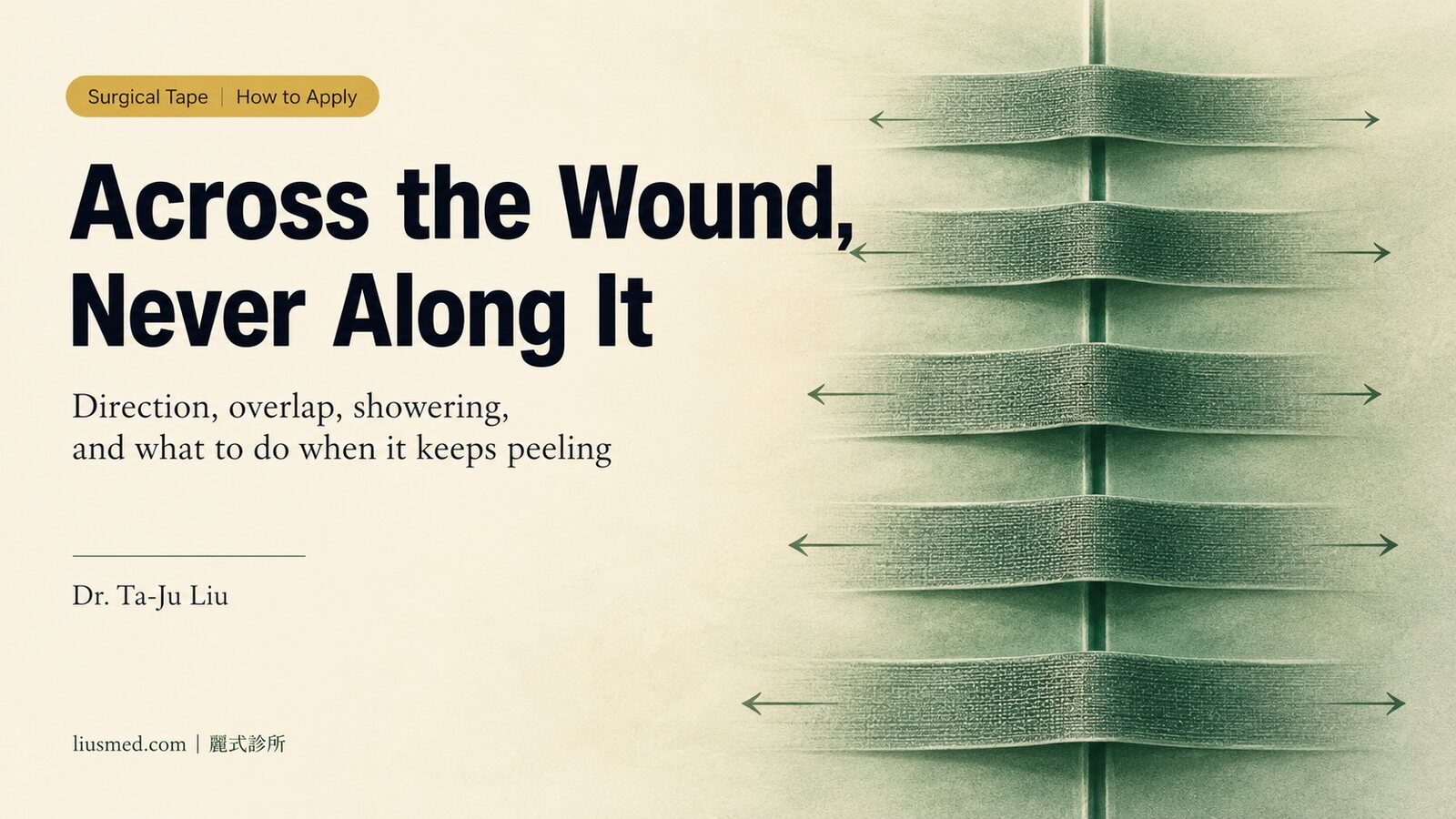
Surgical tape goes across the wound.
Picture the wound as a line. The tape runs perpendicular to it, strip after strip, like railway sleepers under a track.
Why? Because tape isn't a drug. It doesn't dissolve anything. It does exactly one job — it takes some of the outward pull off the wound edges. While a wound heals, the skin on either side is constantly pulling apart, and the harder it pulls, the wider and thicker the scar grows. The force you're fighting runs outward, across the wound. So the tape has to run that way too.
Lay the tape along the wound and it's just a cover. It catches none of that force.
What makes this mistake so awkward is that patients never spot it themselves — because the tape is on, and it looks tidy.
The details
Each strip should extend about 1 cm past each end of the wound. Short strips can't grip the normal skin on either side, so they can't hold anything.
Overlap each strip by about a third. Don't leave gaps. A gap is a stretch of wound getting no tension relief at all.
The skin has to be clean, dry, and free of oil before you tape. Straight after a shower, straight after ointment, or with sweat on the skin, the tape will not hold. That — not the quality of the tape — is the usual reason it falls off.
As you apply each strip, you can nudge the skin on both sides gently towards the middle first, so the wound sits relaxed rather than stretched.
When to start: after the sutures come out
Getting this straight clears up most of the confusion.
The first two weeks after surgery are not really tape's job.
During that stretch the surface hasn't closed yet, and the priority is protecting the wound and keeping it dry. In our clinic we cover the wound with a waterproof dressing, or the patient comes in for a daily dressing change. Those two weeks belong to wound protection, not to tension relief.
Surgical tape generally starts once the sutures are out.
By then the surface has healed over. What you're managing from that point isn't infection or drainage any more — it's tension. That's when tape earns its place.
With the sequence clear, the next question answers itself.
Can you shower? What if it gets wet?
Yes, you can shower.
By the time you're taping, the wound is past the stage where water is the problem. The genuinely water-restricted period is those first two weeks, while the surface is still closing — and that period is handled with a waterproof dressing or daily dressing changes.
So what happens when the tape gets wet?
A single soaking doesn't strip the adhesive. Shower, get water on it, and it will keep holding. You don't need to peel it off in a panic the moment it's damp.
Plenty of aftercare leaflets say "change it as soon as it gets wet." In practice it isn't that tight. The signal to change isn't it got wet — it's it's starting to lift, and the tack is going.
Baths, swimming pools, and hot springs are a different matter. Those wait until the wound is genuinely settled.
How often to change it
Leave a strip on for two or three days. Once the corners start lifting, or the tack is clearly going, put a fresh one on.
You don't need to strip it off and replace it daily. Pulling tape off newly healed skin over and over is its own irritation.
Change it when:
- The corners lift or curl.
- The tack is obviously gone and it won't stay put.
- It's dirty.
- There's still drainage from the wound — and that one means come back and let me look at it, not just re-tape.
When it keeps peeling off
Go back to basics: was the skin completely dry? That's the number one cause, and it accounts for most of the "it won't stick" complaints.
If the wound sits somewhere that's always moving — over a joint, across the abdomen, on a shoulder — tape is going to get worked loose. Change it a bit more often, or use a stretchier tape that moves with the skin instead of fighting it.
If clothing rubs against the site, a layer of breathable gauze or a skin-tone tape over the top will protect it.
If your skin reacts to it
Redness, itching, small bumps where the tape sits — that's a reaction to the adhesive, not to the idea of tension relief.
Stop, and try a different brand. Adhesive formulations differ, and switching brands often settles it completely.
If a second brand still irritates, skip straight to silicone. Skin that's being irritated day after day is worse for the scar than the tape was ever going to be good for it — inflaming your skin in the name of tension relief is a bad trade.
When and how to use silicone is its own article: how to use silicone scar sheets.
When can you stop
That's a different question from this one, and the answer swings enormously with how much tension is on the wound — two to four weeks for an ordinary incision, a full three months for a caesarean or laparoscopic wound.
The full timeline is here: how long to wear surgical tape.
Tape is the first leg of a relay. Get the direction right, carry the wound through its highest-tension weeks, then hand over to silicone.
Common questions
Can I shower with surgical tape on?
Yes. Tape starts after the sutures are out, by which point the surface has healed. The period to keep dry is the first two weeks after surgery.
It got wet — do I have to change it right away?
No. One soaking doesn't kill the adhesive. Change it when it lifts or the tack goes.
How often do I change it?
Every two or three days, or whenever it starts lifting. Daily changes aren't necessary.
Does the tape go along the scar or across it?
Across — perpendicular to the wound. Along the wound gives you no tension relief.
Should I pull the skin tight when I apply it?
Not tight. Nudge the skin from both sides gently towards the middle, so the wound sits relaxed.
It keeps falling off. Is it bad tape?
Usually not. Check whether the skin was completely dry before you applied it — that's the most common reason by far.
Reference
- Atkinson JA, McKenna KT, Barnett AG, McGrath DJ, Rudd M. A randomized, controlled trial to determine the efficacy of paper tape in preventing hypertrophic scar formation in surgical incisions that traverse Langer's skin tension lines. Plast Reconstr Surg. 2005;116(6):1648-56.
Further reading
- How long to wear surgical tape after surgery
- How to use silicone scar sheets
- Can you use scar gel and surgical tape together
- Complete guide to post-surgical scar prevention
About the author
Dr. Ta-Ju Liu
Director of Liusmed Clinic. Over 15 years of clinical experience in minimal-incision surgery; board-certified dermatologist. Specialises in extreme minimal-incision surgery (lipoma, epidermoid cyst), bromhidrosis surgery, and post-surgical scar care.
Related specialties

Specialties
Credentials
- Kaohsiung Medical University, School of Medicine
- Attending Physician, Dermatology, Kaohsiung Chang Gung Memorial Hospital
- Attending Physician, Aesthetic Center, Kaohsiung Chang Gung Memorial Hospital
- Visiting Physician, Dermatology, Xiamen Chang Gung Hospital
- Visiting Physician, Aesthetic Center, Xiamen Chang Gung Hospital
"For every surgery, I strive to achieve a good outcome through a small incision and refined technique. Minimally invasive surgery is not just a technique — it's a commitment of respect to every patient."
Recovery after any procedure needs peer support too


Want to learn more?
Schedule a consultation for professional evaluation and advice