Stiff, Unnatural Expressions After Filler? Nerve Compression vs. Tissue Adhesion Explained
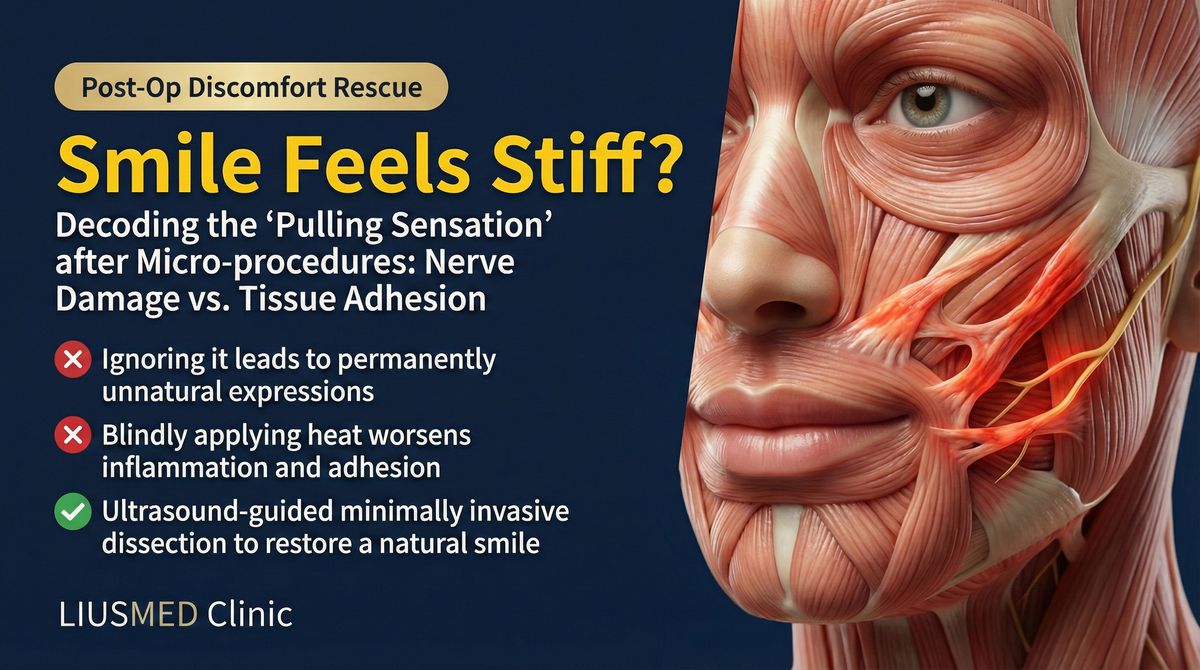
Your Smile Has Changed—The Expression Dilemma After Filler
You smile in the mirror and suddenly realize something is wrong. The upward curve of your mouth is no longer fluid. Your cheeks seem to meet resistance when they move. Your smile looks "stuck." Sometimes it is not just visual—you can physically feel it. A pulling, tightness, or even mild pain in a specific area when you make expressions.
This is not your imagination. Post-filler expression stiffness is a real clinical problem, and its causes are more complex than most people assume.
Why Can Filler Affect Facial Expression?
The Precision Machinery of Facial Expression
Your face is one of the most precise dynamic systems in the human body. Every micro-expression involves the coordinated action of dozens of muscles, fascial layers, subcutaneous fat pads, nerves, and blood vessels. These structures slide, contract, and stretch with precision across different tissue planes.
When filler is injected into this precision system, it occupies space that was not originally there. If the location, depth, and volume are exactly right, the filler coexists peacefully with surrounding tissue and does not affect dynamic expression. But if any element goes wrong, the filler disrupts this delicate dynamic equilibrium.
Key Insight: Expression stiffness does not necessarily mean "too much filler." Even a small volume of filler placed in the wrong tissue plane can interfere with the normal gliding of expression muscles.
Three Main Causes of Expression Stiffness
Cause 1: Filler in the Wrong Tissue Plane
Facial tissue structure is like a layered cake. From superficial to deep: skin → subcutaneous fat → SMAS fascia → expression muscles → deep fat pads → periosteum. Between each layer exists a gliding plane that allows expression muscles to contract and stretch freely.
| Injection Plane | Effect on Expression | Risk Level |
|---|---|---|
| Dermis (very superficial) | Usually does not affect deep expression | Low |
| Superficial subcutaneous fat | May restrict natural skin gliding | Medium |
| SMAS fascial layer | May bind the gliding interface between muscles and skin | High |
| Within expression muscles | Directly interferes with muscle contraction | Very high |
| Deep fat pads | Usually less impact, but large volumes may compress | Medium |
| Supraperiosteal | Usually safe, but migration can reach dangerous planes | Low → Medium |
When filler is injected into—or migrates to—the gliding interface between expression muscles and skin, it acts as a physical block. When you make an expression, the muscle contracts, but the skin cannot move smoothly with it. This is the source of that "pulling sensation."
Cause 2: Tissue Fibrosis (excess scar tissue formation) and Adhesion
After filler injection, even if no expression problems occur initially, your body gradually responds to the foreign material. One standard response is forming a layer of fibrous tissue around the filler—the capsule.
This process does not necessarily cause problems. But in certain cases:
- Excessive fibrosis: The capsule becomes progressively thicker and harder, eventually "welding" the filler to surrounding tissue
- Cross-layer adhesion: Fibrous tissue binds not just around the filler but across tissue planes that should glide freely
- Scar contracture: Fibrous tissue contracts, pulling on surrounding normal tissue (see why dissolvers fail on encapsulated filler)
Key Insight: Fibrotic adhesion is a gradual process. You may not notice expression stiffness until months or even years after injection—because adhesions form slowly over time.
Cause 3: Nerve Compression or Interference
The face contains a dense network of sensory and motor nerves. Filler can affect nerve function through several mechanisms:
- Direct compression: Large filler deposits pressing on nearby nerve trunks or branches
- Capsule compression: As the fibrous capsule thickens, it compresses adjacent nerves
- Inflammatory involvement: Chronic inflammation around filler affecting nearby nerve endings
- Migration compression: Filler migrating to positions near important nerves
Nerve compression typically produces not just "stiffness" but also:
- Localized numbness or altered sensation
- Tingling or burning sensations
- Pulling pain with specific directional movements
- In severe cases, localized muscle weakness
Self-Assessment: What Type of Stiffness Do You Have?
Simple Dynamic Tests
Stand before a mirror and perform the following expressions in sequence, observing and feeling:
1. Natural smile
- Observe symmetry of the smile on both sides
- Feel whether one side is notably "tighter" or "stuck"
2. Forceful squinting
- Note whether periorbital skin can wrinkle naturally
- Feel for abnormal tightness under the eyes or at the temples
3. Puckering lips
- Observe whether lips can push forward evenly
- Feel for resistance in any particular direction
4. Wide open mouth
- Note any pulling sensation during jaw opening
- Feel for abnormal traction at the chin or cheeks
5. Unilateral eyebrow raise
- Observe whether forehead skin lifts naturally
- Compare mobility between the two sides
| Test Result | Possible Cause | Recommendation |
|---|---|---|
| Symmetric but overall reduced expression range | Excessive volume or too-superficial placement | Assess whether volume reduction is needed |
| Clearly unilateral restriction | Localized adhesion or asymmetric filler distribution | Ultrasound evaluation of local structure |
| Definite pulling pain during expression | Possible nerve involvement or deep adhesion | Prompt professional evaluation |
| Restricted movement in specific direction | Filler blocking a specific muscle's gliding path | Assess filler position and plane |
| Accompanied by numbness or altered sensation | Nerve compression | Priority management |
Treatment Strategies
Can Hyaluronidase (enzyme that dissolves HA filler) Resolve Expression Stiffness?
This depends on the cause:
- If caused purely by excess volume or incorrect positioning (no fibrosis): HA (Hyaluronic Acid — sugar molecule naturally in skin, holds water) filler can be dissolved with hyaluronidase, but ultrasound confirmation of exact position and plane is essential
- If fibrotic adhesion has formed: Hyaluronidase dissolves only hyaluronic acid, not fibrous tissue. Even after dissolving the HA, fibrotic adhesions may persist
- If the filler is non-HA: Hyaluronidase is completely ineffective
Ultrasound-Guided Pinhole Extraction
For expression stiffness caused by filler problems, our ultrasound-guided pinhole extraction offers unique advantages:
- Precise localization: Ultrasound shows the real-time spatial relationship between filler and surrounding structures (including nerves and vessels)
- Selective removal: Only the problematic filler is removed, preserving correctly positioned material
- Adhesion release: Fibrotic adhesions can be addressed simultaneously during extraction
- Nerve protection: Important nerve and vascular structures are avoided under visual guidance
Post-Procedure Rehabilitation
After filler removal and adhesion release, expression recovery is not instantaneous. Like a joint that has been in a cast requires rehabilitation to regain mobility, expression muscles that have been restricted long-term need gradual recovery.
Prevention Is Better Than Repair
For Those Considering Injection
The following measures significantly reduce the risk of post-injection expression stiffness:
- Choose an experienced injector: Precise command of facial anatomical planes is the key to avoiding expression problems
- Inject gradually in small volumes: Excessive single-session volume increases compression and adhesion risk
- Consider filler rheological properties: Different products vary in hardness and elasticity—select the one appropriate for the target area
- Avoid aggressive massage immediately after injection: While gentle molding is appropriate, excessive massage may cause filler displacement
When to Seek Help
If you experience any of the following after filler injection, seek professional evaluation promptly:
- Unnatural expression persisting beyond two weeks without improvement
- Clear pain or pulling sensation during expression
- Localized numbness, tingling, or altered sensation
- Visibly asymmetric expression
- Progressive worsening of expression restriction
Do not wait until adhesions and fibrosis have fully matured before taking action. Early intervention yields far better outcomes than late-stage repair.
Schedule a consultation and let us use ultrasound to identify exactly where your expression problem originates.
Common questions
Does a stiff smile after filler mean I got too much?
Not necessarily. Even a small amount can catch the gliding of your expression muscles if it sits in the wrong tissue plane. Clinically the stiffness tends to come from one of three sources: filler in the wrong layer, fibrosis and adhesion around it, or pressure on nearby nerves. So it is less about how much went in and more about which layer it landed in and whether it interferes with movement.
Does the stiffness show up right after the injection, or can it appear later?
Both happen. If the plane is wrong, you may feel the pulling from the start. But fibrotic adhesion builds up slowly, so some people only notice their expression getting less natural months or even years later, because the adhesion accumulates over time.
If I just dissolve it with hyaluronidase, will the stiffness resolve?
It depends on the cause. If it is purely too much HA or poor positioning without fibrosis, the HA can be dissolved, but the position and plane should be confirmed with ultrasound first. If fibrotic adhesion has already formed, hyaluronidase only breaks down the HA, not the fibrous tissue, so the adhesion can remain even after the HA is gone. And if the filler is not HA, hyaluronidase does nothing.
If it needs to come out, how do you remove it? Could the nerves be injured?
We use ultrasound-guided extraction through a single pinhole. The ultrasound shows the filler and the nearby nerves and vessels in real time, so we can take out only the part causing the problem, keep what sits correctly, release the fibrotic adhesion along the way, and steer clear of the important nerves and vessels under image guidance.
How bad does the stiffness have to get before I should come in?
You do not need to wait until the adhesion and fibrosis fully mature. If the unnatural expression lasts beyond two weeks without improving, if making an expression brings clear pain or pulling, if there is numbness or tingling, if the two sides are visibly uneven, or if the restriction keeps getting worse, it is worth being evaluated early. Early intervention usually turns out better than waiting for a late-stage repair.
Related Reading
- Why Do Fillers Migrate? The Science of Filler Displacement
- Why Dissolvers Fail: The Encapsulation Problem
- The Complete Filler Repair Evaluation Process
Related Services

Specialties
Credentials
- Kaohsiung Medical University, School of Medicine
- Attending Physician, Dermatology, Kaohsiung Chang Gung Memorial Hospital
- Attending Physician, Aesthetic Center, Kaohsiung Chang Gung Memorial Hospital
- Visiting Physician, Dermatology, Xiamen Chang Gung Hospital
- Visiting Physician, Aesthetic Center, Xiamen Chang Gung Hospital
"For every surgery, I strive to achieve a good outcome through a small incision and refined technique. Minimally invasive surgery is not just a technique — it's a commitment of respect to every patient."
Recovery after any procedure needs peer support too


Want to learn more?
Schedule a consultation for professional evaluation and advice