Temple Hollowing After Dissolving Filler? The Cost of Over-Dissolution
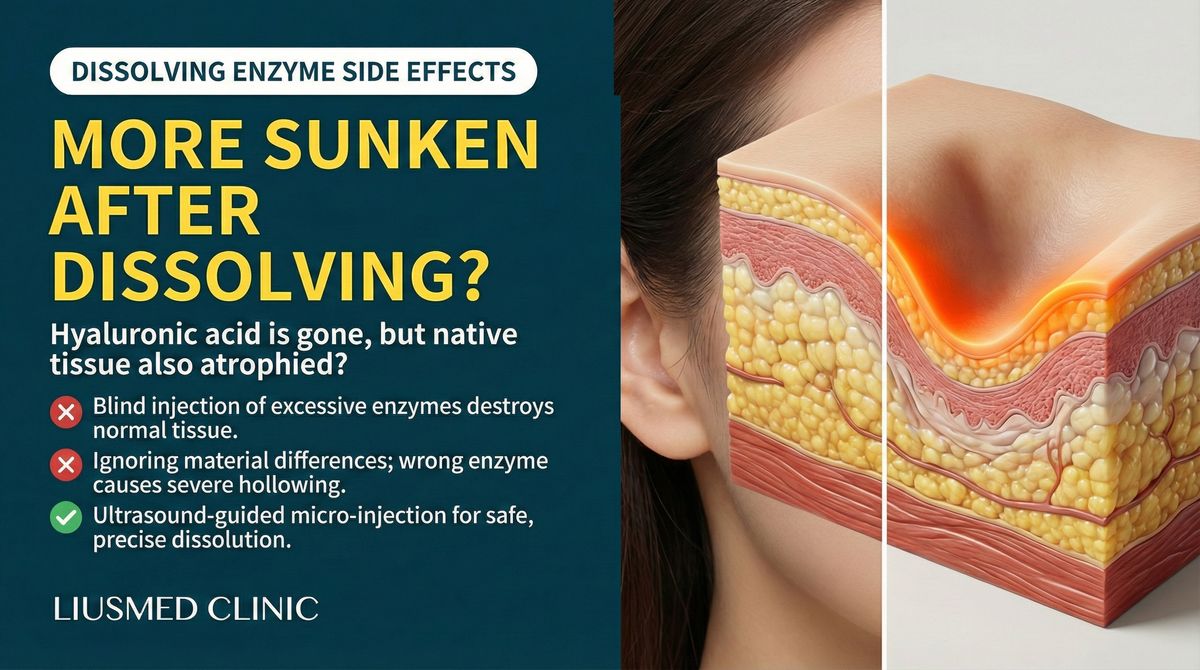
You Dissolved the Problem Filler—But Now Your Temples Are More Hollow Than Before
Your temple filler had issues—perhaps migration, clumping, or simply an unsatisfactory result. You were advised to use hyaluronidase to dissolve it. After dissolution, the filler problem was indeed gone. But a new problem appeared: your temples are now more hollow than they were before you ever had filler, with new concavities or asymmetry that didn't exist before.
This is the cost of over-dissolution—a clinical problem that is far more common than most patients realize.
Why Hyaluronidase (enzyme that dissolves HA filler) Causes Over-Dissolution
Hyaluronidase Is Not a Precision Scalpel
| Ideal Dissolving Agent | Reality of Hyaluronidase |
|---|---|
| Dissolves only the injected filler | Cannot distinguish injected filler from native hyaluronic acid |
| Precisely controlled dissolution zone | Diffuses through tissue, affecting a larger area than intended |
| One injection dissolves exactly the right amount | Dosing is difficult to calibrate precisely |
| No effect on surrounding tissue | May degrade native HA and tissue matrix |
Key Insight: Hyaluronidase doesn't only dissolve the hyaluronic acid filler you injected—it simultaneously breaks down the naturally occurring hyaluronic acid in surrounding tissue. This means that while dissolving filler, you are also "dissolving" part of your own tissue matrix. This is why post-dissolution hollowing is often worse than expected.
Why the Temple Is Particularly Vulnerable
The Temple's Anatomical Vulnerability
The temple region is naturally prone to hollowing—that's why it needed filling in the first place. But this also means:
- Thin native tissue: The temple's soft tissue is inherently thin; additional tissue loss has an outsized visual impact
- Fat pad atrophy: The temporal fat pad naturally atrophies with age; hyaluronidase accelerates this process
- Native HA (Hyaluronic Acid — sugar molecule naturally in skin, holds water) content: When the temple region's native hyaluronic acid is dissolved along with filler, tissue support drops further
- Bony concavity contrast: With less soft tissue covering the temporal fossa, the underlying bony depression becomes dramatically more visible
Key Insight: The temple is one of the areas with the least margin for error on the entire face. Even a small amount of volume loss creates a noticeable change in appearance. This is precisely why using hyaluronidase in the temple requires extraordinary caution.
Clinical Signs of Over-Dissolution
What You May See
- Deepened hollowing: Temples more concave than before any filler was injected
- Asymmetry: Uneven dissolution resulting in bilateral asymmetry
- Skin texture changes: Loss of native HA may leave skin looser and thinner
- Accelerated aging appearance: Temple hollowing is a key marker of aging; over-dissolution makes the face look significantly older
- "Skull-like" appearance: In severe cases, deep temple hollowing with visible temporal ridge
Are These Changes Reversible?
Some native hyaluronic acid naturally regenerates over time, so some over-dissolution effects may partially improve over weeks to months. However, if the damage is severe or dissolution has been repeated, recovery may be incomplete.
The Role of Ultrasound Before and After Dissolution
Before Dissolution: Precise Assessment
Before using hyaluronidase, ultrasound assessment can confirm:
- The exact location and volume of filler
- Whether the filler has fibrous encapsulation (making dissolution ineffective)
- The area that actually needs treatment
- Whether alternative approaches (such as extraction) would be safer
After Dissolution: Damage Assessment
If over-dissolution has already occurred, ultrasound can evaluate:
- Residual filler volume and distribution
- Degree of soft tissue loss
- Whether there is space for repair
- Timing and strategy for re-filling
Why "Dissolve Then Re-Fill" Is Not the Best Strategy
Many patients are told to "dissolve the problematic filler, then re-inject." But this strategy has several flaws:
- Dissolution-induced tissue damage needs time to recover—injecting too soon builds on a compromised tissue bed
- Repeated dissolution compounds cumulative damage—each round of dissolution sacrifices more native tissue matrix
- No guarantee the new injection will perform better—if the original problem was migration or product choice, re-injection may repeat the same mistakes
A Better Alternative
For temple filler problems, ultrasound-guided pinhole extraction is often the superior choice:
- Does not damage native tissue
- Precisely removes the problematic filler while preserving correctly positioned material
- No recovery waiting period needed
- Avoids the unpredictability of hyaluronidase diffusion
See why dissolving enzymes can't break down your filler and does HA really fully absorb? for more context.
What to Do If Over-Dissolution Has Already Happened
Repair Strategies
- Wait and observe: Allow about 3 months for natural tissue recovery, then reassess at follow-up
- Ultrasound assessment: Confirm tissue status and available space for repair
- Cautious re-filling: After tissue recovery, re-fill with conservative volumes, appropriate products, and correct depth
- Avoid re-dissolution: If the new filler develops issues, prioritize extraction over another round of hyaluronidase
Key Insight: The temple region rewards patience and precision. Rushing to re-fill before tissue has recovered, or reaching for hyaluronidase again when problems arise, risks creating a worsening spiral of dissolution and re-injection that progressively degrades tissue quality.
Preventing Over-Dissolution
- Ultrasound assessment before dissolution: Confirm whether hyaluronidase is actually the right approach
- Consider alternatives: Extraction may be safer and more controllable than dissolution
- Staged dissolution: If hyaluronidase is necessary, multiple small doses are safer than a single large dose
- Choose experienced practitioners: Those with thorough knowledge of both temple anatomy and hyaluronidase behavior
If you've experienced temple hollowing after dissolution, schedule a consultation. Let ultrasound assess your current situation and help plan the most appropriate repair strategy. See also the filler repair evaluation process.
Common questions
Doesn't hyaluronidase only dissolve the filler I had injected—so why are my temples more hollow now?
Hyaluronidase can't tell the difference between the filler you had injected and the hyaluronic acid your own tissue naturally holds, so it breaks down both. The temple's soft tissue is already thin with very little margin for error, so losing even a bit of your own tissue matrix can leave it looking more hollow than it did before any filler.
Will the hollowing after dissolving recover on its own?
Some of it can. Your native hyaluronic acid regenerates over time, so part of the effect may improve over weeks to months. But if the damage was heavier, or you've dissolved more than once, recovery may be incomplete—an ultrasound look at the actual tissue helps clarify where you stand.
Someone suggested I dissolve the bad filler and just re-inject. Is that a good plan?
It's a common suggestion, but it has some flaws. The tissue damage from dissolving needs time to recover, so re-injecting too soon builds on a compromised bed; repeated dissolving keeps sacrificing more of your own tissue; and if the original issue was migration or product choice, re-injecting won't necessarily turn out better. If you do refill, it's safer to wait for recovery and use conservative volumes.
Is there a better option than hyaluronidase for a problem temple filler?
Often yes—ultrasound-guided pinhole extraction tends to be the steadier route. It removes the problematic filler precisely while keeping correctly placed material, doesn't damage your own tissue, needs no recovery-waiting period, and sidesteps the unpredictable diffusion you get with hyaluronidase.
I've already over-dissolved. What can I do now?
Give the tissue roughly three months to recover on its own, and use ultrasound to check the current tissue status and how much room there is to repair. Once it has recovered, re-fill cautiously with the right product and depth in small amounts. If new filler runs into trouble later, lean toward extraction rather than dissolving again—and you're welcome to come in for an ultrasound assessment.
Related Reading
- Does HA Really Fully Absorb? The Truth About Residual Filler
- Why Dissolving Enzymes Can't Break Down Your Filler
- The Filler Repair Evaluation Process
Related Services

Specialties
Credentials
- Kaohsiung Medical University, School of Medicine
- Attending Physician, Dermatology, Kaohsiung Chang Gung Memorial Hospital
- Attending Physician, Aesthetic Center, Kaohsiung Chang Gung Memorial Hospital
- Visiting Physician, Dermatology, Xiamen Chang Gung Hospital
- Visiting Physician, Aesthetic Center, Xiamen Chang Gung Hospital
"For every surgery, I strive to achieve a good outcome through a small incision and refined technique. Minimally invasive surgery is not just a technique — it's a commitment of respect to every patient."
Recovery after any procedure needs peer support too


Want to learn more?
Schedule a consultation for professional evaluation and advice