Your Clinic Says the Lump Will 'Absorb on Its Own'—Can You Really Just Wait?
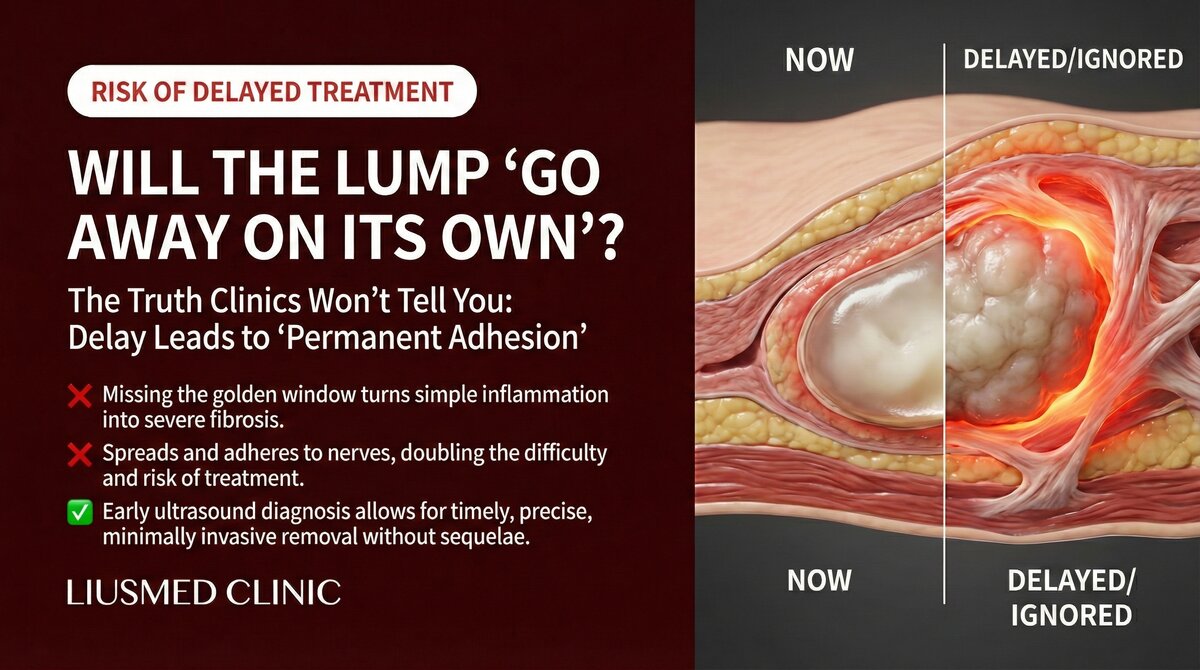
"Don't Worry, It Will Disappear on Its Own"
This may be the most commonly heard—and most misleading—statement for patients with filler complications. When you return to the original treating clinic with concerns about a lump on your face, "wait and see" is almost the standard response. Sometimes it is genuine advice; other times it is a way to avoid accountability.
The problem is that for some situations, waiting is indeed reasonable—for example, normal short-term swelling after injection. But for others, waiting is not only unhelpful but allows the problem to become progressively more difficult to manage. Distinguishing between these two situations is exactly what this article aims to help you understand.
When Can You Wait, and When Should You Not?
Situations Where Observation Is Reasonable
| Situation | Expected Natural Resolution | Recommended Observation Period |
|---|---|---|
| Normal post-injection swelling | 3-7 days | 1-2 weeks |
| Mild bruising | 1-2 weeks | 2-3 weeks |
| Slight unevenness after HA injection | 2-4 weeks (adjusts with hydration) | 4-6 weeks |
| Very minor textural irregularity | May soften over weeks | 4-8 weeks |
Warning Signs That You Should Not Keep Waiting
- Lump persists or grows 4+ weeks after injection
- Lump is firm with well-defined borders
- Pain, redness, or warmth develops
- Skin color changes (redness, purple discoloration, blanching)
- Lump is in a high-risk area (periorbital, nasal, glabellar)
- Injected material is non-HA (Radiesse, Sculptra, Ellanse, etc.)
Key Insight: "Wait and see" does not mean "do nothing." Even when deciding to observe temporarily, clear timelines and monitoring criteria should be established. If improvement does not occur within the expected timeframe, active intervention is needed. The most dangerous approach is indefinite waiting—when "let us see" becomes "let us keep seeing" with no end point.
The Cost of Waiting: How Time Makes Problems Worse
Encapsulation Progression
This is one of the most serious consequences of delayed treatment. Over time, the body continuously builds a fibrous capsule around the filler. An early thin membrane gradually thickens, hardens, and ultimately forms a dense, impermeable capsule wall.
How time affects encapsulation:
| Time Period | Capsule Status | Treatment Difficulty |
|---|---|---|
| 0-3 months | Early membrane, not fully matured | Lower—dissolvers may still work |
| 3-6 months | Mid-stage thickening, cross-linking begins | Moderate—dissolver effectiveness decreasing |
| 6-12 months | Mature capsule, vascular regression | Higher—physical extraction usually needed |
| 1+ years | Fully matured, dense cross-linking | High—physical extraction required |
For a complete analysis of the encapsulation mechanism, see: The Myth of Complete HA (Hyaluronic Acid — sugar molecule naturally in skin, holds water) Absorption.
Tissue Deformation and Adaptation
A long-standing lump forces surrounding tissues to adapt to its presence:
- Skin stretched or compressed continuously may develop permanent texture changes
- Surrounding fat and muscle tissue displaced, creating asymmetry
- Vessels and nerves may be compressed or shifted
Accumulating Psychological Burden
The psychological impact during the waiting period should not be underestimated. Looking at the lump in the mirror every day, worrying whether it will worsen, not knowing how long to wait—this uncertainty is itself a continuous source of stress.
The "It Will Absorb" Myth
Will HA Always Be Completely Absorbed?
Many practitioners tell patients the lump will eventually disappear based on the premise that "HA is an absorbable material." But clinical reality is far more complex than this simple assumption:
- Cross-linked HA is absorbed far more slowly than native hyaluronic acid
- Encapsulated HA may persist indefinitely
- Research has shown that so-called "temporary" fillers can remain in the body far longer than expected
For a more complete analysis, see: The Myth of Complete HA Absorption.
Non-HA Materials Are Even Less Likely to Disappear
If the injected material is Radiesse, Sculptra, Ellanse, or other non-HA substances, the advice to "wait for absorption" is even less defensible. These materials are designed to persist long-term, and some are effectively permanent.
The Treatment Window: Why Early Intervention Matters
Filler complication management has an optimal timing. Intervening within this window means lower difficulty, better outcomes, and less tissue impact.
Advantages of Early Intervention (0-3 Months)
- Capsule not yet fully matured; dissolvers (for HA) may still be effective
- Filler has not yet bonded tightly with tissue
- Surrounding tissue has not undergone significant deformation
- Post-recovery appearance is more natural
Challenges of Delayed Intervention (6+ Months)
- Mature, hardened capsule renders dissolvers nearly ineffective
- Filler may be tightly wrapped in fibrous tissue
- Surrounding tissue has adapted to the lump; removal may require additional procedures
- Procedural complexity increases
Key Insight: Early intervention does not mean immediate surgery. It means obtaining a professional evaluation early, understanding the nature of the problem, and establishing an appropriate management timeline. Even if the ultimate decision is to observe, that decision should be an active choice based on thorough evaluation—not a passive outcome of neglect or delay.
When Should You Stop Waiting and Seek Evaluation?
If any of the following applies to your situation, we recommend seeking an ultrasound evaluation as soon as possible:
- Lump persists for more than 4 weeks post-injection without improvement
- Lump is growing or hardening
- Any pain or inflammatory symptoms present
- Injected material is not hyaluronic acid
- More than 6 months since injection
- Previous treatments (dissolvers, anti-inflammatory injections) have been ineffective
The correct next step is a comprehensive ultrasound evaluation to precisely determine the lump's material, location, encapsulation status, and whether there are signs of progressive worsening.
If encapsulation has already formed around the filler, understanding why dissolvers may fail is also important: Encapsulation: Why Dissolvers Fail.
Schedule a consultation and let us help you replace uncertainty with clarity.
Conclusion
"Wait for it to resolve" is sometimes correct advice, but more often it is reassurance that may delay necessary treatment. Truly responsible guidance should include specific monitoring criteria, clear timelines, and a contingency plan for what to do if improvement does not occur. Do not let waiting become avoidance. The first step in facing a problem is seeing it clearly.
Not sure whether to keep waiting? Share your situation on the FillerRescue Forum and see how other patients and experts weigh in — it may help you make a more informed decision.
Related Services

Specialties
Credentials
- Kaohsiung Medical University, School of Medicine
- Attending Physician, Dermatology, Kaohsiung Chang Gung Memorial Hospital
- Attending Physician, Aesthetic Center, Kaohsiung Chang Gung Memorial Hospital
- Visiting Physician, Dermatology, Xiamen Chang Gung Hospital
- Visiting Physician, Aesthetic Center, Xiamen Chang Gung Hospital
"For every surgery, I strive to achieve a good outcome through a small incision and refined technique. Minimally invasive surgery is not just a technique — it's a commitment of respect to every patient."
Recovery after any procedure needs peer support too

Want to learn more?
Schedule a consultation for professional evaluation and advice