Why Repeated Steroid or 5-FU Injections Cannot Cure Collagen Stimulator Lumps
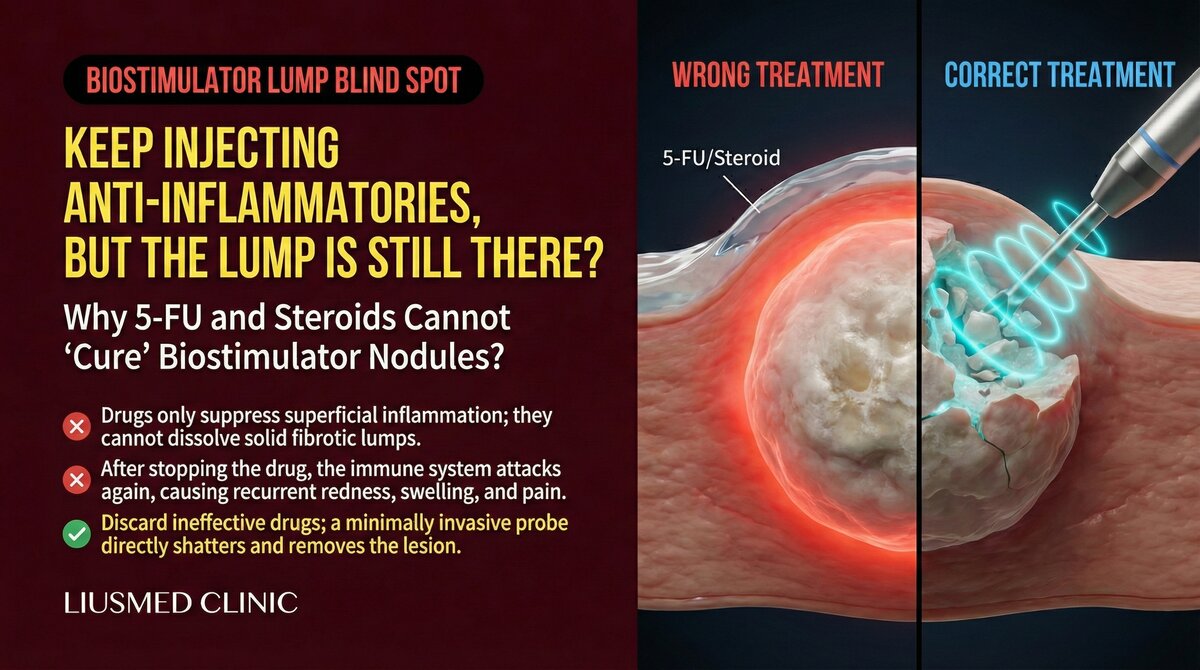
Countless Anti-Inflammatory Injections Later, Why Is the Lump Still There?
Collagen stimulators—including poly-L-lactic acid (Sculptra), polycaprolactone (Ellanse), and other products marketed as stimulating the body's own collagen production—are widely promoted as "the most natural filling option." However, when these products develop lumps, nodules, or other complications, patients and practitioners quickly discover a critical limitation: unlike hyaluronic acid, there is no dissolving enzyme available.
Facing this dilemma, many practitioners turn to corticosteroid or 5-fluorouracil (5-FU) injections as alternative treatments, hoping to shrink lumps by suppressing inflammation or inhibiting fibroblast proliferation. Initial improvement may be observed, but most patients ultimately find that no matter how many injections they receive, the lumps never completely disappear.
This article provides a thorough analysis of why these pharmacological treatments face fundamental limitations.
The Nature of Collagen Stimulator Lumps
To understand why drug treatments fail, we must first understand the biology of lump formation.
Two Main Categories of Lump Causes
| Cause Type | Mechanism | Drug Treatability |
|---|---|---|
| Material accumulation | Injected material (PLLA or PCL microspheres) not evenly dispersed, creating focal areas of excessive concentration | Very low—drugs cannot dissolve the material |
| Foreign body granulomatous reaction | Immune system overreacts to the material; macrophages and fibroblasts aggregate to form granulation tissue | Partial—drugs can suppress the reaction but cannot eliminate the material |
| Mixed type | Material accumulation combined with foreign body reaction | Very low—even with inflammation suppressed, the material remains |
Key Insight: The core problem with collagen stimulator lumps is that "the material is still inside." Neither steroids nor 5-FU can break down PLLA (Poly-L-Lactic Acid (Sculptra) — particle injection stimulating collagen) or PCL (Polycaprolactone (Ellansé) — longer-lasting collagen stimulator) microspheres themselves. They can only influence the body's reaction to these particles, not eliminate the particles.
Limitations of Steroid Injections
Mechanism and Ceiling
Steroids suppress immune responses to reduce swelling and firmness. For lumps that are primarily inflammatory, they can provide temporary improvement. However:
- The material does not disappear: Steroids cannot dissolve PLLA or PCL microspheres
- Recurrence after discontinuation: Once injections stop, if the material remains, inflammation often reignites
- Tissue atrophy risk: Repeated injections cause fat atrophy and skin depression
- Skin thinning: Long-term use leads to dermal atrophy, compounding the problem
For a detailed analysis of steroid treatment for Sculptra lumps, see: Why Steroids Fail for Collagen Stimulator Lumps.
Limitations of 5-FU Injections
What Is 5-FU?
5-Fluorouracil (5-FU) is an antimetabolite drug originally developed for oncology. In dermatology and aesthetic medicine, it is used to inhibit fibroblast proliferation, thereby reducing scar tissue and granuloma formation.
Why 5-FU Has Limited Effectiveness Against Collagen Stimulator Lumps
The mechanism of 5-FU is to suppress rapidly proliferating fibroblasts and reduce excessive collagen synthesis. In theory, this should help shrink lumps formed by fibroproliferation. In practice, clinical results are often disappointing:
- Only affects actively proliferating cells: Has limited effect on mature, stabilized fibrous tissue
- Cannot dissolve material particles: PLLA and PCL microspheres are not cells—5-FU has no effect on them
- Effects are not lasting: Requires multiple repeated injections with diminishing returns
- Has a ceiling: Even in the best case, can only reduce a portion of fibrous tissue—lumps do not disappear completely
Typical Timeline of 5-FU Treatment
| Treatment Phase | Patient Experience | Actual Situation |
|---|---|---|
| Injections 1-2 | Lump seems slightly softer | Some active fibrous tissue suppressed |
| Injections 3-5 | Improvement plateaus or is minimal | Suppressible cells have reached their limit |
| Injection 6+ | Almost no further improvement | Material remains; mature fibrous tissue unaffected |
| After stopping treatment | Lump may enlarge again | Material continues to stimulate new foreign body reactions |
Key Insight: 5-FU treatment for collagen stimulator lumps has a "ceiling effect"—the maximum improvement it can achieve is limited, and this ceiling often falls far short of the patient's expectation of complete resolution. The fundamental reason is that the causative material particles remain in place.
The Myth of Combined Steroid + 5-FU Treatment
Some practitioners combine steroids with 5-FU, hoping the dual action will produce better results. This combination does have some evidence supporting its use in keloid treatment, but for collagen stimulator lumps, effectiveness is equally limited:
- Steroids suppress acute inflammation, temporarily reducing swelling
- 5-FU suppresses fibroblasts, reducing new fibrous tissue formation
- But the material particles remain, and the continuous stimulus source is not eliminated
The best outcome of this combination therapy: the lump softens and shrinks to a certain degree, then improvement stops. The worst outcome: steroids cause tissue atrophy while the lump persists.
The Special Problem with Ellanse
Ellanse uses polycaprolactone (PCL) microspheres suspended in a carboxymethylcellulose (CMC) gel carrier. The CMC (Carboxymethyl Cellulose) gel is absorbed within about 6–8 weeks, but the PCL microspheres can persist in tissue for 2-4 years depending on the formulation.
This means that even if 5-FU and steroids can temporarily control the surrounding fibroproliferative reaction, the PCL microspheres will continue to exist and continue to stimulate new tissue reactions. For more on whether Ellanse can be removed, see: Can Ellanse Be Removed?. And if you want the full sequence — from watchful waiting through drug injections to physical extraction — see what to do about Ellansé lumps.
Why Physical Extraction Is the Only Definitive Solution
The shared limitation of all pharmacological treatments is that they can only influence the body's response but cannot eliminate the root cause of that response—the material itself.
Advantages of Ultrasound-Guided Minimally Invasive Extraction
| Treatment Aspect | Drug Therapy (Steroids/5-FU) | Ultrasound-Guided Extraction |
|---|---|---|
| Removes material particles | Cannot | Direct removal |
| Reduces fibrous tissue | Partially effective | Removed together with capsule |
| Recurrence risk | High (material remains) | Low (root removal) |
| Number of treatments | Multiple repeated sessions | Typically one session |
| Side effects | Atrophy, depression, skin thinning | Tiny pinhole |
| Visual confirmation | None | Real-time ultrasound |
Treatment Process
- Precision ultrasound scanning: Identifies the location, depth, and distribution of material particles
- Real-time image guidance: Precise positioning under ultrasound monitoring
- Minimally invasive pinhole extraction: Physical removal of material and capsule tissue through a single pinhole
- Post-procedure confirmation: Ultrasound verification of clearance
When Should You Stop Drug Therapy and Pursue Extraction?
If you are currently receiving steroid or 5-FU treatment and experiencing any of the following, consider switching your treatment strategy:
- Three or more injections with no significant lump reduction
- The lump re-enlarges after stopping medication
- Steroid side effects have appeared (depression, atrophy, pigment changes)
- The lump feels firm with well-defined borders
- Combined steroid and 5-FU treatment has shown limited results
The correct first step is a comprehensive ultrasound evaluation to precisely determine the material type, location, and surrounding tissue condition before formulating the most appropriate treatment plan.
Schedule a consultation and let us help you escape the cycle of repeated injections with no end in sight.
Conclusion
Steroids and 5-FU have their place in specific clinical scenarios, but they are not curative treatments for collagen stimulator lumps. Continuing to rely on pharmacological treatment for a problem that requires physical extraction only prolongs the treatment timeline, increases the risk of side effects, and erodes patient confidence and resources. Seeing the problem is the first step to truly solving it.
Related Services

Specialties
Credentials
- Kaohsiung Medical University, School of Medicine
- Attending Physician, Dermatology, Kaohsiung Chang Gung Memorial Hospital
- Attending Physician, Aesthetic Center, Kaohsiung Chang Gung Memorial Hospital
- Visiting Physician, Dermatology, Xiamen Chang Gung Hospital
- Visiting Physician, Aesthetic Center, Xiamen Chang Gung Hospital
"For every surgery, I strive to achieve a good outcome through a small incision and refined technique. Minimally invasive surgery is not just a technique — it's a commitment of respect to every patient."
Recovery after any procedure needs peer support too


Want to learn more?
Schedule a consultation for professional evaluation and advice