Can Ellansé Be Removed? Collagen Stimulator Extraction
Can Ellanse Really Be Removed Once Injected?
Ellanse has become one of the most popular collagen-stimulating fillers worldwide, prized for its long-lasting results that can span one to four years depending on the formulation. But what happens when the results are not what you expected? What if you develop lumps, asymmetry, or simply want the filler reversed?
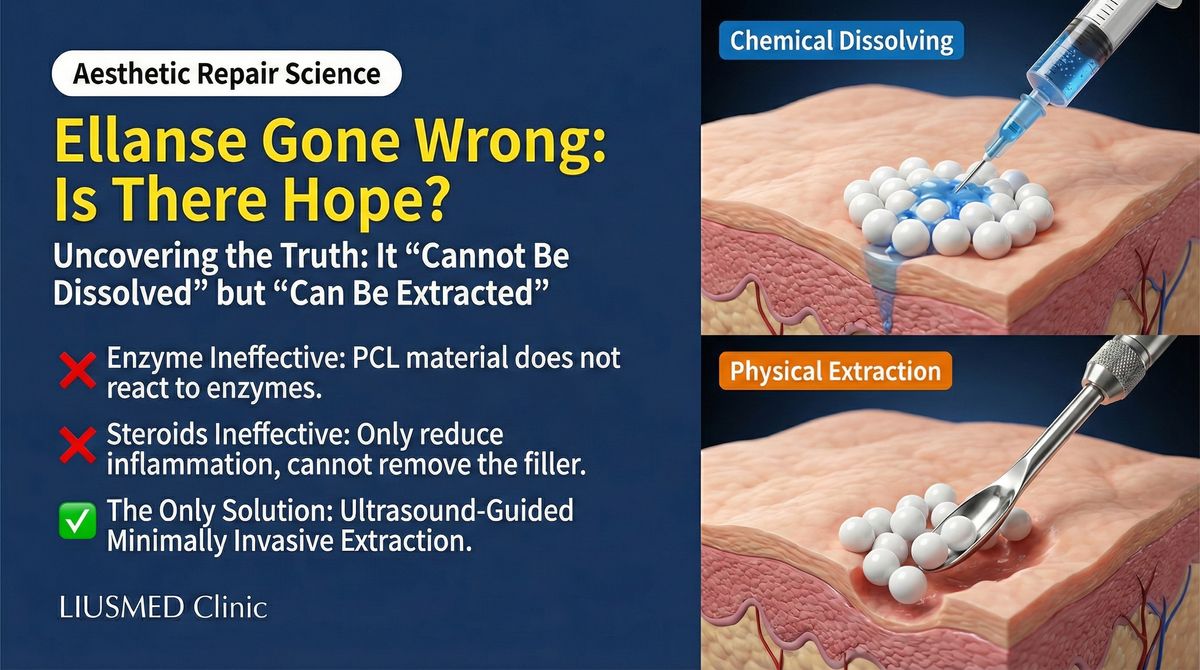
The short answer: Ellanse cannot be dissolved. Unlike hyaluronic acid fillers, there is no enzyme or medication that can break down polycaprolactone (PCL). However, physical removal through ultrasound-guided extraction is possible and has become an increasingly reliable solution. For what Ellansé is as a material — the composition of PCL and how the formulations differ — the filler-revision site has an Ellansé (PCL) encyclopedia page.
This article provides a comprehensive overview of Ellanse removal—what works, what does not, and what you can realistically expect.
Understanding Ellanse: Why It Cannot Be Dissolved
What Is Ellanse Made Of?
Ellanse consists of:
- Polycaprolactone (PCL) microspheres: Synthetic biodegradable polymer particles
- Carboxymethylcellulose (CMC) gel carrier: A water-based gel that provides immediate volume
The CMC carrier is absorbed by the body within weeks. The PCL (Polycaprolactone (Ellansé) — longer-lasting collagen stimulator) microspheres remain and stimulate the body to produce new collagen around them. This is the mechanism that creates the long-lasting volumizing effect.
Why Hyaluronidase (enzyme that dissolves HA filler) Does Not Work
| Filler Type | Composition | Dissolvable? | Enzyme |
|---|---|---|---|
| Hyaluronic Acid | HA polymer | Yes | Hyaluronidase |
| Ellansé | PCL + CMC | No | None available |
| Sculptra | PLLA | No | None available |
| Radiesse | CaHA | No | None available |
Hyaluronidase is an enzyme specifically designed to break the molecular bonds in hyaluronic acid. It has zero effect on PCL, PLLA (Poly-L-Lactic Acid (Sculptra) — particle injection stimulating collagen), or CaHA (Calcium Hydroxyapatite (Aesthefill / Radiesse) — mineral-based filler). Injecting hyaluronidase into an Ellanse-treated area will only dissolve any naturally occurring hyaluronic acid in the surrounding tissue, potentially causing unwanted volume loss without addressing the Ellanse itself.
Key Insight: If a practitioner suggests dissolving Ellanse with hyaluronidase, this indicates a fundamental misunderstanding of the product's chemistry. Seek a second opinion from a specialist experienced in non-HA filler complications.
How Ellanse Behaves Over Time
The Encapsulation Timeline
After injection, Ellanse undergoes a predictable biological process:
| Phase | Timeline | What Happens |
|---|---|---|
| Immediate | Day 0–7 | CMC gel provides volume, mild swelling |
| Transition | Week 2–8 | CMC absorbs, collagen production begins |
| Maturation | Month 2–6 | Collagen network forms around PCL microspheres |
| Encapsulation | Month 6–24 | Fibrous capsule may develop around filler deposits |
| Late phase | Year 2–4+ | PCL slowly degrades, but capsule and collagen persist |
When Problems Develop
Common issues that lead patients to seek Ellanse removal:
- Nodule formation: Hard lumps that become visible or palpable
- Asymmetry: Uneven results between the left and right sides
- Overcorrection: Too much volume that creates an unnatural appearance
- Migration: Filler material that has shifted from the original injection site
- Delayed inflammatory reaction: Redness, swelling, or tenderness months after injection
- Aesthetic dissatisfaction: The final result does not match the patient's expectations
Dr. Liu explains: "Ellanse complications can be particularly distressing because patients are told there is nothing that can be done. They may wait months hoping the problem will improve, only to find the encapsulation has progressed further. Early assessment is always preferable."
The Solution: Ultrasound-Guided Pinhole Extraction
Why Ultrasound Is Essential
Removing Ellanse without ultrasound guidance is like operating blindfolded. The PCL microspheres are embedded within tissue, often surrounded by a fibrous capsule and new collagen. Ultrasound provides:
| Capability | Clinical Benefit |
|---|---|
| Real-time visualization | See the filler during the entire extraction process |
| Depth mapping | Know exactly how deep the material sits |
| Boundary definition | Distinguish Ellanse from surrounding normal tissue |
| Vessel avoidance | Identify and protect important blood vessels |
| Completeness check | Confirm adequate removal before closing |
The Extraction Procedure
Step 1: Comprehensive Assessment
- Detailed history: Ellanse type (S, M, L, E), injection date, areas treated
- Physical examination: Palpation of all affected areas
- Ultrasound mapping: Document location, depth, volume, and capsule characteristics
Step 2: Surgical Planning
- Determine optimal pinhole entry points (concealed locations)
- Assess whether single or staged extraction is appropriate
- Discuss realistic expectations with the patient
Step 3: Extraction
- Local anesthesia plus gentle pain-relief anesthesia
- Pinhole incision (typically less than 1.5mm)
- Under continuous ultrasound guidance, access the capsule
- Carefully separate PCL material and fibrous tissue from normal tissue
- Extract the encapsulated filler through the pinhole
- Ultrasound confirms satisfactory removal
Step 4: Post-Procedure Care
- Light pressure dressing
- Ice application for 24–48 hours
- Follow-up at about 14 days, 1 month, and 3 months
Success Rates and Realistic Expectations
| Scenario | Expected Outcome |
|---|---|
| Discrete nodules | Usually staged: about 30–50% the first time, about 80–90% over two or three sessions (not a guaranteed 100%) |
| Diffuse deposits | May require staged extraction |
| Heavily encapsulated | Good removal, capsule wall may be left if adherent to vital structures |
| Multiple areas | Can be treated simultaneously or in stages |
| Long-standing (3+ years) | PCL may be partially degraded; capsule and collagen can still be extracted |
Important: Complete 100% removal of every microscopic PCL particle is not always the goal. The clinical objective is to remove enough material to resolve the visible or palpable problem while preserving normal tissue.
More important than the removal rate is the quality of the removal: removed cleanly (capsule included — the less left behind, the lower the chance of recurrence); removed evenly (leaving no new dents or ridges — the most decisive point of all, since removal done without enough control often turns one lump into a whole uneven surface); and removed precisely (mapping the whole face beforehand, allowing for how expression and the filler itself shift, and once swelling settles, taking out exactly what is needed and no more). This feel for evenness and precision comes from the cross-disciplinary experience Dr. Liu internalized over years of underarm rotary-blade surgery, liposuction and fat grafting, and the repair of failed liposuction; for the many patients who had material removed elsewhere yet were left uneven and came back for help, this is exactly the difference that matters.
What About Steroid Injections for Ellanse Lumps?
Limited and Risky
Some practitioners attempt to treat Ellanse nodules with intralesional steroid injections (triamcinolone). While steroids can reduce inflammation and soften some nodules:
| Potential Benefit | Significant Risk |
|---|---|
| Temporary softening | Skin atrophy (thinning, depression) |
| Reduced inflammation | Telangiectasia (visible blood vessels) |
| Modest size reduction | Hypopigmentation (color loss) |
Steroids do not dissolve or remove PCL microspheres. They may temporarily reduce the inflammatory component around the filler, but the physical material remains. Repeated steroid injections carry cumulative risks of tissue damage, particularly in facial skin.
Dr. Liu's position: "I see patients who have received three, four, even five rounds of steroid injections for Ellanse lumps. By that point, the surrounding skin is often atrophied and thinned. Extraction becomes the only remaining option, and the tissue quality is compromised. If a lump persists after two or three steroid attempts, it is time to consider definitive extraction."
Recovery After Ellanse Extraction
Timeline
| Period | What to Expect |
|---|---|
| Day 1–3 | Swelling peak, mild discomfort, ice application |
| About 2 weeks | Pinholes heal, follow-up assessment |
| About 2–3 weeks | Swelling and bruising largely settle |
| Month 1–3 | Progressive tissue recovery |
| About 3 months | Final appearance; consider additional treatment if needed |
Post-Extraction Considerations
- Volume loss: The area may appear deflated after removal. This is expected.
- Tissue recovery: The body needs time to remodel after the foreign material is removed
- Secondary treatment: If volume restoration is desired, safe HA (Hyaluronic Acid — sugar molecule naturally in skin, holds water) filler can be considered after at least about 3 months, once the result is close to final and has been reassessed
- Scarring: Pinhole incisions heal with virtually invisible scars
For what recovery actually looks like, see five angles at three months for a patient whose forehead Ellansé had been hard lumps for two years: a three-month record of Ellansé forehead lumps. It also explains why we wait until three months to take the photos used to judge a result.
Frequently Asked Questions
Can Ellanse be removed years after injection?
Yes. Even after 3–4 years, the capsule and any remaining PCL material can be extracted. In fact, some of the PCL may have already degraded by this point, but the collagen capsule typically persists and can still cause visible nodules.
Is extraction more difficult than for HA fillers?
Ellanse extraction is generally more complex than HA removal because the material stimulates collagen growth and encapsulation. However, with ultrasound guidance and experienced technique, the outcomes are reliable.
Will I need multiple sessions?
Removal is usually staged: the first session typically takes out about 30–50%, and two or three sessions usually remove about 80–90%. If Ellanse was injected in multiple areas or the deposits are diffuse, staging also helps minimize tissue trauma.
Can I have Ellanse injected again after removal?
This is a personal decision. If the initial complication was due to technique (wrong plane, excessive volume), and a different approach is used, re-injection may be reasonable. However, many patients choose HA fillers for future treatments due to their reversibility.
Take Control of Your Outcome
If you are unhappy with your Ellanse results or have developed nodules, asymmetry, or other complications, know that removal is possible. The first step is a thorough ultrasound evaluation to understand the current state of the filler and plan the most effective extraction strategy.
Schedule a consultation for an Ellanse assessment and personalized treatment plan.
Contact us to book your evaluation
About the Author
Dr. Ta-Ju Liu
- Current Position: Director, Liusmed Clinic
- Specialties: Minimally invasive surgery (lipoma, cyst), hyperhidrosis surgery, thread lifting, filler complication repair
- Experience:
- 15+ years of clinical minimally invasive surgery experience
- Over 10,000 successful minimally invasive cases
- Board-certified dermatologist
- Philosophy: "Ellanse is a good product when used correctly, but when complications occur, patients deserve honest information about their options. Physical extraction is the definitive answer."
Related Services

Specialties
Credentials
- Kaohsiung Medical University, School of Medicine
- Attending Physician, Dermatology, Kaohsiung Chang Gung Memorial Hospital
- Attending Physician, Aesthetic Center, Kaohsiung Chang Gung Memorial Hospital
- Visiting Physician, Dermatology, Xiamen Chang Gung Hospital
- Visiting Physician, Aesthetic Center, Xiamen Chang Gung Hospital
"For every surgery, I strive to achieve a good outcome through a small incision and refined technique. Minimally invasive surgery is not just a technique — it's a commitment of respect to every patient."
Recovery after any procedure needs peer support too


Want to learn more?
Schedule a consultation for professional evaluation and advice